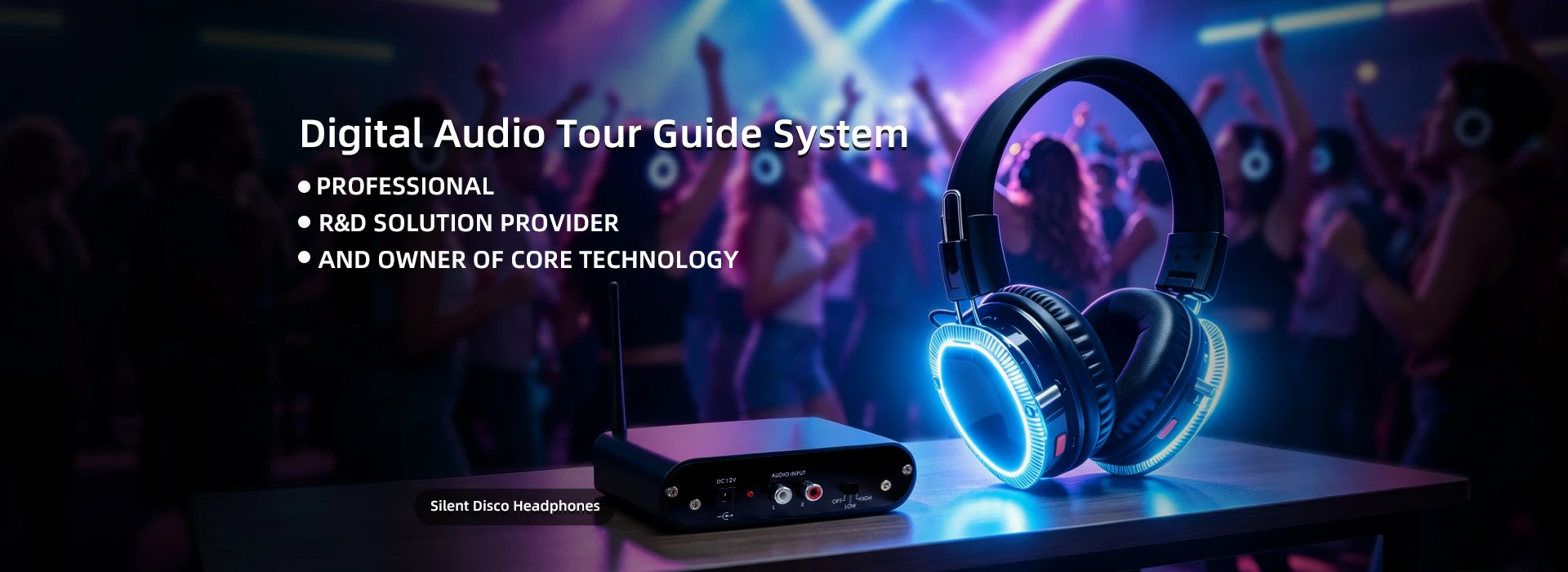
Silent Disco Wireless Headphone System
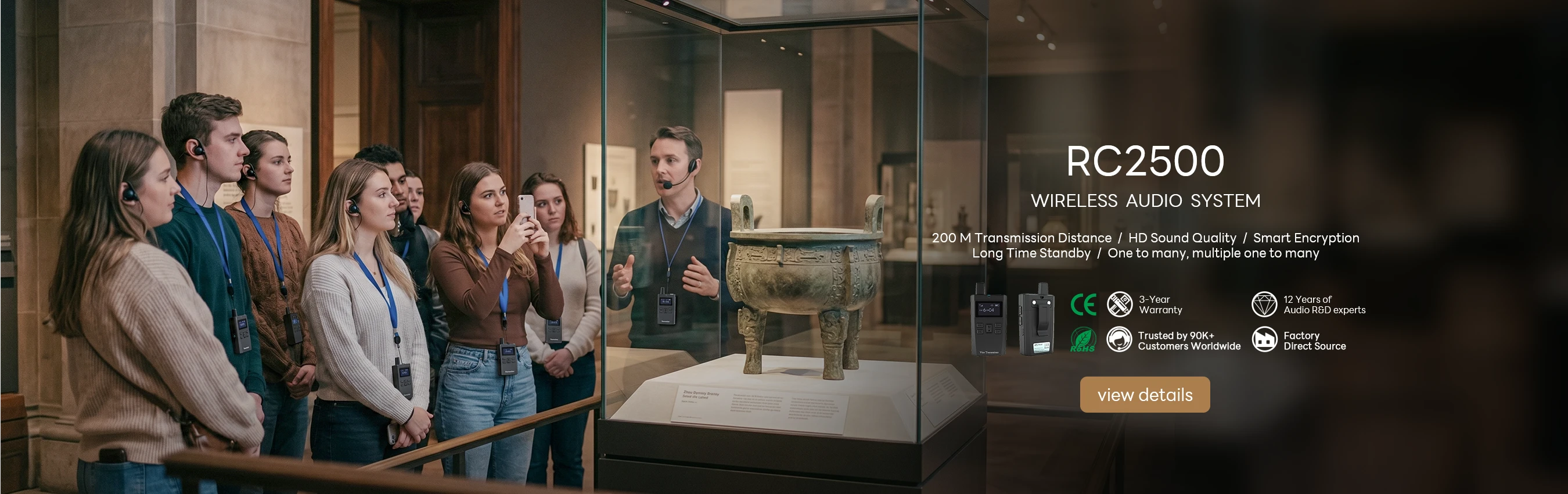
RC2500 Wireless Tour Guide System

Shenzhen Rich Age Electronics Co., Ltd
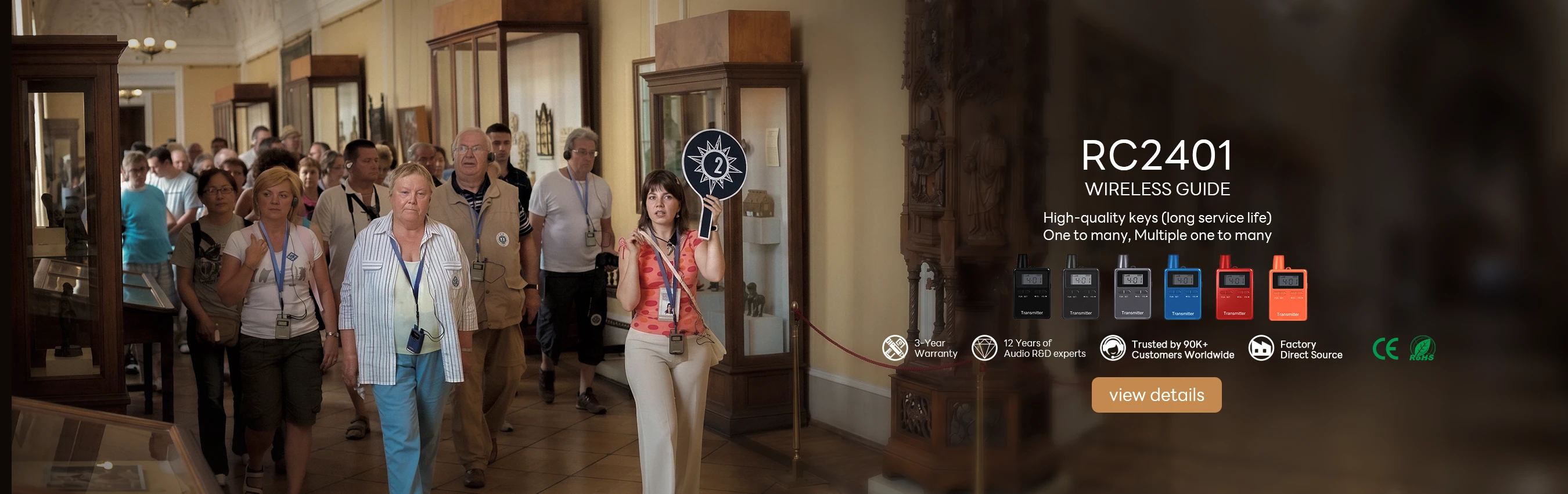
RICH AGE RC2401 Wireless Audio Guide System
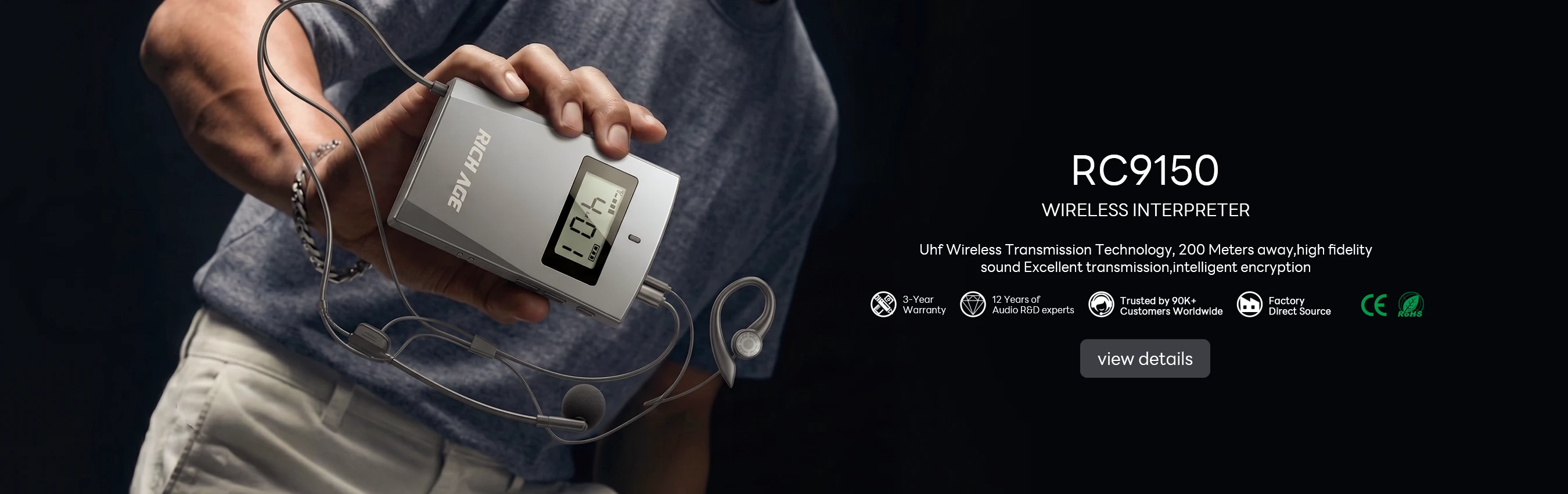
RC9150 High-end 2.4G Wireless Audio
Our Wireless Audio Transmitters and Receivers for Training and Teaching leverage advanced digital tech to eliminate cable clutter, ensuring instructors' voices carry flawlessly to every student without vocal strain.
Engineered with anti-interference UHF/2.4GHz bands, these lightweight educational audio transmitters and receivers fully support multi-channel group teaching, CE/RoHS certified quality, and direct factory wholesale or OEM/ODM configurations.
Understanding Wireless Audio Transmission
Before choosing equipment, it's essential to understand how wireless audio actually works:
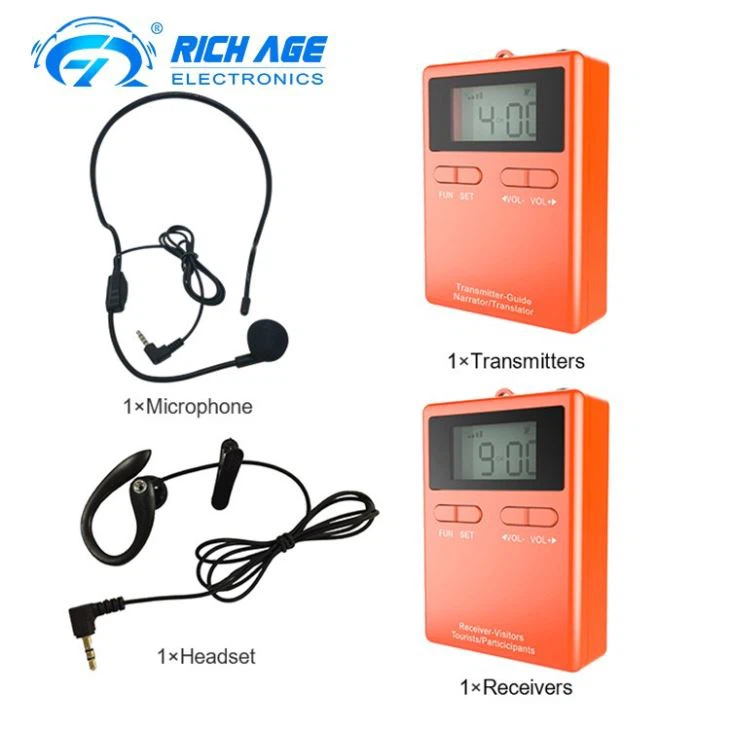
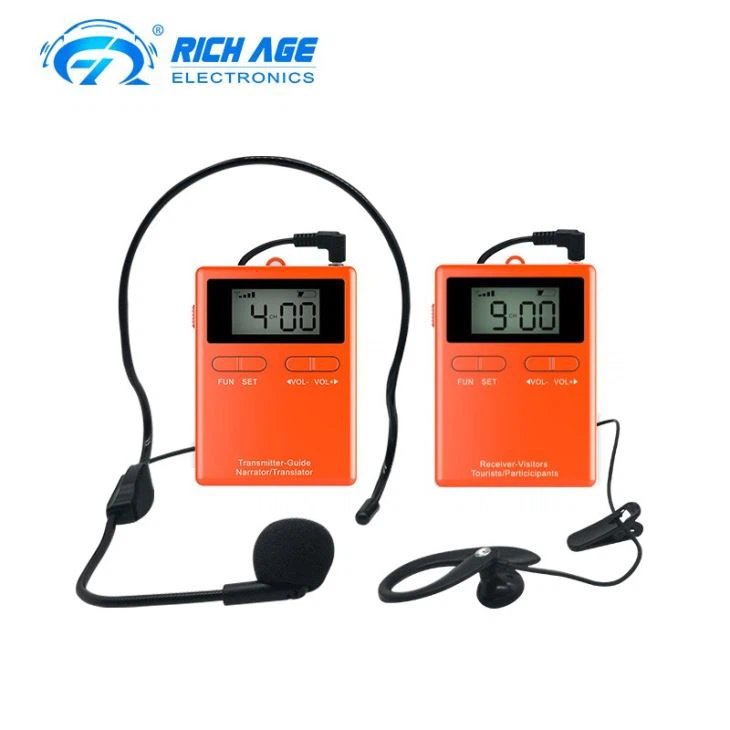
The Transmitter
The transmitter captures audio through a microphone or line input, converts the analog sound wave into a digital signal, modulates it onto a radio frequency carrier wave, and broadcasts it through an antenna. Key transmitter specifications include:
Transmit power: Measured in milliwatts (mW) — higher power extends range but drains battery faster
Frequency stability: Measured in parts per million (ppm) — determines how precisely the transmitter stays on its assigned channel
Audio input sensitivity: How quietly the transmitter can capture sound without adding noise
Harmonic distortion: Below 1% THD ensures faithful voice reproduction
Signal-to-noise ratio: 70dB or higher for professional-grade clarity
The Receiver
The receiver captures the radio signal through its antenna, filters out interference, demodulates the audio from the carrier wave, converts it back to analog, and delivers it to headphones or speakers. Critical receiver specifications include:
Selectivity: The ability to reject adjacent channel interference — essential when 80 channels operate simultaneously
Sensitivity: How weak a signal the receiver can detect — measured in microvolts (μV)
Audio output power: Sufficient to drive headphones at comfortable listening levels
Battery efficiency: Milliamps consumed per hour of operation
Frequency Bands: UHF vs. 2.4GHz vs. Bluetooth
| Technology | Frequency Range | Best For | Limitations |
|---|---|---|---|
| UHF (Ultra High Frequency) | 470-960 MHz | Large venues, outdoor events, professional installations | Requires licensing in some countries; larger antennas |
| 2.4GHz ISM Band | 2.400-2.485 GHz | Portable systems, international travel, plug-and-play use | Congestion from WiFi and Bluetooth; shorter range |
| Bluetooth | 2.400-2.485 GHz | Consumer headphones, short-range personal audio | Maximum 8 devices paired; 10m range; high latency |
Rich Age systems primarily use the 2.4GHz band with frequency-hopping spread spectrum (FHSS) technology. This provides the international portability of 2.4GHz while avoiding the congestion problems that plague standard Bluetooth and WiFi devices.
Our Transmitter and Receiver Product Line
| Model | Type | Best Application | Key Spec |
|---|---|---|---|
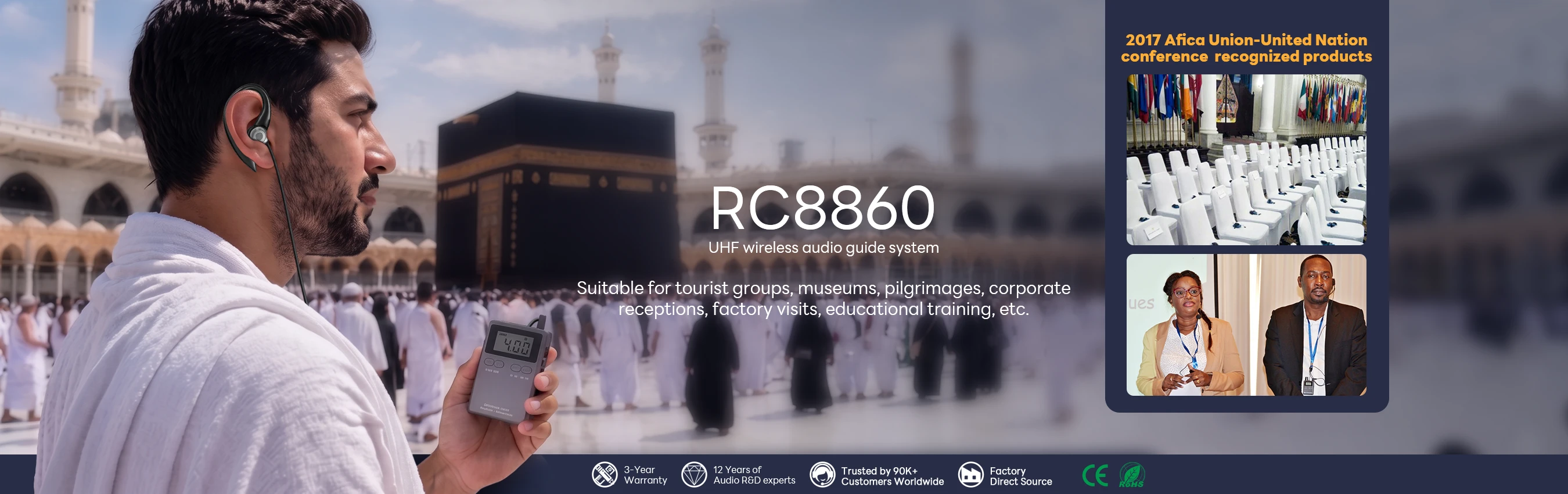
| RC8860 | Transmitter | Teaching, coaching, guided tours | Long-range antenna, 20-hour battery |
| RC2468 | Receiver | Student/pilgrim/visitor listening | Ultra-light 35g, 18-hour battery |
| RC2401 | Transceiver pair | Two-way training communication | Switchable TX/RX mode, 80 channels |
| RC9150 | Professional transmitter | Simultaneous interpretation, large conferences | Studio-grade preamp, 80 channels |
Critical Specifications for Professional Applications
Latency: The Hidden Killer of Live Audio
Latency is the delay between when a word is spoken and when it's heard. For pre-recorded content, 500ms is acceptable. For live interaction, it must stay below 50ms or conversations become awkward and disjointed. Our transmitters and receivers maintain sub-30ms latency — imperceptible to human ears.
Channel Separation
When 80 channels operate in the same room, signals can bleed into each other. Our systems achieve 60dB channel separation — meaning an adjacent channel's signal is 1,000 times weaker than the intended channel. This prevents the nightmare scenario of a Spanish interpreter bleeding into the Mandarin channel.
Dynamic Range
Human voice spans from whispered secrets (30dB) to shouted warnings (90dB). A system with poor dynamic range clips loud sounds into distortion and buries quiet sounds in noise. Our transmitters capture 80dB of dynamic range — from the softest whisper to the loudest shout, faithfully reproduced.
Applications Across Industries
The same fundamental transmitter-receiver technology serves wildly different markets:
Training and Teaching
Instructors use our wireless audio transmitters and receivers for training and teaching to deliver lessons in noisy workshops, open fields, and factory floors. The teacher's voice reaches every student clearly, regardless of classroom acoustics.
Factory Tours
Industrial tour headsets use our transmitters to broadcast over the roar of machinery. The same receiver that works in a quiet classroom becomes a noise-isolating tool when paired with over-ear cups in a steel mill.
Religious Services
Church translation headphones rely on our transmitters to broadcast live interpretation across sanctuaries holding 5,000 worshippers. The receiver's long battery life ensures services aren't interrupted by mid-sermon power failures.
Conference Interpretation
Simultaneous interpretation systems push our transmitters to their limits — 80 channels, 200+ receivers per channel, zero tolerance for dropouts. This is where frequency-hopping spread spectrum proves its worth, automatically avoiding interference in RF-congested convention centers.
Choosing the Right Transmitter-Receiver Pair
| Your Need | Recommended Pairing | Why This Combination |
|---|---|---|
| Small classroom (20 students) | 1x RC8860 + 20x RC2468 | Cost-effective, sufficient range, easy management |
| Large church (500+ attendees) | 2x RC9150 + 100x RC2406 | Redundant transmitters, 80 channels for multiple languages |
| Factory tour (40 visitors, 90dB noise) | 1x RC9150 + 40x RC2401 with over-ear cups | High noise isolation, durable construction |
| International conference (10 languages) | 10x RC9150 + 200x RC2406 | Professional audio quality, massive receiver capacity |
| Cross-country equestrian course | 2x RC8860 + 1x RC2468 per rider | Long-range, lightweight, weather-resistant |
Installation and Troubleshooting
Antenna Positioning
Antenna orientation affects range dramatically. For maximum coverage:
Keep transmit antennas vertical — horizontal orientation reduces range by 50%
Maintain line-of-sight where possible — each wall reduces signal by 30%
Elevate antennas 2+ meters above audience heads — bodies absorb UHF signals
Use repeater stations for coverage beyond 200 meters — don't simply increase power
Interference Management
When audio cuts out or crackles, interference is the usual culprit. Diagnostic steps:
<
Check channel congestion — scan for occupied frequencies before the event
Identify WiFi conflicts — 2.4GHz WiFi channels 1, 6, and 11 overlap with our band
Move away from LED screens — poorly shielded displays generate RF noise
Verify antenna connections — loose connectors cause intermittent dropouts
Test with fresh batteries — weak batteries cause transmitters to reduce power output
Battery Technology and Management
Wireless audio lives or dies by battery performance. Our systems use lithium-polymer cells with these characteristics:
| Specification | Our Standard | Industry Average |
|---|---|---|
| Operating time (transmitters) | 12-20 hours | 8-12 hours |
| Operating time (receivers) | 18-24 hours | 10-15 hours |
| Charge cycles before degradation | 500+ cycles to 80% capacity | 300 cycles |
| Charge time (0-100%) | 2.5 hours | 4+ hours |
| Operating temperature | -10°C to 60°C | 0°C to 45°C |
Future of Wireless Audio Transmission
The industry is evolving in three directions:
Digital encryption: AES-256 encryption for diplomatic and corporate confidentiality
Networked control: Smartphone apps that monitor all devices, adjust channels, and diagnose issues remotely
Integrated translation: AI-powered real-time translation built into receivers, reducing interpreter costs
Rich Age invests 15% of revenue in R&D, ensuring our transmitters and receivers incorporate these advances while maintaining the reliability that 90,000+ customers depend on.
Build Your Custom Wireless Audio System
Whether you need a single transmitter for a yoga studio or 500 receivers for a stadium tour, Rich Age provides the technical expertise to design your perfect configuration. Browse our complete wireless tour guide systems or contact our engineering team for a custom RF survey and system design.
Great communication starts with great transmission. Let's build yours.
Learn More About Wireless Audio Solutions
Want to understand how wireless audio technology can transform your industry? Explore our complete solutions for museum, church, factory, conference, and education applications — all built on our professional transmitter and receiver technology.