.webp)
In modern "Industry 4.0" facilities, the primary threat to a tour guide system isn't physical distance; it is electromagnetic congestion. Automated Guided Vehicles (AGVs), localized Wi-Fi mesh networks, and industrial IoT sensors all compete for the same 2.4GHz spectrum used by systems like the RC2408 tour guide system. For a procurement manager, the critical metric isn't just the "80 available channels," but how those channels are spaced to prevent intermodulation distortion.

When running multiple VIP tours through a high-tech production line, 2.4GHz systems can face micro-interference from high-gain routers. While the RC2408 tour guide system provides a 200-meter line-of-sight range, signal penetration through heavy shielding or metal storage racks is significantly reduced. If your facility is dense with steel structures, you must account for the fact that a 2.4GHz signal diffuses rather than penetrates, which might require a more disciplined group movement strategy than a UHF alternative would.

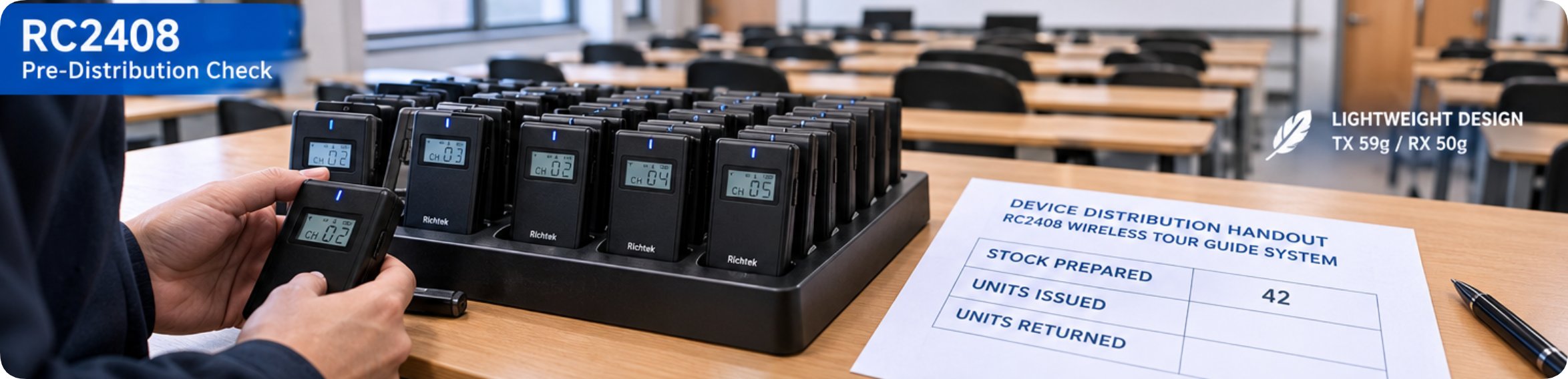
The "one-key" synchronization feature is often dismissed as a convenience, but in high-density environments, it is a functional necessity. Manually tuning forty receivers in a zone with high RF noise increases the risk of a receiver locking onto a harmonic frequency rather than the primary transmitter. Automating this process ensures the group stays on a clean sub-band before entering the noise-heavy sections of the plant.

If your facility is a "smart" plant with heavy Wi-Fi 6 deployment, the RC2408 tour guide system is viable only if you have sufficient channel overhead (80 CH) to bypass local interference. If you cannot guarantee a clear line of sight, you should prioritize lower-frequency bands that handle diffraction more effectively.