.webp)

The Silent Revolution in Projection Mapping: Why Heritage Sites are Switching to Personalized Wireless Tour Guide System
How cutting-edge RF distribution solves the historical conflict between high-decibel multimedia spectacles, acoustic degradation, and local noise regulations.
My View: I once watched an ambitious light projection show mapped across the facade of a magnificent 12th‑century castle. Visually, it was a masterpiece—breathtaking, photorealistic dragons scaled the ancient stone walls, and holographic knights clashed in fierce jousting tournaments. But acoustically, the production was a complete disaster. A massive, single loudspeaker tower blasted the mono narration across the open courtyard, creating violent slap-back echoes off the medieval masonry. The acoustic distortion turned the phrase “brave knight” into a muddy, unintelligible “brave right.” Half the audience spent the evening squinting and whispering, entirely unable to decipher the storyline.
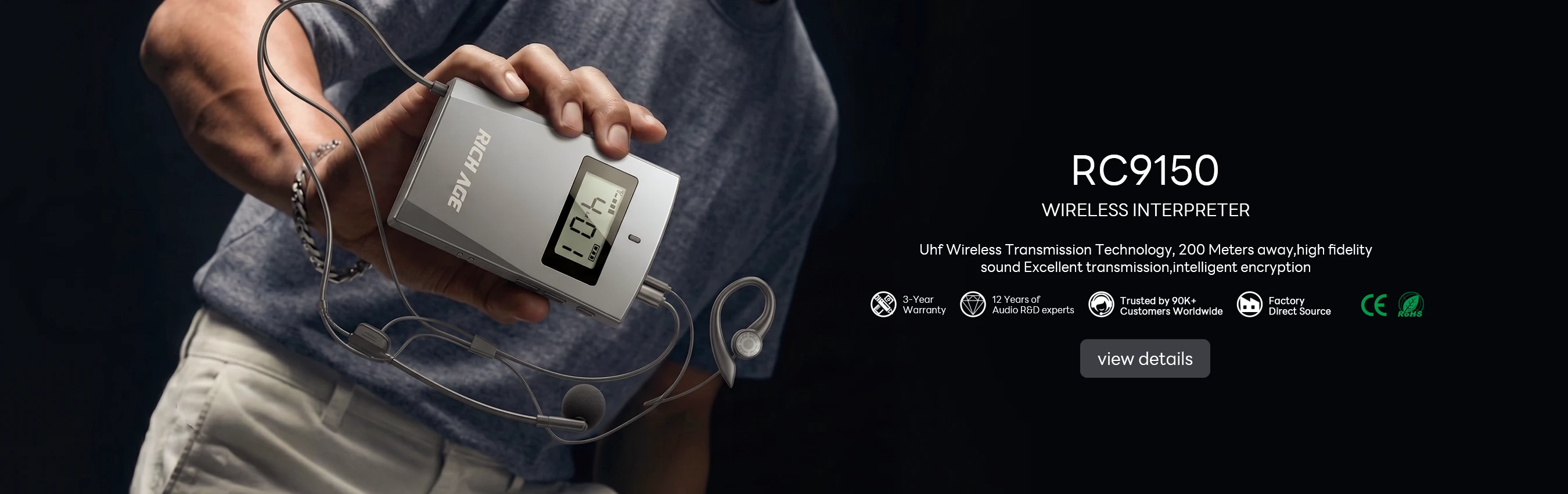
Years later, I collaborated with a heritage trust in France to completely overhaul their flagship nighttime historical spectacle using the RC9150 wireless system. Instead of fighting the hostile acoustics of the architecture with raw volume, we distributed lightweight RC2408 receivers to every single guest. The transformation was profound. The narrator could speak in a natural, intimate cadence, and the high-fidelity sound was delivered directly into the ears of the listeners. The castle courtyard remained completely silent to the outside world, yet the sonic narrative was crystal clear to the audience. That was the exact moment I realized a fundamental truth: immersive night projection shows require silent, personalized audio infrastructures to truly match their visual brilliance.

The Multibillion-Dollar Dilemma of Architectural Projection Mapping
The global projection mapping market is accelerating at an unprecedented pace, with financial forecasts projecting it to reach $12.4 billion by 2030. Within this sector, ancient castles, cathedrals, ruins, and heritage sites represent the fastest-growing segment for night tourism installations. However, these historic venues present a severe logistical paradox. Traditional open-air sound systems rely on high-SPL (Sound Pressure Level) loudspeakers that inevitably trigger severe noise complaints from nearby residential zones, while simultaneously muddying the audio through uncontrolled reflections off historic stone walls.
Deploying a sophisticated 100‑channel wireless system like the RC9150 completely bypasses these architectural and environmental limitations. By leveraging a multi-channel RF architecture, production engineers can seamlessly broadcast complex, multi-track audio dramas—comprising synchronized multi-language narration, sweeping orchestral scores, and localized cinematic sound effects—directly to thousands of simultaneous audience members. This approach achieves zero environmental noise pollution while delivering an uncompromised 20Hz‑20kHz Hi‑Fi frequency response. Every nuance is preserved, capturing everything from the delicate, hushed whisper of a ghost story to the thunderous low-end boom of a simulated cannon blast without rattling the neighborhood's windows.

Engineering the Perfect Nighttime Receiver: The RC2408
Outdoor evening performances introduce brutal operating conditions for standard wireless equipment. The physical layout of modern light shows is a minefield of electromagnetic interference (EMI), driven by heavy-duty LED controllers, automated stage lighting fixtures, high-powered laser arrays, and thousands of personal smartphones packed into a tight viewing area. The RC2408 receiver was specifically engineered to thrive within this chaotic RF landscape.
Enhanced RF Stability: Advanced internal filtering isolates the desired audio signal, blocking out the high-frequency switching noise generated by surrounding LED video walls and structural lighting arrays.
Tactical Red-Only Indicator Lights: Standard bright blue or green LEDs ruin human night vision adaptation and distract nearby viewers. The RC2408 uses a specialized low-wavelength red indicator to preserve dark adaptation in low-light environments.
40-Hour Continuous Duty Cycle: Powered by high-density lithium-polymer chemistry, the receiver handles back-to-back performance schedules, technical rehearsals, and multi-show evenings on a single charge cycle.
Granular Volume Customization: Every attendee possesses unique auditory profiles. Dedicated tactile volume controls empower guests—from children to seniors with mild hearing loss—to tailor their own optimum listening level.
 Figure 1: Immersive architectural projection mapping utilizing localized RF audio distribution to maintain site sanctity.
Insights From the Field: What Show Producers Say
“Our production venue sits right in the heart of an old European village, and we used to receive persistent municipal noise complaints from residents living over half a kilometer away. The low-frequency rumble from our old subwoofers traveled through the valley. Once we transitioned the entire event soundtrack over to the RC9150 system, we were able to deliver a deeply impactful, cinematic audio mix directly to the audience’s ears while dropping our external environmental noise footprint to zero. Our community relations issues vanished overnight.”
Beyond solving noise pollution issues, using the RC9150 provides a crucial technological safeguard for intellectual property. The system integrates intelligent proprietary encryption algorithms across its digital transmission channels. This effectively prevents bootleg recordings, unauthorized audio harvesting, and script copying by competing production companies or tourist piracy operations, keeping the exclusive show content securely within the headphones of paying patrons.
Why the RC2408 Excels in High-Density Crowds
When hundreds of human bodies are packed into an enclosed ancient stone courtyard, the physical mass creates a highly reflective, dampening environment for RF signals. Lower-tier wireless systems quickly suffer from signal dropouts, phase cancellations, and static pops. The RC2408 mitigates this via ultra-precise PLL (Phase-Locked Loop) frequency synthesis. This circuit constantly locks the receiver onto the exact center frequency transmitted by the master unit, maintaining a rock-solid, drift-free audio stream even when operating deep inside massive, high-density crowds.
Physical comfort is another critical variable that determines viewer retention. The ergonomic ear‑hook design of the RC2408 distributes its minimal weight evenly across the ear structure, avoiding the painful clamping force associated with standard over-ear headphones during 45-to-60-minute historical dramas. Furthermore, the specialized matte black chassis finish prevents stray light reflections from the projection grid. The receiver remains visually invisible in the dark, ensuring the audience's attention stays entirely focused on the intricate light art instead of the hardware they are wearing.
This versatile methodology has proven highly effective across a diverse array of global applications, including sound-and-light events at the Egyptian pyramids, Gothic cathedrals, and solemn war memorials. In every single scenario, the ability to deliver high-fidelity spatial audio without violating the structural sanctity or the natural silence of the monument has proven to be a transformative operational asset.
Strategic Counsel for Heritage Site Directors
An architectural light show is a complex, multi-layered work of contemporary art. Do not allow budget loudspeakers or compromised acoustic environments to degrade the emotional impact of your historical storytelling. Investing in a professional-grade wireless RF distribution network respects the historical value of your monument, eliminates municipal liabilities, and maximizes the safety, comfort, and immersion of your paying guests.