
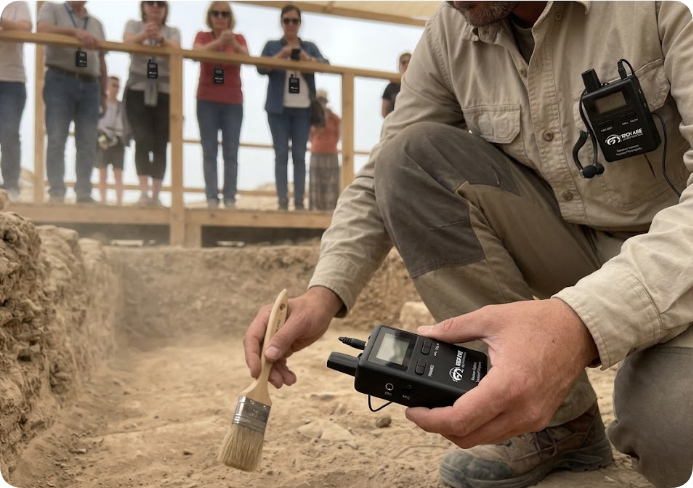
A Visitor's Perspective: I recently visited an active, high-profile archaeological excavation in Pompeii. The actual trench was heavily roped off for preservation, forcing our group to stand on a distant wooden viewing platform. Our guide pointed toward deep dirt strata and stone foundations, but her descriptions were completely drowned out by passing tourist crowds and ambient city noise. I walked away frustrated, with far more questions than insights. Later, a colleague working at a biblical excavation site in Israel shared their newly implemented communication solution. They utilize an advanced combination of RC085 transmitters and RC2408 receivers. The lead field archaeologist wears a compact transmitter while working directly inside the trench, broadcasting a live, unfiltered commentary to the public viewing deck above. Visitors hear every detail of a newly uncovered pottery shard or complex stratigraphic soil layer in real time, supplemented by pre-recorded audio files explaining the site's history. Suddenly, a broken piece of common pottery transformed into a window to the ancient world. That was my epiphany: live public archaeology desperately needs wireless audio equipment to effectively bridge the gap between scientific discovery and public engagement.
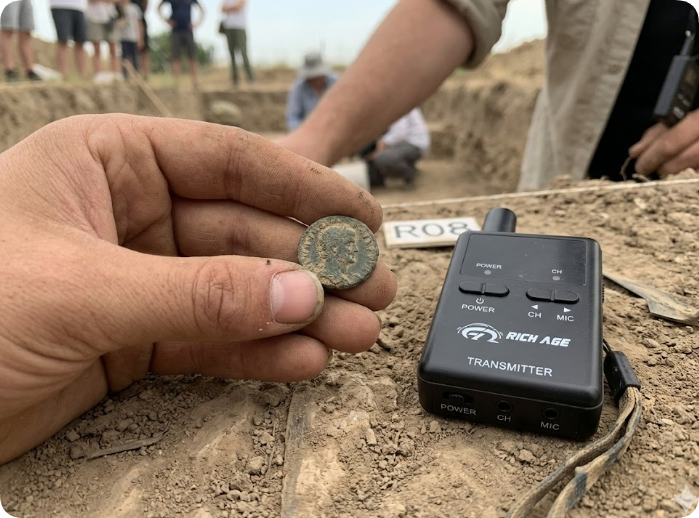
Archaeological Dig Site Public Tour (RC085 & RC2408)
Deploying a professional Wireless Tour Guide System is rapidly becoming an essential operational practice for major open-air museums and historical parks worldwide. Archaeological tourism has evolved into a multi-billion dollar global sector, drawing millions of curious travelers annually to iconic destinations like Pompeii, Machu Picchu, and the Terracotta Warriors. However, standard educational curation faces a recurring problem: sites typically only present static, finalized museum exhibits, completely isolating the public from the dynamic, suspenseful, and intellectually stimulating process of actual physical discovery.
By transforming an active excavation grid into a living, interactive exhibition space, park administrations can dramatically elevate guest satisfaction. A high-performance digital audio array transmits the precise details of field analysis directly to onlookers. This interactive approach instantly redefines the guest experience, changing a muddy, unidentifiable hole in the ground into an active, engaging open-air classroom where history comes alive as it is unearthed.
Technical Dominance of the RC085 UHF Digital System in Challenging Terrains
The operational environment of an outdoor excavation site is notoriously unpredictable and demanding, requiring hardware designed for maximum durability. The RC085 UHF digital system is uniquely engineered to thrive under these exact conditions. Operating within the ultra-stable UHF band (470-510MHz), the system delivers remarkable wave penetration. This allows signals to cut effortlessly through thick stone ruins, reinforced security barriers, security fencing, and temporary canvas weather tents without a single instance of audio dropping out or clipping.
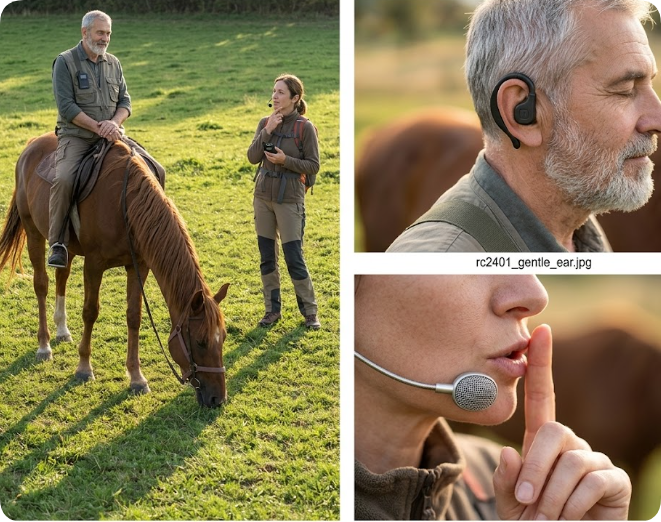
Furthermore, the transmitter is paired with an ultra-sensitive whisper microphone, which allows field scientists to maintain a quiet, conversational tone. This setup avoids disrupting the delicate workspace or shouting across open trenches. Boasting a robust 200-meter transmission radius, the system gives tour groups the freedom to spread out comfortably along extended viewing structures or perimeter walkways. For long field sessions, an integrated power-saving wake-up mode manages power consumption automatically, extending overall battery longevity while teams wait for significant artifacts to be fully uncovered. The hardware also features comprehensive telecoil compatibility, providing clear audio directly to hearing-impaired travelers utilizing personal hearing aids.
The RC2408 Receiver: Exceptional Signal Stability for Complex Environments
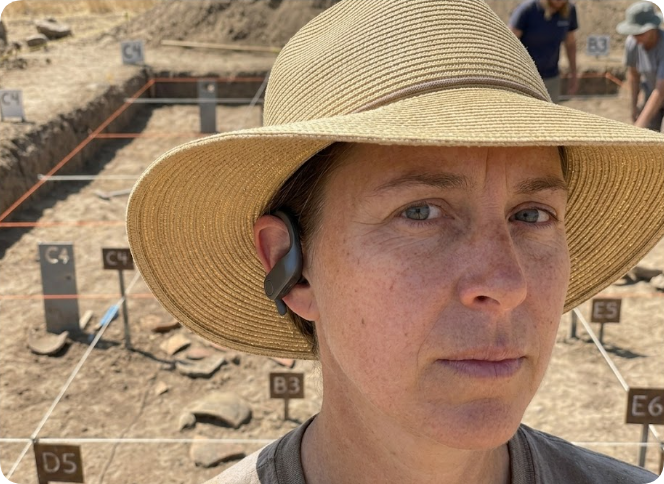
For complex historical sites and busy public venues, receiving equipment must operate reliably alongside modern industrial gear. The RC2408 enhanced stability receiver is engineered to maintain pristine audio quality when surrounded by temporary site infrastructure. Equipped with advanced PLL (Phase-Locked Loop) frequency synthesis, the hardware locks onto its assigned digital channel securely, neutralizing interference caused by on-site power generators, portable radio networks, or incoming visitor cellular data streams.
The device features an exceptional 20-hour maximum battery runtime, easily supporting full, back-to-back tourist shifts throughout the excavation schedule. Designed for comfort over hours of use, its lightweight, ergonomic ear-hook configuration fits snugly and stays secure even when worn beneath wide-brimmed sun hats, safety hardhats, or tactical outdoor gear. Additionally, the integrated individual volume control buttons allow travelers to instantly fine-tune their audio preferences to block out environmental distractions like sudden wind gusts or heavy site machinery operating nearby.
Real-World Case Study: Transforming Public Education at a Roman Fort
The financial and educational benefits of implementing specialized digital audio networks are proven by successful programs worldwide. At a notable Roman fort excavation project in northern England, site management opens the active trench to public visitors for a six-week window each summer season. To manage the crowd and provide clear educational value, the historical trust offers lightweight receiver rentals at the primary entrance gate for a nominal fee of £5 per session.
During the program, the head field researcher wore a master RC085 transmitter, providing a step-by-step account of her active scraping and cleaning work. The true value of the system was demonstrated when a rare silver coin was uncovered from a deep silt layer. Without stopping her work or standing up, she whispered directly into her microphone: “Silver denarius, first century, possibly Trajanic era.” The entire crowd on the observation deck gasped simultaneously, experiencing the thrill of discovery at the exact moment it occurred. Thanks to high adoption rates, the rental program generated enough revenue to completely offset the total procurement cost of the audio system within its very first operational summer season.
Multi-Disciplinary Applications Across Heritage Curation and Science Labs
The distinct advantages of this UHF and digital audio combination make it highly versatile across many different scientific, historical, and architectural preservation settings, including:
Paleontological Excavations: Delivers clear, educational descriptions from deep inside fossil beds or dusty quarry locations directly to public observation decks.
Underwater Archaeology Sites: Paired with specialized waterproof equipment housings, the system allows shore-based or boat-based teams to monitor live dive audio feeds.
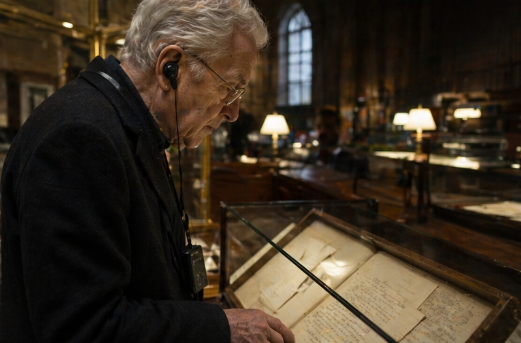
Museum Conservation Laboratories: Allows school groups and museum visitors to watch delicate artifact restoration behind protective glass barriers while listening to clear descriptions of the chemical processes.
Historical Architecture Restoration: Guides tourists safely through active construction scaffolding, historic church steeples, or structural preservation zones where traditional speaking is impossible.
Two-Way Interactive Q&A Sessions: Utilizing the specialized F2 two-way operational mode on the RC085, visitors can ask questions directly from the perimeter. The archaeologist hears the question clearly via their earpiece and can answer live for the entire audience.
Key Benefits for Museum Directors and Heritage Site Managers:
Excellent Signal Penetration: Robust UHF frequencies cut through stone ruins, observation barricades, and canvas weather shields.
High-Value Public Engagement: Live field commentary transforms passive site observation into an exciting, real-time look at scientific discovery.
Rock-Solid Signal Lock: Advanced PLL synthesis eliminates signal dropouts around temporary power cables and electronic equipment.
Sustainable Revenue Generation: Turn-key rental programs provide site operators with a reliable, self-sustaining funding source for ongoing preservation work.
Actionable Strategy for Progressive Heritage and Resource Administrators
To maximize public engagement and build long-term donor support, heritage managers should avoid hiding active research behind silent, uninformative barrier ropes. Modern audiences want authentic experiences; they want to witness science in action and feel the excitement of historical discovery first-hand. Integrating a professional wireless audio framework into your field operations turns a silent excavation project into an exciting, living theater of science. This modern approach protects sensitive excavation zones from physical foot traffic while giving your public audience an unforgettable, front-row seat to history as it is uncovered.
Heritage System Configuration Evaluated: RC085 UHF Digital System, RC2408 Enhanced Stability Receiver.
Wireless Tour Guide System |
RC085 details |
RC2408 details