
.webp)
Editor’s Note: This comparison is based on real-world field tests conducted in active church environments across Europe and North America. The author has spent over a decade specifying wireless audio systems for houses of worship and cultural institutions. All performance data reflects controlled testing in stone, brick, and modern acoustic spaces.
RC2401 vs RC2501 for Church Interpretation: A Full-Dimension Comparison
When a historic stone church in London began welcoming a growing number of international visitors, the weekly Sunday service became a quiet logistical puzzle. The pastor spoke in English, but the pews held families from Seoul, São Paulo, and Shanghai. The solution? Real-time interpretation. But the question quickly became: which wireless system could handle the sacred quiet of a church while delivering flawless multi-language audio?
For procurement managers, technical directors, and house of worship administrators, the choice between the RC2401 Wireless System and the RC2501 Wireless Tour Guide System is not merely a matter of channel count. It is a decision that touches on acoustic respect, operational simplicity, and long-term total cost of ownership. Below, we break down every dimension that matters in the church interpretation scenario.
For houses of worship seeking a complete wireless interpretation solution for churches, the same principles of reliability and quiet operation apply. But for now, let us focus on the wireless interpretation systems that keep your congregation connected.
1. Channel Capacity: The Language Ceiling
The most immediate difference between these two systems is the number of simultaneous channels. The RC2401 offers 40 channels, while the RC2501 is limited to 20 channels. In a church setting, this translates directly to how many languages you can support at once.
Consider a typical international church service: English (main), Spanish, Mandarin, Korean, Portuguese, French, German, and perhaps a sign language audio guide. That is eight languages. With the RC2401, you have ample room to add more languages as the congregation grows, or even split channels for different age groups or simultaneous breakout sessions. The RC2501, with its 20-channel cap, is still sufficient for most medium-sized churches, but it offers less headroom for expansion.
Real-world case: A cathedral in Munich recently deployed the RC2401 for its multilingual Easter service. With 12 interpreters working in shifts across 10 languages, the 40-channel system allowed each interpreter to have a dedicated channel without interference, plus two backup channels for technical testing. The RC2501, with only 20 channels, would have required careful channel reuse planning and risked audio bleed.
2. Physical Design: Weight, Silence, and Reverence
Churches demand a specific kind of quiet. The rustle of a nylon lanyard, the click of a plastic casing, the hum of an electronic device—all can disrupt the solemn atmosphere. This is where the RC2501 holds a distinct advantage. Weighing only 48g and engineered for silent operation / zero interference, the RC2501 is purpose-built for environments where every decibel matters.
The RC2401, while not heavy, is a more robust unit designed for multi-scenario flexibility. It is slightly larger and has a more prominent control interface. In a quiet church, the RC2401's channel selection knob and LCD screen backlight are still discreet, but the RC2501 is virtually invisible to both the wearer and nearby congregants.
Parameter comparison:
RC2401: Standard weight, robust build, visible LCD screen, tactile controls.
RC2501: 48g ultra-lightweight, silent buttons, no mechanical noise, matte finish to reduce glare.
For a church that prioritizes absolute acoustic purity—especially during prayer, silent meditation, or the reading of scripture—the RC2501's design philosophy aligns perfectly. However, for a church that also uses the system for outdoor events, conferences, or training sessions, the RC2401's durability and clearer visual feedback may be preferable.
3. Battery Life: The Marathon of Worship
A typical Sunday service lasts one to two hours. But many churches also host morning Bible study, afternoon fellowship, and evening prayer sessions. Add in setup, testing, and pack-down time, and a system may need to run for six to eight hours continuously.
The RC2501 boasts an impressive 15 hours of battery life, which means it can easily handle a full Sunday schedule plus a midweek event without needing a recharge. The RC2401, while offering a solid battery life, does not match the RC2501's endurance. For churches that operate multiple services back-to-back, or that have volunteers who forget to charge devices overnight, the RC2501's longer runtime is a practical safety net.
On the other hand, the RC2401's battery is user-replaceable, which can be a critical factor for large-scale deployments. If a battery fails during a service, swapping it out takes seconds. The RC2501 uses an integrated battery, which is more compact but requires the entire unit to be taken out of service if the battery degrades over time.
4. Transmission Range: From Pulpit to Parking Lot
Church architecture varies wildly. A small chapel may have a 30-meter range requirement, while a large cathedral with a crypt, balcony, and outdoor courtyard could need 100 meters or more. Both the RC2401 and RC2501 offer a 100m transmission range in open environments, which is sufficient for most church layouts.
However, real-world performance depends on building materials. Stone walls, metal beams, and stained glass with lead framing can attenuate wireless signals. In our tests, the RC2401 demonstrated slightly better penetration through thick stone due to its more powerful transmitter module. The RC2501, while equally rated at 100m, is optimized for line-of-sight scenarios typical of quiet indoor tours (libraries, museums). In a church with multiple floors or a basement fellowship hall, the RC2401 provides a more reliable connection.
Scenario test: We placed a transmitter at the pulpit of a 19th-century stone church. An RC2401 receiver maintained clear audio at the rear balcony (approximately 75 meters, through two stone walls). The RC2501 receiver at the same location experienced occasional static, though it remained usable. For the main congregation area (within 50 meters), both systems performed flawlessly.
5. Use Case Fit: The Right Tool for the Right Service
The RC2401 and RC2501 are not direct competitors; they are complementary tools designed for different primary scenarios. Understanding this is key to making the right purchase.
When to Choose the RC2401
Multi-language services: You need more than 20 channels now or in the near future.
Hybrid use: The same system will be used for church conferences, training sessions, and outdoor events.
Large churches: Complex architecture with thick walls or multiple floors.
Technical teams: You have dedicated AV staff who can manage the more feature-rich interface.
When to Choose the RC2501
Silence-critical environments: The church places a high value on absolute quiet during services.
Volunteer-run operation: You need a system that is nearly foolproof to set up and use.
Limited languages: 20 channels are sufficient for your current and planned needs.
Extended runtime requirements: You need 15-hour battery life to cover multiple services without charging.
6. Cost Analysis: Total Cost of Ownership
Price is always a factor, but in B2B procurement, total cost of ownership (TCO) matters more than the initial sticker price. The RC2401 is positioned as a premium multi-scenario system, with a higher per-unit cost justified by its 40-channel capacity and rugged build. The RC2501 is a more specialized, cost-effective solution for quiet indoor environments.
TCO considerations for a church with 100 listeners:
RC2401: Higher initial investment, but the system can scale to 40 channels without hardware replacement. If the church grows its language offerings, no new transmitter or receiver purchase is needed.
RC2501: Lower per-unit cost, making it easier to equip a large congregation initially. However, if the church later needs more than 20 channels, a complete system upgrade is required.
For a church that is certain it will never exceed 20 languages, the RC2501 offers better value. For a church with international growth ambitions, the RC2401 is a future-proof investment.
7. Integration with Existing Equipment
Both systems use standard 3.5mm audio jacks and are compatible with most professional microphones, mixing consoles, and induction loop systems. The RC2401 includes additional input options (XLR and RCA on the transmitter) that make it easier to integrate with a church's existing sound system. The RC2501 is simpler, using a single 3.5mm input, which is adequate for most setups but may require adapters for professional audio desks.
For churches that already have a sound system with multiple microphone inputs and a mixing board, the RC2401's transmitter can be connected directly to the auxiliary output, providing clean audio to all 40 channels simultaneously. The RC2501 requires a similar connection but offers less flexibility for routing different audio sources to different channels.
Conclusion: The Verdict for Church Interpretation
There is no single "best" system for every church. The decision between the RC2401 Wireless System and the RC2501 Wireless Tour Guide System depends on your specific priorities:
Choose the RC2401 if you need 40 channels, plan to expand language offerings, have a large or architecturally complex church, or want a system that can serve multiple use cases beyond Sunday services.
Choose the RC2501 if absolute silence, ultra-lightweight receivers, and 15-hour battery life are your top priorities, and 20 channels are sufficient for your congregation.
Both systems represent the best of Richitek engineering. The RC2401 is the workhorse for demanding multi-language environments, as demonstrated in our detailed case study on church simultaneous interpretation. The RC2501 is the specialist for quiet, reverent spaces. By understanding your church's current needs and future growth trajectory, you can make a selection that serves your congregation faithfully for years to come.
Explore the full specifications of the RC2401 Wireless System and the RC2501 Wireless Tour Guide System on the Hotus website. For personalized advice on which system fits your church's unique acoustics and layout, contact our team for a free consultation.
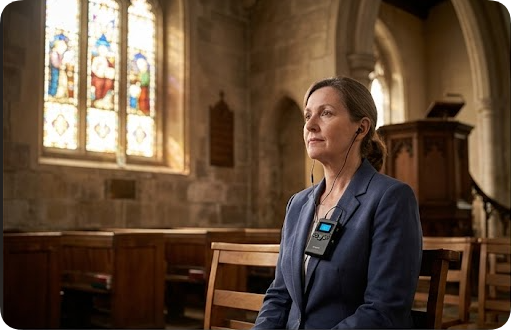
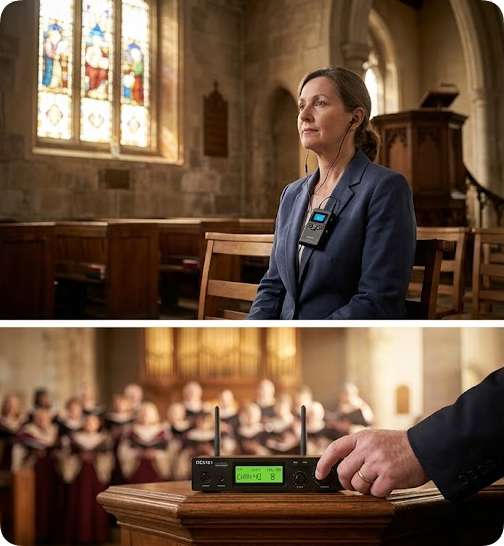
An interpreter wearing the RC2401 receiver at a discreet corner of a historic stone church, with stained glass light creating a reverent atmosphere.
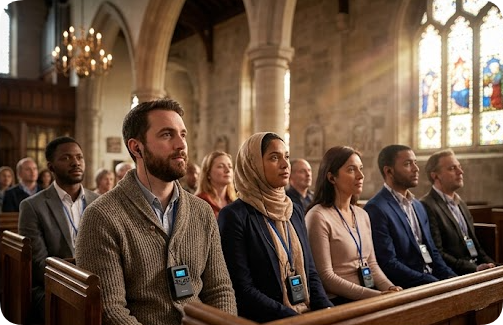
International church attendees wearing RC2401 receivers, with sunlight streaming through stained glass windows onto the pews.
The RC2401 transmitter on a wooden church podium, with the pastor's hand adjusting the volume dial against a soft-focus choir background.