

A science museum that budgets a wireless tour guide kit for twelve open months misses the weeks when the galleries go quiet. Capital equipment is invoiced once, yet its operating cost keeps moving through closed-door exhibition swaps, overnight recovery charges, back-room storage, and end-of-cycle write-offs.
Equipment quotes focus on runtime during peak visitor hours, leaving off-season labor, attrition, and storage out of the initial calculation. Reviewing how the RC2402, RC085, and RC2468 behave between exhibitions helps operations teams build realistic annual budgets without surprise reorders.
Shut Days and Recovery Charging Labor
Closing a gallery wing for a two-week exhibition changeover pauses ticket sales, not battery maintenance. Lithium cells left idle over a long shutdown lose charge gradually, so technicians or floor staff still have to plug units in, inspect indicators, and return handsets to their racks before public tours resume.
The RC2402 Two Way Wireless Tour Guide System pairs a 3.7V 1000mAh receiver cell rated for roughly 20 hours of use with a DC charging port. Against a standard seven-hour museum day, that endurance looks generous; after ten to fourteen dark days, bringing an entire fleet back to full readiness takes deliberate scheduling rather than a routine nightly top-up.
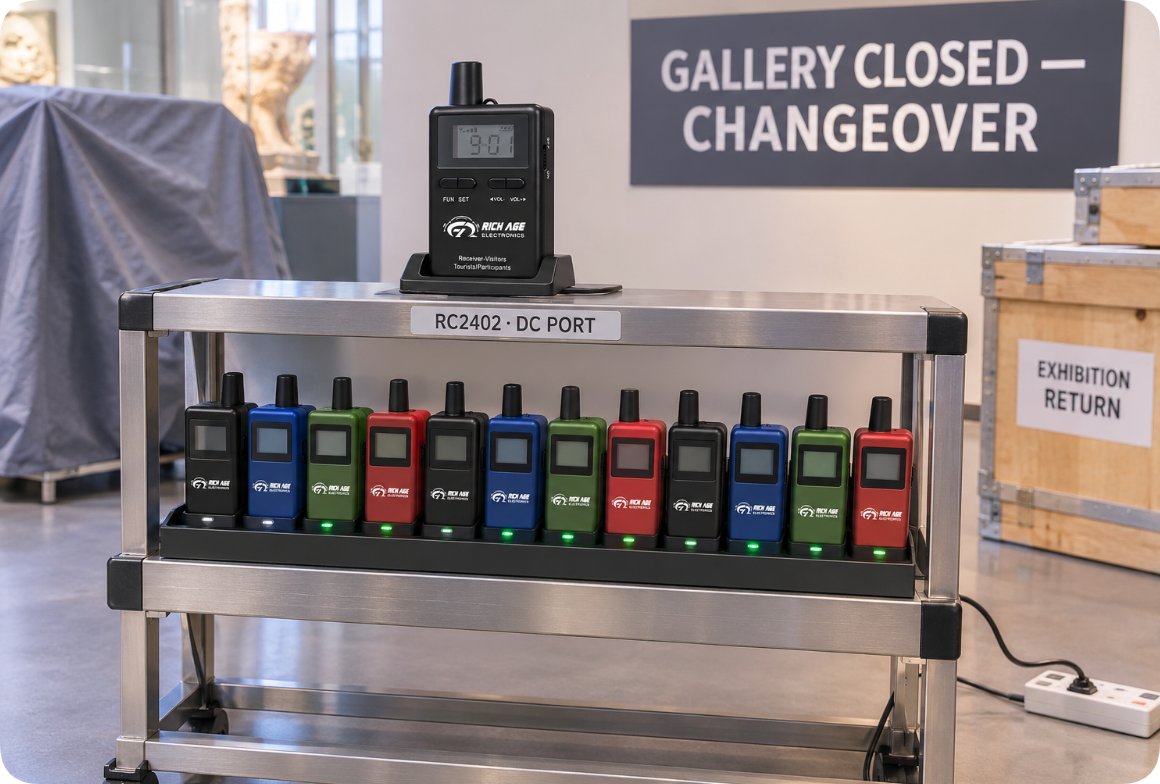
When facilities managers request quotes from a Museum Wireless Audio Guide System Wholesale supplier, sizing should match exhibition changeover intervals rather than single-day events alone. Factoring closed-week charging hours into staff rosters prevents last-minute battery shortfalls on reopening morning.
Fixed Installations and Band Trade-Offs in Back Rooms
Semi-permanent hardware creates quiet overhead long after an exhibit closes. Wall docks, ceiling-mounted transmitters, and bolted charging stations often stay wired into utility closets or gallery alcoves, shifting removal and rewiring costs onto building maintenance budgets rather than tour operations.
Selecting the RC085 Portable Tour Guide System Wholesale shapes how easily equipment moves later. Operating across 470-510 MHz with 100 selectable channels, around -102dBm receiver sensitivity, and optional headset or lavalier microphones, it suits structured talks on a dedicated band—yet specialized mic setups and fixed RF layouts take extra effort to redeploy across different halls.
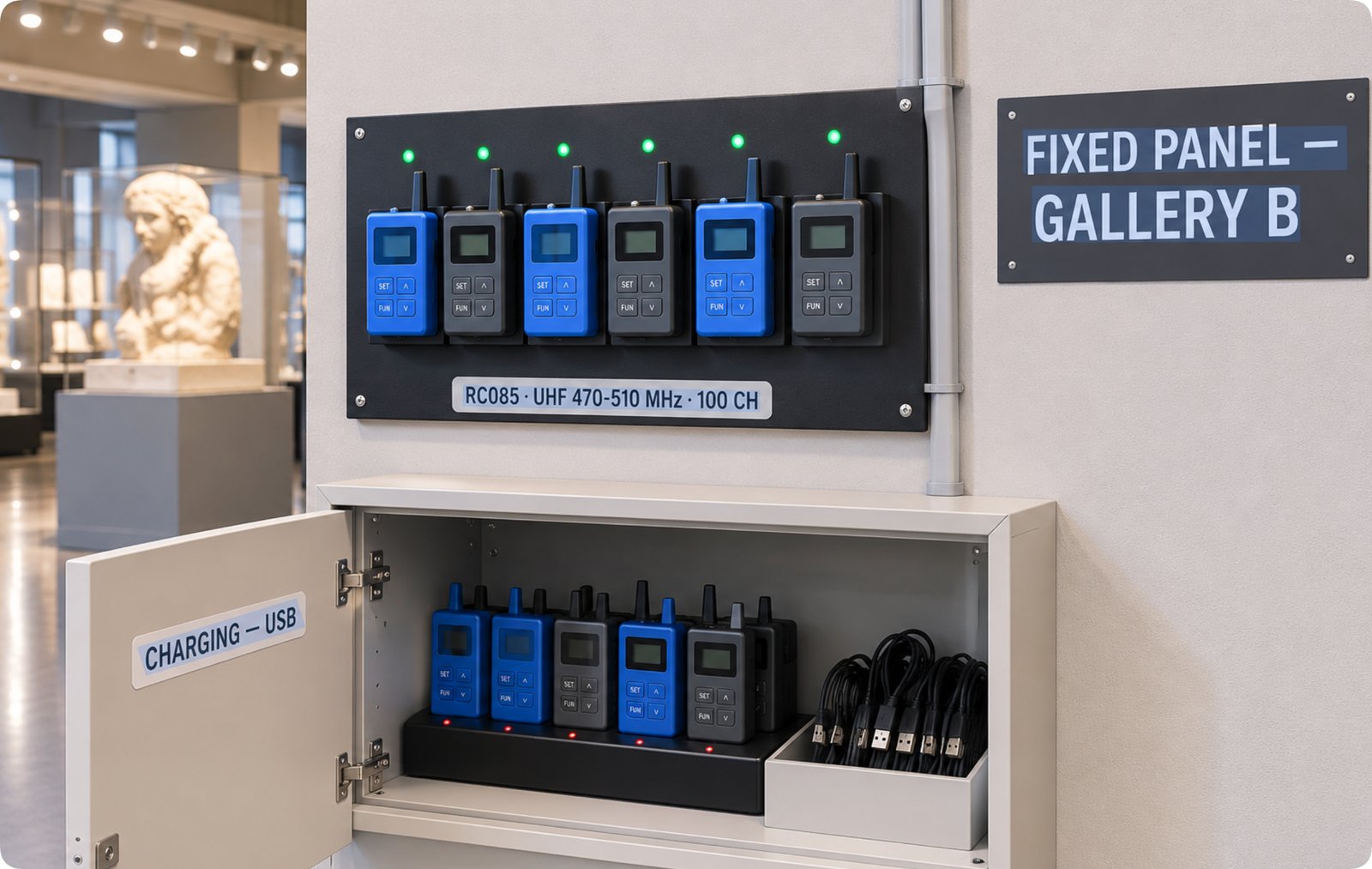
The 2403-2483 MHz band used by both the RC2402 and RC2468 avoids regional frequency coordination hurdles, making quick deployment across spaces straightforward. The trade-off is accountability: portable 2.4GHz sets can drift between departments or pop-up workshops if check-in logs are lax during off-peak weeks.
Between Exhibitions: Lightweight Gear and Attrition Costs
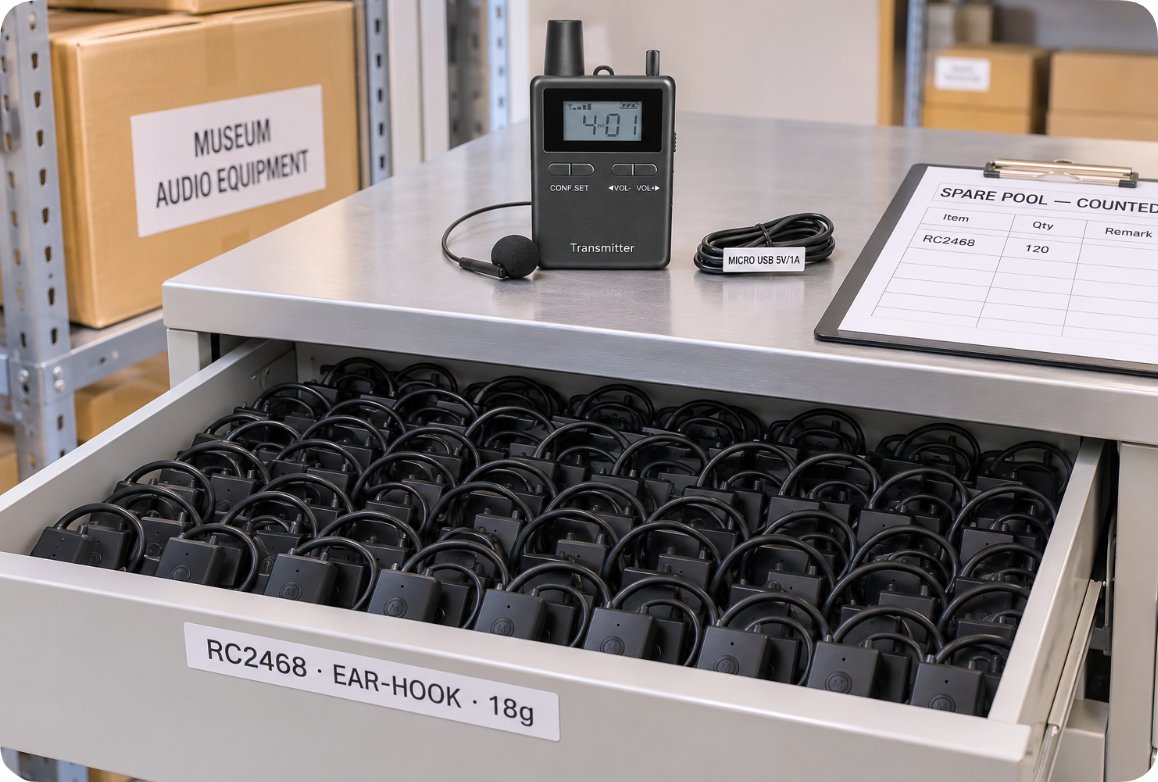
The RC2468 Lightweight Tour Guide Headsets Bulk saves storage space easily, with an 18g ear-hook receiver and a 59g transmitter. Dozens fit in a shallow drawer, but an ultra-light ear-hook is also easy for visitors to forget behind coats or bags—or for staff to overlook during rapid gallery sweeps.
Budgets for compact headsets work best when split into initial purchase plus ongoing replacement allowances. Low unit costs encourage bulk ordering, yet unlogged walk-offs or pocketed receivers turn small top-up orders into a steady recurring expense across active seasons.
Heavier bodies—such as the 50g RC2402 receiver and 59g transmitter, or the 65g transmitter and 60g receiver on the RC085—feel more substantial in hand and are simpler to spot in bins or lost-and-found trays. Even so, every model requires clear serial tracking so missing units are identified immediately rather than assumed safe in storage.
Reading the Ledger After an Exhibition Changeover
Comparing upfront purchase price against full lifecycle cost separates hardware specs from real museum operations. Upfront capital covers radios, accessories, and initial setup, while post-launch ledgers capture replacement batches, off-season charge cycles, out-of-warranty repairs, and storage space.
Each model shifts that ongoing ledger in a distinct way:
RC2402: With 50 selectable channels and up to 200m transmission range, fleet size scales primarily with peak group headcount rather than floor coverage.
RC2468: Compact 18g receivers simplify drawer storage, while small size increases exposure to accidental loss and repeat replacement orders.
RC085: Dedicated 470-510 MHz operation across 100 channels and optional professional microphones tie the kit closer to specific guided-program formats.
Product datasheets naturally highlight live venue performance, whereas internal budget sheets need to track quiet months alongside peak attendance. Reviewing broader Wireless Audio Guide Application Solutions alongside real attendance logs helps align equipment quantities with actual gallery schedules.
| Specification / Lifecycle Factor | RC2402 | RC085 | RC2468 |
|---|---|---|---|
| Frequency band | 2403-2483 MHz | 470-510 MHz | 2403-2483 MHz |
| Selectable channels | 50 | 100 | 50 |
| Output power | 10mW | 8-10mW | 10mW |
| Transmission distance | Up to 200m | Up to 200m | Up to 200m |
| Transmitter battery | 3.7V 1500mAh | 3.7V 1200mAh | 3.7V 1500mAh |
| Receiver battery | 3.7V 1000mAh | 3.7V 1000mAh | 3.7V 300mAh |
| Transmitter working life | 10h | 12h | 10h |
| Receiver cell and working life | 3.7V 1000mAh / 20h | 3.7V 1000mAh / 20h | 3.7V 300mAh / 8h approx. |
| Transmitter weight | 59g | 65g | 59g |
| Receiver weight | 50g | 60g | 18g ear-hook |
| Charging port | DC Port | USB | Micro USB 5V/1A |
| Certifications | CE, FCC, RoHS | CE, FCC, RoHS | CE, FCC, RoHS |
| Warranty | 1-Year Limited | 1-Year Limited | 1-Year Limited |
Hardware specifications establish baseline capability, while internal operational notes keep multi-year costs transparent. Tracking closed weeks, changeover labor, annual replacement rates, and storage write-off dates gives budget reviewers concrete figures grounded in the museum's own calendar.
Managing Spare Pools and Mixed Charging Setups
A reliable spare pool contains charged, tested, and inventoried units ready for immediate dispatch—not uncounted receivers sitting uncharged in a back cabinet. Counting unverified gear as spare capacity inflates confidence during busy school-trip weeks and leaves guides short-handed when a receiver fails or goes missing.
Mixed fleets add charging complexity across rooms. The RC085 receiver charges via USB, the RC2402 uses a DC port, and the RC2468 uses Micro USB at 5V/1A. Standardizing charging bays, cable labels, and off-season maintenance checks—even when sourcing directly from a Wireless Tour Guide System Manufacturer Direct—keeps daily turnaround smooth for technical staff.
Planning Ahead for Renewal and Fleet Scaling
As stored or aging units approach retirement, teams weigh whether to renew at full capacity or scale down to match smaller exhibitions. Standard 2.4GHz handsets with clear specifications, CE/FCC/RoHS compliance, and a 1-year limited warranty are often easier to redeploy across secondary programs than dedicated-band setups tied to a single hall's layout.
Long-term support matters alongside hardware specs. Backed by a manufacturer with 12 years of experience and lifetime technical support alongside the 1-year limited warranty, museums can plan multi-year upkeep with clear expectations. Comparing operational time metrics—similar in spirit to how a crossing gate counts the minutes between halls—helps clarify how idle intervals shape true cost.
Scaling down works cleanly when spare counts and replacement rates are tracked accurately. If a fleet shrinks mainly through unrecorded losses rather than planned retirement, small top-up orders can quietly mask declining active counts until the next major budget review.