




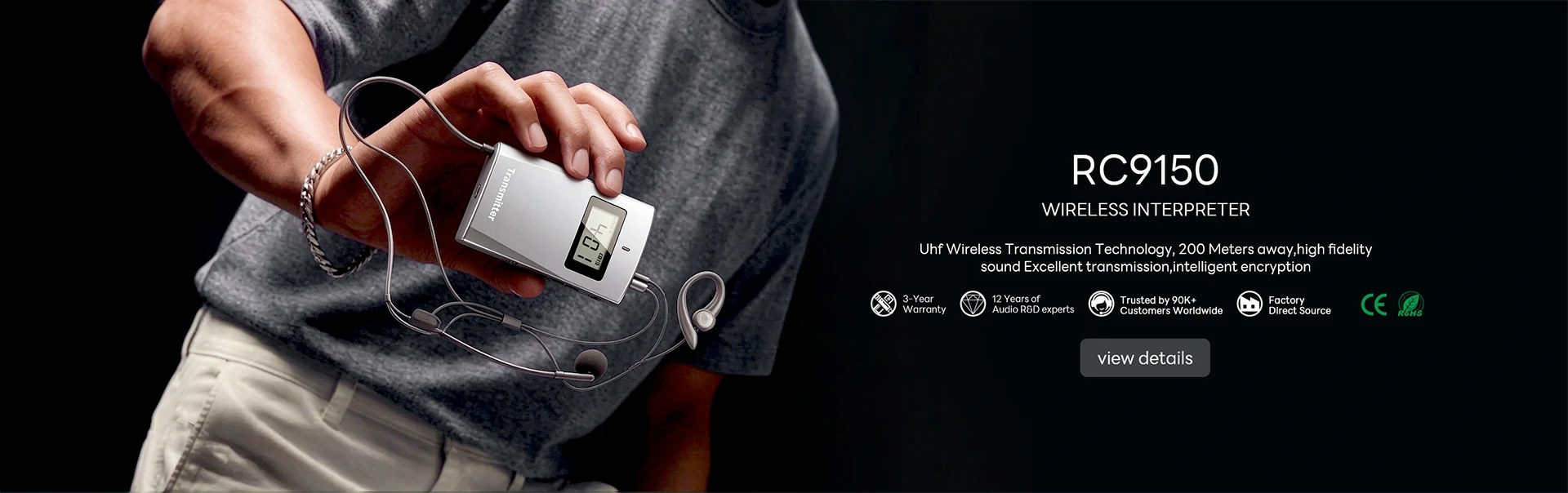
RC8860, RC2401 and RC2500: A Channel Plan for an Open Day That Never Stops
At a university open day the queue does not form at the lecture theatre. It forms at a folding table in the entrance hall, where a sign-up sheet, a stack of lanyards and a pile of earpieces appear together. By mid-morning the hired audio kit has to serve three jobs at once: hand out hardware to a first-time visitor, keep two intake batches apart under the same roof, and survive a guide who walks his group across a courtyard and loses the signal on the way. The three units below answer those jobs from different directions. RC8860 uses the UHF band for the crossing. RC2401 is the plain 2.4G kit for a standard batch. RC2500 is the flagship that keeps working when the handover happens mid-tour. None of them is the whole answer; the channel plan is.
An open day is a useful stress test because the timetable is compressed. A school may run an Classroom Teaching Audio System Solutions program on a normal Tuesday with one class and one transmitter. On Saturday the same rooms take four intake batches, each with its own guide, and the batches overlap in the corridor. Nothing about the hardware changed between Tuesday and Saturday. What changed is the number of separate audio conversations that have to stay independent inside one building. That is a channel-count problem before it is a volume problem, and it is why this article starts at the sign-up desk rather than at the speaker.
The Sign-Up Desk Sets the Channel Count
Channel count sounds like a specification you read after the purchase. At an open day it is a number you write on the roster before the doors open. Each simultaneous batch needs its own channel; if two guides transmit on the same frequency the two groups hear each other, and the cleaner fix is to plan the allocations than to ask one guide to shout. A desk that expects two parallel batches can work with a modest channel pool. A desk that quietly plans for five cannot, and discovers the limit only when the groups meet in the stairwell.
This is where the distinction between a UHF set and a 2.4G set becomes practical rather than theoretical. A 2.4G tour guide radio system in the 2403-2483 MHz band offers tens of channels and is comfortable when the batches stay in one wing. A UHF unit in the 860-870 MHz band offers fewer channels but holds them more reliably through walls and across open ground. The desk does not choose a band; it decides how many groups will exist at the same minute, and the band follows from that decision. Write the peak parallel-batch number on the sign-up sheet first, then match the kit.
📡 Two Batches, One Building, One Radio System
Two batches under one roof do not need two buildings. They need two independent audio conversations that never merge. In practice the assignment is simple: batch A receives on channel 04 and batch B on channel 11, the guides carry transmitters locked to those channels, and the lanyards in the sign-up tray are colour-coded to match. The visitor never sees the channel number. What the visitor notices is that the voice in the earpiece belongs to the guide in front of them and not to the group around the corner.
The failure mode is not interference from outside. It is the moment a well-meaning volunteer swaps two earpieces because the lanyards look alike. The system only stays separate while the receiver and the transmitter remain paired to the same plan. That is why the desk, not the equipment crate, is the real control point: the person issuing hardware decides which batch a visitor joins, and the decision is recorded by the channel written on the tray label. Pair the hardware to the plan at issue time and the mid-tour handover becomes a routine swap rather than a reset.
📡 UHF for the Wing the Signal Has to Cross
RC8860 is the unit for the route that leaves the building. It works on a single UHF band at 860-870 MHz with 20 channels, 10 mW output and a transmission distance rated at 1-200 m. The transmitter runs 10 hours on a 3.7V 1500mAh battery, the receiver 20 hours on a 3.7V 1000mAh cell, and the pair weighs 59 g and 50 g respectively. Charging is through a DC port and the frequency response sits at 50Hz-12kHz. The figures matter less as a list than as a shape: few channels, long receiver life, light hardware, and a band that copes when the group moves between a corridor and a courtyard.
The 20-hour receiver life is what makes the outer route practical. A morning tour and an afternoon tour can share the same earpiece without a charge in between, so the desk issues one receiver per visitor for the whole day rather than collecting them at the gate. The 59 g transmitter sits in the guide's pocket for six hours, and the 10 mW output is enough for a group of twenty spread along a walkway. None of those numbers is impressive alone; together they describe a kit that a volunteer can hand out once and forget until closing time.
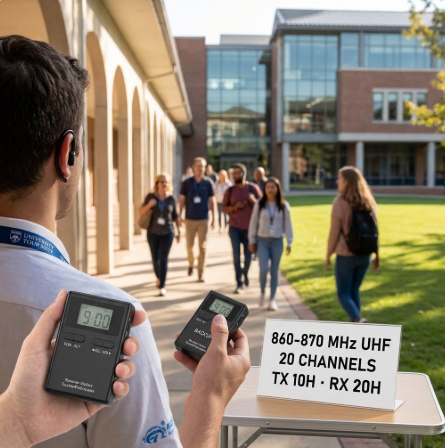
In an open-day layout the 20-channel ceiling is not a weakness. A campus visit rarely runs more than a handful of parallel batches, and the UHF band buys stability on the walk between the science block and the sports field. The RC8860 Wireless Teaching Microphone System is therefore the natural choice for the outer route, the one where a guide turns a corner and the building stops shielding the signal. It is also the unit to keep in the kit when the event spills outdoors, because the alternative is a 2.4G set fighting the same air as every phone in the crowd.
Fifty Choices on the Basic 2.4G Set
RC2401 is the standard 2.4G kit. It covers 2403-2483 MHz with 50 channels at 10 mW and a 1-200 m rated distance. Transmitter life is 10 hours from a 3.7V 1500mAh pack, receiver life 20 hours from a 3.7V 1000mAh pack, and the weights are 59 g and 50 g. Both units charge through a DC port. The frequency response is 50Hz-200kHz on transmit and 50Hz-12kHz on receive, which is the profile of a general-purpose voice system rather than a music system. Fifty channels is the number that earns its place at a multi-batch desk: it leaves room to give each intake group its own frequency and still reserve a spare for a late arrival.
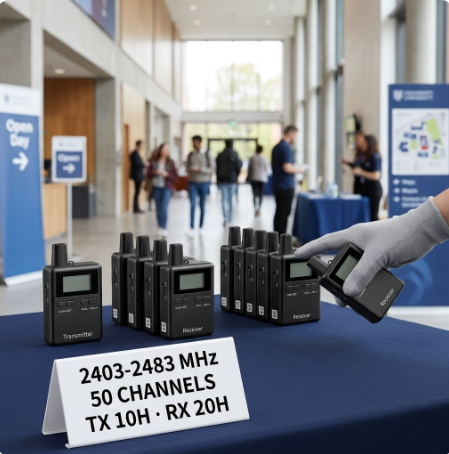
The RICH AGE RC2401 Wireless Audio System Factory kit is the one a school buys when the tours stay inside a single building and the requirement is straightforward: enough channels to separate the batches, enough receiver life to last a morning, and no configuration that a volunteer has to understand. A transmitter-receiver pairing is set once at issue time and stays set for the session. The unit does not try to be a flagship; it delivers the plain channel separation that most open days actually need, which is why it is the default in the tray rather than the exception.
🗺️ The Flagship That Hands Over Mid-Tour
RC2500 is the top of the range and behaves differently in two ways. It runs 15 hours on a 3.7V 1800mAh transmitter and 35+ hours on a 3.7V 1800mAh receiver, both weighing 104 g, and it charges through Type-C rather than a DC port. It keeps the same 2403-2483 MHz band, 50 channels, 10 mW and 1-200 m reach as the basic kit, but the frequency response narrows to 50Hz-8kHz. The feature that changes an open day is one-button sync, shutdown and mute: when a guide hands the group to a colleague at the museum door, the change takes one press instead of a menu.
Battery capacity is the quiet difference on a long Saturday. A receiver rated at 35+ hours and a transmitter at 15 hours survive two full open days on one charge, which matters when the kit is stored in a locked cabinet and nobody wants to collect fifty earpieces on a Sunday evening. The Type-C port also means the same charging cable stock used for phones can top up the fleet, rather than a separate DC lead that disappears after the first event. That housekeeping detail is why the flagship ends up on the busiest route even when the basic kit would carry the audio.
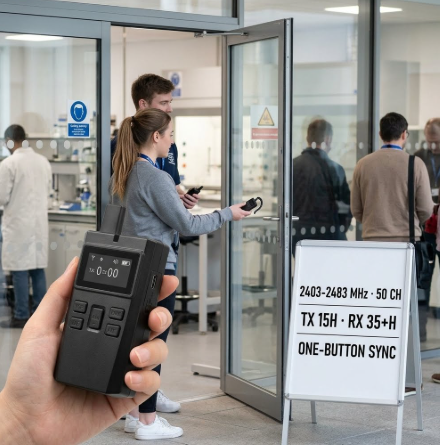
That handover is common on a campus tour. A student ambassador walks the first half and a faculty member takes the laboratory wing; the visitors keep their earpieces and the receiver keeps its channel. The RC2500 Digital Tour Guide System Price reflects the extra battery capacity and the one-button control, and it is the unit to allocate to the route where a guide change is built into the timetable. The heavier 104 g body is noticeable on a lanyard but acceptable for a receiver that will not need charging between two open days.
📡 Pairing Each Transmitter During Check-In
Transmitter and receiver matching is a desk task, not a technical one. The clean method is to number the tray: transmitter 04 and every receiver on channel 04 go in the same labelled compartment, transmitter 11 takes the next, and the volunteer hands out a matched set. At the check-in desk the visitor receives a lanyard and a receiver in one motion, and the channel is already set. This removes the two questions that slow a queue: which channel is this on, and who do I ask if it stops. The answer is printed on the tray, not explained at the door.
The same discipline covers the spare kit. A school that plans one extra transmitter per four batches can absorb a dead battery without interrupting a tour, but only if the spare is charged and already assigned to a free channel. The Wireless Tour Guide System Manufacturer Direct range supplies the three units discussed here from one catalogue, which keeps the charging spares interchangeable across a fleet. Mixing bands is fine — UHF on the outer route, 2.4G inside — as long as the desk knows which tray belongs to which band.
🗺️ What a First-Time Visitor Never Sees
A first-time visitor sees a corridor, a guide and an earpiece. The visitor does not see the 50-channel plan behind the batch split, the UHF choice for the courtyard, or the one-button handover at the laboratory door. That invisibility is the point of the planning. When the system is matched to the route, the open day feels like a sequence of conversations rather than a piece of equipment, and the school spends its morning answering questions about courses instead of questions about reception.
| Comparison dimension | RC8860 | RC2401 | RC2500 |
|---|---|---|---|
| Wireless tour guide system class | UHF single-band | Basic 2.4G | Flagship 2.4G |
| Core frequency band | 860-870 MHz | 2403-2483 MHz | 2403-2483 MHz |
| Number of channels | 20 | 50 | 50 |
| Output power | 10 mW | 10 mW | 10 mW |
| Transmitter / receiver battery life | 10h / 20h | 10h / 20h | 15h / 35+h |
| Transmitter / receiver weight | 59 g / 50 g | 59 g / 50 g | 104 g / 104 g |
| Charging port | DC Port | DC Port | Type-C |
| Transmitter-receiver pairing note | Few channels, stable on the crossing | Fifty channels for parallel batches | One-button sync, shutdown and mute |
Reading the table as a decision, the outer route takes RC8860 because the band survives the walk between buildings; the indoor batches take RC2401 because fifty channels separate the groups without configuration; and the route with a scheduled guide change takes RC2500 because the handover is one button. The Wireless Audio Guide Application Solutions page groups these use cases by venue, which is a useful cross-check when the campus layout is unusual. A guide who has worked a similar open day can read a related write-up in this factory tour bundle cost breakdown, where the same batch logic appears with a different crowd.
🔮 Industry trend: the desk, not the crate, becomes the control point
Across campus events the purchasing conversation has moved from the loudest speaker to the most flexible allocation plan. Three years ago a school bought one kit and shared it across whatever groups turned up; today it buys a mix of bands and channels and assigns them at the sign-up table. The reason is not that visitors became more demanding. It is that intake batches, parent groups and language streams now overlap in time, and each overlap needs an independent audio channel. The hardware that wins the open day is the hardware that lets a volunteer run that allocation without calling technical support.
The trend favours kits with spare channels and simple pairing over kits with headline power. A 50-channel 2.4G set and a 20-channel UHF set cover the two halves of a typical campus: the indoor batch split and the outdoor crossing. A flagship with one-button sync covers the handover route. The learning for a procurement team is to ask the event organiser for the peak number of simultaneous groups before asking for a specification sheet. That single number decides whether the open day needs one kit or three, and which of the three units above belongs at each desk.