

Operational Reality Check: A stadium tour on match day operates under vastly different time pressures than a routine museum visit. Crowds arrive in dense waves, concourses fill rapidly between kick-offs, and a single guide cannot simultaneously cover the player tunnel, the VIP hospitality lounge, and the upper stands. Venue operators frequently discover staffing gaps on the roster long before noticing equipment shortages—there are simply more visitor viewing points than there are available human guides.
Solving this challenge requires determining which station genuinely demands a live human guide versus which static briefing can be handed over to a dedicated playback device. Utilizing professional hardware solutions sourced directly through a Wireless Tour Guide System Manufacturer Direct channel ensures that fixed exhibits and moving tour groups receive appropriate technical support without inflating payroll.
Categorizing Match-Day Posts by Staffing Requirements
During a quiet mid-week walkthrough, all stadium stations appear identical: a doorway, a corridor, a display case, or a viewing gallery. On match day, however, these locations serve distinct operational functions. A secure credential checkpoint requires a security officer; a repetitive directional corridor represents a briefing post that can be automated via keypad audio guides; and an interactive viewing gallery where visitors ask dynamic questions demands a conversational live guide.
Furthermore, venue managers must evaluate whether a station is fixed or mobile. While all wireless models in this guide share a published 1–200 meter operating range, battery longevity and multi-channel density determine how many concurrent groups a building can support. Automating repetitive static briefings frees trained personnel to manage high-touch interactive zones.
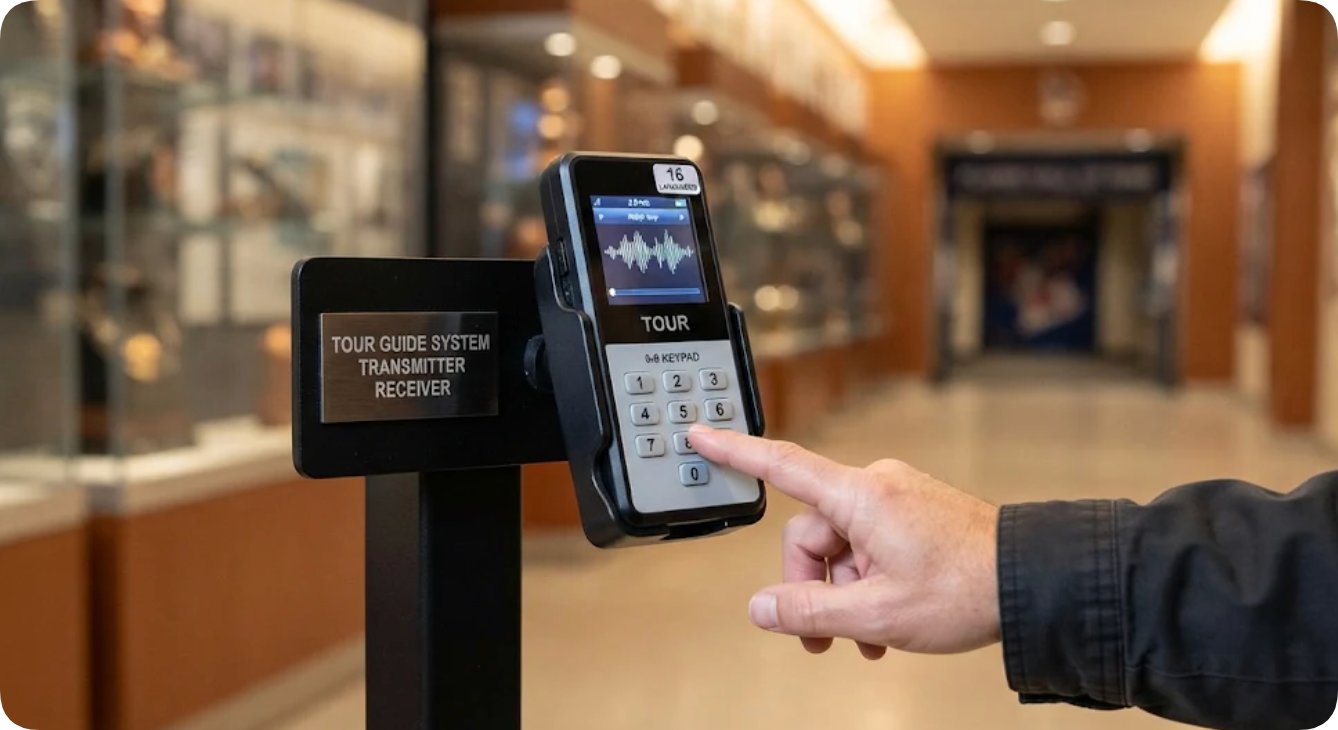 Automating static exhibits: deploying the 2.8-inch keypad audio guide at high-traffic historical display points.
1. The Keypad Unit: Automating Repeating Briefings
The 2.8 Inch Display Automatic Museum Audio Guide is purpose-built for fixed exhibits where scripts remain constant. Featuring a clear 2.8-inch screen and a 0–9 numeric keypad, visitors simply enter the code associated with an artifact or historical display to trigger pre-recorded commentary. With 2GB of internal memory supporting up to 9,999 audio files across 16 languages and an 18-hour continuous runtime via Micro USB, it operates reliably without staff supervision.
Placing this device at legacy trophy cases, retired player walls, or accessible-route briefing stations eliminates the need for standing attendants whose sole job is pressing play. Staff can instead be redeployed to active greeting zones like the player tunnel. For comprehensive wholesale options tailored to cultural venues, explore Museum Wireless Audio Guide System Wholesale catalogs.
2. RC2501: Supporting Dynamic, Live Guided Tours
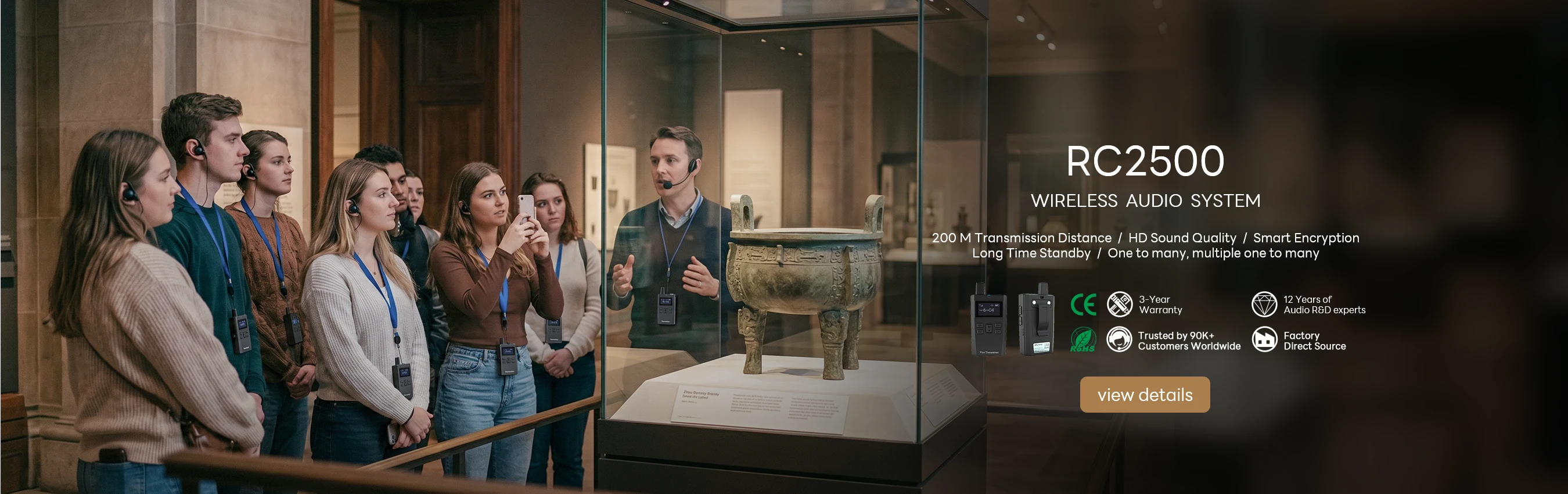
Guided tours through restricted areas like the players' tunnel or locker rooms require dynamic interaction—answering spontaneous questions and adapting to route changes. The RC2501 Wireless Interpretation Headset System fulfills this role with 2.4 GHz transmission, 50 selectable channels, 13 mW RF output, and an exceptional battery endurance of 15 hours for transmitters and 35+ hours for receivers.
Weighing only 47 grams per unit (86 × 50 × 19 mm), the RC2501 minimizes neck and belt fatigue for both guides and visitors across extended match-day shifts. Featuring Type-C charging, a 20 Hz–200 kHz frequency response, and CE, FCC, and RoHS certifications, it provides crystal-clear audio even in noisy stadium environments.
 Live guide engagement: maintaining crystal-clear voice transmission in high-noise areas with the ultralight RC2501.
3. RC2402: Managing Parallel Tours Across Multiple Suites
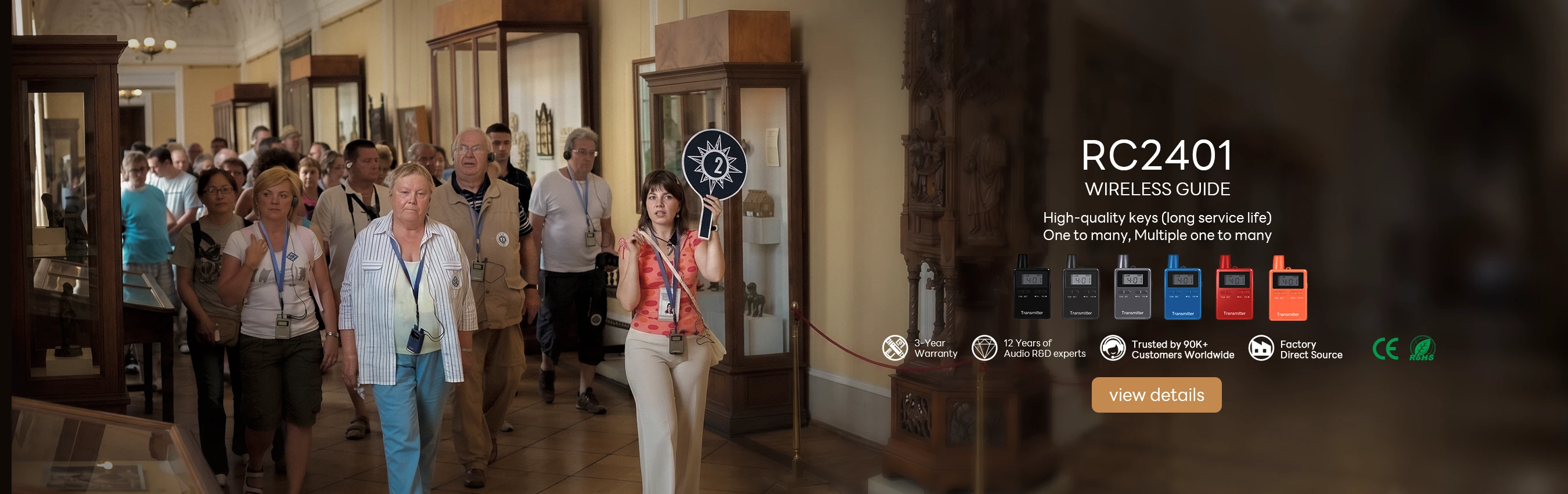
Match days frequently require concurrent event hosting—such as a VIP hospitality briefing in the executive suite, a family concourse walk, and a media walkthrough in the press room. Operating multiple tours simultaneously without cross-talk requires dedicated frequency isolation. The RC2402 Two Way Wireless Tour Guide System delivers 50 channels on 2.4 GHz with 10 mW output, 10-hour transmitter endurance, and 20-hour receiver battery life.
Assigning specific channel blocks to designated rooms ahead of time prevents guides from clashing on overlapping frequencies. Utilizing robust multi-channel setups as detailed in professional Wireless Audio Guide Application Solutions ensures seamless visitor flow across complex multi-zone venues.
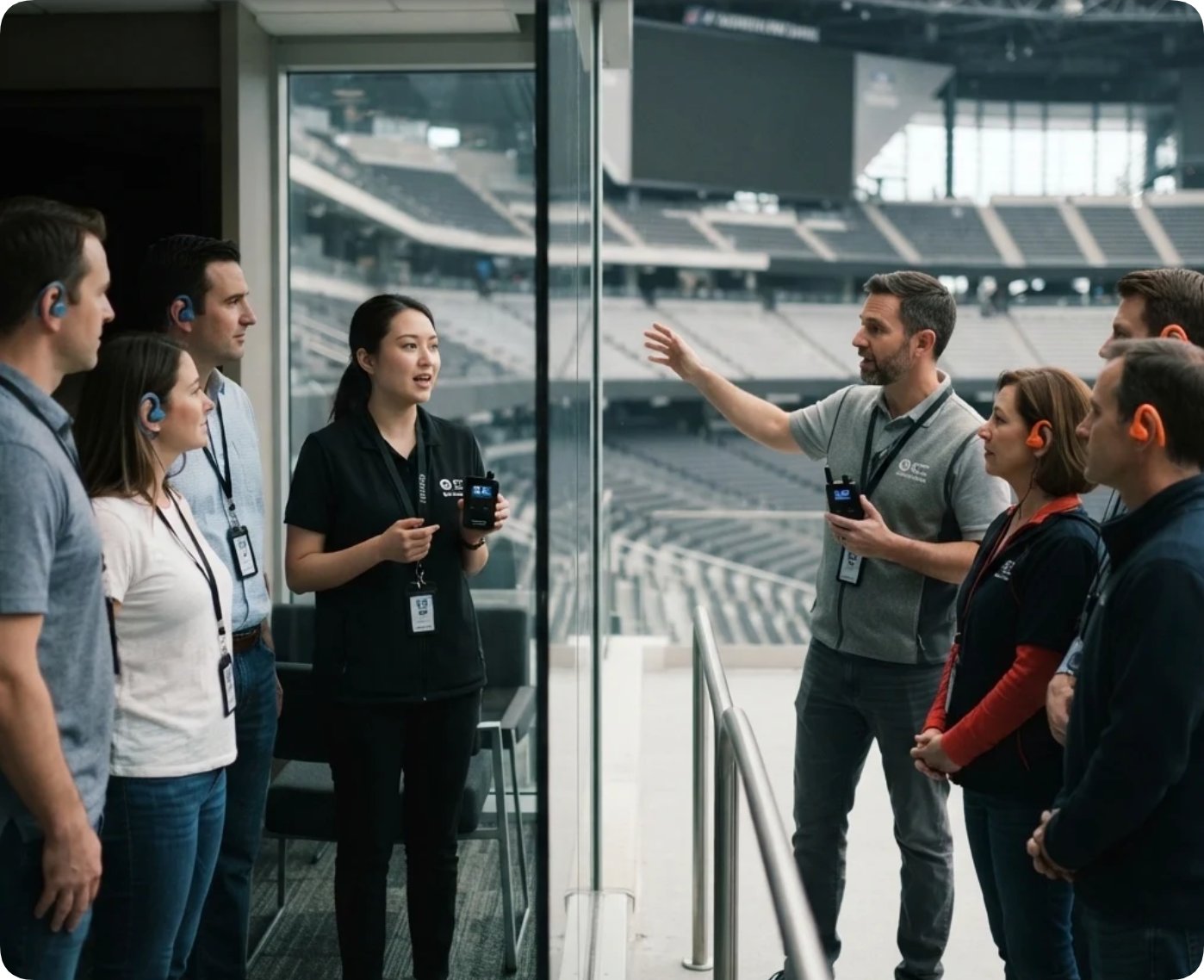 Parallel tour management: isolating independent audio channels for simultaneous suite briefings and concourse walks using the RC2402.
Match-Day Roster Allocation & Specification Matrices
To optimize staff deployment, match each stadium post to its corresponding hardware solution, keeping operational constraints in mind:
| Post Type | Traditional Manual Staffing | Recommended Hardware Solution | Operational Limitation |
|---|---|---|---|
| Repeating Briefing Post | Staff member repeats short descriptions to every arrival | 2.8-inch Keypad Audio Guide | Cannot answer custom ad-hoc visitor inquiries |
| Moving Live Guide Route | Guide walks groups and answers interactive questions | RC2501 Wireless Headset System | Limited to single-channel group conversation per guide |
| Parallel Room / Stand | Multiple guides shouting over each other in nearby areas | RC2402 Two-Way System | Shorter battery endurance than enterprise models |
Review published technical specifications across the device lineup to plan your charging infrastructure and shift rotations accurately:
| Specification Parameter | 2.8-Inch Keypad Guide | RC2501 Wireless Unit | RC2402 Two-Way Unit |
|---|---|---|---|
| Frequency & Channels | Not published (Local storage) | 2.4 GHz / 50 channels | 2.4 GHz / 50 channels |
| RF Output Power | Not published | 13 mW | 10 mW |
| Battery Runtime | 18 hours continuous | TX 15 h / RX 35+h | TX 10 h / RX 20 h |
| Charging Port | Micro USB | Type-C | DC Port |
| Unit Weight | Not published | 47 g (TX) / 47 g (RX) | 50–59 g |
| Storage Capacity | 2 GB / 9,999 files / 16 languages | Not applicable | Not applicable |
| Certifications | Not published | CE, FCC, RoHS | CE, FCC, RoHS |
Executing Seamless Changeovers Between Crowds
Between successive tour groups, venues typically have a narrow twenty-minute window to collect receivers, reissue transmitters, verify audio playback on static keypad units, and ready the next group. Establishing a strict handover protocol managed by a designated staff member at a fixed station ensures smooth transitions. For further insights into overcoming match-day audio bottlenecks, refer to specialized guides on troubleshooting stadium tour audio on match day.
Frequently Asked Questions
1. How does a channel plan determine the correct wireless system for parallel rooms?
The number of simultaneous live voices dictates channel allocation. Each parallel room or stand operates on an isolated channel block, and a 50-channel 2.4 GHz unit such as the RC2402 provides ample frequency separation for suites, concourses, and media tours to run concurrently without signal interference.
2. Which stadium stations can operate entirely without human staff?
Static exhibits with fixed scripts can be fully automated. The 2.8-inch keypad audio guide features 9,999 files across 16 languages and an 18-hour runtime, reliably delivering consistent pre-recorded briefings to visitors so personnel can be reassigned to interactive posts.
3. How long can a live transmitter remain active across a full match day?
Published battery ratings define operational limits. The RC2501 transmitter provides 15 hours of runtime with a 35+ hour receiver, easily covering pre-game build-ups, matches, and post-event clear-downs. The RC2402 offers 10 hours for transmitters and 20 hours for receivers, perfectly suiting shorter suite briefings.
4. What charging requirements must venue managers plan for when mixing device types?
Mixed device fleets require multiple cable standards. Because the keypad guide utilizes Micro USB, the RC2501 uses Type-C, and the RC2402 relies on a DC port, charging stations must be equipped with dedicated cables for each unit during shift changeovers.