
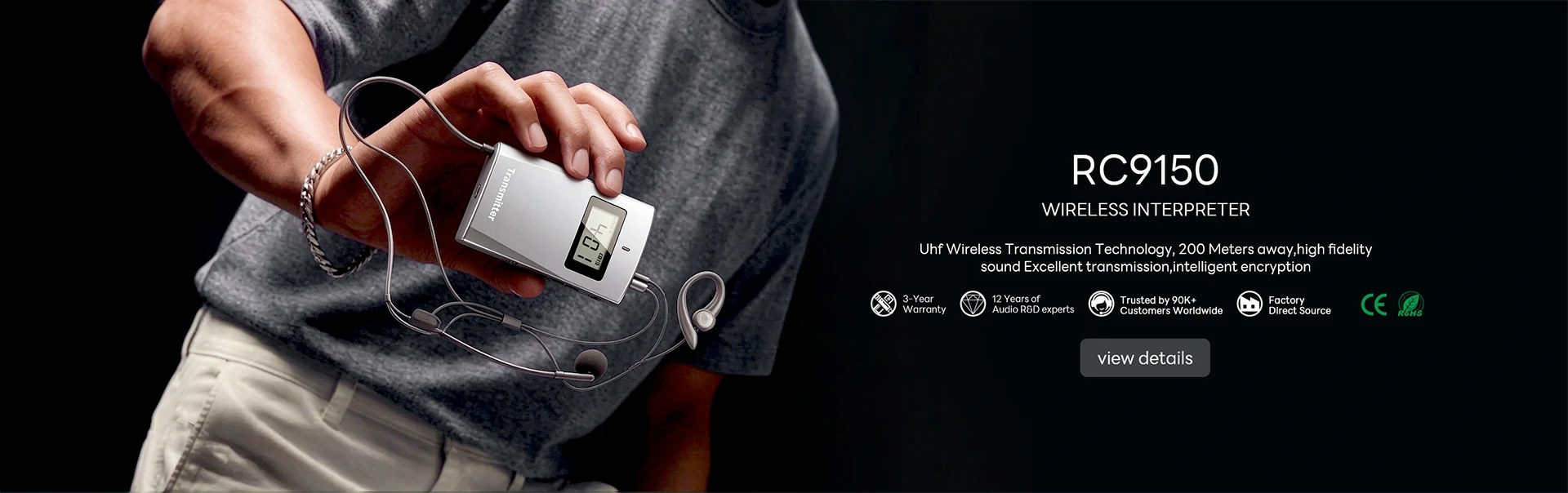
Every wireless voice system relies on a three-stage signal chain: a microphone capsule captures speech, a transmitter sends that audio over a radio band, and a receiver delivers it to the listener's ear. For trainers, facilitators, and presenters, the practical choice comes down to which microphone placement sits closest to the mouth—a decision that shapes voice consistency, speaker comfort, and room-to-room clarity.
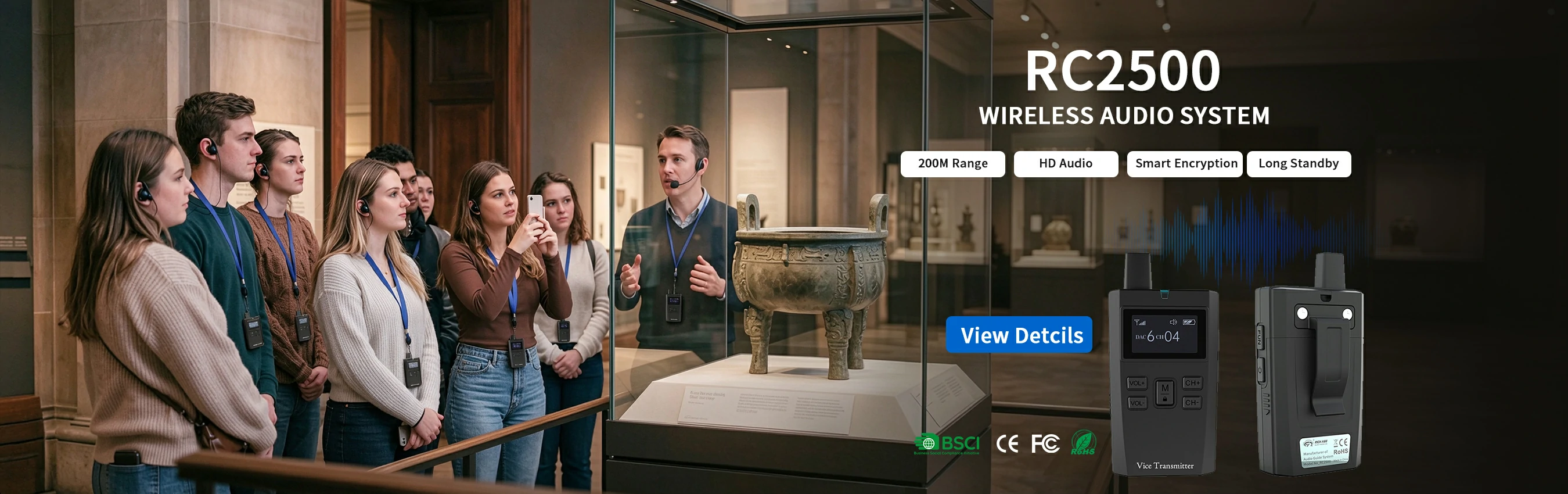
The RC2501 pairs a collar-line clip capsule (with a head-worn option) and roughly -38 dBm MIC sensitivity for soft-spoken chest pickup; the RC085 supports collar-clip and head-worn options on the 470–510 MHz UHF band with 100 channels for multi-group spaces; and the RC2500 integrates the microphone directly into a handheld transmitter with one-key mute. Explore the broader training and conference lineup on the Conference Simultaneous Translation Solutions page.
2.4 GHz Wireless vs. 470–510 MHz UHF: Spectrum Planning in Practice
Whether a system is described as wireless or radio, the underlying signal flow is the same capsule-to-transmitter-to-receiver path. What differs is the operating band: the RC2501 and RC2500 operate in the 2.4 GHz band (2403–2483 MHz) with compact hardware and 50 channels, whereas the RC085 operates in the 470–510 MHz UHF band with 100 channels away from dense 2.4 GHz Wi-Fi and personal devices.
In shared buildings, spectrum planning prevents avoidable overlap. On 50-channel 2.4 GHz setups, assigning fixed channels per recurring room or class on the charging rack—and spacing active groups across non-adjacent channels—keeps traffic organized. On 100-channel UHF setups like the RC085, extra channel headroom makes it easier to run parallel sessions or accommodate visiting groups without crowding nearby frequencies.
RC2501: Collar-Line Pickup for Quiet or Camera-Facing Speakers
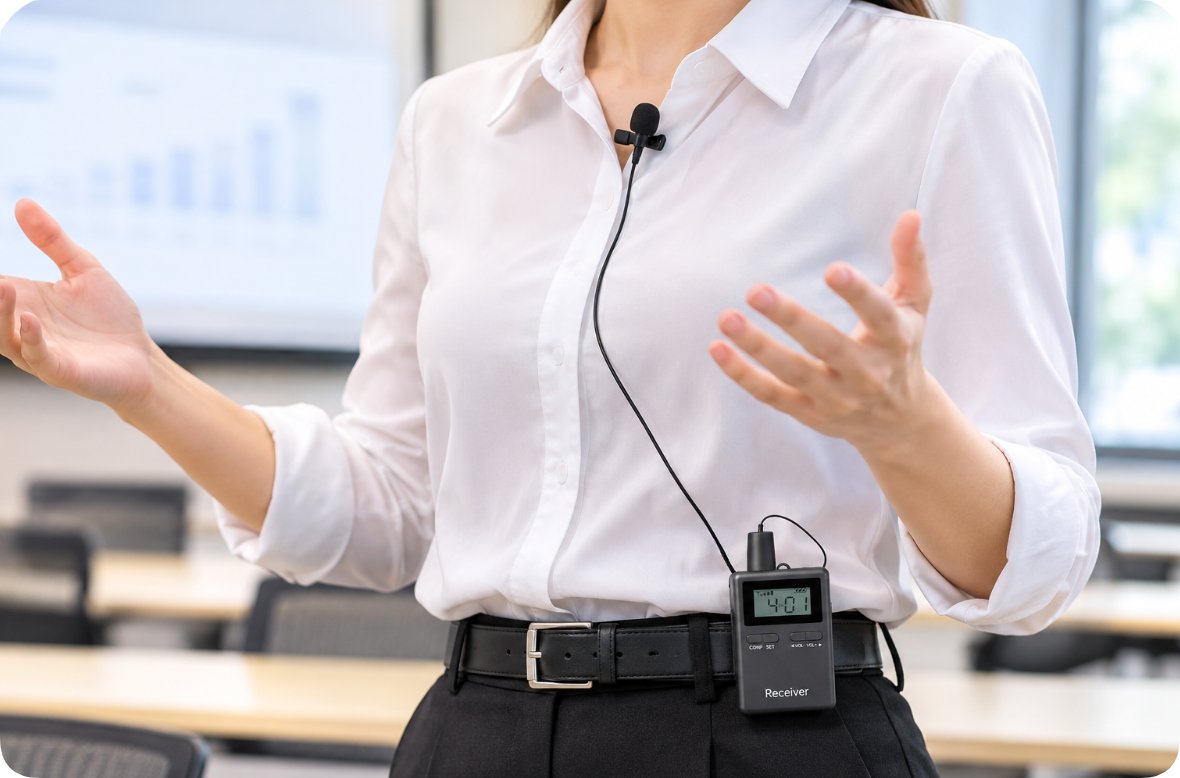
A compact lapel or collar-line capsule stays unobtrusive on camera and during recorded sessions, making it a natural fit when trainers prefer minimal visible gear. With MIC sensitivity around -38 dBm, the RC2501 captures softer, unprojected speech from the chest area without requiring the presenter to lean toward a mic.
At 47 grams for the transmitter and 15 hours of runtime from its 1500 mAh cell, the RC2501 stays light on a shirt collar across multi-hour or multi-day training blocks. When a speaker turns frequently toward a whiteboard or flipchart, swapping to an optional head-worn capsule avoids level drops when the head turns away from a fixed chest clip. Full details appear on the RC2501 Wireless Interpretation Headset System page.
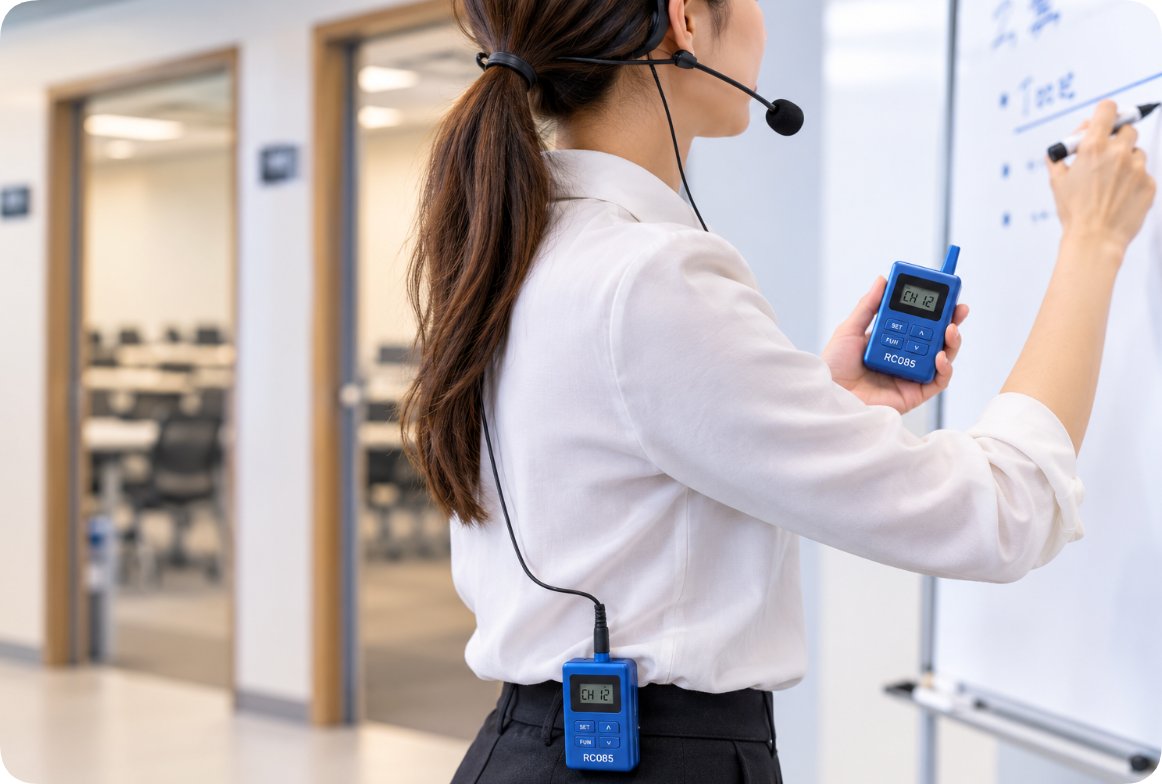
RC085: Head-Worn Mic Stability and Multi-Room UHF Channels
Mounting the microphone on a head-worn frame holds capsule-to-mouth distance steady as a trainer turns between slides, writes on a board, or demonstrates equipment with both hands free. Paired with a 60-gram pocket receiver and 8–10 mW output supporting up to a 200-meter working range, the RC085 combines consistent head-worn voice pickup with 100 UHF channels for multi-room or multi-group venues.
Proper fitting and hygiene keep shared training kits clean and reliable: clip a collar mic roughly two fingers below the collar away from shirt-button rustle, loop the cable with slack so arm movement does not tug the lead, refit head frames to each speaker, and assign individual foam windscreens when multiple trainers share gear across a day. Additional specifications are listed on the RC085 Portable Tour Guide System Wholesale page.
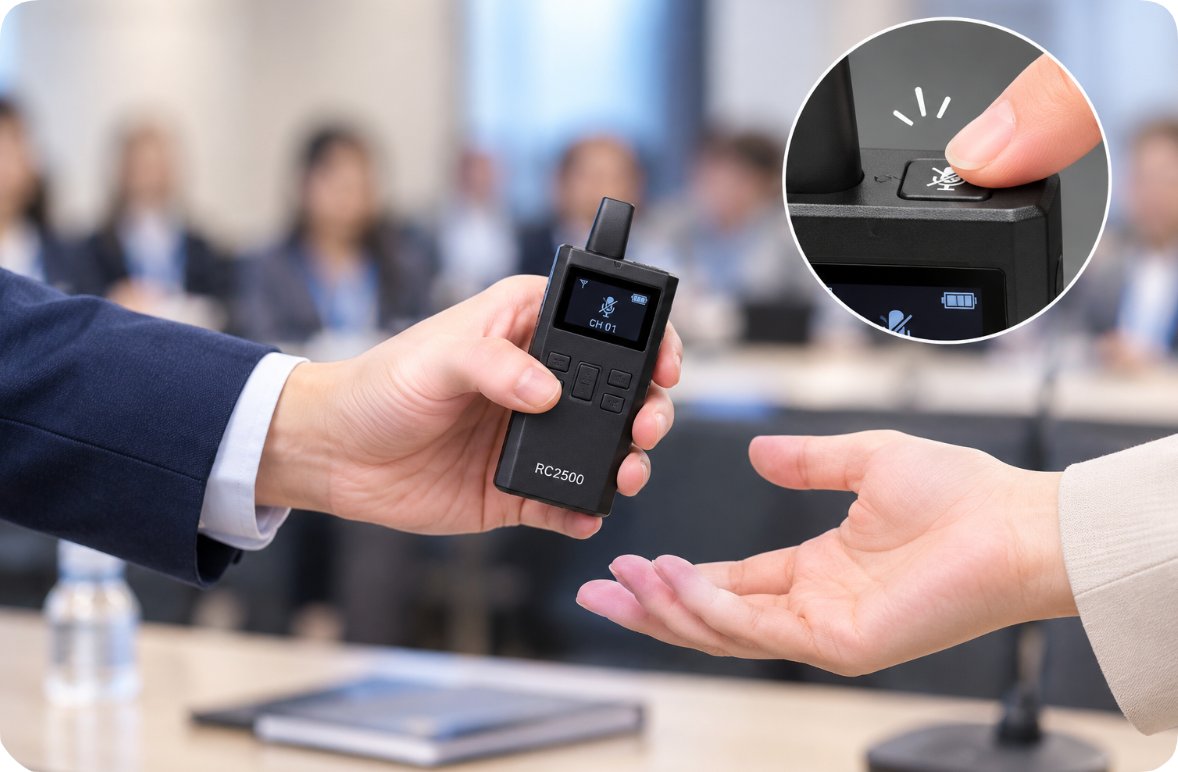
RC2500: Handheld Transmitter for Fast Speaker Hand-Offs and Mute Control
When sessions rotate between guest speakers, moderators, or Q&A participants, a handheld transmitter with a built-in microphone avoids clip routing or cable adjustments. The RC2500 lets a speaker pick up the unit, speak directly into it, and use one-key mute to silence transmission between remarks without powering down the session.
Because one hand holds the 104-gram transmitter, it suits turn-based speaking and panel moderation better than two-handed equipment demos. Its 1800 mAh battery delivers up to 15 hours of transmission and 35+ hours of receiver standby with overnight Type-C recharging; see full details on the RC2500 Digital Tour Guide System Price page.
Microphone Role Comparison Across Training Rooms
Use this matrix to match each microphone role to speaker movement, room layout, and operational watchpoints:
| Microphone Role | Model | Best Session Fit | Key Watchpoint |
|---|---|---|---|
| Collar-line capsule | RC2501 | Recorded sessions, camera-facing trainers, soft-spoken presenters | Output can drop when the speaker turns away from the chest clip |
| Head-worn capsule | RC085 | Multi-room facilities and active trainers needing steady mic distance | Refit the headset frame and swap windscreens between speakers |
| Handheld transmitter mic | RC2500 | Guest speakers, Q&A sessions, and frequent speaker hand-offs | Occupies one hand during speaking turns |
Consistent speaking distance and room-wide receiver volume checks make any of the three roles cleaner: keep mouth-to-mic distance steady—especially on handheld units—and test receiver listening levels from the back of the room rather than the front row before doors open. Browse additional models and charging accessories on the Wireless Tour Guide System Manufacturer Direct page.
Choosing the Right Mic Role for Your Facility
Evaluating how many concurrent rooms run at once and how presenters move during sessions narrows the choice quickly. Facilities running multiple parallel sessions or active trainers benefit from the RC085's UHF channel separation and fixed head-worn pickup, presenters focused on discreet chest-level pickup or camera-facing sessions fit the RC2501, and rotating guest speakers or moderated Q&A formats move smoothly on the RC2500. For additional room layouts and field examples, see Wireless Audio Guide Application Solutions and RC2500 and RC085.
Quick Selection Summary by Role
Discreet Collar / Quiet-Voice Pickup: RC2501.
Multi-Room UHF Channel Plan & Head-Worn Stability: RC085.
Rapid Speaker Hand-Offs & One-Key Mute: RC2500.
Frequently Asked Questions
1. How do wireless (2.4 GHz) and UHF (470–510 MHz) systems differ in training venues?
Both use a capsule, transmitter, and receiver chain, while the RC085's 470–510 MHz UHF band provides 100 channels outside 2.4 GHz Wi-Fi traffic, and 2.4 GHz units like the RC2501 and RC2500 offer compact form factors across 50 channels.
2. Which microphone style maintains the most consistent level when a trainer moves?
A head-worn microphone keeps capsule-to-mouth distance consistent as a trainer turns toward boards, slides, or demonstrations, whereas a fixed collar clip can lose level when the head turns away.
3. How does the RC2501 support speakers who talk softly from a shirt clip?
With around -38 dBm MIC sensitivity in a lightweight 47-gram transmitter and 15-hour battery life, the RC2501 picks up soft chest-level speech clearly across long training sessions.
4. Why choose the RC2500 for guest speakers and Q&A sessions?
Using the transmitter directly as a handheld microphone allows fast hand-offs with no clip fitting and uses one-key mute to silence audio cleanly between speakers.