
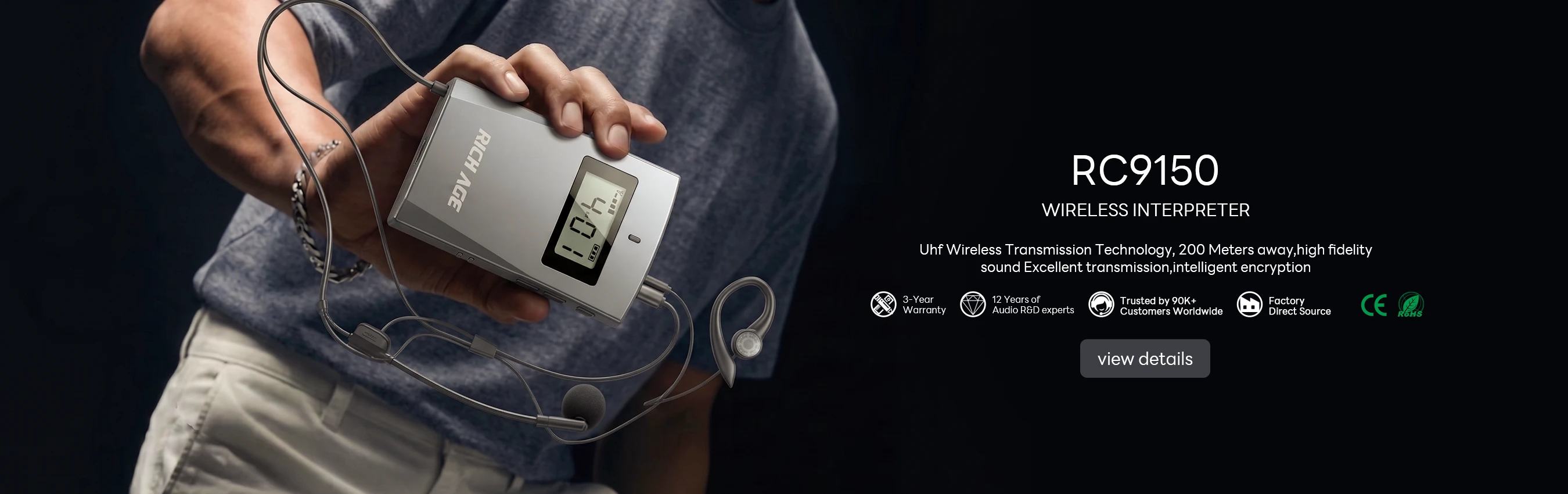
Operational Reality Check: Industrial visitor programmes are almost universally sold as bundled invoices—a fixed count of transmitters, matching receivers, and a single purchase order total. While that initial figure satisfies purchasing, it rarely reflects the total cost of ownership carried by plant operations over a three-year lifecycle. Hidden expenses accumulate in subtle ways: custom charging rack fabrication, headset inventory drift when tour groups split at automated assembly cells, or misplaced receivers left in visitor coat pockets.
Evaluating a mixed equipment bundle—such as the interpretation-grade RC2501, the high-capacity RC2406, and the Silent Disco Wireless Audio Headphone System—requires examining what is paid at purchase versus what is consumed daily on the plant floor. Sourced directly through a Wireless Tour Guide System Manufacturer Direct channel, these units serve distinct acoustic zones. Structuring them correctly prevents the morning shift from restructuring itself around audio device distribution.
Why the Purchase Quote Differs from the Operational Budget
A standard purchase order captures hardware and freight, but it omits the physical locker space required to stage forty charging headsets, the labeled storage slots that make missing units immediately visible at 4:00 PM, or the fifteen minutes supervisors spend reconciling counts after simultaneous tour groups intersect. Over an operating season, these recurring administrative friction points outweigh minor unit price variances. That is why any Factory Tour Noise Reduction Audio Solutions deployment must be budgeted as an integrated workflow ecosystem rather than a collection of isolated parts.
Time carries an unbilled cost as well. When visitor guide units are uncharged or disorganized when a VIP tour bus pulls up, the tour either starts late or commences without audio coverage. In a high-throughput manufacturing environment where conveyor lines and robotic cells cannot pause for late arrivals, that lost engagement cannot be recovered. The core strategic question is not which handset is cheapest, but which bundle maintains 100% accountability at the exact moment the delegation steps onto the shop floor.
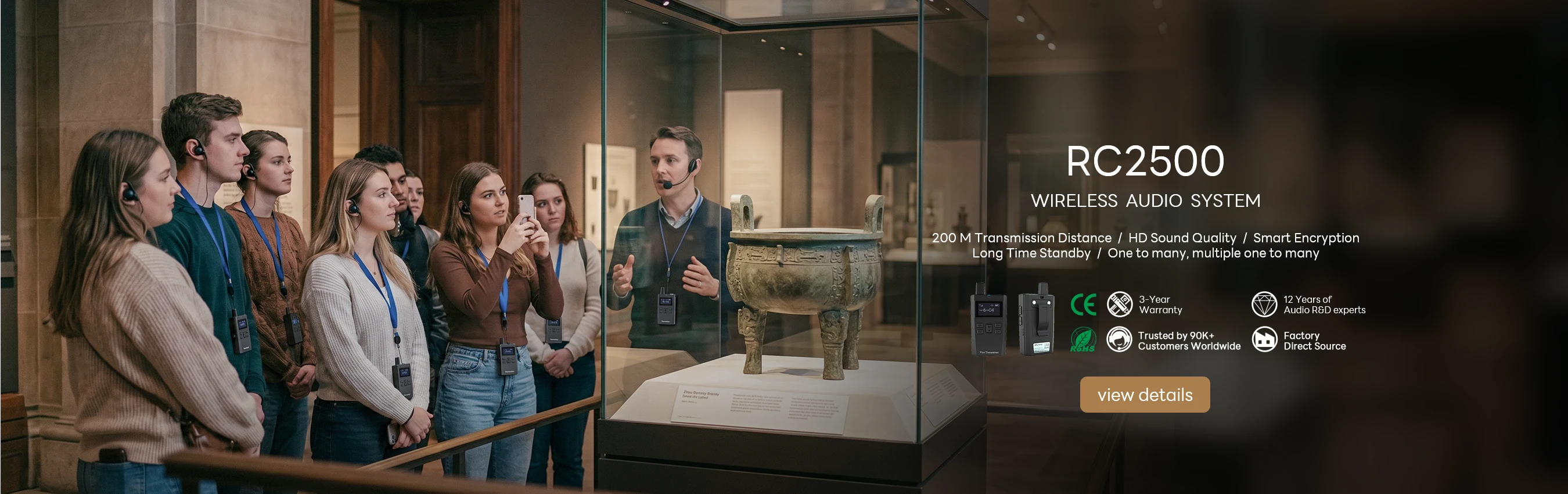
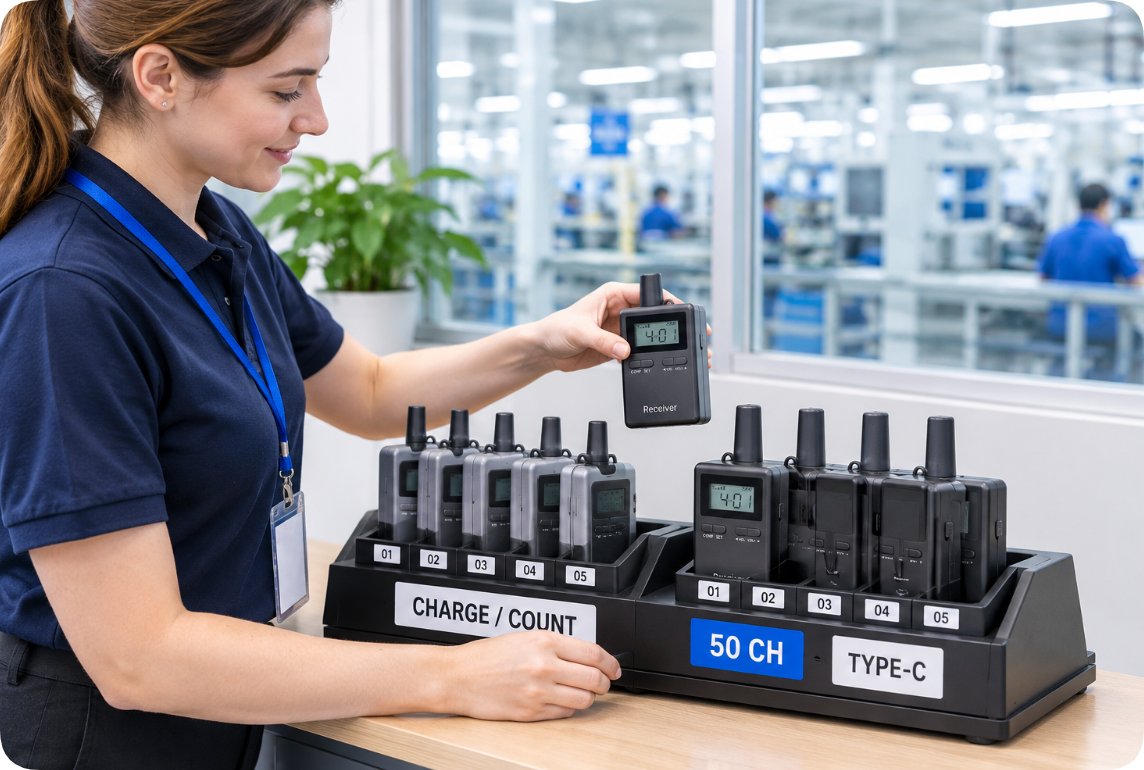 Pre-shift handover: issuing lightweight RC2501 receivers for multi-language delegation tours in high-noise assembly zones.
Day-One Handover: Analyzing Hardware Specifications
At initial deployment, the three core products in this bundle fulfill specialized operational roles, necessitating careful upfront planning for accessories and charging infrastructure:
RC2501 Professional Interpretation Unit: Operates on 50 selectable channels across the 2.4 GHz band (2403–2483 MHz) with 13 mW RF output and a 200-meter line-of-sight range. Both transmitter and receiver weigh an ultralight 47 grams. It features modern Type-C charging, delivers 15 hours of transmitter runtime and 35+ hours on receivers, and pairs with optional headsets or lavalier mics (-38 dBm sensitivity). Rated for -10 ℃ to 45 ℃ environments, it carries CE, FCC, and RoHS certifications backed by a 1-year limited warranty. Explore technical details on the RC2501 Wireless Interpretation Headset System product page.
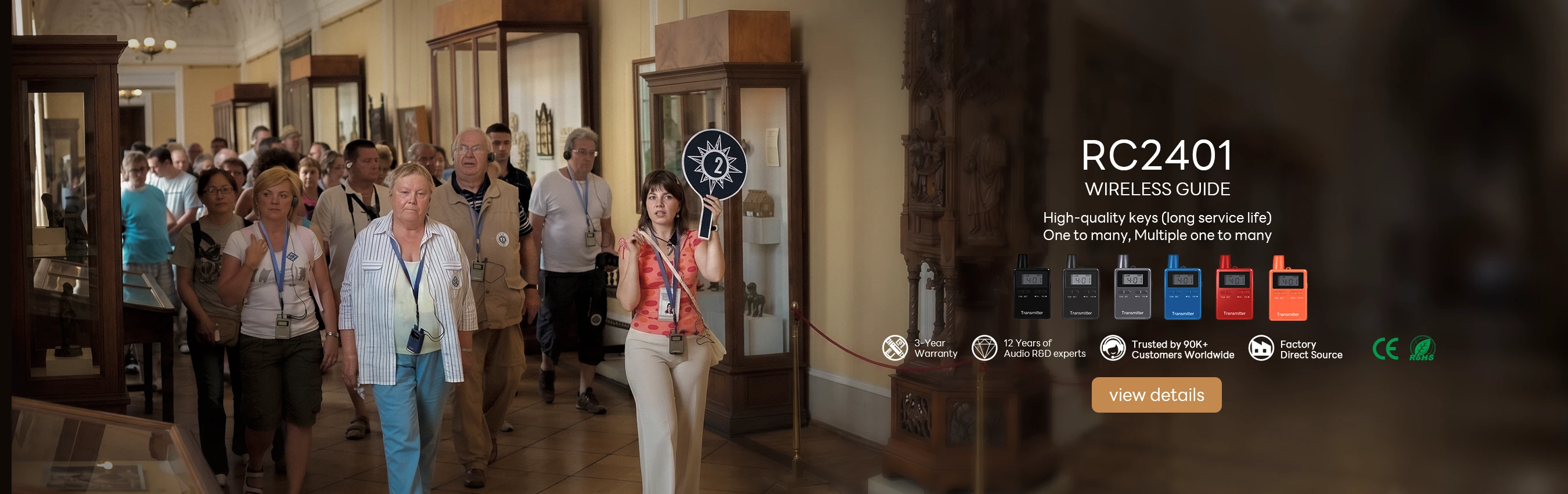
RC2406 High-Capacity Volume Unit: Provides 80 selectable channels on the 2.4 GHz spectrum with 10 mW output and a 200-meter range. Designed for larger groups, its batteries deliver 10 hours (1500 mAh transmitter) and 20 hours (1000 mAh receiver) of endurance. Weighing 50 grams for the receiver, it features IPX4 splash resistance and charges via a dedicated DC port. Review complete specifications for the RC2406 80 Channel Tour Guide Transmitter Receiver.
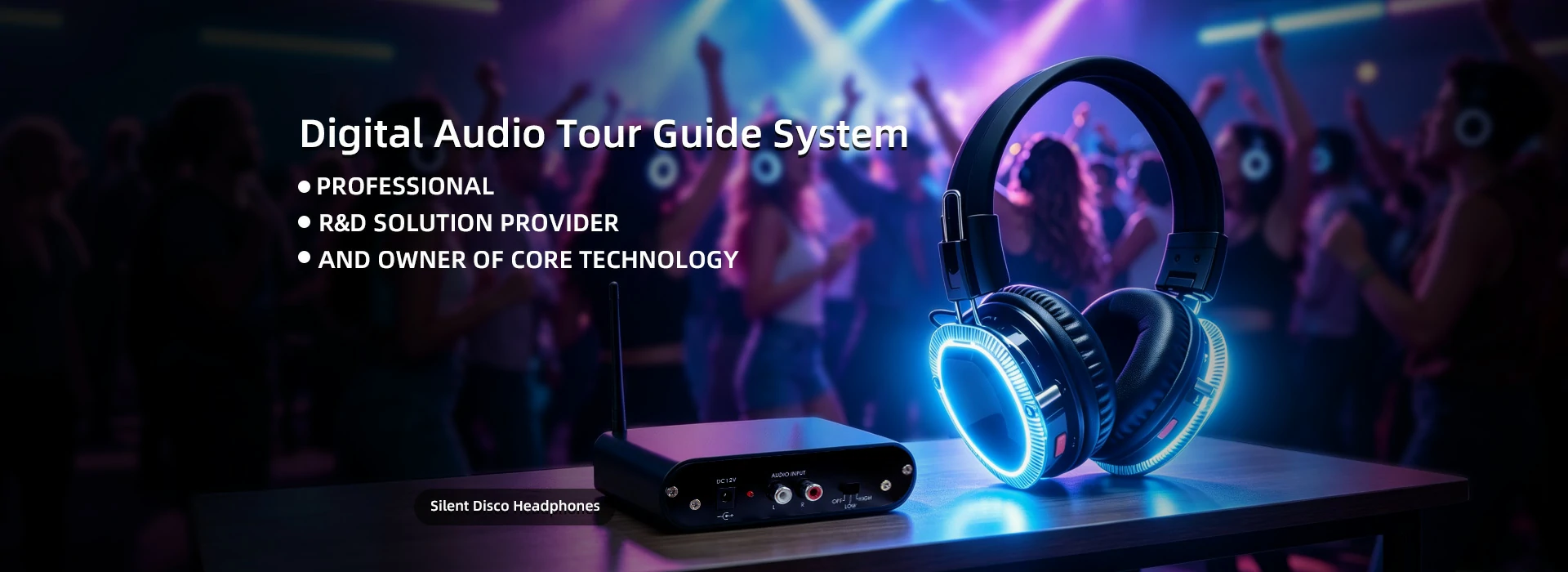
Silent Disco Wireless Audio System: Utilizing RC-409 headphones paired with an RC-50RF transmitter, this system operates on UHF/RF (863/925 MHz) with 3 or 10 selectable channels. It offers a 200-meter low-power range extending past 500 meters in high-power mode. Powered by 40 mm drivers and a 500 mAh built-in battery, headphones deliver 10 hours of runtime with a 3-hour charge cycle and feature integrated LED channel indicator lights. Learn more via the Silent Disco Wireless Audio Headphone System guide.
Managing Charging Standards and Daily Close Routines
Mixing hardware standards introduces immediate logistical considerations on day one. The RC2501 relies on universal Type-C connectors, the RC2406 utilizes proprietary DC charging ports, and the Silent Disco headphones require their own dedicated charging interfaces. A centralized charging cabinet must be pre-wired with appropriate adapters to prevent cord clutter and power failures.
Furthermore, battery endurance disparities (such as a 35+ hour receiver versus a 10-hour headset) mean devices deplete at uneven rates. Establishing a channel-sorted end-of-shift reconciliation protocol—rather than tossing units into a generic bin—drastically reduces daily closeout time and ensures complete equipment readiness for the following morning.
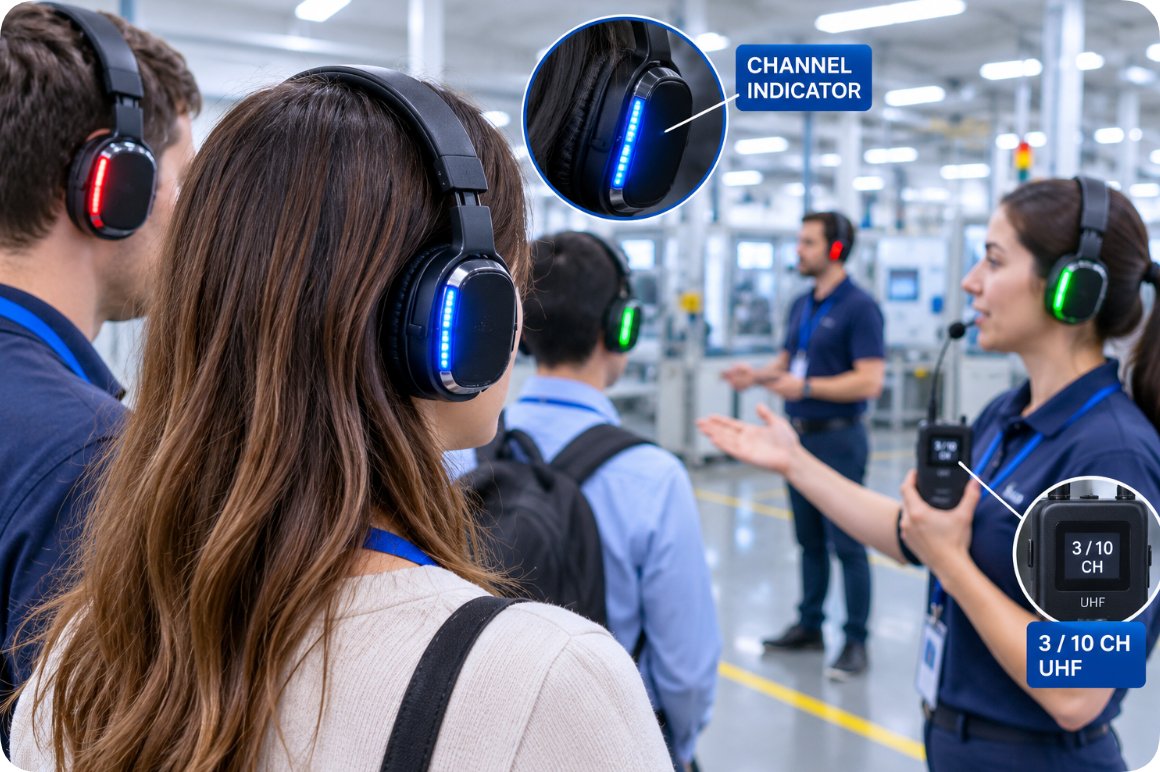 Channel segregation: using Silent Disco LED indicators to manage simultaneous tour groups across high-decibel production zones.
RC2501: Maximizing ROI on Extended, High-Noise Routes
The RC2501 fundamentally alters long-term operating costs through its exceptional 35+ hour receiver endurance and robust -10 ℃ to 45 ℃ operating threshold. By eliminating mid-tour battery swaps across long production complexes, it preserves labor efficiency. At only 47 grams, it minimizes visitor fatigue during extensive walking tours.
Additionally, its 50 crosstalk-free channels support simultaneous dual-language broadcasting (such as a primary technical guide in English alongside an interpreter channel in German), enabling plants to host international clients without duplicating hardware investments or tour guides.
Silent Disco Systems: Controlling Multi-Group Audio Clarity
Deploying Silent Disco headphones on the factory floor resolves acoustic interference in loud manufacturing environments where traditional open-air loudspeakers fail. The inclusion of visible LED channel indicators allows tour supervisors to verify at a glance that every participant in a split group is tuned to the correct audio feed.
With up to 500+ meters of range in high-power mode, visitors can disperse safely along catwalks and mezzanine viewing galleries without signal dropouts. Reviewers and safety managers should note, however, that while the hardware carries standard CE, FCC, and RoHS compliance, specific IP weather-resistance ratings are not formally published for the headphones, requiring caution in damp washdown areas.
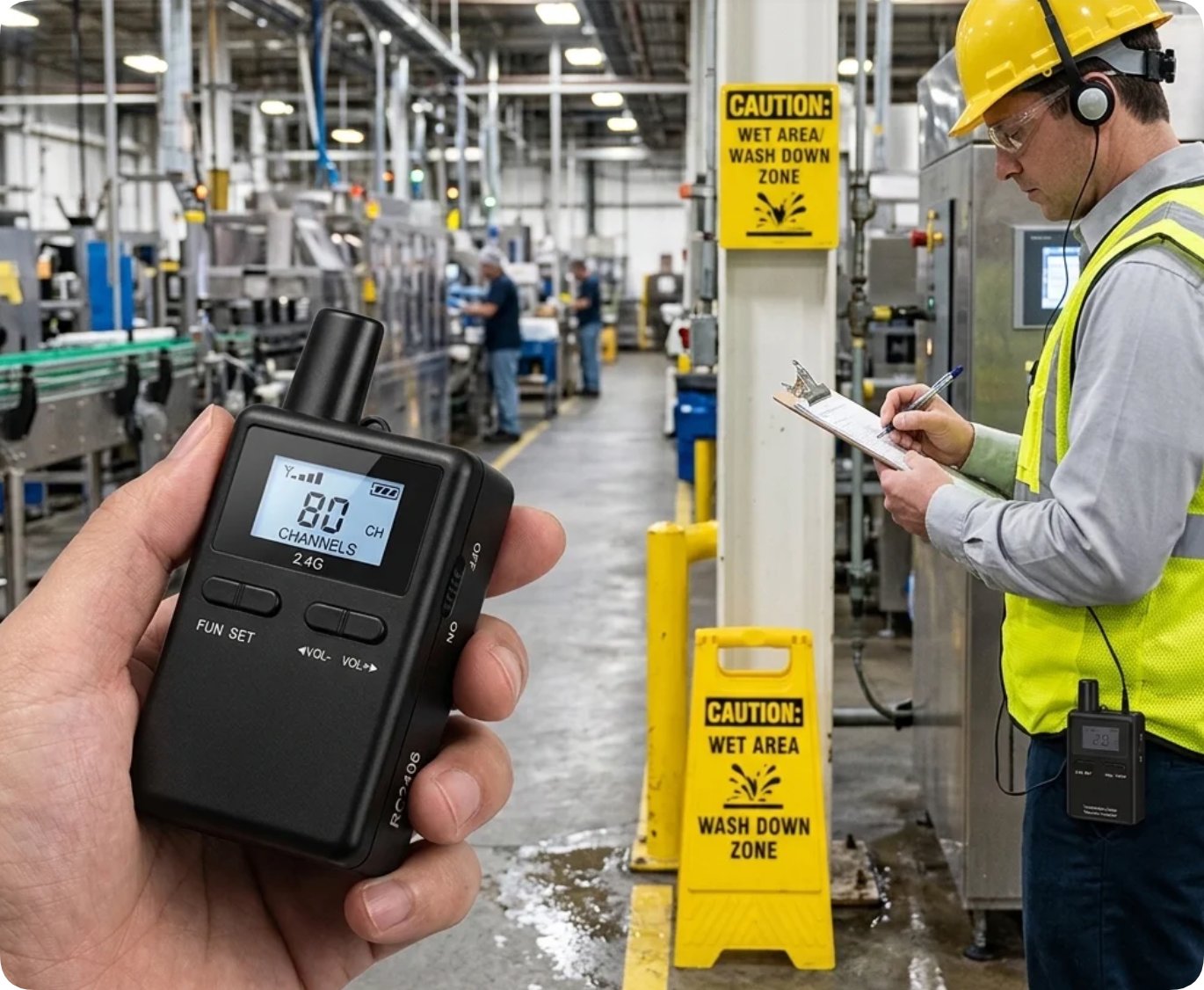 Interference management: navigating crowded 2.4GHz wireless spectra across automated machining lines with the RC2406.
RC2406: Securing Interference Margin and Splash Resistance
The primary operational advantage of the RC2406 lies in its 80 selectable channels and official IPX4 splash resistance rating. In heavy industrial facilities operating dense wireless sensor networks, 80 channels provide ample frequency headroom to avoid local Wi-Fi and Bluetooth interference without requiring daily channel re-allocations.
The IPX4 rating protects units against accidental fluid splashes near coolant pumps or beverage bottling lines. While its DC charging connector differs from the RC2501's Type-C standard, the superior channel density and moisture resilience make it an indispensable asset for heavy industrial routes.
Four-Stage Cost Stack Comparison Matrix
To evaluate how these systems align with specific plant layouts, compare their published specifications across the four lifecycle stages:
| Lifecycle Stage | RC2501 Professional | Silent Disco (RC-409/50RF) | RC2406 High-Volume |
|---|---|---|---|
| Channel Capacity | 50 channels (2.4 GHz) | 3 or 10 channels (UHF 863/925 MHz) | 80 channels (2.4 GHz) |
| RF Output & Range | 13 mW, up to 200 m | 200 m (low) to 500 m+ (high power) | 10 mW, up to 200 m |
| Daily Battery Endurance | TX 15 h / RX 35+h | Headphone RX 10 h (3 h charge) | TX 10 h / RX 20 h |
| Charging Interface | Universal Type-C | Dedicated headphone charging dock | Proprietary DC port |
| Environmental Tolerance | -10 ℃ to 45 ℃ operating range | LED indicators; no published IP rating | IPX4 splash-resistant enclosure |
| Compliance & Warranty | CE / FCC / RoHS, 1-year limited | CE / FCC / RoHS, 1-year limited | CE / FCC / RoHS, 1-year limited |
Crucial Questions to Ask Suppliers Before Signing the Purchase Order
To eliminate post-purchase budget surprises, plant managers should clarify four specific operational details with their equipment supplier before finalizing contracts:
Charging Cable Standardization: Confirm whether multi-unit charging trays can accommodate Type-C, DC, and proprietary headphone connections without requiring multiple power strips.
Group Accountability Protocols: Establish whether inventory tracking procedures rely on channel sorting or physical unit counts to prevent post-tour reconciliation bottlenecks.
Environmental Protection Verification: Verify exact IP ratings for all components against your facility's specific washdown, outdoor transit, or cleanroom environments.
Warranty Fulfillment Terms: Review local repair turnaround times and replacement module availability under the 1-year limited warranty to guarantee uninterrupted tour schedules. For further case studies on specialized industrial environments, explore our field notes on frozen cold-storage facility routing or browse broader applications across Wireless Audio Guide Application Solutions.
Frequently Asked Questions
1. Does a 35+ hour receiver battery eliminate mid-shift charging during factory tours?
Yes. The RC2501 receiver's 35+ hour endurance rating easily spans full-day visitor schedules and multi-shift plant operations without requiring intermediate recharges, provided units are docked overnight.
2. Can a single universal charging rack power every device in a mixed bundle?
No. Because the RC2501 uses Type-C, the RC2406 requires a DC port, and Silent Disco headphones feature independent charging interfaces, charging stations must be equipped with dedicated cables for each hardware standard.
3. Is the Silent Disco audio system certified for wet outdoor production routes?
No published IP rating exists for the headphones. Plant managers operating outdoor or washdown tours must verify weatherproofing tolerances directly with the manufacturer prior to procurement.
4. Do 80 channels on the RC2406 eliminate daily frequency management?
Yes for the vast majority of facilities. Eighty selectable channels provide more than enough frequency spacing to isolate concurrent plant tours and avoid localized wireless congestion without manual reprogramming.
5. What compliance certifications do these tour guide systems carry?
All units are fully certified. The RC2501, RC2406, and Silent Disco systems carry CE, FCC, and RoHS regulatory approvals and are backed by a 1-year limited manufacturer warranty.