

A supplier quote is only as reliable as the post-delivery acceptance tests it enables. A battery endurance figure that gate staff can verify with a stopwatch and twenty test headsets carries far more operational value than an unverified marketing claim. Sorting published specifications into verifiable field checks—using an active old-town walking route rather than a quiet showroom—prevents costly mid-season hardware replacements.
Why Historic Old Towns Expose Weaknesses in Generic Audio Quotes
An open-air historic district behaves nothing like the controlled testing environment of a Wireless Tour Guide System Manufacturer Direct facility. Tour groups move in irregular clusters, guides project over street traffic, and stone facades reflect RF signals unpredictably at head height. When comparing competing quotes, procurement managers are really testing one critical scenario: whether audio remains intelligible around the fourteenth stone corner when half the group trails behind. Because the RC2500, RC2501, and RC2468 all specify a 1–200m line-of-sight working range, headline distance alone cannot separate them.
All three models operate within the global 2403–2483 MHz ISM frequency band, meaning none holds an exclusive spectrum advantage. The real operational differences lie in channel management controls, transmitter RF output, receiver ergonomics, and battery capacity—the exact parameters tested during back-to-back walking tours.
Channel Capacity and Group Control: Preventing Crosstalk at Bottlenecks
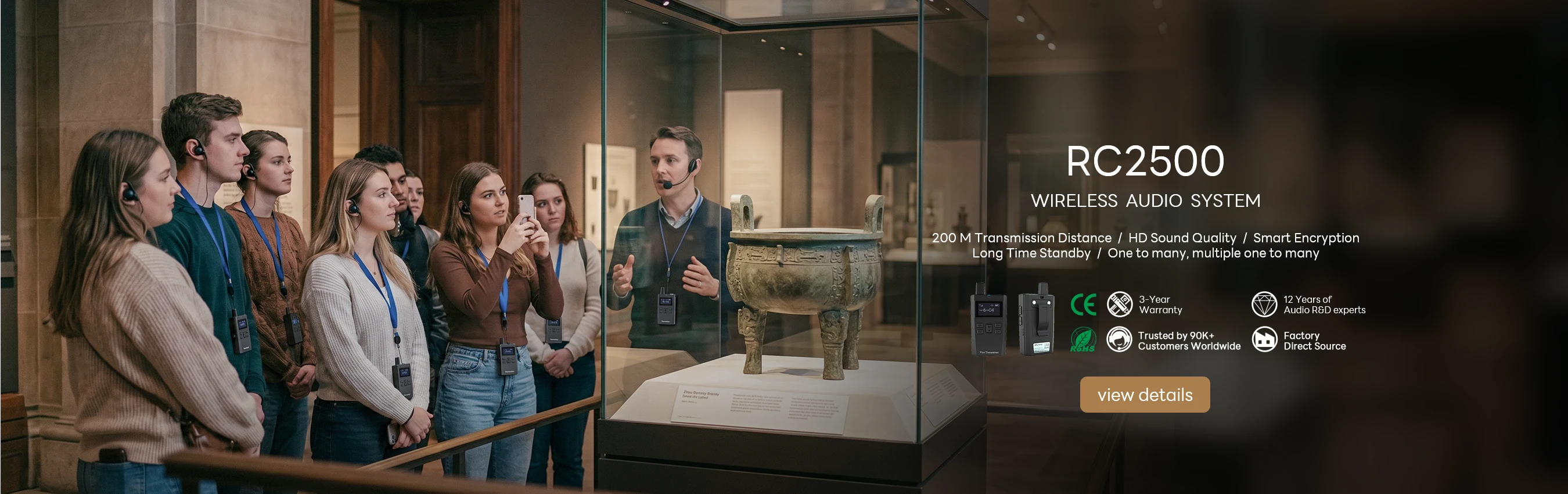
Every model in this comparison provides 50 independent channels. Budget quotes often print a channel count without explaining how guides manage group pairing in the field. At busy cathedral plazas or narrow alley intersections where multiple tour groups converge simultaneously, 50 channels prevent cross-group interference—provided staff can synchronize receivers rapidly. The RC2500 Digital Tour Guide System Price combines those 50 channels with one-touch group synchronization, centralized mute, and one-key remote shutdown alongside 35+ hours of receiver battery life. Guides can mute or power down an entire group of receivers between museum rooms without collecting individual units, turning a spec-sheet line into measurable labor savings at the gate.
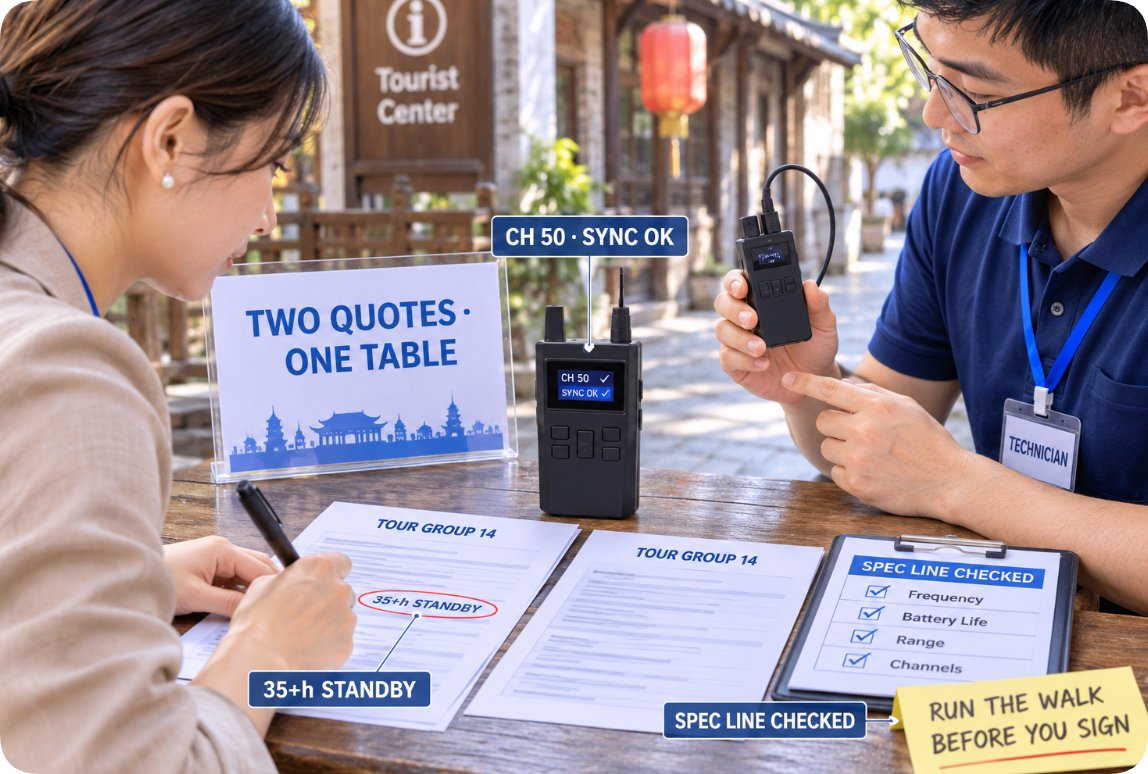
Deploying the RC2500 digital wireless tour guide system for multi-group historic city sightseeing
Receiver Weight and Ergonomics Across Multi-Hour Walking Routes
Physical weight separates these three quotes immediately. The RC2501 Wireless Interpretation Headset System weighs just 47g for both transmitter and receiver, making lanyard wear virtually unnoticeable during two-hour walking itineraries. The RC2468 reduces listener burden even further with an 18g integrated ear-hook receiver paired with a 59g transmitter, eliminating separate headphone cords entirely. By contrast, the RC2500 features a heavier, ruggedized 104g housing on both transmitter and receiver to accommodate larger internal cells and tactile group-control keys. Auditing weight requires zero lab equipment: issue units to test walkers on a 90-minute route and observe which model guests remove at the first rest stop. Quotes that omit separate receiver weights conceal this critical comfort metric.
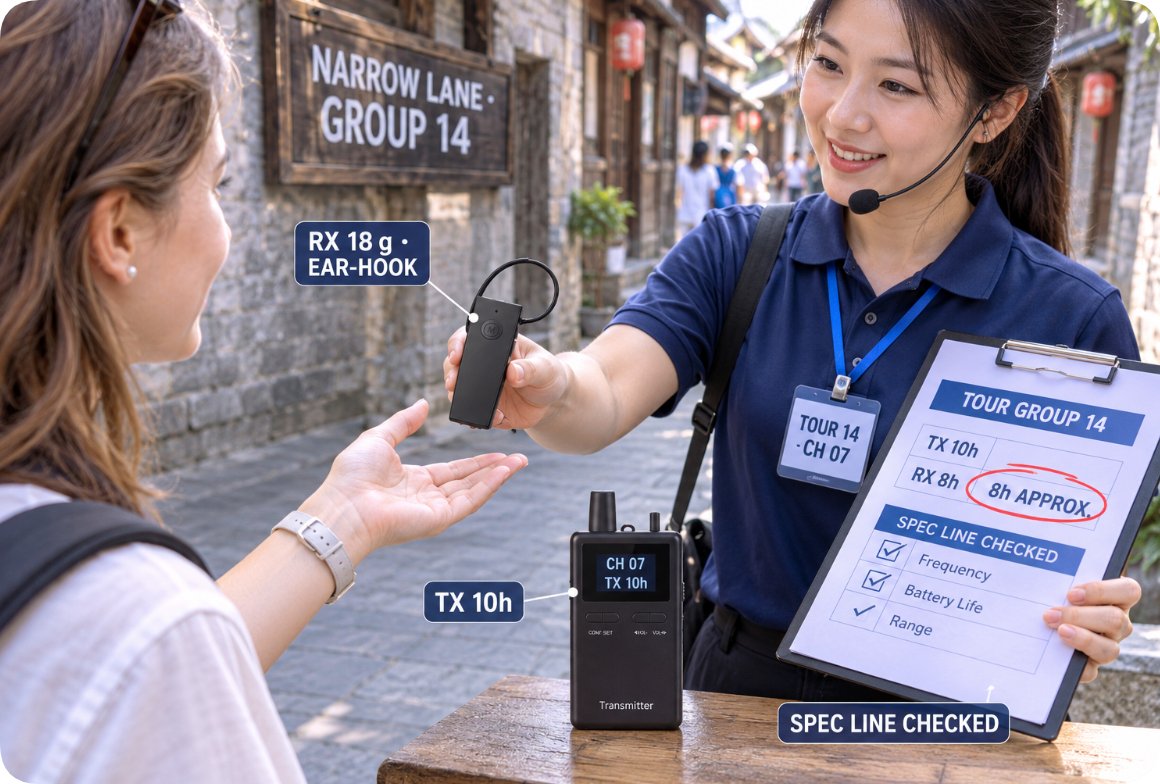
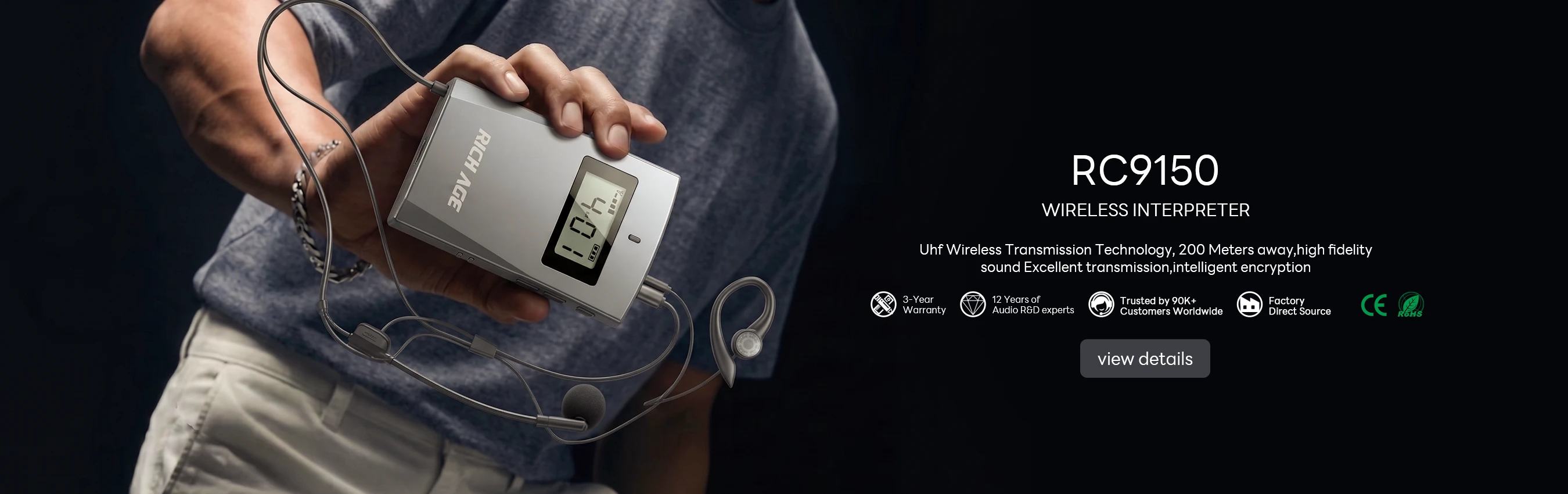
Ultra-lightweight 18g ear-hook receiver design of the RC2468 for cord-free visitor comfort
Battery Endurance: Separating Transmitter Runtime from Receiver Runtime
Battery specifications offer the clearest pre-purchase benchmark because staff can verify them directly on a charging rack. Both the RC2500 and RC2501 deliver 15 hours of continuous transmitter operation and 35+ hours of receiver runtime. Meanwhile, the RC2468 Lightweight Tour Guide Headsets Bulk provides 10 hours on the transmitter and approximately 8 hours on the receiver. That receiver runtime gap stems directly from battery capacity: the ultra-light 18g RC2468 ear-hook houses a compact 3.7V 300mAh cell, whereas the RC2500 series utilizes high-capacity 1000mAh+ cells. While 8 hours easily covers single-shift factory tours or daytime museum loops, sightseeing operators running back-to-back morning and evening twilight walks without midday recharging require the 35+ hour endurance of the RC2500 or RC2501.
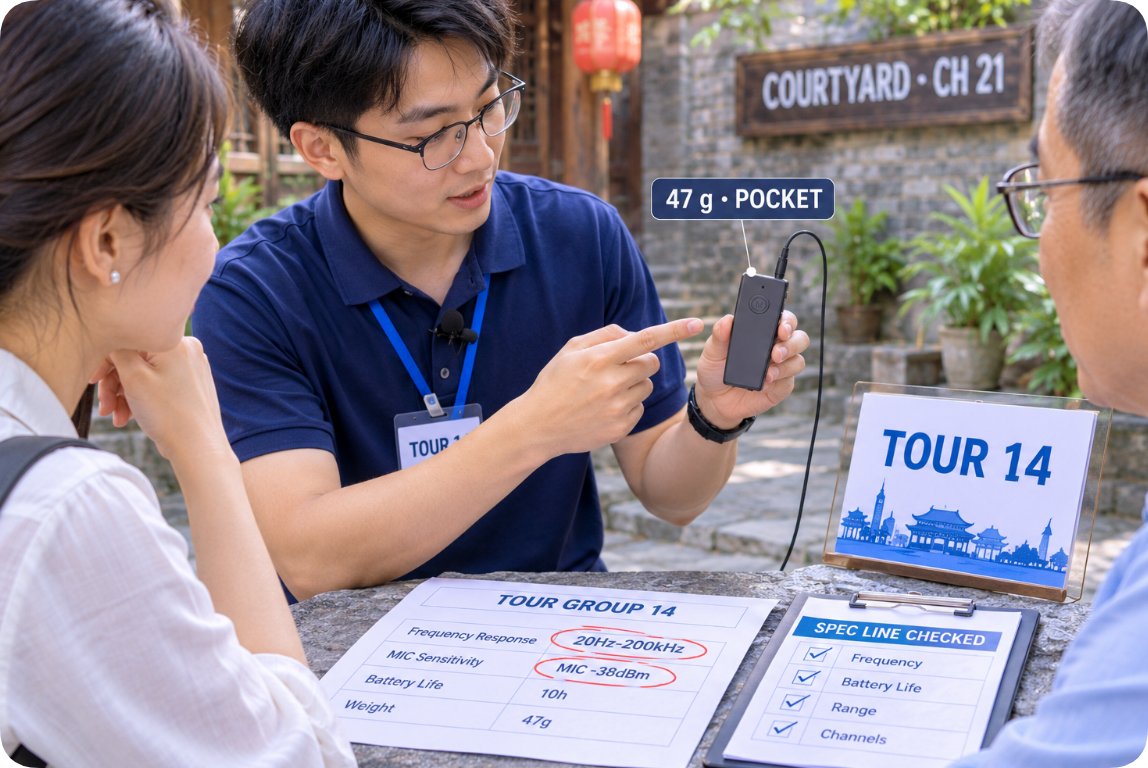
Balanced 47g form factor and 35+ hour receiver endurance of the RC2501 interpretation system
Verifiable Specification Comparison: RC2500 vs. RC2501 vs. RC2468
The table below isolates published specifications shared across all three datasheets that buyers can directly inspect upon delivery, keeping transmitter and receiver metrics separate for accurate gate auditing:
| Verifiable Specification | RC2500 | RC2501 | RC2468 |
|---|---|---|---|
| Core Frequency Band | 2403–2483 MHz | 2403–2483 MHz | 2403–2483 MHz |
| Selectable Channels | 50 Channels | 50 Channels | 50 Channels |
| Line-of-Sight Working Range | 1–200m | 1–200m | 1–200m |
| RF Output Power | 10mW | 13mW | 10mW |
| Transmitter Battery Life | 15 Hours | 15 Hours | 10 Hours |
| Receiver Battery Life | 35+ Hours | 35+ Hours | 8 Hours (approx.) |
| Transmitter / Receiver Weight | 104g / 104g | 47g / 47g | 59g / 18g (Ear-hook) |
| Charging Interface | Type-C | Type-C | USB |
| Compliance Certifications | CE, FCC, RoHS | CE, FCC, RoHS | CE, FCC, RoHS |
| Warranty & Technical Support | 1-Year Limited, Lifetime Support | 1-Year Limited, Lifetime Support | 1-Year Limited, Lifetime Support |
Two infrastructure details in this matrix warrant careful procurement checks. First, charging interfaces differ: the RC2500 and RC2501 utilize standardized Type-C ports, whereas the RC2468 uses standard USB—an important detail when standardizing charging bays and replacement cables. Second, the RC2501 publishes compact physical dimensions of 86mm × 50mm × 19mm, making pocket or lanyard stowage effortless during active tours.
Compliance, Support Commitments, and Acoustic Verification
Low-cost generic quotes can easily copy basic channel and distance numbers, but they rarely back those figures with verifiable regulatory compliance and post-sale accountability. All three Richitek models carry documented CE, FCC, and RoHS certifications alongside a 1-year limited warranty and lifetime technical support. For municipal venues and international tour operators, verified RF compliance eliminates customs delays and local spectrum fines. Reviewing structured deployment frameworks across Wireless Audio Guide Application Solutions ensures these contractual commitments remain front and center during vendor selection.
Frequency response metrics also provide baseline acoustic insight—the RC2501 specifies 20Hz–200kHz response with -38dBm microphone sensitivity, the RC2500 specifies 50Hz–8kHz vocal optimization, and the RC2468 pairs a 50Hz–200kHz transmitter with a 50Hz–12kHz receiver. However, paper frequency graphs cannot simulate acoustic reflections off medieval stone walls; final audio approval must always occur during a live walk on the actual tour route.
Three-Step Gate Acceptance Test Before Signing Off on Delivery
Convert spec-sheet claims into objective acceptance criteria using three straightforward operational checks:
Multi-Channel Congestion Check: Issue twenty receivers to staff at opposite ends of your busiest alleyway and verify simultaneous crosstalk-free channel separation across active transmitters.
Full-Shift Receiver Drain Benchmark: Run a full fleet on a single charge cycle and log the exact runtime hour when the first receiver powers down, benchmarking directly against the published receiver endurance row.
Charging Rack Standardization Audit: Dock all returned transmitters and receivers simultaneously to confirm connector uniformity (Type-C vs. USB) and rapid turnaround times between morning and afternoon tour departures.
For small venues running a single daytime group of eight guests on a 45-minute loop, a basic entry-level kit suffices. Once a destination manages overlapping groups, multi-hour routes, or back-to-back day and night tours, selecting the right model—whether the centralized control of the RC2500, the balanced endurance of the RC2501, or the featherweight ear-hook convenience of the RC2468—protects guest satisfaction. For further comparisons on matching hardware to complex tour itineraries, see our engineering breakdown of RC085 and RC2500 systems.
Frequently Asked Questions (FAQ)
1. Which single line on a tour guide quote matters most for an old town?
Yes, receiver battery runtime is the single most critical specification to verify on a city tour quote because it determines whether one fleet covers full-day operations without midday swaps. Both the RC2500 and RC2501 deliver 35+ hours of receiver runtime, easily spanning consecutive morning and evening sightseeing departures on a single charge, whereas the ultra-light 18g RC2468 ear-hook receiver runs approximately 8 hours per charge.
2. Do 50 channels mean fifty visitors can hear one guide?
Yes, a 50-channel specification allows up to 50 independent tour groups to operate simultaneously in the same district without audio crosstalk, while each channel supports unlimited receivers. Channel count governs how many separate guides can speak concurrently at crowded landmarks, whereas visitor group size per transmitter is unrestricted within the 1–200m line-of-sight operating range.
3. Why is the RC2468 receiver battery figure printed with "approx."?
Yes, the RC2468 receiver runtime is listed at approximately 8 hours because its featherweight 18g ear-hook housing uses a compact 3.7V 300mAh battery. Prioritizing an 18g cord-free ear-hook form factor trades multi-day battery capacity for maximum visitor wearing comfort, making it ideal for single-shift daytime tours and museum visits.
4. Can a lower-priced quote be the right choice for a small town?
Yes, the RC2501 is the optimal choice when operators need both lightweight 47g visitor comfort and 35+ hour multi-day receiver endurance. Delivering 13mW RF output power, Type-C charging, CE/FCC/RoHS compliance, and 35+ hour receiver life in a 47g body bridges the gap between heavy-duty group controllers and ultra-light single-shift ear-hooks.
The video below demonstrates wireless tour guide system setup, audio range testing, and gate acceptance workflows.