
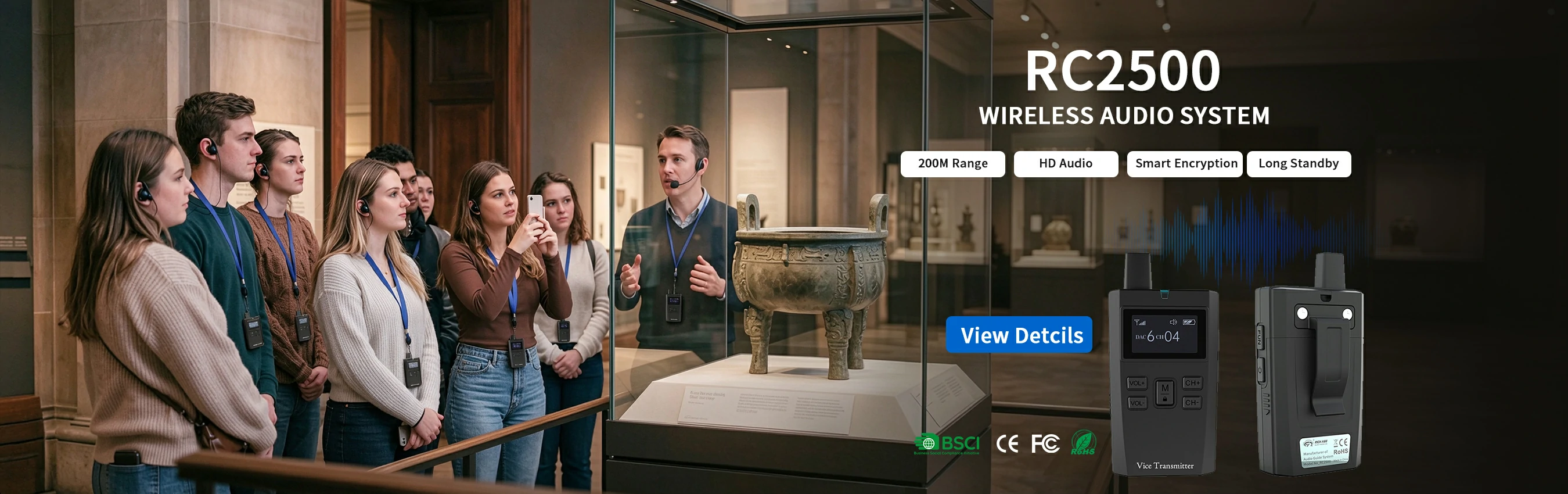

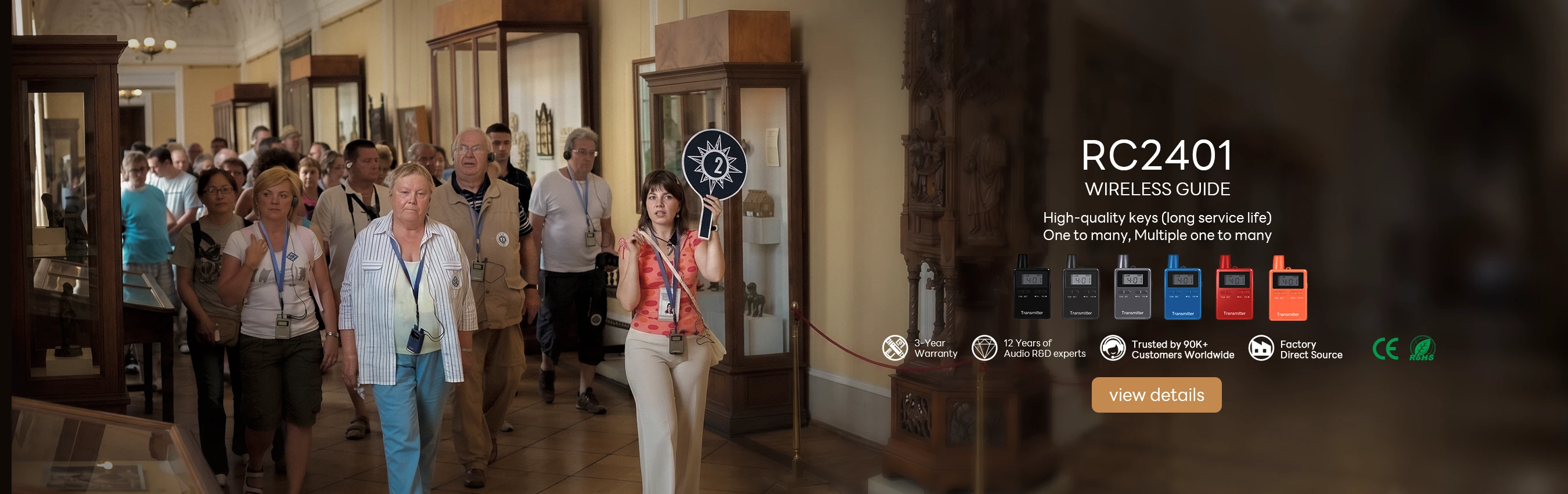
A quiet art gallery or museum hall presents a distinct acoustic challenge. Visitors converse in low voices, yet a docent interpreting a painting or sculpture must reach fifteen to twenty listeners standing across an open room without raising their voice. Multiplying that scenario across ten simultaneous groups moving through shared galleries shifts the problem from speaker volume to RF traffic management—determining which group occupies which channel lane, how lanes are verified before opening, and how adjacent tours stay isolated when two groups pause near the same doorway.
While specification sheets highlight channel counts, battery endurance, and receiver weight, a Museum Self Guided Audio Tour Solutions deployment succeeds or fails on peak-hour discipline—when a school trip, a donor preview, and general walk-in tours share the same floor. Pairing a documented channel map and daily RF sweep check with the right hardware—RC9150, RC2406, or RC2468—keeps every group intelligible throughout peak visiting hours.
Mapping the Exhibition Floor Before Selecting Channel Counts
Effective channel planning begins with a floor plan rather than a hardware quote. Walk every gallery room and corridor, mark the focal artworks where docents routinely pause, identify rooms separated by thin partition walls or open archways, and note bottlenecks where tour routes cross. Each active tour party requires its own dedicated channel lane so adjacent rooms never operate on overlapping or poorly separated frequencies. Starting a wireless tour guide system manufacturer direct specification with a gallery route diagram prevents channel congestion before units ship.
Always size lane capacity around peak Saturday attendance rather than weekday averages. Holding at least one or two unassigned buffer channels above your highest simultaneous tour count allows front-desk coordinators to launch a late-arriving private group or bilingual sub-group immediately without disrupting tours already on the floor.
Running a Pre-Opening RF Sweep Check and Noise Log
A channel allocation chart only protects visitor audio when verified inside the live building environment. Fifteen minutes before gallery doors open, a floor technician or visitor-services lead should walk the primary tour loop carrying one active transmitter and receiver pair across the scheduled channels, confirming crisp voice clarity and checking for background hiss or dropouts. Because modern museums operate amid building Wi-Fi access points, security radios, and temporary exhibition AV gear, Wireless Audio Guide Application Solutions benefit from a repeatable daily walk-through before visitors arrive.
Logging date, channel number, gallery zone, and audio quality at the charging desk turns isolated observations into actionable maintenance records. If a specific corridor shows 2.4 GHz congestion during a temporary installation or a single transmitter develops audio noise, staff immediately retire that channel or unit rather than troubleshooting mid-tour in front of guests.
Color-Coded Fleet Identification for Self-Policing Returns
Even a well-engineered RF plan slows down at the coat check or ticketing desk if guests cannot tell which receiver belongs to their group. Applying color-coded bands or labels to each transmitter and its matching receiver set—paired with matching colored collection bins—lets visitors and part-time attendants verify group assignments at a glance without reading tiny LCD channel digits.
Posting the color-to-channel reference card directly above the charging rack ensures new staff members place every returned unit into the right charging slot on their first shift. When multilingual tours run simultaneously, assigning both a dedicated channel lane and a distinct color tag prevents guests from picking up the wrong language receiver before entering the exhibition wing.
RC9150: 100-Channel Headroom and Multi-Shift Endurance
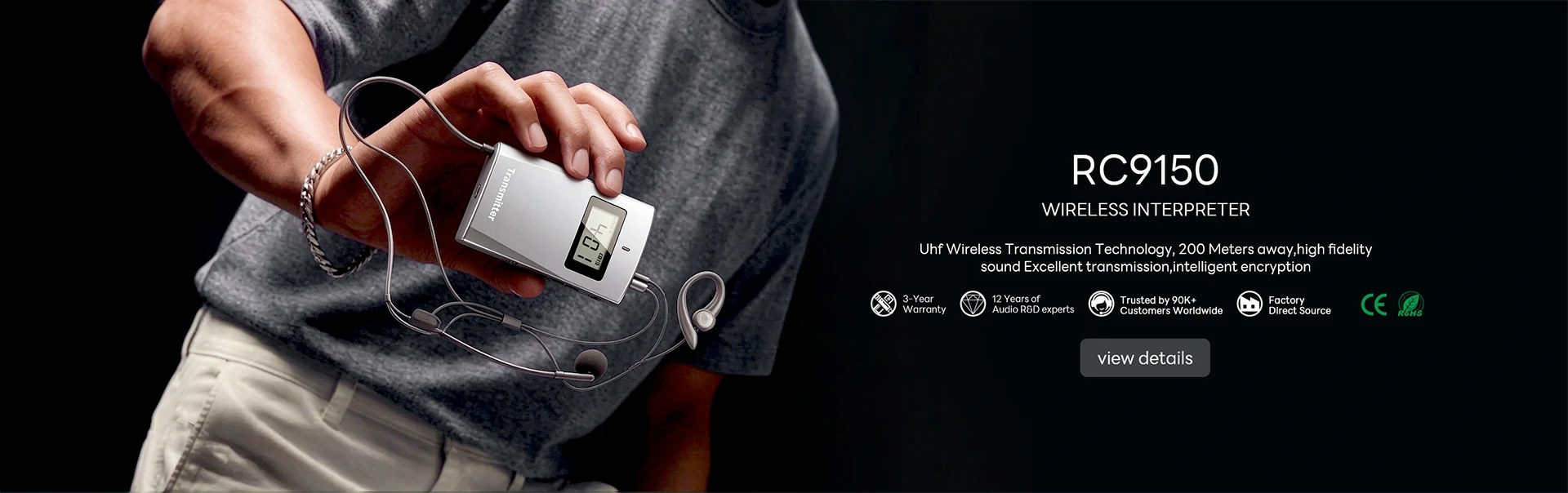
The RC9150 2.4G High Fidelity Audio Guide provides 100 selectable channels across the 2403–2483 MHz band with a 1–200 m working range and 10 mW output power, giving large museums and special-exhibition floors generous channel separation even when ten or more groups overlap. Its receiver delivers 35+ hours of battery life alongside a 15-hour transmitter, allowing receivers issued for morning school tours to be sanitized and reissued for afternoon walk-in groups without mid-day recharging.
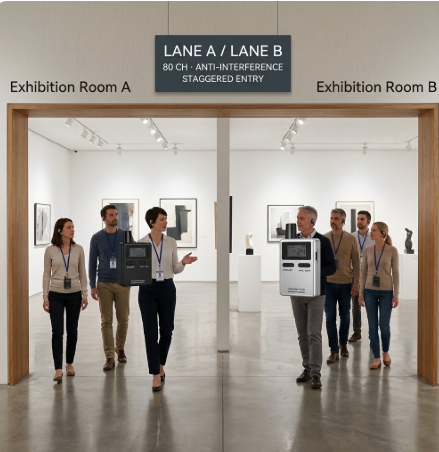
Both the transmitter and receiver weigh 97.5 g and charge via Type-C, with a published 20 Hz–8 kHz audio response voiced cleanly for spoken gallery interpretation. While heavier than an ultra-light ear-hook model, that 97.5 g lanyard form factor sits comfortably during stationary gallery talks and pays back in multi-day battery runtime and 100-channel flexibility.
RC2406: 80-Channel Interference Resistance Across Adjacent Rooms
The RC2406 80 Channel Tour Guide Transmitter Receiver provides 80 channels in the 2403–2483 MHz band (1–200 m range, 10 mW output) engineered specifically for strong anti-interference performance when multiple rooms operate side by side inside one museum building. Its 50 g receiver runs for 20 hours per charge paired with a 59 g, 10-hour transmitter—comfortably covering a full museum visiting day on a single overnight charge.

Because the RC2406 charges via a DC port rather than the Type-C port on the RC9150, facilities running mixed fleets should keep dedicated DC charging stations or labeled cables separated from Type-C leads. Note that RC2406 publishes separate transmit (50 Hz–200 kHz) and receive (50 Hz–12 kHz) response figures whereas RC9150 publishes a single 20 Hz–8 kHz figure, so audio bandwidth rows are omitted from the direct comparison table below to avoid comparing unlike test bases.
RC2468: 18 g Ear-Hook Comfort for Extended Standing Tours
The RC2468 Lightweight Tour Guide Headsets Bulk prioritizes wearer ergonomics with an 18 g cable-free ear-hook receiver paired with a 59 g transmitter across 50 channels on the 2403–2483 MHz band (1–200 m range, 10 mW output). During two- to three-hour curatorial walkthroughs or senior visitor tours, eliminating lanyard cords and reducing ear weight to 18 g keeps guests and docents comfortable without ear fatigue.
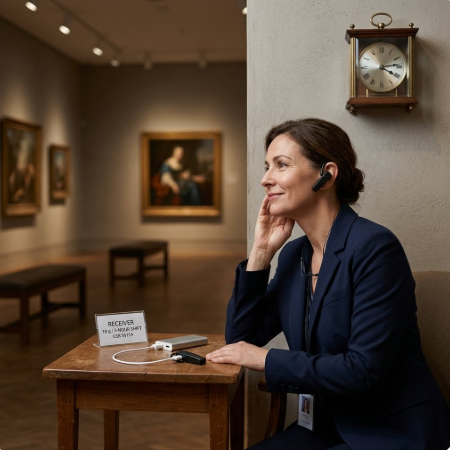
With 50 selectable channels, a 10-hour transmitter rating, an approximate 8-hour receiver runtime, and 5 V / 1 A USB charging, the RC2468 fits scheduled curatorial tours and moderate group concurrency best, while higher-density floors rely on the 80-channel RC2406 or 100-channel RC9150.
Side-by-Side Specification Comparison for Gallery Deployments
All three models operate within the 2403–2483 MHz band at 10 mW output and 1–200 m working range, making structured channel assignment and battery turnaround planning the primary differentiators across your gallery fleet:
| Specification | RC9150 | RC2406 | RC2468 |
|---|---|---|---|
| Selectable Channels | 100 channels | 80 channels | 50 channels |
| Frequency Band | 2403–2483 MHz | 2403–2483 MHz | 2403–2483 MHz |
| Working Range & Power | 1–200 m, 10 mW | 1–200 m, 10 mW | 1–200 m, 10 mW |
| Transmitter Runtime | 15 hours | 10 hours | 10 hours |
| Receiver Runtime | 35+ hours | 20 hours | 8 hours (approx.) |
| Transmitter Weight | 97.5 g | 59 g | 59 g |
| Receiver Weight & Style | 97.5 g (lanyard/bodypack) | 50 g (lanyard/bodypack) | 18 g ear-hook |
| Charging Port | Type-C | DC port | USB (5 V / 1 A) |
For foundational RF architecture details across these three platforms, read RC9150, RC2468 and RC2406: What a Tour Guide System Actually Is.
Best for maximum 100-channel headroom and multi-day receiver runtime: RC9150.
Best for multi-room gallery wings needing 80-channel anti-interference stability: RC2406.
Best for lightweight 18 g ear-hook comfort on extended standing tours: RC2468.
Frequently Asked Questions
1. Does the RC9150 provide enough channels for ten simultaneous gallery groups?
Yes; the RC9150 offers 100 selectable channels in the 2403–2483 MHz band, giving ten concurrent docent groups dedicated non-overlapping lanes plus ample reserve channels for overflow tours.
2. Is the RC2468 comfortable for visitors and docents during a three-hour gallery tour?
Yes; the RC2468 receiver weighs just 18 g in a cable-free ear-hook design, eliminating lanyard bulk and ear fatigue across extended standing tours.
3. How does the RC2406 perform when multiple exhibition rooms operate side by side?
The RC2406 provides 80 selectable channels with strong anti-interference circuitry, keeping parallel tours in adjacent rooms isolated on distinct channel assignments.
4. Will a single battery charge cover a full day of museum tours?
Yes; RC9150 receivers run for 35+ hours and RC2406 receivers run for 20 hours on one charge, while RC2468 receivers deliver approximately 8 hours to cover a full standard museum shift.