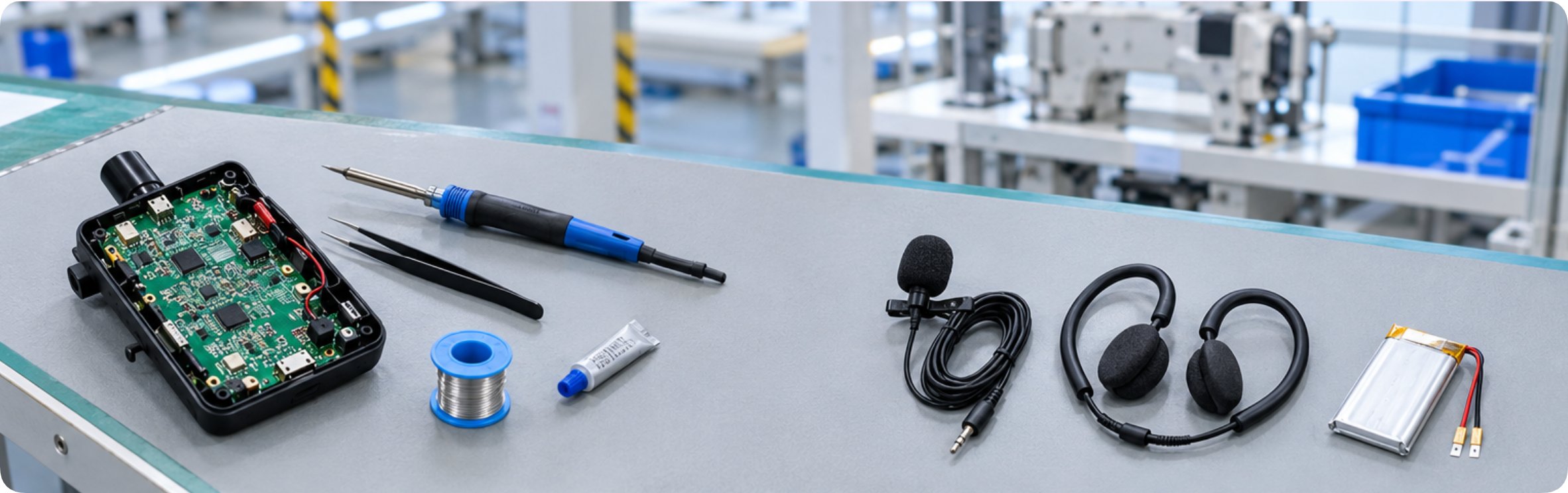
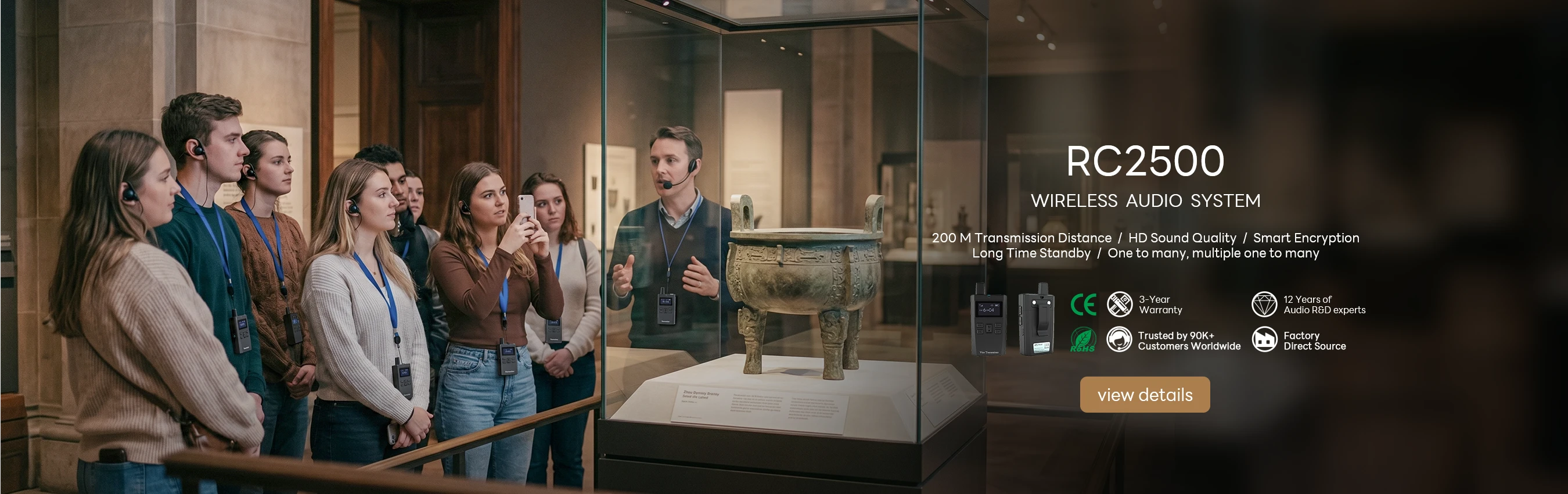

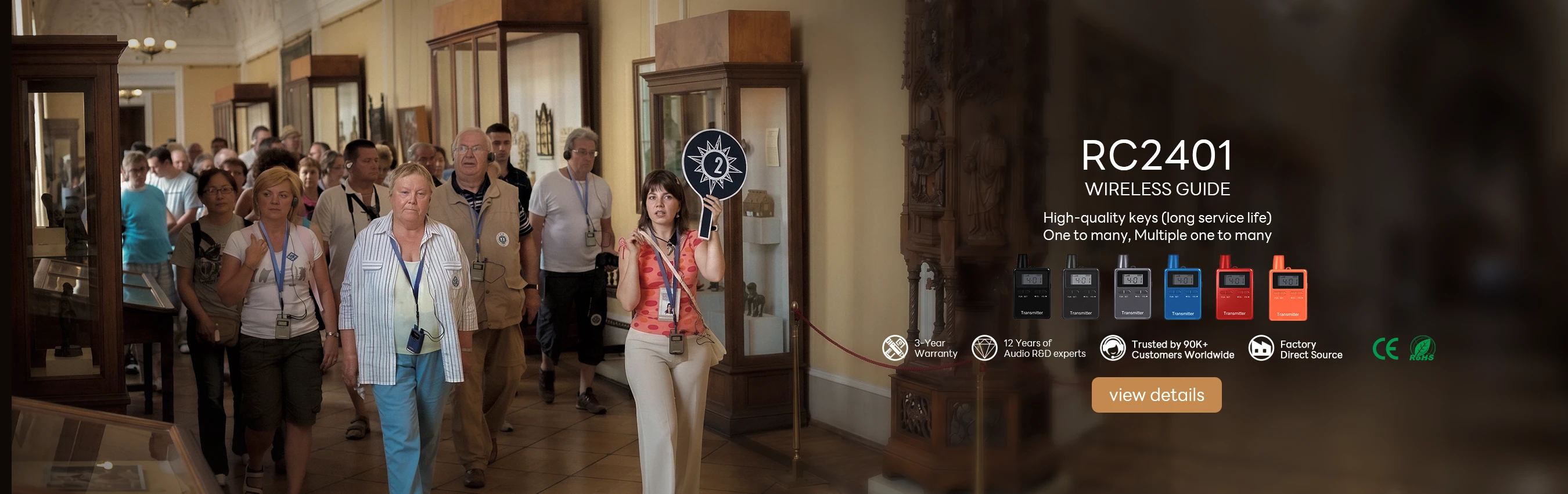
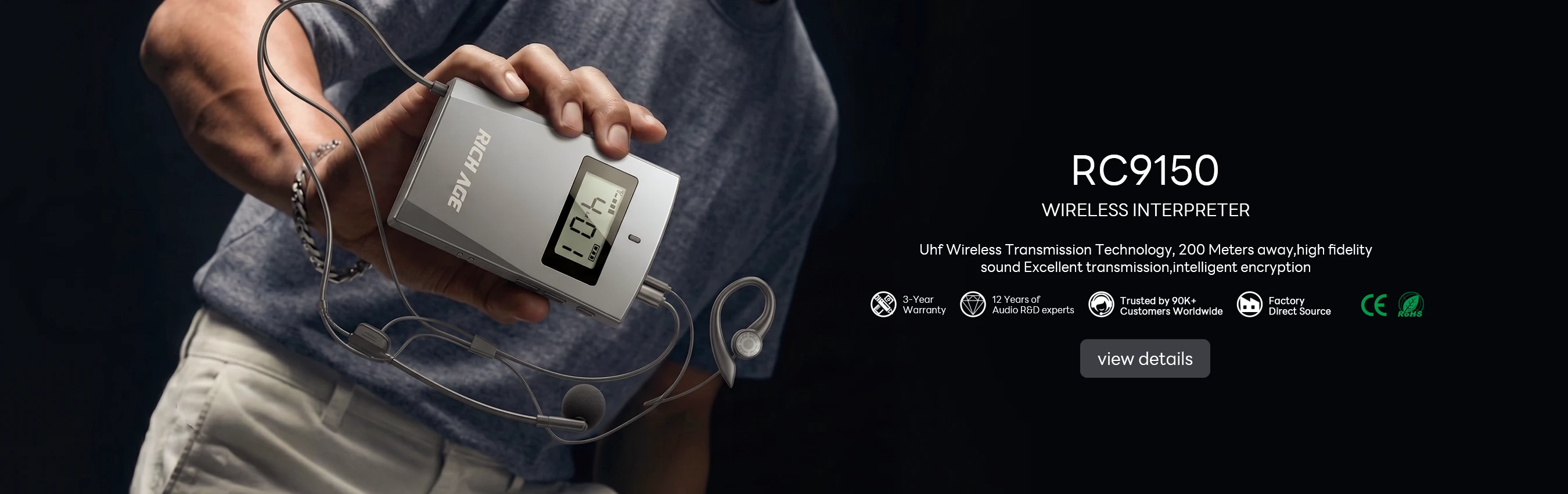
We are a large factory from China.Specializing in the production of wireless tour guide systems translation headphones for church、Museum audio guide equipment, Simulation Interpretation etc

Tel:+86 18922879583

Email:tiger.wang@richitek.com

Revolutionizing Inclusive Tourism: How a Wireless Tour Guide System Empowers Visually Impaired Hikers

My View: My neighbor is blind. He loves hiking but always relies on a sighted guide holding his arm. He told me, “I wish I could walk alone and still know where I‘m going.” A park ranger in Washington heard that wish and created a narrated trail using a Wireless Tour Guide System. She installed GPS triggers along the path, and each hiker carries a RC2501 receiver. As my neighbor walks, he hears: “Large boulder on your left. Switchback ahead. Listen for the creek.” He finished the trail smiling, alone but not lost. That‘s when I realized: accessible audio doesn‘t just guide — it gives independence.

Revolutionizing Inclusive Tourism: How a Wireless Tour Guide System Empowers Visually Impaired Hikers(图1)

Accessible Travel for Blind & Low‑Vision Hikers (RC2501 & RC2402)

Accessible travel for people with visual impairments is a rapidly growing segment of the global travel industry. Globally, over 285 million people live with vision loss, and historical statistics show that a vast majority avoid outdoor activities entirely due to navigating unfamiliar terrain and severe safety concerns. While the global accessible tourism market is projected to reach an unprecedented $1.9 trillion by 2034, public nature trails, national parks, and botanical gardens remain largely inaccessible to solo travelers. Traditional braille signage and tactile paving simply cannot scale across miles of rugged wilderness.

Implementing a state-of-the-art GPS‑triggered wireless audio system completely changes this dynamic. By merging location-based satellite triggers with long-range radio frequencies, park managers can now provide real-time, turn‑by‑turn navigation, localized hazard warnings, and immersive descriptive interpretive content—all seamlessly delivered through a small, lightweight receiver. Visually impaired hikers can finally shed the anxiety of getting lost, walking without a sighted guide, maintaining their own pace, and exploring nature with total confidence.

Engineering Independence: The RC2501 Pocket-Sized Audio Receiver

The RC2501 pocket‑sized system is engineered specifically for the demanding environments of accessible outdoor trails. When managing public infrastructure, simplicity is paramount. The device features an intuitive one‑click pairing mechanism and zero‑threshold operation, ensuring that visitors of all ages and technical skill levels can use the equipment at the trailhead without requiring dedicated technical assistance from park staff.

While the integrated smart noise‑canceling microphone technology is not utilized for active trail navigation (as the directional audio descriptions are pre-recorded and broadcast via local transmitters), the physical architecture of the receiver is highly optimized for outdoor ergonomics. A tactile, mechanical volume wheel allows the user to make instant micro-adjustments to counteract ambient wind noise, rushing rivers, or distance from the path triggers. Powered by an ultra-efficient lithium battery, its 20‑hour continuous battery life easily covers extended day hikes, while the robust 200‑meter operational range ensures that GPS triggers can be spaced widely across sprawling geographic zones. The compact form factor fits effortlessly into a standard pocket or clips securely to a backpack shoulder strap for hands-free mobility.

Dual-Sensory Adaptability: The RC2402 Dual-Channel Receiver

True universal design recognizes that many travelers experience overlapping sensory needs. For instance, hikers with age-related macular degeneration or partial blindness often experience age-related hearing loss simultaneously. The RC2402 receiver offers specialized hardware features tailored for hearing‑impaired hikers who require high-fidelity acoustic reinforcement alongside visual trail cues. Equipped with advanced digital noise cancellation algorithms, it intelligently filters out high-frequency wind shear and distant highway traffic, rendering the pre-recorded voice narration crisply and legibly.

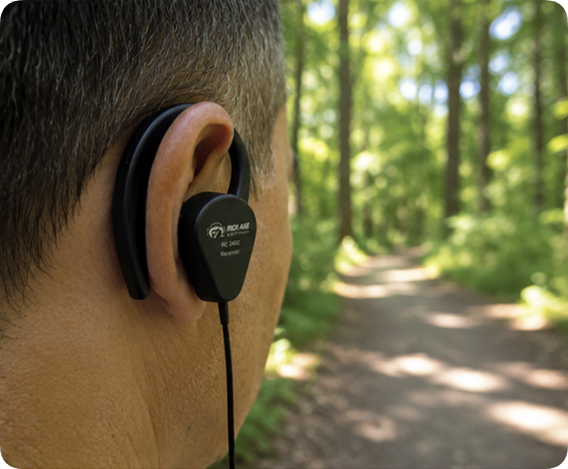
Furthermore, the RC2402 boasts an exceptional 40‑hour battery lifespan. While this extended capacity may seem excessive for a standard afternoon stroll, it becomes an invaluable safety asset for multi‑day backpacking excursions, backcountry camping trips, or remote eco-resorts lacking consistent electrical charging grids. The ergonomic, lightweight ear‑hook design guarantees the device stays firmly secured under heavy rain hoods, winter hats, or hiking helmets. Individualized volume controls give users complete autonomy to balance the audio stream with environmental sounds, ensuring they maintain situational awareness of their surroundings.
Revolutionizing Inclusive Tourism: How a Wireless Tour Guide System Empowers Visually Impaired Hikers(图3)

Case Study: Transforming Eco-Tourism in the Pacific Northwest

This innovative technology is already yielding remarkable real-world outcomes. A prominent 5‑mile loop trail within an Oregon state park recently underwent a comprehensive accessibility overhaul. Park rangers strategically deployed ten localized, weather-resistant GPS‑triggered audio beacons along the path. As hikers pass each coordinates-based waypoint, a dedicated high-definition audio segment automatically plays through their personal receivers. Rather than offering dry directional commands, the narration provides rich, layered context: the deep history of the region's logging era, interactive identification of native bird calls, and critical safety warnings regarding proximity to poison oak or loose shale.

The emotional impact of this infrastructure deployment is profound. One local resident noted: “I‘ve lived in this town for thirty years, watching my family head out into the forest while I stayed behind in the parking lot. This is the absolute first time in my life I‘ve hiked a mountain trail completely alone. Thank you.” To maximize accessibility, the park administration also published downloadable, descriptive audio maps online. This allows prospective visitors to pre-scout the terrain from the comfort of their home, utilizing the RC2501 receiver‘s universal compatibility with standard digital audio file formats to memorize the topography before stepping foot on the dirt.

Versatile Architectural Deployment Beyond the Wilderness

The practical applications of an automated Wireless Tour Guide System extend far beyond forestry and municipal parks. Municipalities, educational institutions, and cultural organizations are rapidly deploying this hardware combination to meet strict modern accessibility mandates and elevate their visitor experiences:

  • Museum Audio Guides for Blind Visitors: Seamlessly describing intricate visual art collections, sculptural dimensions, and gallery layouts hands-free as patrons move from hall to hall.

  • Historic Downtown & Urban Audio Tours: Providing autonomous wayfinding through complex pedestrian intersections, historical architecture summaries, and curb-ramp warnings.

  • University Campus Wayfinding: Allowing visually impaired students, faculty, and visiting parents to navigate sprawling academic quadrangles, library networks, and student centers independently.

  • Botanical Garden Sensory Walks: Syncing descriptive audio with specialized tactile and olfactory plant exhibits, guiding users safely along winding brick walkways.

  • Revolutionizing Inclusive Tourism: How a Wireless Tour Guide System Empowers Visually Impaired Hikers(图4)

Technical Comparison: RC2501 vs. RC2402 for Park Managers

Feature SpecificationsRC2501 Pocket SystemRC2402 Noise-Cancelling System
Form Factor StyleUltra-compact pocket/strap clipErgonomic, secure over-ear hook
Battery Run TimeUp to 20 hours continuous useUp to 40 hours continuous use
Signal Range Limit200 meters omnidirectional180 meters with DSP optimization
Primary DeploymentDay trails, museums, gardensMulti-day trips, windy areas, high traffic

Why these specific hardware systems perform in rugged, accessible terrain: Their lightweight construction prevents physical fatigue during all-day excursions. The ultra-simplified, tactile interface layout guarantees that users do not have to struggle with complex touchscreen menus or mobile apps while wearing gloves or holding a white cane. Long-lasting power reserves mean park operations can run a full weekend shift without rotating units. Most importantly, seamless compatibility with geo-fenced RF and GPS triggers ensures true hands-free navigation.

Actionable advice for forward-thinking park and trail managers: Modern accessibility compliance is no longer restricted to building concrete wheelchair ramps and wider asphalt parking spaces. True inclusion is rooted in equal access to informational equity. Investing in a localized wireless audio trail network breaks down steep invisible barriers, opening up the profound physical and mental health benefits of the great outdoors to millions of underserved travelers who have been excluded from our public lands for far too long.

Commercial Equipment Procurement Details: RC2501 Ultra-Light Pocket System, RC2402 High-Fidelity Noise-Cancelling Receiver.
Discover professional eco-tourism solutions on our specialized product channels:             Wireless Tour Guide System |            RC2501 details |            RC2402 details

2026年05月26日 08:38
click: 532

Revolutionizing Inclusive Tourism: How a Wireless Tour Guide System Empowers Visually Impaired Hikers

time: 2026年05月26日 click:532

My View: My neighbor is blind. He loves hiking but always relies on a sighted guide holding his arm. He told me, “I wish I could walk alone and still know where I‘m going.” A park ranger in Washington heard that wish and created a narrated trail using a Wireless Tour Guide System. She installed GPS triggers along the path, and each hiker carries a RC2501 receiver. As my neighbor walks, he hears: “Large boulder on your left. Switchback ahead. Listen for the creek.” He finished the trail smiling, alone but not lost. That‘s when I realized: accessible audio doesn‘t just guide — it gives independence.

Revolutionizing Inclusive Tourism: How a Wireless Tour Guide System Empowers Visually Impaired Hikers(图1)

Accessible Travel for Blind & Low‑Vision Hikers (RC2501 & RC2402)

Accessible travel for people with visual impairments is a rapidly growing segment of the global travel industry. Globally, over 285 million people live with vision loss, and historical statistics show that a vast majority avoid outdoor activities entirely due to navigating unfamiliar terrain and severe safety concerns. While the global accessible tourism market is projected to reach an unprecedented $1.9 trillion by 2034, public nature trails, national parks, and botanical gardens remain largely inaccessible to solo travelers. Traditional braille signage and tactile paving simply cannot scale across miles of rugged wilderness.

Implementing a state-of-the-art GPS‑triggered wireless audio system completely changes this dynamic. By merging location-based satellite triggers with long-range radio frequencies, park managers can now provide real-time, turn‑by‑turn navigation, localized hazard warnings, and immersive descriptive interpretive content—all seamlessly delivered through a small, lightweight receiver. Visually impaired hikers can finally shed the anxiety of getting lost, walking without a sighted guide, maintaining their own pace, and exploring nature with total confidence.

Engineering Independence: The RC2501 Pocket-Sized Audio Receiver

The RC2501 pocket‑sized system is engineered specifically for the demanding environments of accessible outdoor trails. When managing public infrastructure, simplicity is paramount. The device features an intuitive one‑click pairing mechanism and zero‑threshold operation, ensuring that visitors of all ages and technical skill levels can use the equipment at the trailhead without requiring dedicated technical assistance from park staff.

While the integrated smart noise‑canceling microphone technology is not utilized for active trail navigation (as the directional audio descriptions are pre-recorded and broadcast via local transmitters), the physical architecture of the receiver is highly optimized for outdoor ergonomics. A tactile, mechanical volume wheel allows the user to make instant micro-adjustments to counteract ambient wind noise, rushing rivers, or distance from the path triggers. Powered by an ultra-efficient lithium battery, its 20‑hour continuous battery life easily covers extended day hikes, while the robust 200‑meter operational range ensures that GPS triggers can be spaced widely across sprawling geographic zones. The compact form factor fits effortlessly into a standard pocket or clips securely to a backpack shoulder strap for hands-free mobility.

Dual-Sensory Adaptability: The RC2402 Dual-Channel Receiver

True universal design recognizes that many travelers experience overlapping sensory needs. For instance, hikers with age-related macular degeneration or partial blindness often experience age-related hearing loss simultaneously. The RC2402 receiver offers specialized hardware features tailored for hearing‑impaired hikers who require high-fidelity acoustic reinforcement alongside visual trail cues. Equipped with advanced digital noise cancellation algorithms, it intelligently filters out high-frequency wind shear and distant highway traffic, rendering the pre-recorded voice narration crisply and legibly.

Furthermore, the RC2402 boasts an exceptional 40‑hour battery lifespan. While this extended capacity may seem excessive for a standard afternoon stroll, it becomes an invaluable safety asset for multi‑day backpacking excursions, backcountry camping trips, or remote eco-resorts lacking consistent electrical charging grids. The ergonomic, lightweight ear‑hook design guarantees the device stays firmly secured under heavy rain hoods, winter hats, or hiking helmets. Individualized volume controls give users complete autonomy to balance the audio stream with environmental sounds, ensuring they maintain situational awareness of their surroundings.

Revolutionizing Inclusive Tourism: How a Wireless Tour Guide System Empowers Visually Impaired Hikers(图3)

Case Study: Transforming Eco-Tourism in the Pacific Northwest

This innovative technology is already yielding remarkable real-world outcomes. A prominent 5‑mile loop trail within an Oregon state park recently underwent a comprehensive accessibility overhaul. Park rangers strategically deployed ten localized, weather-resistant GPS‑triggered audio beacons along the path. As hikers pass each coordinates-based waypoint, a dedicated high-definition audio segment automatically plays through their personal receivers. Rather than offering dry directional commands, the narration provides rich, layered context: the deep history of the region's logging era, interactive identification of native bird calls, and critical safety warnings regarding proximity to poison oak or loose shale.

The emotional impact of this infrastructure deployment is profound. One local resident noted: “I‘ve lived in this town for thirty years, watching my family head out into the forest while I stayed behind in the parking lot. This is the absolute first time in my life I‘ve hiked a mountain trail completely alone. Thank you.” To maximize accessibility, the park administration also published downloadable, descriptive audio maps online. This allows prospective visitors to pre-scout the terrain from the comfort of their home, utilizing the RC2501 receiver‘s universal compatibility with standard digital audio file formats to memorize the topography before stepping foot on the dirt.

Versatile Architectural Deployment Beyond the Wilderness

The practical applications of an automated Wireless Tour Guide System extend far beyond forestry and municipal parks. Municipalities, educational institutions, and cultural organizations are rapidly deploying this hardware combination to meet strict modern accessibility mandates and elevate their visitor experiences:

  • Museum Audio Guides for Blind Visitors: Seamlessly describing intricate visual art collections, sculptural dimensions, and gallery layouts hands-free as patrons move from hall to hall.

  • Historic Downtown & Urban Audio Tours: Providing autonomous wayfinding through complex pedestrian intersections, historical architecture summaries, and curb-ramp warnings.

  • University Campus Wayfinding: Allowing visually impaired students, faculty, and visiting parents to navigate sprawling academic quadrangles, library networks, and student centers independently.

  • Botanical Garden Sensory Walks: Syncing descriptive audio with specialized tactile and olfactory plant exhibits, guiding users safely along winding brick walkways.

  • Revolutionizing Inclusive Tourism: How a Wireless Tour Guide System Empowers Visually Impaired Hikers(图4)

Technical Comparison: RC2501 vs. RC2402 for Park Managers

Feature SpecificationsRC2501 Pocket SystemRC2402 Noise-Cancelling System
Form Factor StyleUltra-compact pocket/strap clipErgonomic, secure over-ear hook
Battery Run TimeUp to 20 hours continuous useUp to 40 hours continuous use
Signal Range Limit200 meters omnidirectional180 meters with DSP optimization
Primary DeploymentDay trails, museums, gardensMulti-day trips, windy areas, high traffic

Why these specific hardware systems perform in rugged, accessible terrain: Their lightweight construction prevents physical fatigue during all-day excursions. The ultra-simplified, tactile interface layout guarantees that users do not have to struggle with complex touchscreen menus or mobile apps while wearing gloves or holding a white cane. Long-lasting power reserves mean park operations can run a full weekend shift without rotating units. Most importantly, seamless compatibility with geo-fenced RF and GPS triggers ensures true hands-free navigation.

Actionable advice for forward-thinking park and trail managers: Modern accessibility compliance is no longer restricted to building concrete wheelchair ramps and wider asphalt parking spaces. True inclusion is rooted in equal access to informational equity. Investing in a localized wireless audio trail network breaks down steep invisible barriers, opening up the profound physical and mental health benefits of the great outdoors to millions of underserved travelers who have been excluded from our public lands for far too long.

Commercial Equipment Procurement Details: RC2501 Ultra-Light Pocket System, RC2402 High-Fidelity Noise-Cancelling Receiver.
Discover professional eco-tourism solutions on our specialized product channels:             Wireless Tour Guide System |            RC2501 details |            RC2402 details

×

Contact us

email:
name:
subject:
content: