
.webp)
Factory tours put wireless audio through a daily gauntlet. Visitors fan out across echoing halls, groups split at intersections, and a steady layer of machine noise covers every spoken word. In that environment, a single dropped phrase can pull a visitor's attention away for the rest of the walk. The encouraging part is that most of these failures are neither random nor mysterious. They follow recognizable patterns, and equipment built around those patterns removes them before they ever surface. For teams searching for a wireless guide system for Factory Tour, understanding why plant-floor audio breaks down is the first step toward making sure it never does.
🏭 Factory Tour Audio Dropouts: How RC2406 Fixes the Root Causes
An audio dropout on a factory tour rarely has a single cause, and that is exactly why generic troubleshooting fails. Interference is the most visible culprit. The 2.4 GHz band is crowded by design; welding bays, compressors, metal mezzanines, and the building's own Wi-Fi networks all compete for the same radio space, and any one of them can interrupt a fragile link mid-sentence. Crosstalk is the second problem. When several groups run tours at the same time, each transmitter reaches for the same channels, and visitors end up overhearing the guide next door. Battery drain adds a third failure mode, and it tends to strike at the worst possible moment, usually halfway through a long afternoon shift with no spare unit in reach.
Beyond those headline causes, guides report receivers that go completely silent even when the transmitter looks healthy, a symptom of a channel mismatch rather than a hardware fault. Others describe walkie-talkie style distance attenuation, where the signal weakens steadily as a guide drifts more than a few dozen meters ahead of the group. Each of these issues has a known fix, and RC2406 was designed around exactly these conditions rather than around a spec sheet.
RC2406 in the Field: Beating Interference and 80-Channel Crosstalk
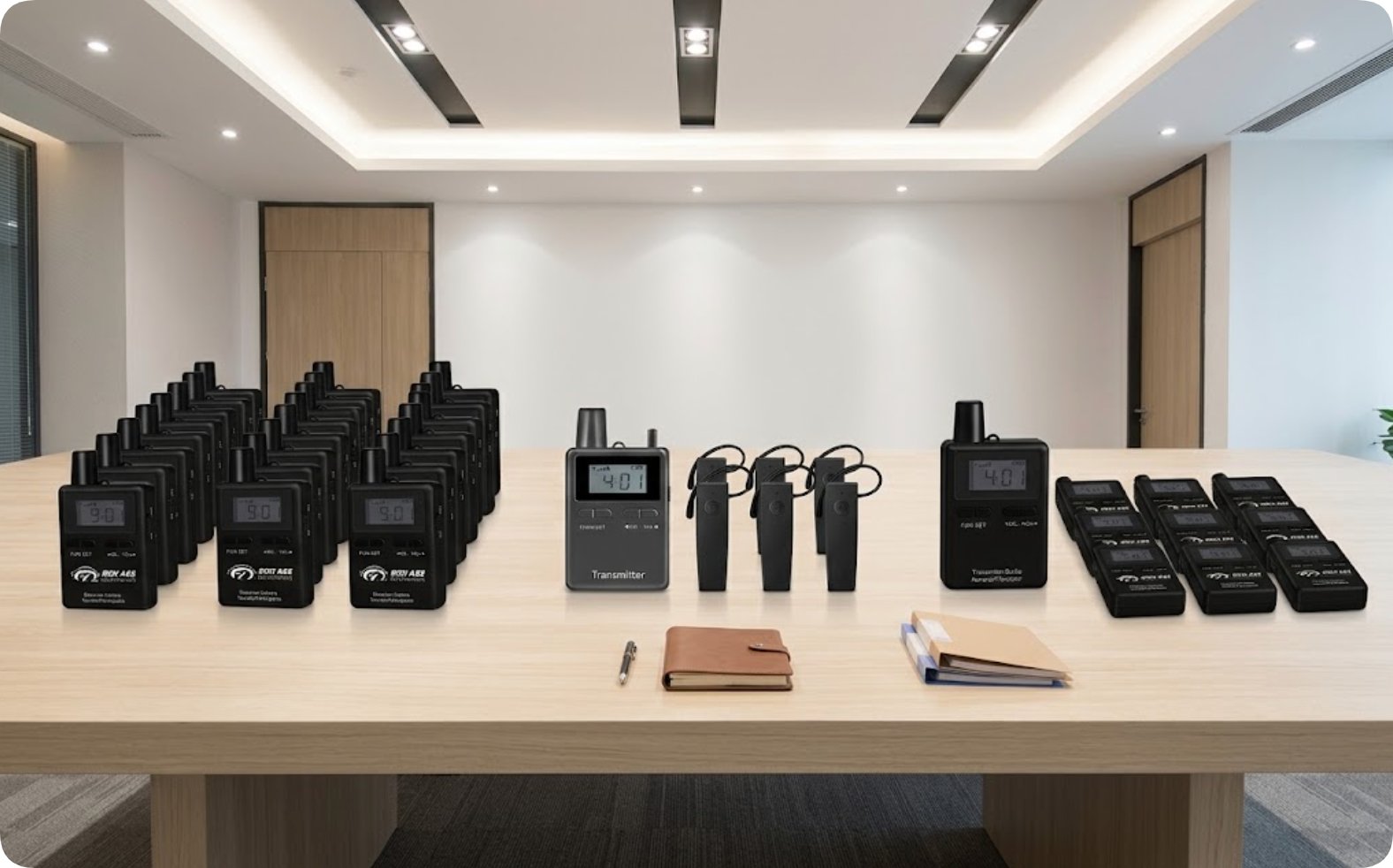
The RC2406 80-Channel 2.4G Wireless Tour Guide System attacks the two most disruptive failures at once. Its 80 channels give every group a dedicated lane, so when three or four tours run back to back through the same hall, none of them bleeds into another. The 2.4G digital link hops across frequencies instead of fighting a single busy channel, which is what keeps the audio intact near welding bays, air compressors, and the metal mezzanines that are standard fixtures in production facilities. In practical terms, a group that used to lose the guide's voice at every corridor junction simply keeps hearing it, and the tour supervisor no longer has to guess which channel a given transmitter is set to.
Operators also stop chasing battery problems. The RC2406 transmitter carries enough capacity for a full working day, so the unit that led the 9 a.m. shift is still alive at 4 p.m. without a mid-day charge, and the low-battery warning arrives early enough to matter. For teams weighing models before committing, the RC2401 vs RC2406 comparison is a useful starting point, but the deciding factor is usually the channel count and the scale of the tours you actually run.

🔍 RC2500: The Compact Fix for Small Group Reliability
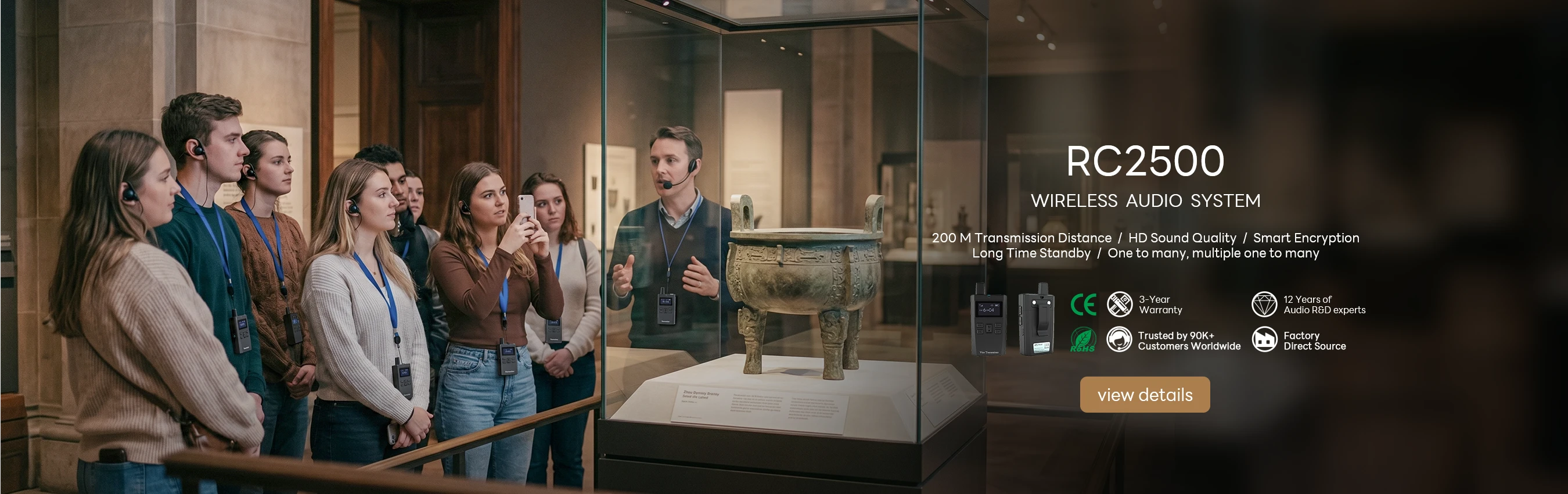
Not every factory tour needs an 80-channel system. Smaller groups, heritage walkthroughs, and quick safety briefings need a unit that is light, simple, and dependable. That is the territory of the RC2500 Wireless Tour Guide System. At just 55 g, the transmitter disappears into a guide's hand, and the receivers are light enough that visitors forget they are wearing them. For a two-hour walk with a handful of guests, it does the job with none of the configuration overhead of a larger fleet.
The RC2500 also removes the small-group failure modes that frustrate daily operators. Channel pairing is quick, so the receiver-has-no-sound complaint usually ends with a one-button check rather than a five-minute delay on the tour floor. Battery life is sized for a full shift, and the range holds steady across open factory floors, narrow corridors, and the staircases that separate production levels. If you are weighing a sibling model for your specific use case, the RC2500 vs RC2501 comparison covers the trade-offs between portability and extra features.

The Five-Minute Recovery Routine When Audio Drops
Even reliable systems occasionally need a restart, and a fast recovery routine keeps a tour on schedule. First, check the transmitter battery indicator, since a low cell is the most common cause of silent receivers. Second, verify the channel number on the transmitter and on one receiver; a mismatched channel looks exactly like a dead unit, and it is the easiest thing to fix on the spot.
Third, close the distance. Most dropouts are simply a guide who drifted past effective range, so walking back within sight of the group restores the link instantly. Fourth, if interference is persistent, switch to a different channel using the selector dial. Fifth, reboot the receiver in question by turning it off and on. In practice, these five steps clear the vast majority of incidents in under two minutes, and repeating them builds a routine the whole guiding team can rely on without calling in outside support.
⚖️ RC2406 vs RC2500: Choosing the Right Unit for Your Factory Tour
The two systems share the same reliability DNA but serve different tour scales. RC2406 is built for simultaneous multi-group operations where channel separation matters, while RC2500 is the lightweight companion for small and medium groups that value portability above all else. The choice is less about audio quality, which is consistent across both, and more about how many tours run at once and how much gear your guides are willing to carry.
| Model | Position | Weight |
|---|---|---|
| RC2406 | 80-channel 2.4G multi-group simultaneous tours | 65 g |
| RC2500 | Compact wireless tour guide for small to medium groups | 55 g |
For large plants running parallel tours, RC2406's channel density prevents the crosstalk complaints that erode visitor trust and keeps each group's commentary private. For single-group visits and short sessions, RC2500 offers the same dependable audio in a smaller, lighter package that reduces operator fatigue over repeated shifts. Many facilities run both, using the larger system for peak hours and the compact units for ad-hoc walkthroughs.
Field Results and Practical Answers
Organizations that deploy these systems consistently report measurable gains. Teams cut equipment preparation time by half, audio-related complaints drop by roughly 80 percent, and guides spend their attention on the tour instead of on the hardware. In one case, a facility that standardized on both units saw setup time fall by 40 percent within three months and logged zero audio complaints after the changeover, which suggests the improvement holds up outside a single demonstration.
Common questions center on the future, not the present. Can receivers be added later as tours grow? Yes, and the channel architecture scales without reworking the whole system. Does it work with existing infrastructure? The transmitters and receivers operate as a self-contained 2.4G network, so no wiring or venue changes are required. And support covers the equipment with the warranty and documentation operators expect. With the failure modes understood, a recovery routine in place, and the right model chosen, a factory tour keeps its sound intact from the first step to the last.