
A coastal route earns money only when the boat leaves the quay. The ferry company sets the departure board, the harbour master sets the boarding window, and the weather sets everything else. Into that narrow window the operator has to move sixty people across an open pier, keep them together during boarding, and still make the commentary audible over wind and idling engines.
Return on audio equipment along such a route is therefore not a sticker-price question. The gear earns its keep across a fixed number of paid departures, and it loses value on every sailing where the guide cannot be heard or the group straggles away from the gangway. Three kits from the same 2.4 GHz family make that arithmetic unusually clean.
A Route That Runs on Someone Else's Departure Board
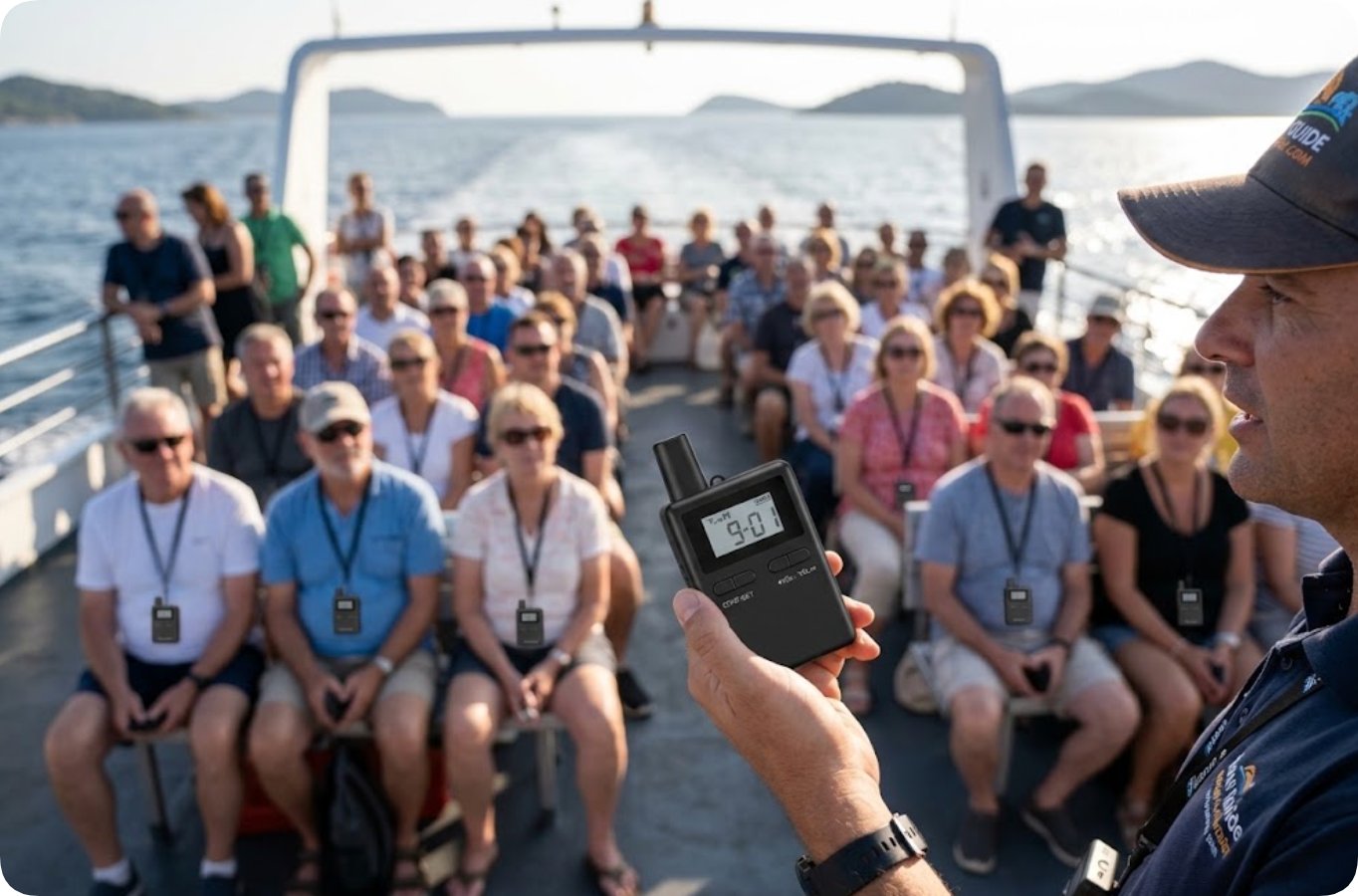
Vessel capacity caps the group long before the operator does. A forty-seat ferry means a forty-head party is the ceiling, no matter how many bookings the office takes, and a two-boat day doubles the ceiling only if the second sailing actually fills. The audio kit has to serve that whole window: commentary starts on the quay while passengers are still queueing, continues across the boarding gap, and resumes on deck once the engines settle. Equipment that only works once everyone is seated inside a quiet cabin is the wrong shape for this route, because the quay and the deck are exactly where the money changes hands. The same logic that carries city tour solutions through crowded streets applies at a wet boarding ramp, just with a harder deadline: when the gangway lifts, the tour leaves with or without the group assembled.
Counting Trips, Not Weeks, in the Payback Fraction
The payback fraction for this route divides kit cost by carried heads, not by calendar months. An operator who rents audio gear pays by the month and keeps paying through the quiet shoulder, while an owned kit amortizes only across the departures that actually run. If a route carries forty heads per sailing and holds two sailings a day, one sixty-receiver kit covers the morning rotation with units to spare, and the same pool re-deploys in the afternoon without a charge cycle in between. Every sailing that departs with a guide who can be heard from the ticket office to the bow is a sailing where the fraction moves. Operators who think in weeks overpay for the empty ones; operators who think in trips buy exactly the capacity their timetable can fill. The same fraction also tells the office when to add a second kit: the moment the morning rotation starts borrowing receivers from the afternoon pool, the borrowed units are a waiting order, not a saving.
Weather Holds Belong in the Denominator
Coastal arithmetic has a second term that inland routes never price: the cancelled departure. Squalls, swell and shoulder-month demand mean a realistic season is shorter than the printed timetable, and the denominator of the payback fraction should use sailing days that historically run, not days that were scheduled. The kit also has to survive those idle weeks in a harbour locker. None of the three data sheets covered here claims a water-ingress rating, so the practical discipline falls on storage: charged units sealed in a dry case ashore, transmitters wiped down after spray, and receivers cased before the crossing rather than after. That is not a spec limitation to hide; it is a maintenance line item that belongs in the same calculation as fuel. It also argues for keeping the locker inventory short: two shared baseline units and one flagship mean fewer case sizes, fewer charging routines and fewer things to forget before a long weekend mooring.
Two Order Lines Share One Spec Sheet
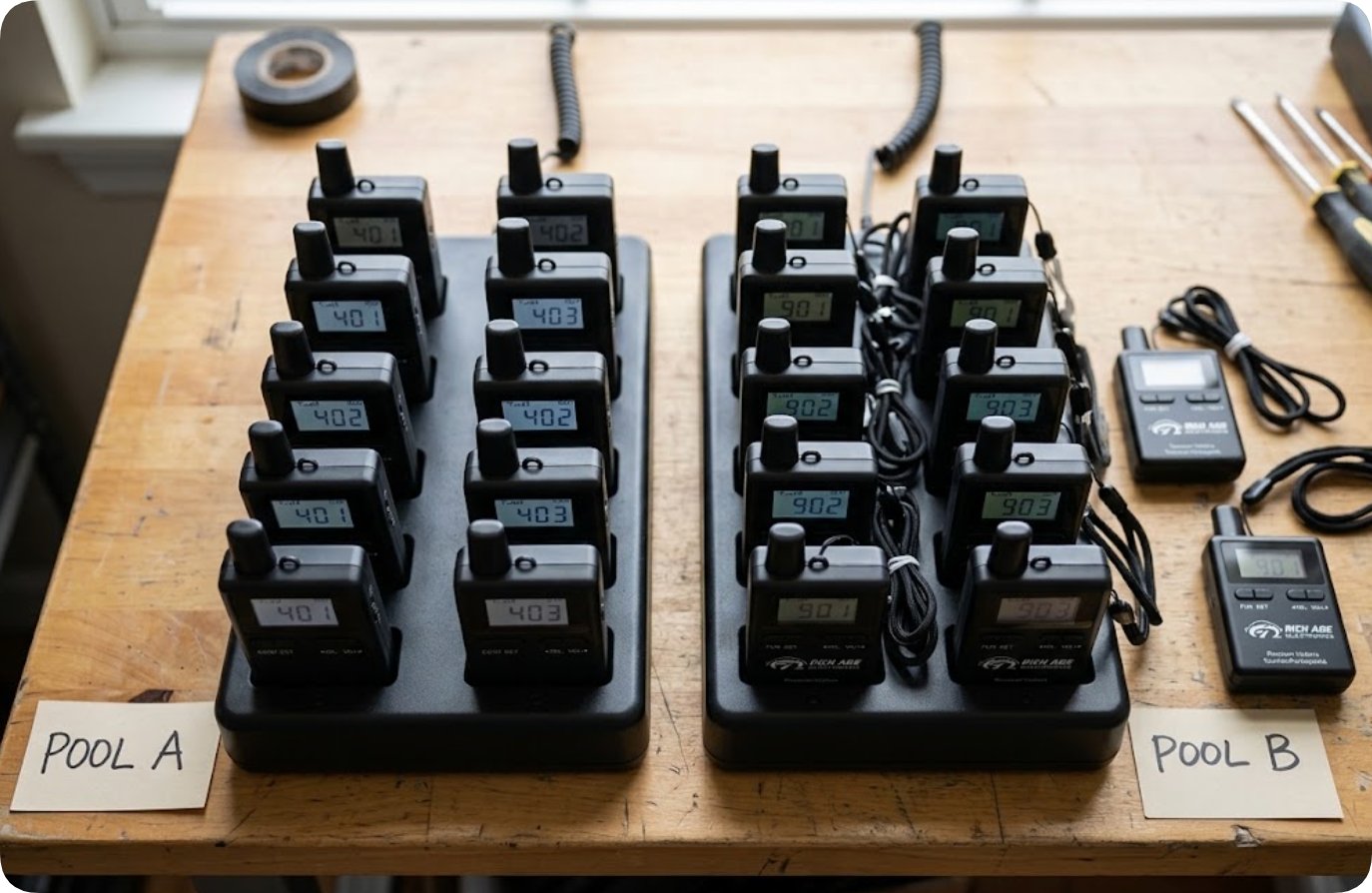
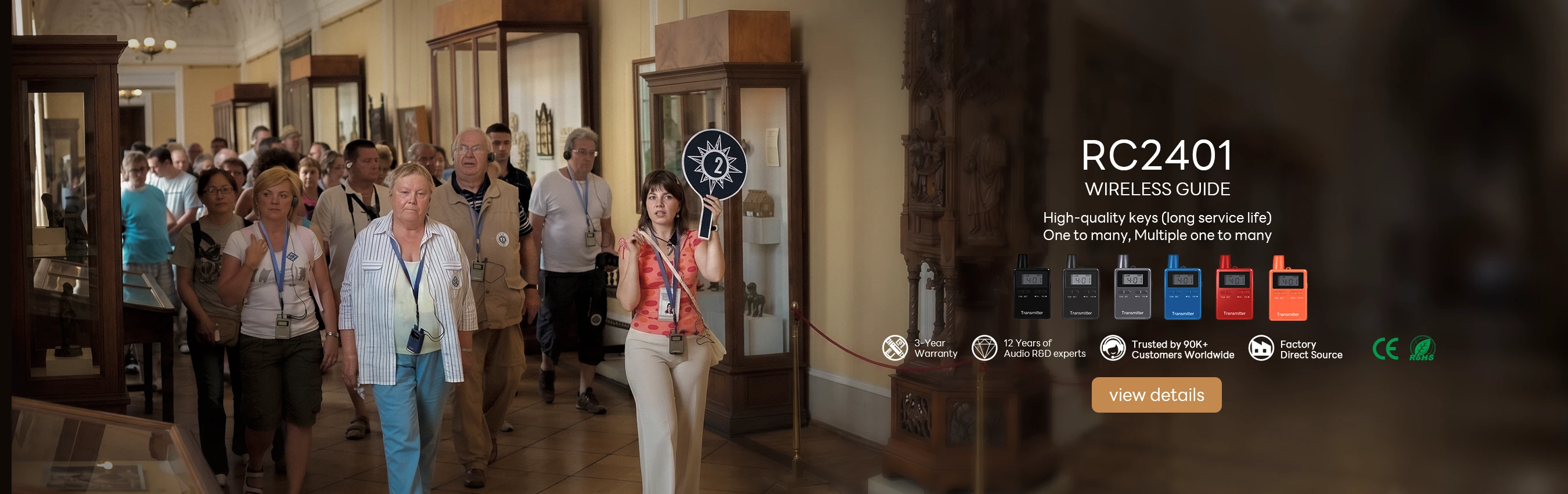
The quiet efficiency play in this trio is the baseline pair. The RC2401 2.4G wireless tour guide system and the RC2402 wireless tour guide system publish the same figures on the September comparison sheet: both operate across 2403-2483 MHz, both carry 50 channels at 10 mW output, both run 10 hours on the transmitter and 20 hours on the receiver, and both weigh 59g for the transmitter and 50g for the receiver, charged through a DC port. For return-on-investment purposes that symmetry is worth more than a feature difference, because two order lines with one shared specification mean a single spare pool, one charger tray layout, and transmitters that swap between pools without re-training staff. The distinction between the two lines is operational rather than technical: one pool runs the everyday rotations while the second stays cased as the surge and service-exchange stock, and either unit can step into either role on any morning.
The Hundred-Channel Flagship Takes the Open Deck
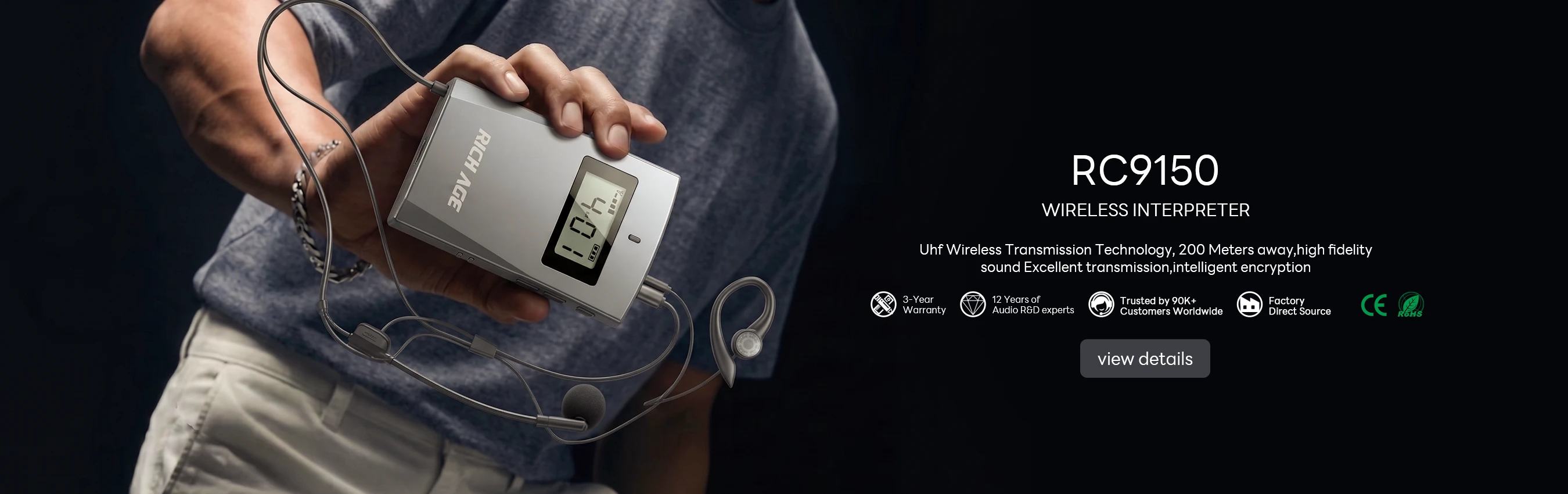
Where the baseline pair is a volume play, the RC9150 is the capacity play. Its 100 channels matter most at a popular island quay, where several operators land parties at the same hour and the 2.4 GHz band fills with neighbouring groups; fifty channels are enough on a quiet Tuesday and tight on a cruise-day Saturday. The battery figures carry the rest of the argument: 15 hours of transmitter use and 35-plus hours of receiver use, drawn from 1800mAh cells on both units, which spans a multi-day charter without a nightly charge cycle. At 97.5g per unit the transmitter and receiver stay comfortable through a long crossing, the Type-C port accepts power from the same banks crews already carry, and the 20Hz-8kHz frequency response keeps commentary intelligible when wind noise is part of every departure.
What the Quote Sheet Should List
| Model | Band and channels | Battery life TX / RX | Weight TX / RX | Charging port | Role on the route |
|---|---|---|---|---|---|
| RC2401 | 2.4 GHz, 50 channels | 10h TX, 20h RX | 59g TX, 50g RX | DC port | volume baseline pool |
| RC2402 | 2.4 GHz, 50 channels | 10h TX, 20h RX | 59g TX, 50g RX | DC port | everyday departures |
| RC9150 | 2.4 GHz, 100 channels | 15h TX, 35+h RX | 97.5g each unit | Type-C | open-deck flagship |
All three transmit at 10 mW and reach 1-200 m, so the numbers that actually sort the quotes are channel count, battery hours and charging convenience. Weights are listed separately for transmitter and receiver exactly as the September sheet publishes them, and the RC9150's single figure reflects a transmitter and receiver built to the same mass.
🔋 Where Each Charge Has to Come From
Island boarding points rarely offer an outlet at the ramp, so the charging routine is part of the operating cost. The baseline pair charges through a DC port, which in practice means an overnight tray at the office or a vehicle inverter between rotations; with 20 hours of receiver use, a full morning-and-afternoon doubleheader never touches a charger. The RC9150 charges over Type-C from any power bank in the crew bag, and its 35-plus-hour receiver figure spans overnight charters where the units sleep on the boat. Battery cell sizes track those figures: 1500mAh transmitter and 1000mAh receiver cells on the baseline pair, and 1800mAh on both RC9150 units. A route that plans its charging around the timetable instead of around wall sockets recovers roughly an hour of crew time every day, and it keeps the spare pool genuinely spare: units that never finish a rotation half-drained are units the office can promise to a surprise second coach at short notice.
A Trial Run Before the Routes Reopen
The cheapest way to validate the arithmetic is one trial sailing before the timetable fills. Put a full kit on a single departure, count the heads that stay with the group from quay to quay, note every moment the guide had to repeat a point over the wind, and divide the whole exercise into a per-head figure the office can compare against the rental quotation. Operators who want a longer reference point can look at a twenty-one-day European season that ran on the RC2401, and the full wireless tour guide system range is available for a mixed order that matches whatever the departure board actually holds. The route will sell exactly as many seats as the ferry allows; the only variable the operator controls is whether every one of those seats hears the tour.