
A leading China factory specializing in Wireless Tour Guide Systems, Church Audio Guides, and Translation Headphones with premium OEM/ODM solutions.

Tel:+86 18922879583

Email:tiger.wang@richitek.com

RC2500, RC2468 and RC2501: The Ancient Town Trend Runs Toward Smaller Groups and Softer Audio

An ancient town compresses every audio problem a tour operator faces into a few hundred meters of lane. Walls reflect sound, passages pinch crowds into bottlenecks, and residents live close enough to hear whatever a guide amplifies. The equipment that worked at a wide outdoor plaza behaves differently between two high walls, and operators who run these routes daily have been adjusting their kits accordingly.

The adjustment shows up in purchase data as a clear direction: fewer single loud groups, more small groups on earpieces, and more departures staggered across a day. Three Richitek units sit at different points on that curve. The RC2500 acts as the flagship that anchors a fleet, the RC2468 is the lightest receiver a visitor can wear, and the RC2501 is the presenter's unit with swappable microphone options. This article reads the trend through what each of them does on a town route.

What Old Streets Do to an Unamplified Voice

A raised voice dies quickly in a town built from hard surfaces and tight corners. Echo smears consonants, a crowd of twenty stretches beyond arm's reach within one turn, and shopfront noise fills the gaps. Guides compensate by stopping at fixed points, but that turns a walk into a lecture series and slows the whole itinerary. The practical answer most operators have landed on is a transmitter at the guide's mouth and a short-range receiver on every visitor, with audio kept at conversational level rather than projected level. The kit itself shrank at the same time, which is why the change stuck: a pocket transmitter and an ear-level receiver add no burden to a guest who is already carrying a bag, a phone, and a bottle of water through a summer street. On a route through a preserved district, that single change removes most of the stopping, and the city walking tour playbook now treats it as the default rather than an upgrade.

The Flagship That Holds the Whole Town Block

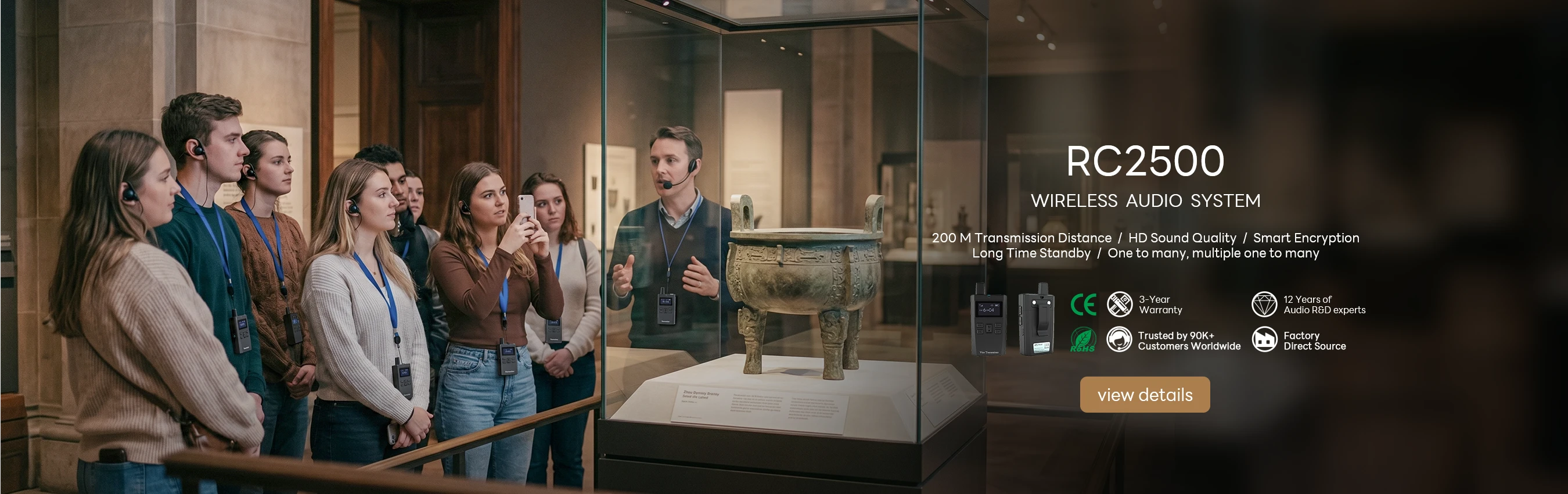
The RC2500 is built for the operator who runs several departures a day and cannot afford a slow turnover between them. One-touch sync pairs a fresh batch of receivers without a menu walk, one-touch mute lets a guide handle a ticket check in silence, and the same button layout handles shutdown at day's end. The transmitter and receiver each weigh 104 grams, run on 1800 mAh cells, and hold 15 hours of transmit time or 35-plus hours of standby, so a charge in the morning covers a double shift. Charging runs over Type-C, which means the same cable stock as the rest of a modern kit. For a town operation where the RC2500 wireless tour guide system anchors the fleet, those numbers translate into fewer mid-day swaps.

RC2500-ancient_town

The Ear-Hook Visitors Barely Notice

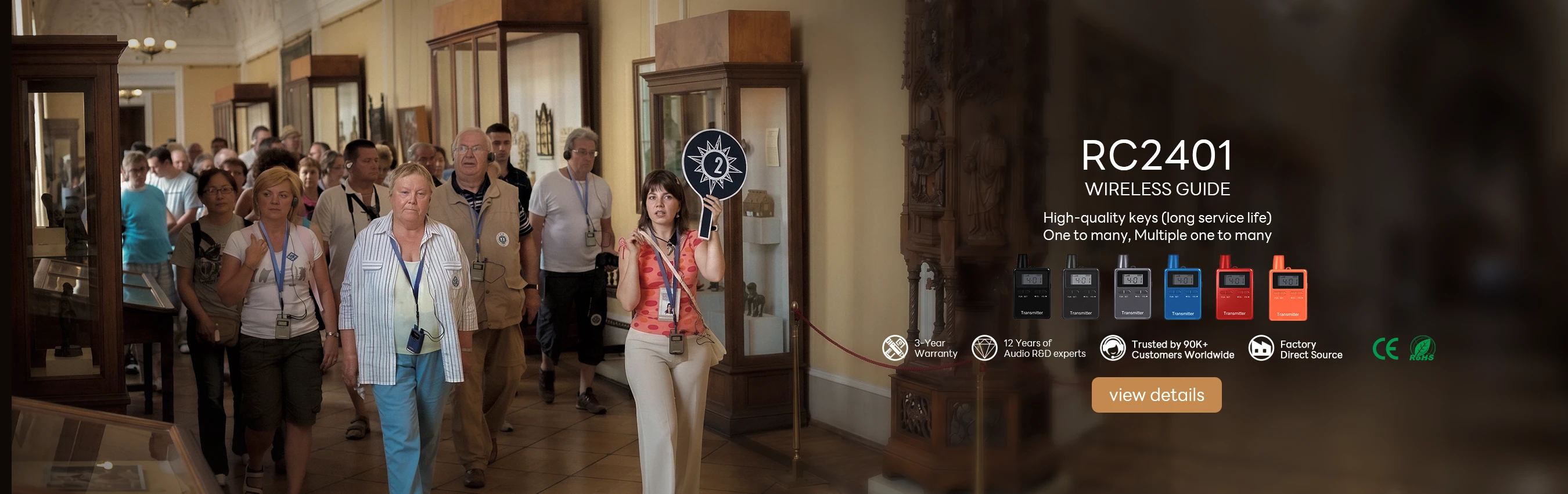
Visitor comfort decides whether people actually keep wearing the receiver, and the RC2468 attacks that problem from the hardware side. Its ear-hook receiver weighs 18 grams, light enough that a guest forgets it after the first lane, and the transmitter stays at 59 grams on the guide's belt or lanyard. Battery life reads 10 hours on the transmitter and roughly 8 hours on the receiver, which covers the standard day-trip window with margin. The receiver charges over Micro USB at 5V/1A, a slower port than the rest of the range but adequate for an overnight turn. Operators who hand units to walk-in guests, rather than coached groups, tend to favor the RC2468 ultra-light 2.4G tour guide system precisely because first-time wearers need no instruction.

RC2468-ancient_town

The Unit With the Mic You Can Swap

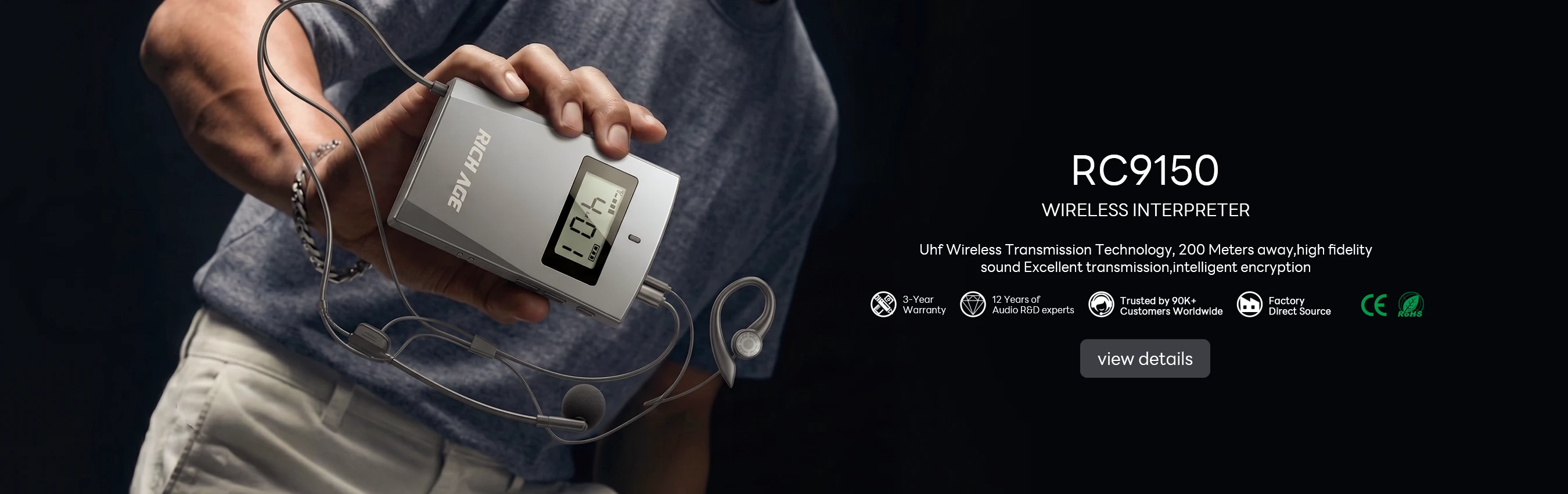
The RC2501 takes a different bet: the guide, not the visitor, is the person whose comfort limits a full-day route. Its transmitter and receiver each weigh 47 grams, the lightest pair in this comparison, and the transmitter accepts an optional headset or lavalier microphone, so a guide can move from speaking over a courtyard to narrating inside a quiet hall without changing units. Output power reads 13 mW, the highest of the three, which helps when a group spreads across an open square before funneling back into a lane. Both units charge over Type-C, hold 15 hours of transmit time and 35-plus hours of standby, and the RC2501 wireless tour guide system suits operations where the same guide works morning and afternoon shifts.

RC2501-ancient_town

What the Spec Table Sorts Out

ComparisonRC2500RC2468RC2501
Frequency band2403-2483 MHz (2.4G)2403-2483 MHz (2.4G)2403-2483 MHz (2.4G)
Channels505050
Output power10 mW10 mW13 mW
Transmitter battery15 h10 h15 h
Receiver battery35+ h8 h approx.35+ h
Transmitter weight104 g59 g47 g
Receiver weight104 g18 g ear-hook47 g
Charging portType-CMicro USB 5V/1AType-C
Standout featureone-touch sync, mute and shutdown18 g ear-hook receiveroptional headset or lavalier mic

The table shows where the three units genuinely diverge. Band and channel count are identical, so none of them wins on interference by specification; the separation lies in power, endurance, and who carries the weight. A buyer matching equipment to a town route should start from group size and shift length, then let those two rows pick the unit.

Splitting Channels When Groups Share One Block

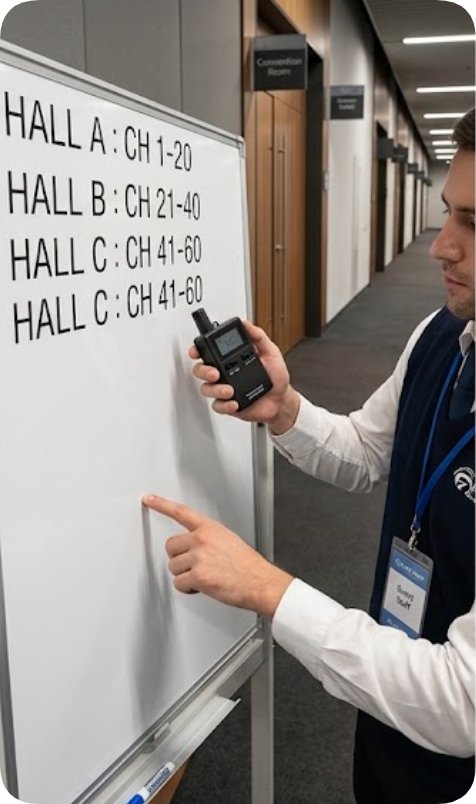
Town routes rarely run one group at a time anymore. A typical afternoon stacks a local guide, a school cohort, and a private party within the same block, and two guides on the default channel will bleed into each other's audio at every intersection. With 50 channels on all three units, the fix is administrative rather than technical: assign channel blocks by departure time, hand spares on a separate channel, and brief every guide at the morning roll call. A published walking-tour case from a Mediterranean city operator shows the same discipline keeping three concurrent groups clean on a single route, and the Cyprus city walking tour case documents how the assignment was written down and enforced. The hardware allows the coexistence; the paperwork is what makes it hold.

Evening Openings Prolong the Touring Day

The newest change in town tourism runs after sunset. Districts that once closed at dusk now sell lantern-lit evening slots, and the audio kit has to survive a second shift. Here the endurance figures matter more than any other row: a transmitter rated at 15 hours and a receiver at 35-plus hours absorb a double shift without a charging cart, while an 8-hour receiver needs a scheduled swap between the afternoon and evening departures. Town districts also enforce quieter rules after dark, so an evening unit that once competed with market noise now works beside resident bedroom windows; keeping the level low is often a condition of the operating permit rather than simple courtesy. Operators running both shifts usually split the difference by assigning long-endurance units to the evening, where a mid-route failure is hardest to fix, and lighter-but-shorter units to the morning. Charging ports matter at this point too, because a Type-C evening top-up can happen from a power bank while a Micro USB unit needs its dedicated dock.

Fitting the Kit to a Town's Booking Window

Sizing a purchase comes down to the booking pattern of the route. An operator selling fixed departures counts peak heads per slot and buys receivers to that ceiling; an operator selling private walks buys per guide instead, with a small spare pool. Across the range, the wireless tour guide system lineup covers both patterns from the same 2.4G platform, which keeps spare parts and channel plans interchangeable as the fleet grows. Operators who mix units should also standardize the small items early, because a shared pouch, a common lanyard, and one charging caddy cut the daily setup time more than any single specification does. Whatever the mix, the direction of the trend is already settled: smaller groups, softer audio, and equipment chosen for how a town actually runs rather than how a plaza does.


2026年10月09日 10:39
ꄘ click: 12

RC2500, RC2468 and RC2501: The Ancient Town Trend Runs Toward Smaller Groups and Softer Audio

time: 2026年10月09日 click:12

An ancient town compresses every audio problem a tour operator faces into a few hundred meters of lane. Walls reflect sound, passages pinch crowds into bottlenecks, and residents live close enough to hear whatever a guide amplifies. The equipment that worked at a wide outdoor plaza behaves differently between two high walls, and operators who run these routes daily have been adjusting their kits accordingly.

The adjustment shows up in purchase data as a clear direction: fewer single loud groups, more small groups on earpieces, and more departures staggered across a day. Three Richitek units sit at different points on that curve. The RC2500 acts as the flagship that anchors a fleet, the RC2468 is the lightest receiver a visitor can wear, and the RC2501 is the presenter's unit with swappable microphone options. This article reads the trend through what each of them does on a town route.

What Old Streets Do to an Unamplified Voice

A raised voice dies quickly in a town built from hard surfaces and tight corners. Echo smears consonants, a crowd of twenty stretches beyond arm's reach within one turn, and shopfront noise fills the gaps. Guides compensate by stopping at fixed points, but that turns a walk into a lecture series and slows the whole itinerary. The practical answer most operators have landed on is a transmitter at the guide's mouth and a short-range receiver on every visitor, with audio kept at conversational level rather than projected level. The kit itself shrank at the same time, which is why the change stuck: a pocket transmitter and an ear-level receiver add no burden to a guest who is already carrying a bag, a phone, and a bottle of water through a summer street. On a route through a preserved district, that single change removes most of the stopping, and the city walking tour playbook now treats it as the default rather than an upgrade.

The Flagship That Holds the Whole Town Block

The RC2500 is built for the operator who runs several departures a day and cannot afford a slow turnover between them. One-touch sync pairs a fresh batch of receivers without a menu walk, one-touch mute lets a guide handle a ticket check in silence, and the same button layout handles shutdown at day's end. The transmitter and receiver each weigh 104 grams, run on 1800 mAh cells, and hold 15 hours of transmit time or 35-plus hours of standby, so a charge in the morning covers a double shift. Charging runs over Type-C, which means the same cable stock as the rest of a modern kit. For a town operation where the RC2500 wireless tour guide system anchors the fleet, those numbers translate into fewer mid-day swaps.

RC2500-ancient_town

The Ear-Hook Visitors Barely Notice

Visitor comfort decides whether people actually keep wearing the receiver, and the RC2468 attacks that problem from the hardware side. Its ear-hook receiver weighs 18 grams, light enough that a guest forgets it after the first lane, and the transmitter stays at 59 grams on the guide's belt or lanyard. Battery life reads 10 hours on the transmitter and roughly 8 hours on the receiver, which covers the standard day-trip window with margin. The receiver charges over Micro USB at 5V/1A, a slower port than the rest of the range but adequate for an overnight turn. Operators who hand units to walk-in guests, rather than coached groups, tend to favor the RC2468 ultra-light 2.4G tour guide system precisely because first-time wearers need no instruction.

RC2468-ancient_town

The Unit With the Mic You Can Swap

The RC2501 takes a different bet: the guide, not the visitor, is the person whose comfort limits a full-day route. Its transmitter and receiver each weigh 47 grams, the lightest pair in this comparison, and the transmitter accepts an optional headset or lavalier microphone, so a guide can move from speaking over a courtyard to narrating inside a quiet hall without changing units. Output power reads 13 mW, the highest of the three, which helps when a group spreads across an open square before funneling back into a lane. Both units charge over Type-C, hold 15 hours of transmit time and 35-plus hours of standby, and the RC2501 wireless tour guide system suits operations where the same guide works morning and afternoon shifts.

RC2501-ancient_town

What the Spec Table Sorts Out

ComparisonRC2500RC2468RC2501
Frequency band2403-2483 MHz (2.4G)2403-2483 MHz (2.4G)2403-2483 MHz (2.4G)
Channels505050
Output power10 mW10 mW13 mW
Transmitter battery15 h10 h15 h
Receiver battery35+ h8 h approx.35+ h
Transmitter weight104 g59 g47 g
Receiver weight104 g18 g ear-hook47 g
Charging portType-CMicro USB 5V/1AType-C
Standout featureone-touch sync, mute and shutdown18 g ear-hook receiveroptional headset or lavalier mic

The table shows where the three units genuinely diverge. Band and channel count are identical, so none of them wins on interference by specification; the separation lies in power, endurance, and who carries the weight. A buyer matching equipment to a town route should start from group size and shift length, then let those two rows pick the unit.

Splitting Channels When Groups Share One Block

Town routes rarely run one group at a time anymore. A typical afternoon stacks a local guide, a school cohort, and a private party within the same block, and two guides on the default channel will bleed into each other's audio at every intersection. With 50 channels on all three units, the fix is administrative rather than technical: assign channel blocks by departure time, hand spares on a separate channel, and brief every guide at the morning roll call. A published walking-tour case from a Mediterranean city operator shows the same discipline keeping three concurrent groups clean on a single route, and the Cyprus city walking tour case documents how the assignment was written down and enforced. The hardware allows the coexistence; the paperwork is what makes it hold.

Evening Openings Prolong the Touring Day

The newest change in town tourism runs after sunset. Districts that once closed at dusk now sell lantern-lit evening slots, and the audio kit has to survive a second shift. Here the endurance figures matter more than any other row: a transmitter rated at 15 hours and a receiver at 35-plus hours absorb a double shift without a charging cart, while an 8-hour receiver needs a scheduled swap between the afternoon and evening departures. Town districts also enforce quieter rules after dark, so an evening unit that once competed with market noise now works beside resident bedroom windows; keeping the level low is often a condition of the operating permit rather than simple courtesy. Operators running both shifts usually split the difference by assigning long-endurance units to the evening, where a mid-route failure is hardest to fix, and lighter-but-shorter units to the morning. Charging ports matter at this point too, because a Type-C evening top-up can happen from a power bank while a Micro USB unit needs its dedicated dock.

Fitting the Kit to a Town's Booking Window

Sizing a purchase comes down to the booking pattern of the route. An operator selling fixed departures counts peak heads per slot and buys receivers to that ceiling; an operator selling private walks buys per guide instead, with a small spare pool. Across the range, the wireless tour guide system lineup covers both patterns from the same 2.4G platform, which keeps spare parts and channel plans interchangeable as the fleet grows. Operators who mix units should also standardize the small items early, because a shared pouch, a common lanyard, and one charging caddy cut the daily setup time more than any single specification does. Whatever the mix, the direction of the trend is already settled: smaller groups, softer audio, and equipment chosen for how a town actually runs rather than how a plaza does.

×

Contact us

email:
name:
subject:
content: