





Viewing site logistics through a timetable framework rather than a static inventory reveals how workflow bottlenecks impact daily operations. Wireless tour guide hardware resting on a storage shelf between briefings is not idle in financial depreciation terms; it is simply outside the utilization metrics management examines when auditing seasonal performance. Because comparable device tiers publish identical transmitter endurance, receiver battery life, unit weight, and charging port configurations, standard specification columns fail to explain why one operational roster runs smoothly while another stalls mid-day. The operational variance stems entirely from the unmeasured sign-back interval.
What a Sign-Back Control Card Records at Noon
At high-volume educational venues, the return desk follows a standardized physical ritual. Tour guides deposit equipment cases on the counter, staff count individual receivers against printed manifests, and check for missing earpieces. The resulting sign-back card functions strictly as a physical object count. It records no timestamps, active channel assignments, or reissue projections. If a cohort finishes early, equipment rests idly for an hour; if a schedule runs late, the identical case undergoes immediate turnaround. Both scenarios look identical on standard asset logs because tally sheets are engineered solely for loss prevention rather than availability tracking. This limitation becomes glaring on peak days when back-to-back briefings force incoming cohorts to inherit whatever condition preceding groups left behind.
Batch turnover also fragments operational accountability. Morning guides oversee equipment while cohorts occupy exhibition halls; distribution desk staff assume custody once cases are closed; afternoon guides take charge only after cases are reopened. Because no single role owns the interim minutes, no one records them. Season ledgers tallying total tour bookings will report full calendars, even when actual on-time departures fall short. This shortfall represents an unmeasured workflow gap rather than a hardware defect or staffing failure, solvable by tracking turnaround intervals rather than replacing equipment.
The UHF Set Returns on a Different Operational Clock
The RC8860 Wireless Teaching Microphone System operates outside the congested 2.4G band. Its published core frequency spans 860–870 MHz supporting 20 selectable channels, a 1–200 meter transmission range, and 10 mW RF output power. Transmitters deliver 10 hours of operation from a 3.7V 1500mAh battery, while receivers provide 20 hours from a 3.7V 1000mAh cell. Weighing 59 grams (transmitter) and 50 grams (receiver), it maintains ergonomic comfort across full-day walking tours, supported by a unified 50 Hz–12 kHz audio frequency response. For multi-group venues, it addresses core interference questions regarding how many independent tours can operate simultaneously without frequency overlap.
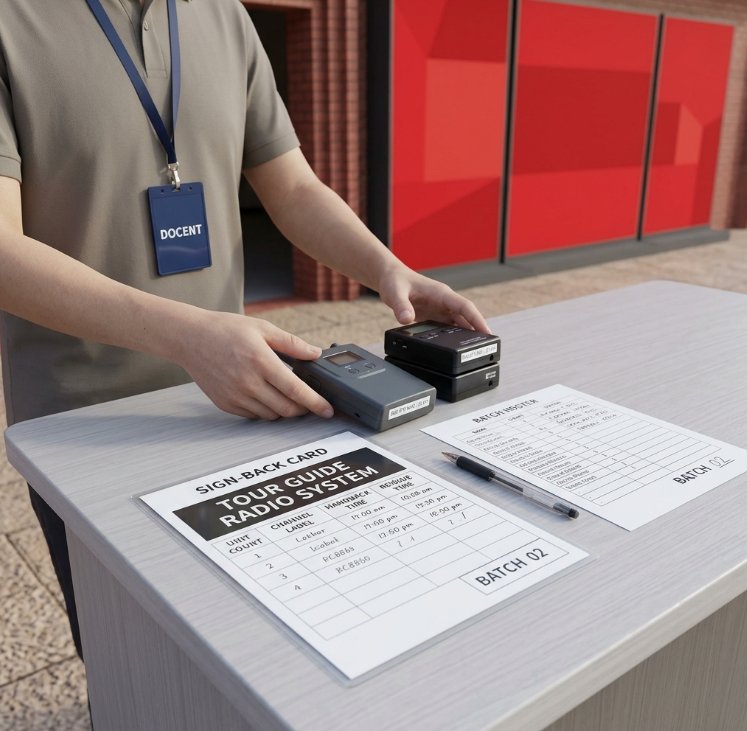
RC8860 UHF equipment cases evaluated against physical sign-back control cards at education base return counters
Product documentation confirms CE, FCC, and RoHS compliance, a 1-year limited warranty with lifetime technical support, and OEM/ODM housing customization options. Its one-touch pairing and menu-free broadcast architecture streamline deployment for rotating guides on busy mornings. However, rapid pairing does not accelerate physical sign-back workflows; hardware cases remain stationary on counters until manually reissued. Fixed room plans tied to a 20-channel ceiling mean frequency allocation is predetermined before cohorts arrive, leaving turnaround timing entirely dependent on desk administration.
Eighty Channels Provide Spectrum Headroom Without Speeding Up Handback
Operating within the 2403–2483 MHz frequency spectrum, the RC2408 Long Range Wireless Audio Guide delivers 80 selectable channels engineered for high-density interference management at busy cultural sites. Battery endurance (10h TX / 20h RX), cell capacities (1500mAh / 1000mAh), unit weights (59g / 50g), and DC charging ports match baseline UHF specifications. While expanded channel density accommodates complex parallel room schedules during peak hours, it exerts zero influence on receiver turnaround velocity.
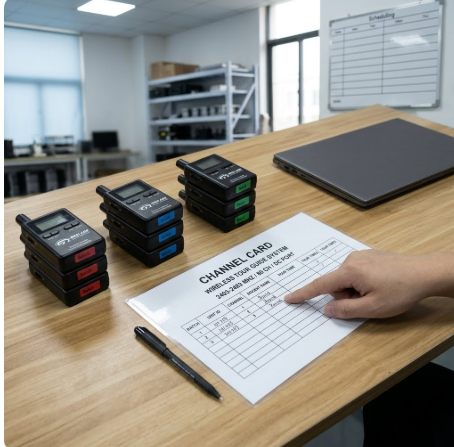
RC2408 80-channel configuration cards streamlining multi-room frequency management during high-density visitor peaks
Published specifications confirm CE, FCC, and RoHS approvals, a 1-year mainboard warranty, and multi-color shell options. Deploying distinct housing colors assists return staff in sorting hardware categories quickly, serving as an operational efficiency gain that improves physical sorting without recording time intervals. Procuring 80-channel systems solves spectrum congestion during peak seasons but leaves asset availability bottlenecks unresolved if return workflows remain unmeasured.
Fifty Channels Establish a Reliable 2.4G Operational Baseline
Representing the standard 2.4G deployment tier, the RICH AGE RC2401 Wireless Audio System Factory model offers 50 selectable channels supported by Phase-Locked Loop (PLL) frequency synthesis, matching 10-hour transmitter and 20-hour receiver endurance, identical unit weights, and standard DC charging ports. Because baseline systems share core electrical specifications with higher-channel variants, they inherit identical sign-back intervals. Standardized compliance (CE, RoHS), a 1-year mainboard warranty, and one-button synchronization streamline initial deployment rather than end-of-tour return processing. Fifty independent channels easily accommodate standard parallel exhibition spaces, ensuring baseline hardware satisfies room requirements while operational delays remain tied strictly to desk record-keeping practices.
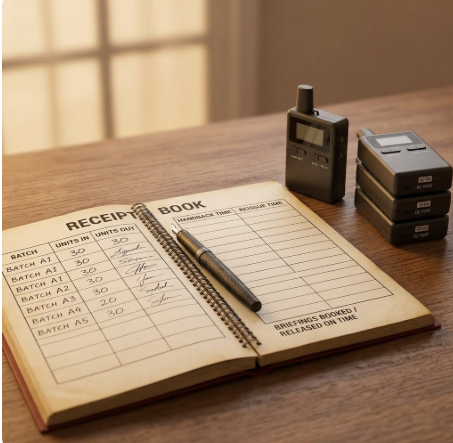
RC2401 baseline distribution ledgers documenting physical equipment issuance across educational facility tours
Comparative Analysis of System Specifications vs. Unrecorded Turnaround Intervals
Synthesizing technical data sheets with operational workflows clarifies why standard logs fail to capture availability limits. Return ledgers record return quantities, while reissue logs record outbound tallies—neither tracks elapsed downtime. The matrix below contrasts recorded asset metrics against unmeasured operational realities:
| Ledger Category | Recorded Data Parameter | Omitted Operational Factor | Observable Venue Impact |
|---|---|---|---|
| Radio System Class | UHF or 2.4G frequency band; channel count | Clock timestamp of final case handback | Subsequent tour briefings experience scheduling delays |
| Receiver Identification | Assigned room or channel number label | Verification status of label clearing at desk | Units redeployed with outdated room assignments |
| Power Subsystem | DC charging port; battery cell capacities | Elapsed idle time prior to dock connection | Incoming cohorts wait on uninitiated charge cycles |
| Compliance & Warranty | CE, FCC, RoHS certifications; 1-year cover | Quarantine status during routine bench inspection | Fully serviceable equipment remains sidelined |
| Event Utilization | Total scheduled briefings per academic term | Exact proportion of tours departing on schedule | Season audit overestimates actual hardware delivery |
Core Technical Specifications Cross-Reference
Evaluating standardized manufacturer metrics confirms that hardware models share core electrical architectures, proving that operational turnaround speed depends entirely on administrative workflow rather than device specifications:
| Model Designation | Core Frequency Band | Channel Capacity | Transmitter Endurance | Receiver Endurance | Unit Weights (TX / RX) | Charging Interface |
|---|---|---|---|---|---|---|
| RC8860 | 860–870 MHz | 20 Channels | 10 Hours | 20 Hours | 59 g / 50 g | DC Port |
| RC2408 | 2403–2483 MHz | 80 Channels | 10 Hours | 20 Hours | 59 g / 50 g | DC Port |
| RC2401 | 2403–2483 MHz | 50 Channels | 10 Hours | 20 Hours | 59 g / 50 g | DC Port |
Reviewing these parameters confirms that procurement decisions based purely on specification tables reveal minimal operational variance between baseline and high-channel tiers, whereas administrative turnaround workflows dictate actual venue throughput. For complete equipment catalogs and direct manufacturer sourcing, explore Wireless Tour Guide System Manufacturer Direct channels.
Frequently Asked Questions (FAQ)
1. Are transmitter-receiver pairs matched reliably to two parallel exhibition rooms prior to cohort entry?
Yes, cultural venues assign one dedicated transmitter to each exhibition space and pre-program matching channel numbers onto receiver banks before visitors arrive. The RC8860 provides 20 selectable channels on the 860–870 MHz band, while the RC2408 and RC2401 offer 80 and 50 channels respectively on the 2403–2483 MHz spectrum. Receivers display room assignments via physical labels, transmitters remain locked to designated frequencies, and desk staff verify both parameters during return processing.
2. What essential data points must sign-back control cards record before subsequent briefings initiate?
Yes, control cards must document physical unit counts, individual receiver room labels, and exact clock timestamps marking case arrival at the return counter. Return processing requires tallying counts against manifests, clearing or updating room labels, and recording handback timestamps beside case identifiers, ensuring equipment is connected to DC charging ports before subsequent tour clearance.
3. Does published channel capacity dictate the maximum number of simultaneous groups supported by UHF systems?
Yes, the RC8860 publishes 20 selectable channels across 860–870 MHz, establishing a hard ceiling of twenty independently monitored groups within a single facility. High-channel variants like the RC2408 (80 channels) and RC2401 (50 channels) scale parallel room capacity accordingly, while all models maintain consistent 1–200 meter transmission ranges and 10 mW RF output power.
4. Do standardized battery endurance specifications determine equipment sign-back intervals?
Yes, because all compared models publish identical 10-hour transmitter endurance, 20-hour receiver endurance, and DC charging ports, battery specifications cannot explain variations in turnaround speed. Turnaround velocity is determined entirely by administrative desk workflows—counting, labeling, channel clearing, charging, and sign-out validation.
The video below demonstrates wireless tour guide system return processing, charging dock management, and multi-cohort sign-back workflow coordination.