

This diagnostic blind spot is not a hardware defect. Two RF communication systems and a handheld media player record zero diagnostic history of their final minutes of operation, and controlled clean-area tours cannot simply be rerun: production batches operate on strict schedules, sterile garments are issued at controlled airlocks, and sanitized hardware crosses cleanroom boundaries once per tour. Closing these complaints requires establishing written operational logs before visitors enter the gowning room. Facilities designing compliant factory workflows can review the Factory Tour Noise Reduction Audio Solutions framework, which structures acoustic planning and documentation around real industrial environments.
Why Intermittent Tour Audio Complaints Cannot Be Replayed on the Bench
An isolated user report differs fundamentally from a repeatable hardware failure. Maintenance technicians can diagnose a depleted battery or damaged earpiece on the workbench within two minutes, yet they cannot recreate the exact thirty-second window when an electric forklift passed a stainless-steel doorway, an adjacent group briefly overlapped on a frequency band, or a tour guide accidentally brushed a control button. In industrial facilities, visitor feedback is collected only after the tour concludes, once devices are stowed back in charging cases and staff have transitioned to subsequent groups. Without identical RF interference, spatial positioning, and environmental conditions, an unlogged complaint remains anecdotal rather than measurable.
Resolving these gaps depends on understanding the exact operational state exposed by each device class. A display-free receiver retains zero state data; a single-button transmitter exposes its immediate broadcast state without recording button history; and a screen-equipped player displays only the currently selected track number until the next digit is entered. Once shift supervisors categorize which device state applies, missing operational context can be captured systematically on shift handover sheets rather than guessed days later.
RC9150: Managing 100 Channels Without Internal Frequency History
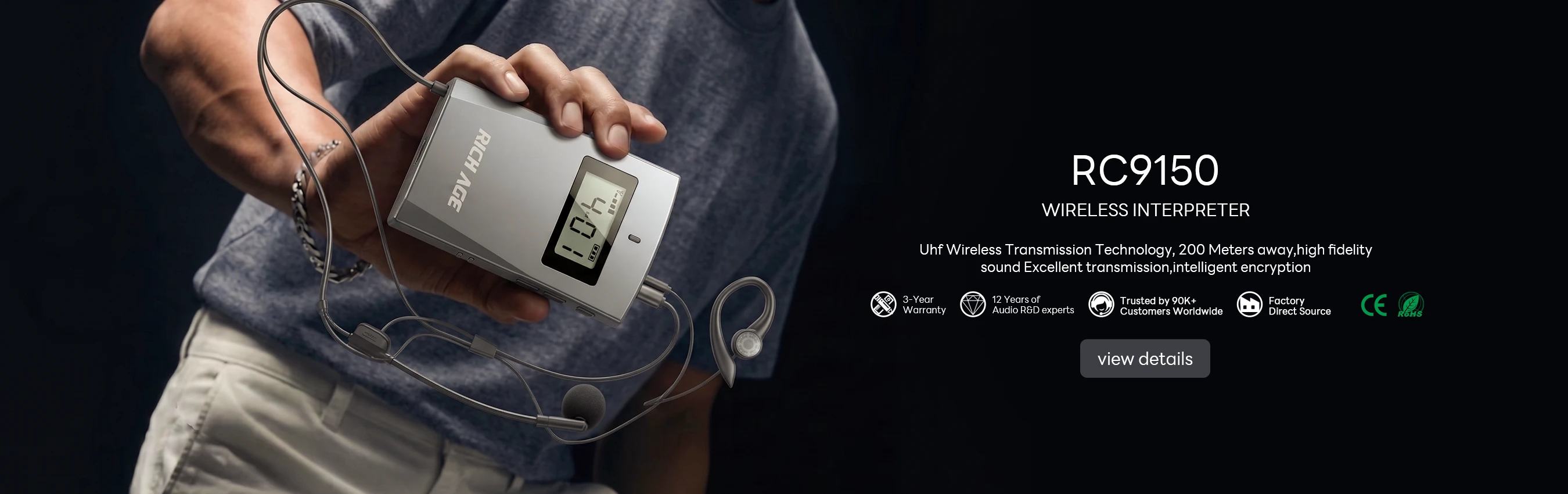
The RC9150 2.4G High Fidelity Audio Guide provides the widest channel capacity in the deployment kit. Operating within the 2403–2483 MHz frequency band, it delivers 100 independent channels, 10 mW RF output power, and a working transmission range of 1–200 meters in open environments. Both transmitter and receiver utilize 3.7V 1800 mAh lithium batteries—delivering 15 hours of transmitter runtime and 35+ hours of receiver runtime—while weighing 97.5 grams per unit with 20 Hz–8 kHz audio frequency response, PLL frequency control, and Type-C charging. Certified under CE, EMC, LVD, RED, and RoHS standards with a one-year mainboard warranty, the system also supports two-way interactive communication using dual transmitters alongside unlimited receivers.
Those exact capabilities explain why momentary signal drops leave no hardware trace. Having 100 channels allows a tour guide to shift groups away from local RF congestion, while two-way mode allows a secondary engineer to speak live on the same route—yet neither action writes a diagnostic entry to internal memory. The active channel exists strictly on the pre-tour channel allocation sheet, meaning investigators must audit the shift sheet rather than inspecting returned receivers.

Pre-tour channel allocation sheets provide the permanent frequency record that display-free RF receivers do not store
| Hardware Unit in Kit | Verified Technical Specifications Used by Shift Supervisors |
|---|---|
| RC9150 Two-Way Audio Guide | 2403–2483 MHz; 100 channels; 10 mW output; TX 15 h / RX 35+ h runtime; 1800 mAh batteries; 97.5 g per unit; Type-C charging |
| RC2500 Digital Tour System | 2403–2483 MHz; 50 channels; 10 mW output; TX 15 h / RX 35+ h runtime; 1800 mAh batteries; 104 g per unit; Type-C charging |
| 2.8-Inch Digital Audio Player | 2.8-inch LCD screen; 0–9 numeric keypad; 16 languages; 9,999 audio files; 2 GB internal memory; 18 h runtime; Micro-USB |
RC2500: How One-Key Mute Functions Leave Zero Event History
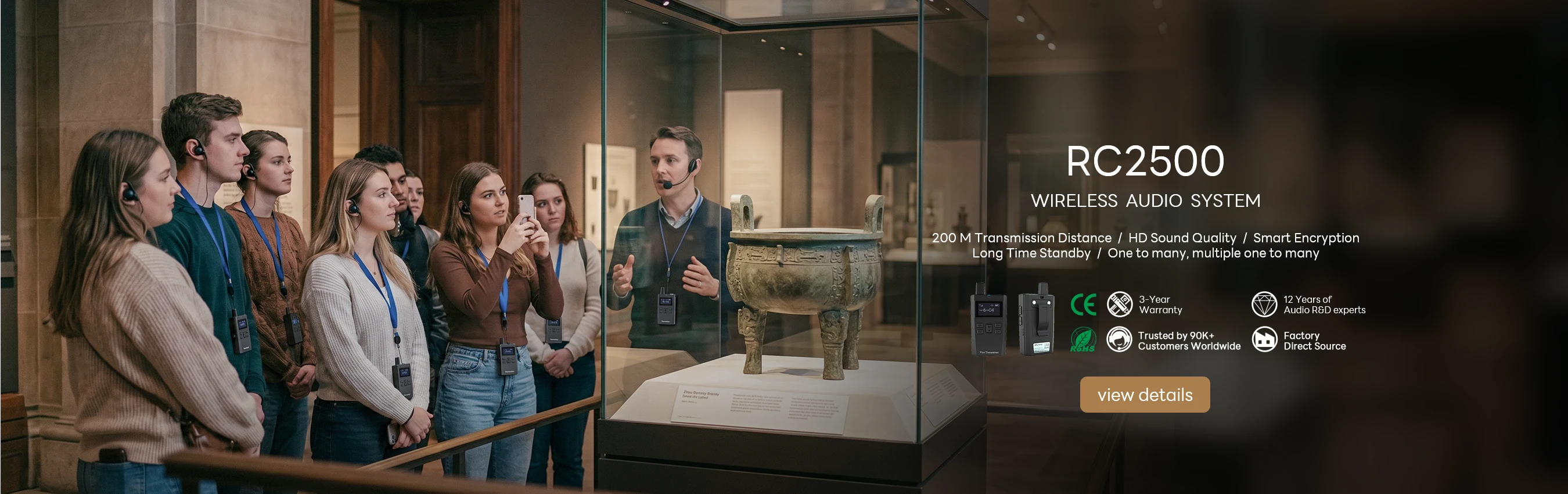
The RC2500 Digital Tour Guide System Price model operates across the same 2403–2483 MHz spectrum at 10 mW output power, configured with 50 channels, 15 hours of transmitter battery life, 35+ hours of receiver endurance, dual 1800 mAh cells, 104-gram unit weight, 50 Hz–8 kHz audio bandwidth, and Type-C charging. Built specifically for streamlined group management, its dedicated hardware functions include one-key channel synchronization, one-key receiver shut-off, and an instant transmitter mute key, backed by a -15°C to 50°C operating temperature range, CE, EMC, LVD, RED, and RoHS certifications, and a one-year mainboard warranty.
These single-button controls explain why simultaneous group-wide silence occurs without hardware faults. When thirty visitors experience audio dropout at the exact same second, the cause is not simultaneous receiver failure—it is an accidental mute press on the active transmitter. Because the transmitter stores no key-press timestamps, durable troubleshooting requires recording three administrative facts on the incident log: the tour batch ID, the assigned transmitter operator, and the exact zone along the facility route.
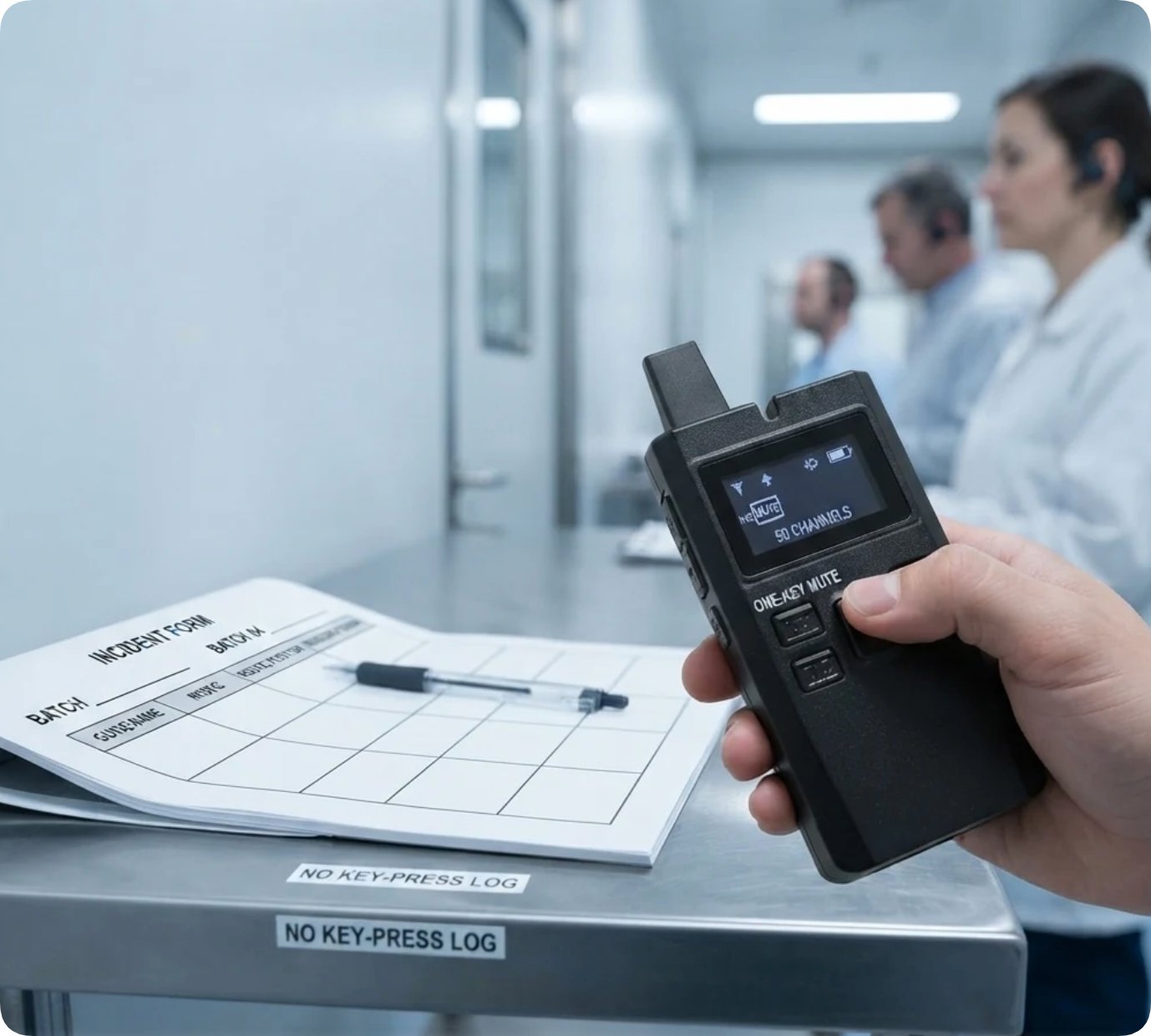
Single-key transmitter mute actions leave no internal log, making operator and route zone tracking essential
2.8-Inch Digital Audio Guide: Tracking Number-Input Events Without File Logs
Unlike wireless RF tour systems, the 2.8 Inch Display Automatic Museum Audio Guide is a standalone offline playback unit. Published specifications include a 2.8-inch display, a tactile 0–9 numeric keypad for direct track entry, 16 language slots, storage capacity for up to 9,999 audio tracks across 2 GB of internal memory, 18 hours of continuous battery life, Micro-USB charging, complimentary earphones, and a one-year main-unit warranty (excluding consumable accessories).
Because no RF transmission occurs, mismatched commentary stems from keypad input errors rather than wireless interference—such as double-tapping a digit, inheriting an altered language slot from a previous visitor, or referencing an outdated station placard. Since the screen immediately overwrites the previous track number upon the next key press, facilities close these reports by auditing the version-controlled exhibit number card and printed language guide handed out at reception.
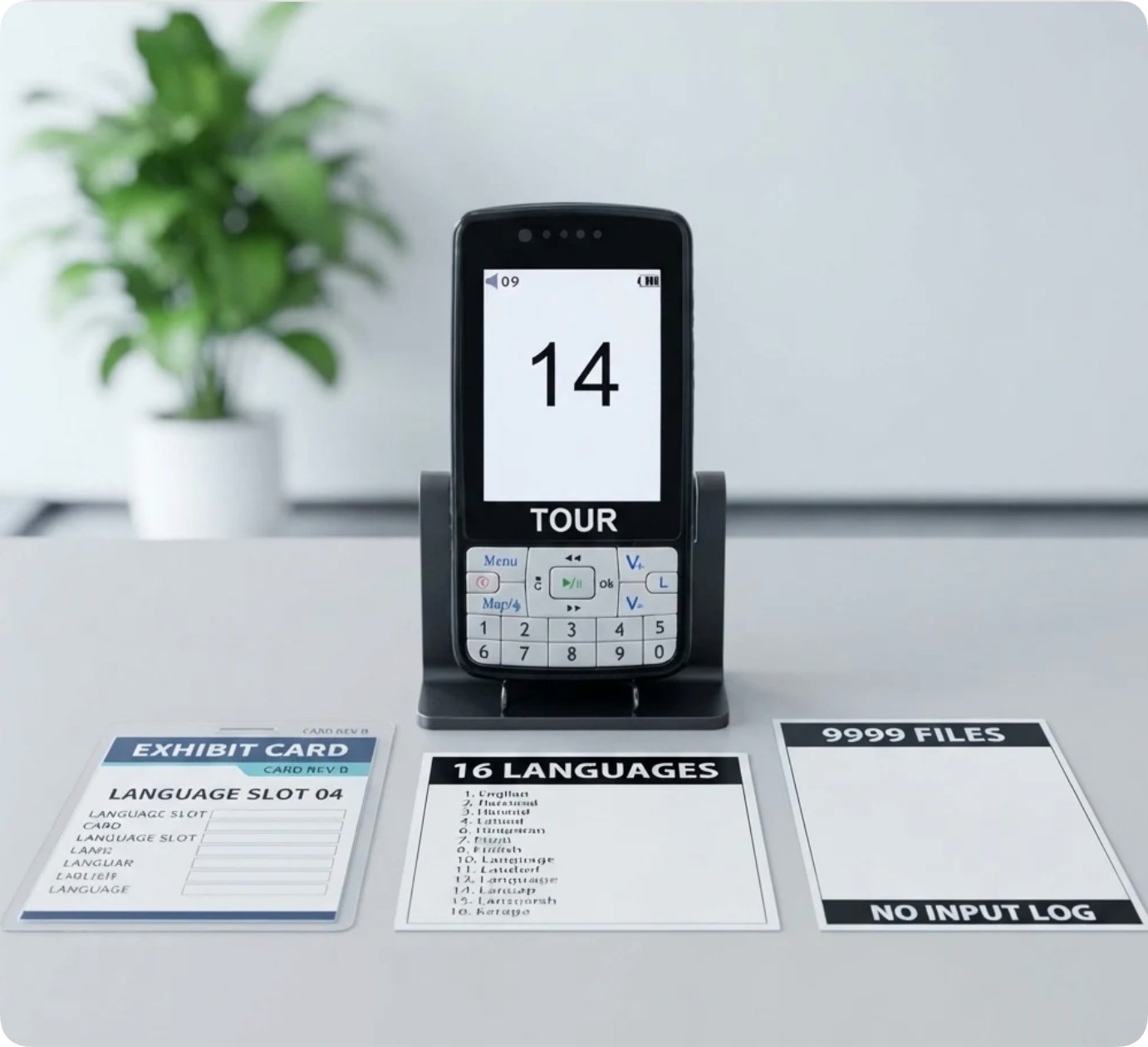
Version-controlled exhibit number cards verify track and language assignments independently of player screen history
Standardizing the Four-Column Shift Incident Log
Isolated audio complaints rarely recur identically because transient variables—passing machinery, temporary band congestion, or accidental button contact—shift between tours. Treating the absence of a repeat fault as proof that nothing occurred leaves underlying route vulnerabilities unaddressed. Keeping the full Wireless Tour Guide System Manufacturer Direct equipment lineup in view helps operations managers match transmitter count and receiver hardware to evolving plant layouts, while a standardized four-column incident log captures the exact facts hardware omits:
| Reported Visitor Symptom | Hardware Unit Involved | Hardware State Retained | Mandatory Shift Log Entry |
|---|---|---|---|
| Audio dropped near sterile filling line | RC9150 receiver | Zero channel or signal history | Assigned channel sheet & batch timestamp |
| Entire group lost audio simultaneously | RC2500 transmitter | Zero mute-key press log | Transmitter operator name & plant zone |
| Wrong exhibit commentary played | 2.8-inch digital player | Zero keypad history log | Issued number card version & language slot |
Maintaining this separation clarifies whether an acoustic disruption stems from route layout or device operation. When recurring interference appears near heavy machinery, operations teams can consult the Wireless Audio Guide Application Solutions portal to evaluate secondary transmitters or revised handover zones—a structured approach similar to the rack-row planning principles detailed in what a frozen rack row asks. Recording batch IDs, channel sheets, transmitter holders, and card versions ensures incoming shifts inherit actionable operational data.
Frequently Asked Questions (FAQ)
1. Does an RC9150 receiver store internal logs of the radio channel used during a plant tour?
Yes, the RC9150 operates across 100 independent channels on 2403–2483 MHz with 15 hours of transmitter runtime and 35+ hours of receiver runtime without storing internal channel history, so shift supervisors document assigned frequencies on a pre-tour channel sheet before entering controlled areas.
2. How do facility teams verify whether a group-wide audio pause was caused by the RC2500 mute key?
Yes, because the RC2500 features one-key frequency sync, one-key receiver shut-off, and a dedicated mute key without button-press memory, teams resolve simultaneous group silence by logging the batch number, transmitter operator name, and exact route location on the shift incident form.
3. Can staff verify wrong-track reports on the 2.8-inch digital audio player after a tour finishes?
Yes, while the 2.8-inch screen displays only the active track number among its 9,999 files and 16 language slots without keeping a keypad log, staff verify content accuracy by checking the version-controlled exhibit number card and printed language slot issued at the tour desk.
4. Which hardware specifications and administrative records belong on a factory tour handover sheet?
Yes, an effective handover sheet pairs verified device parameters—100 channels on the RC9150, 50 channels with one-key controls on the RC2500, and 18-hour battery life with 2 GB memory on the 2.8-inch player—with the batch ID, channel plan, transmitter operator, and number-card version.