


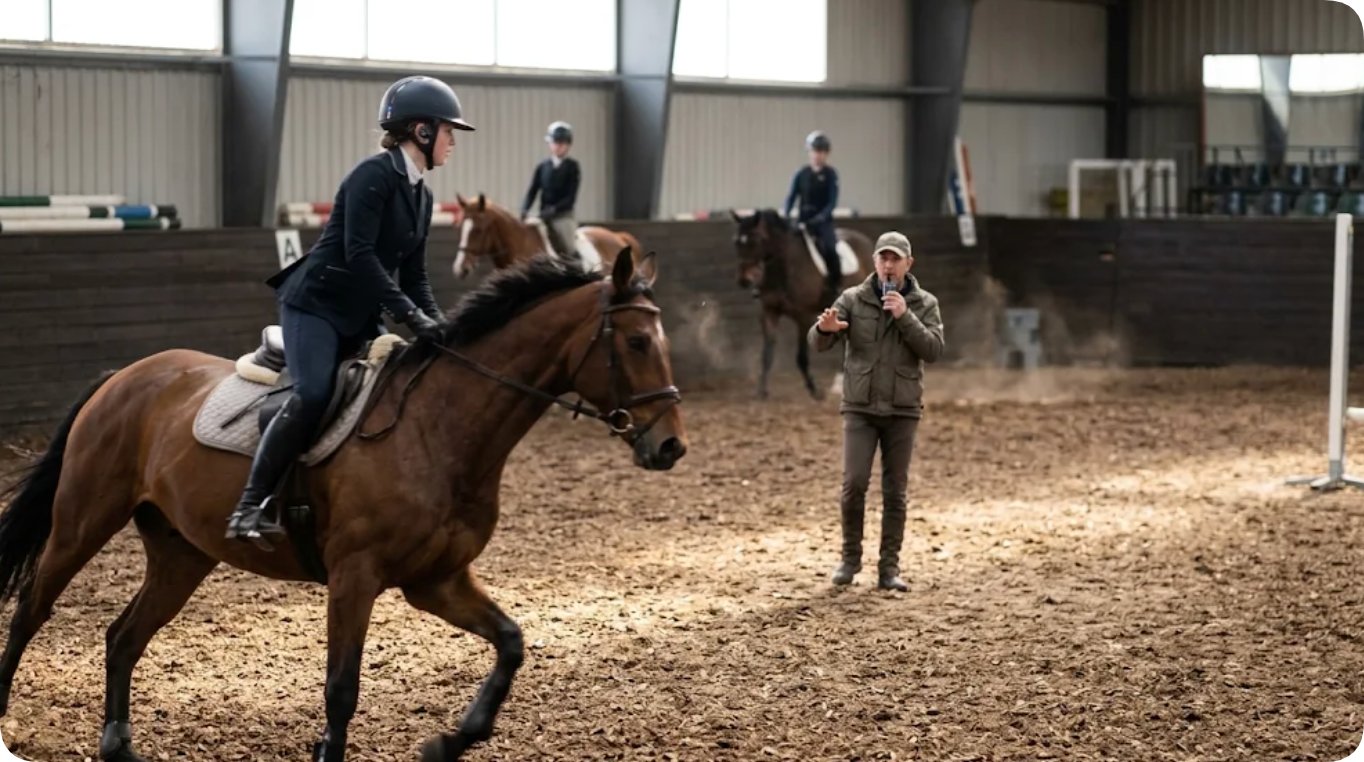
In an equestrian arena, a spoken coaching cue has a shelf life measured in strides. While six riders work a 20-meter circle around an instructor, every horse keeps moving whether the verbal correction arrives on time or two beats late. Telling a student to shorten the inside rein applies to one specific corner; three strides later, the horse has already left that balance point behind. Arena PA speakers and laminated rail cards fail because they anchor instructions to a fixed spot while the lesson moves continuously. Facilities outfitting their arenas with Equestrian Training Wireless Audio Equipment quickly realize that clarity is only half the equation—timing relative to the horse's stride determines whether an instruction works.
Three distinct audio tools now share space in modern tack rooms, each built around a different delivery window: the RC9150 2.4G Wireless Tour Guide System transmits live voice cues at the exact millisecond a horse steps into a turn; a Silent Disco Wireless Headphone System loops steady rhythm tracks and arena safety briefings without external speakers; and a 2.8-Inch Display Automatic Audio Guide stores on-demand technical explanations that riders trigger after dismounting. Rather than competing as upgrades of one another, each device handles a distinct phase of a riding session.
1. Why Arena Acoustics and Static Cues Fail Moving Riders
A rider in motion cannot check a whiteboard or free a gloved hand from the reins to adjust equipment. Wearing a certified riding helmet that partially covers the ears—while contending with hoofbeats, indoor arena echo, or outdoor wind—means coaching cues must land directly inside the ear at the exact moment a horse initiates a transition. A cue heard three seconds late is not merely delayed; applied to the wrong bend or lead, it actively disrupts the horse's balance.
Consider the math of a standard 45-minute group lesson: six riders pass the instructor roughly every 90 seconds, and the coach issues a targeted correction on nearly half of those passes. Between the verbal cue and the arena corner, the horse takes three to four strides—the entire window during which those words remain accurate. Yard managers who track lesson feedback see the same pattern repeatedly: riders rarely complain about volume, but they frequently struggle when shouted instructions echo across the ring after they have already passed the marker. Evaluating tack-room audio equipment therefore starts with three operational questions: who triggers the audio, what causes the message to expire, and what happens when a cue arrives late.
2. Real-Time Stride Corrections: RC9150 2.4G Wireless Audio Guide
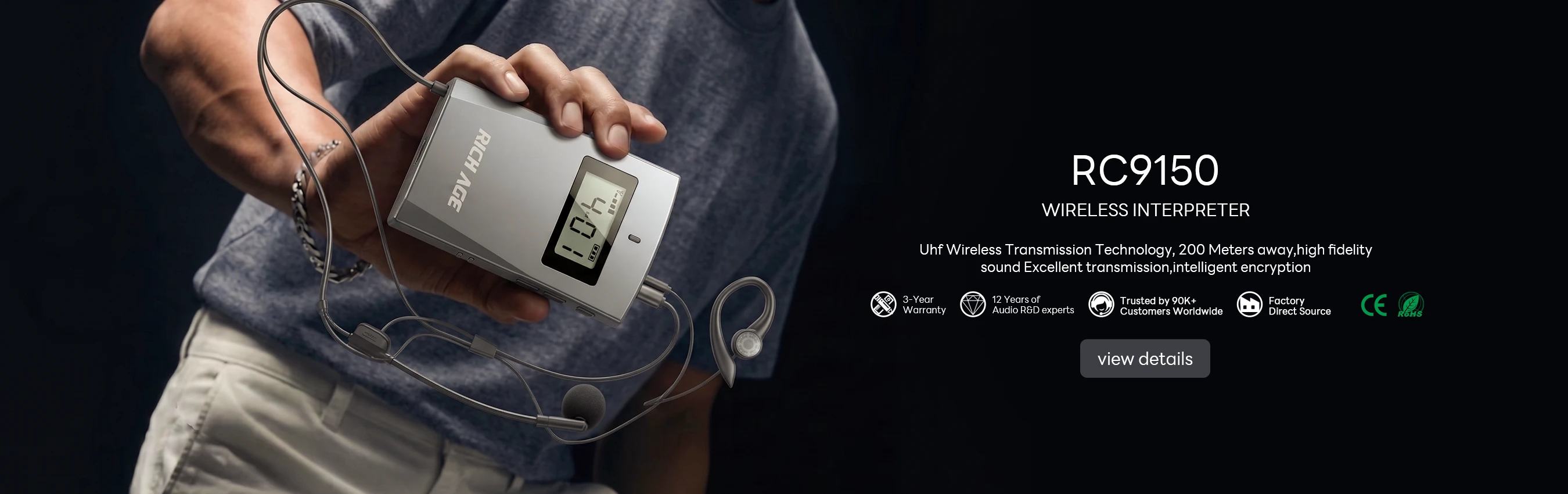
The RC9150 2.4G High Fidelity Audio Guide handles the shortest, highest-value window in equestrian coaching: live, zero-latency feedback while the horse is in motion. The instructor speaks naturally into a compact transmitter, and every paired receiver hears the correction instantaneously—no pre-recording, no buffering delay, and no shouting across an open paddock. Once the horse finishes the turn, that cue's job is done, and the coach delivers a fresh adjustment on the next pass.
Published technical specifications explain why this handset fits daily barn schedules:
100 Independent Channels (2403–2483 MHz): Lets multiple instructors teach simultaneous flatwork, jumping, and dressage sessions in adjacent rings without frequency crosstalk.
1–200 m Working Range & 10 mW Output: Covers full-sized 20 × 60 m dressage arenas and outdoor jumping paddocks with stable PLL frequency synthesis.
15-Hour Transmitter / 35+ Hour Receiver Runtime: Powered by 3.7 V 1800 mAh batteries with USB Type-C charging, allowing receivers to run through two full teaching days per charge.
97.5 g Chassis & 20 Hz–8 kHz Voice Band: Light enough to clip securely to a rider's collar or vest without swinging during posting trot or canter transitions, tuned specifically for crisp vocal intelligibility, and backed by CE, EMC, LVD, RED, and RoHS certifications plus a one-year mainboard warranty.
3. Continuous Tempo & Group Briefings: Silent Disco Wireless Headphone System
A Silent Disco Wireless Audio Headphone System solves a completely different training challenge by broadcasting continuous, non-expiring audio to an entire group without disturbing nearby horses or neighbors. Whether playing a metronome beat for sitting-trot rhythm, running musical freestyle dressage rehearsals, or looping gate safety rules during clinic check-in, the audio track stays valid from the first lap to the final halt.
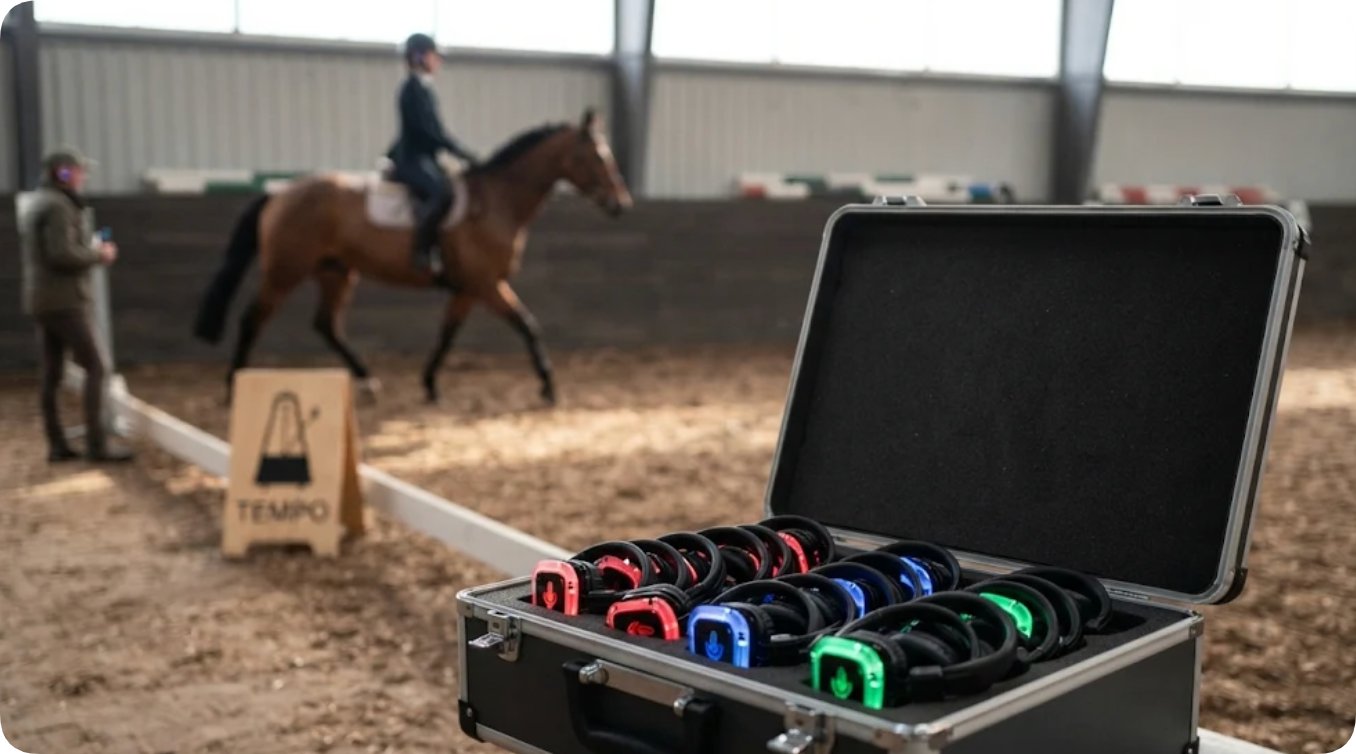
Operating on UHF/RF 863/925 MHz bands, the system delivers 200 m reach in low-power mode—already sufficient for standard riding arenas—and 500 m+ in high-power mode for expansive showgrounds and cross-country warm-up fields. Its specification table lists 10 FM stereo channels with 10 color-coded LED indicators (while the overview notes a three-channel configuration option for smaller setups), allowing barn staff to verify at a glance which channel every rider has selected.
Each foldable headphone houses 40 mm Mylar drivers spanning 30–20,000 Hz (SNR > 75 dB, THD < 1%) for full-spectrum musical clarity, powered by a 500 mAh lithium battery providing 10 hours of playback on a 3-hour USB Type-C charge under CE, FCC, and RoHS compliance with a one-year limited warranty. Because the track never comments on an individual horse's stride, it frees the instructor from repeating tempo counts and safety rules all morning.
4. Post-Ride Review & Self-Guided Drills: 2.8-Inch Display Audio Guide
The 2.8 Inch Display Automatic Museum Audio Guide shifts control directly to the student. Designed as a standalone handheld player with a 2.8-inch LCD screen and tactile 0–9 numeric keypad, it plays pre-loaded audio modules whenever a rider keys in an exercise number. Technical breakdowns—such as half-halt mechanics, jump-course walk notes, or stable-management checklists—never go out of date, remaining just as accurate at 5:00 PM as at 8:00 AM.
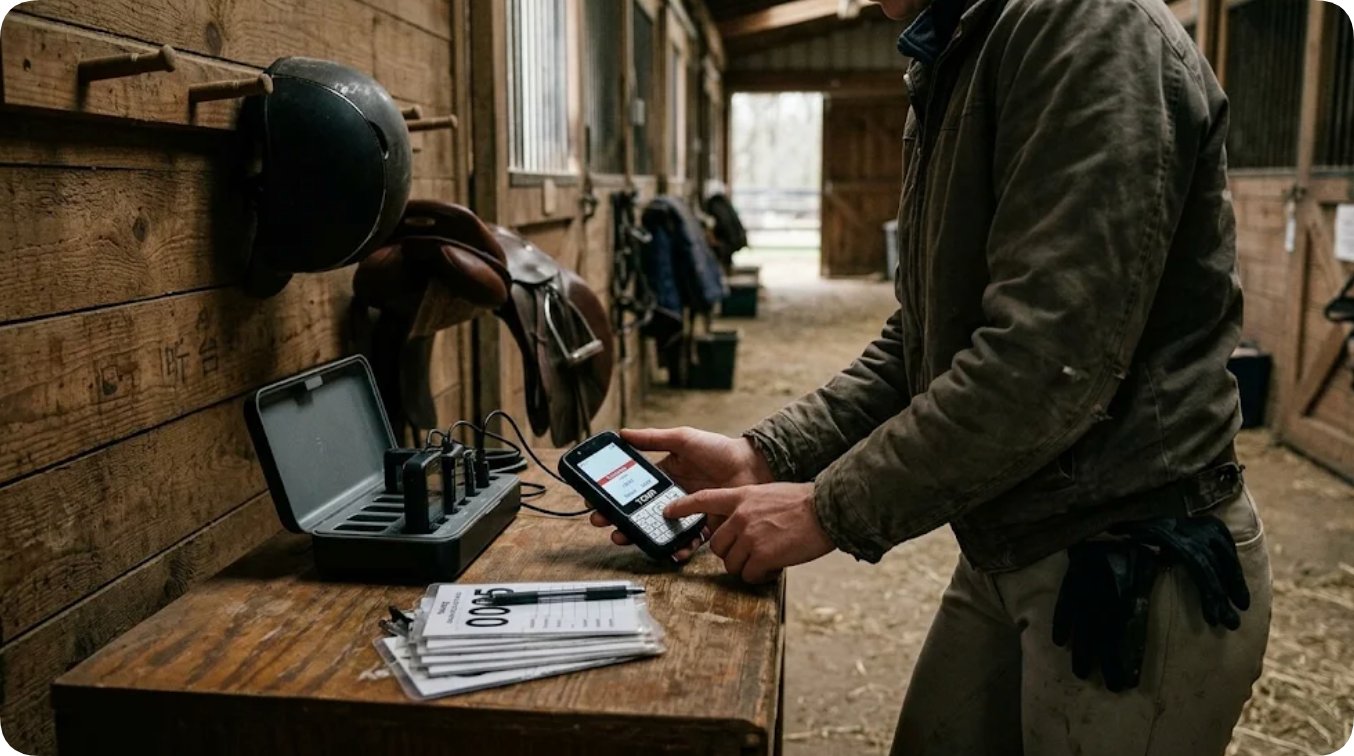
With 2 GB of internal storage holding up to 9,999 audio files across 16 languages, dedicated play/pause/volume keys, included earphones, and 18 hours of continuous battery life (recharged via Micro USB or multi-slot charging trays), this unit shines in tack rooms, course walks, and pony-club theory stations. Because all audio files reside locally inside the player's flash memory rather than over a live RF link, the datasheet omits radio frequency, wireless range, and transmitter-receiver weight rows—reflecting its role as an on-demand study companion once both hands are off the reins.
5. Lesson Timeline Matrix: When Each Coaching Line Expires
Viewing equestrian audio equipment through the lifecycle of a single instruction clarifies why all three formats belong in a well-equipped riding school rather than competing for the same budget line.
| Instruction Format | Who Triggers the Line | What Ends Its Validity | Impact of Late Delivery |
|---|---|---|---|
| Live Coaching Cue (RC9150) | The instructor, at the exact stride needing adjustment | The horse completing that stride or corner turn | High: rider applies a corrective aid after the movement has passed |
| Looping Rhythm / Brief (Silent Disco) | Barn staff or coach, once before the session begins | The end of the riding block or drill phase | Zero: track is designed for continuous pacing rather than single strides |
| Numbered Audio Entry (2.8" Player) | The student, by entering a track number on the keypad | Never: stored explanations remain valid indefinitely | Low: best suited for post-ride review or dismounted course walks |
| Printed Arena Wall Card | Static signage mounted prior to lessons | Any change in drill pattern or horse gait | High: riders lose visual focus on the ring and misread outdated patterns |
Facilities looking to standardize multi-ring wireless hardware directly from the factory can compare full transmitter and receiver families through our Wireless Tour Guide System Manufacturer Direct lineup before mapping devices to lesson blocks.
6. Published Hardware Specifications by Equipment Role
Because these three units serve fundamentally different physical roles—one-way live RF coaching, wide-band stereo headphone broadcasting, and offline keypad playback—each row below lists exact figures published on its respective product datasheet without extrapolating missing fields.
| Equipment Platform | Published Technical Specifications |
|---|---|
| RC9150 Transmitter & Receivers | 100 channels, 2403–2483 MHz (PLL synthesis), 1–200 m range, 10 mW output, 15 h transmitter / 35+ h receiver runtime (3.7 V 1800 mAh), 97.5 g per unit, 20 Hz–8 kHz audio response, USB Type-C charging, CE/EMC/LVD/RED/RoHS certified |
| Silent Disco Wireless Headphone Set | UHF/RF 863/925 MHz, 200 m low-power / 500 m+ high-power reach, 10 FM stereo channels in spec table (3-channel option noted in overview), 500 mAh battery, 10 h playback, 3 h USB Type-C charge, 40 mm Mylar drivers (30–20,000 Hz), CE/FCC/RoHS certified |
| 2.8-Inch Number-Pad Audio Guide | 2.8-inch display screen, 0–9 numeric keypad, 16 languages, up to 9,999 audio tracks, 2 GB built-in memory, 18 h continuous battery life, Micro USB charging (multi-slot tray compatible), one-year unit warranty |
7. Deploying Each System Across Arena Zones and Daily Schedules
Matching hardware to arena architecture eliminates wasted spend and afternoon fatigue:
Indoor Covered Arenas (20 × 40 m): Roof reverb turns PA speakers into muddy echoes, and partition walls rarely stop shouted instructions from bleeding into adjacent rings. The RC9150's 100 channels keep two simultaneous classes completely isolated inside the same building.
Outdoor Paddocks & Showgrounds: Crosswinds strip vocal volume across open sand rings. The RC9150's 1–200 m reach and the Silent Disco set's 200 m low-power mode cover full outdoor rings effortlessly, while the headphone set's 500 m+ high-power mode scales up for multi-ring showgrounds and spectator canopies.
Tack Rooms, Walkways & Open Days: After dismounting, riders have both hands free to key exercise numbers into the 2.8-inch player for structured post-ride recap, while spectator tents run looping safety tracks on Silent Disco channels without pulling coaches away from the ring.
Barn managers organizing multi-zone visitor and student workflows can explore proven layouts across our Wireless Audio Guide Application Solutions portal. Much like our field breakdown on bolting or packing a mine visit kit—which separates gear by what must be anchored before a shift begins—equestrian facilities get the cleanest results when they assign each audio unit to the exact moment its message stays valid.
Frequently Asked Questions
1. Can a single live wireless system like the RC9150 handle every part of an equestrian training program?
Yes for real-time riding instruction, while pairing it with looping headphones and number-pad players covers non-live phases seamlessly. The RC9150 delivers instantaneous stride-by-stride corrections across 100 channels, Silent Disco headphones handle continuous rhythm tracks and spectator safety loops, and the 2.8-inch player supports dismounted theory review on separate channels.
2. How many channels should buyers specify when ordering the Silent Disco Wireless Headphone System?
Ten channels is the standard figure published in the product specification table, with 10 corresponding LED indicator colors on the earcups. Because the product overview also notes a three-channel configuration option for smaller groups, buyers should specify the 10-channel table version on procurement sheets when running multiple concurrent tracks.
3. Does the 2.8-inch display audio guide require a wireless transmitter in the arena?
No. The 2.8-inch player is a self-contained offline audio unit with 2 GB of built-in memory storing up to 9,999 files across 16 languages, so it requires no RF transmitter, radio frequency allocation, or wireless pairing to play numbered training tracks.
4. How long do the RC9150 batteries last across back-to-back daily riding lessons?
The RC9150 transmitter runs for 15 hours and each 97.5 g receiver runs for 35+ hours on a single USB Type-C charge of their 3.7 V 1800 mAh batteries, covering an entire day of lessons on the transmitter and two full days on the receivers without midday swaps.