

Aligning the Three Operational Schedules That Govern Daily Deployment
Three internal operational logs already exist inside every wildlife park and botanical estate prior to hardware selection. Visitor services manages the group booking ledger covering school excursions, coach arrivals, and member mornings. Zoological and horticultural teams maintain the animal husbandry and grounds sheet tracking feeding schedules, quarantine zones, glasshouse replanting, and veterinary rounds. Meanwhile, operations staff control the equipment charging rota. Venue planners designing guided trails frequently consult our City Sightseeing Tour Audio Solutions guide to structure route layouts, yet accurate financial modeling begins one step earlier by auditing permitted operating dates.
Cross-referencing these three records day by day—rather than aggregating weekly summaries—exposes true hardware utilization. A calendar date counts as a productive operating day only when the booking ledger confirms a scheduled group, the husbandry log clears the exhibit path, and the charging rota verifies a paired, fully charged kit. Any date meeting only two of those three conditions represents an unbilled blank day. Auditing raw operational logs rather than cleaned post-season reports preserves rescheduled and canceled entries, pinpointing exactly why fully charged receivers remained untouched in storage.
Why Group Booking Ledgers Overstate Active Equipment Days
Reservation calendars record visitor intent rather than physical exhibit access. School excursions heavily concentrate on midweek mornings—the exact off-peak windows horticultural teams reserve for conservatory pruning and soil maintenance. Similarly, a Saturday coach tour postponed due to heavy rain appears simply as a rescheduled line item on the sales ledger, yet staff have already paired, charged, and logged out the receivers the previous evening, incurring full handling labor with zero tour output.
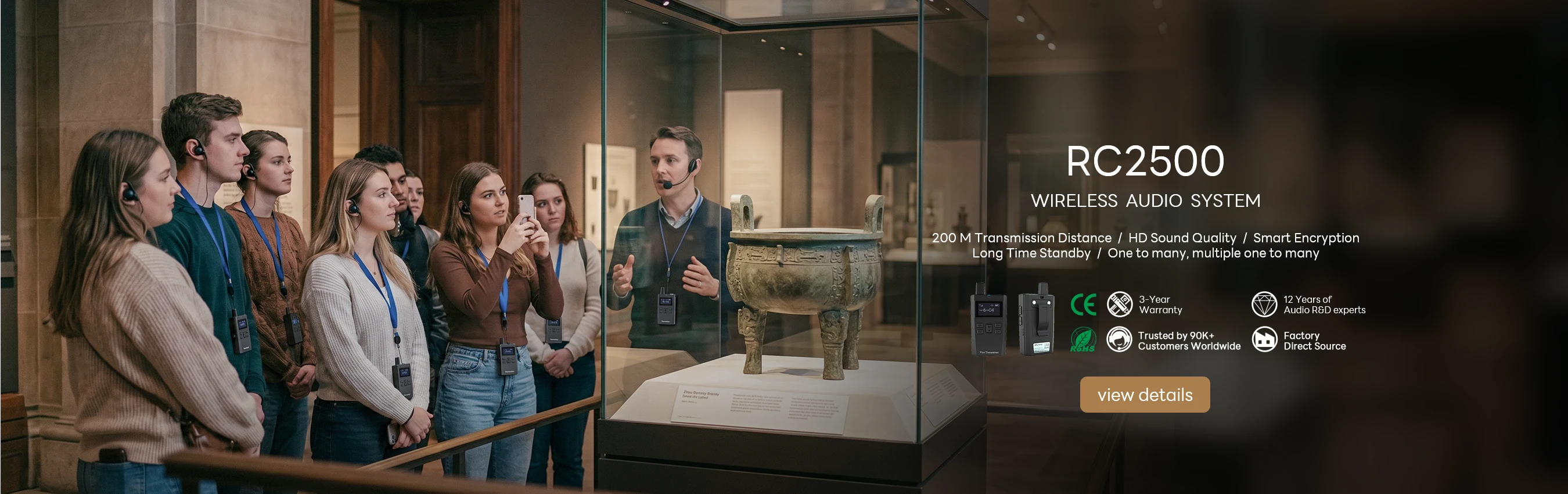
When minimizing daily turnaround labor across multi-day bookings, procurement teams evaluate the RC2500 Digital Tour Guide System Price and technical profile. Operating on the 2403–2483 MHz frequency band with 50 selectable channels, 10 mW transmission output, and a 1–200 m working range, the RC2500 pairs a 15-hour transmitter with a 35+ hour receiver powered by dual 1800 mAh cells. Featuring USB Type-C charging, a 35+ hour standby rating, and one-key channel sync, mute, and shutdown controls, this architecture relieves overnight charging bottlenecks by allowing receivers to remain field-ready across consecutive operating days without mandatory evening collection.
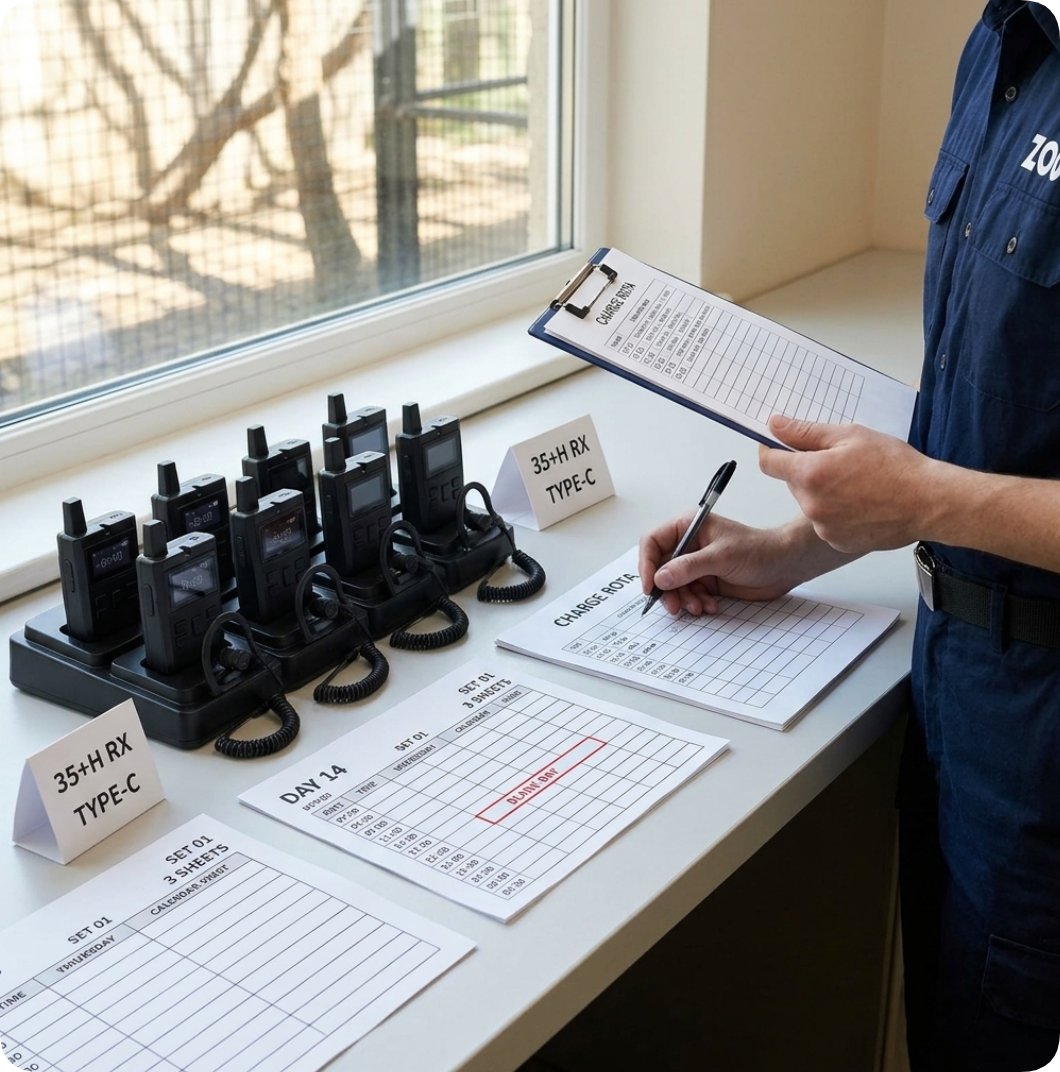
Channel capacity governs a separate operational bottleneck. When four school coaches unload simultaneously during a morning peak, each tour group requires a dedicated interference-free channel plus a pre-assigned backup frequency documented prior to arrival. Built with PLL frequency synthesis, a 50 Hz–8 kHz audio response, and matching 104 g transmitter and receiver housings, the RC2500 supports up to 50 distinct groups—defining the exact ceiling of concurrent tours a single hardware fleet can service during peak hours.
How Animal Husbandry and Exhibit Schedules Restrict Route Availability
Biological care routines remove operating days from the calendar in ways reservation software never anticipates. A two-week veterinary quarantine closes an entire primate pavilion, conservatory replanting suspends indoor tropical loops for forty-eight hours, and shifting carnivore feeding times forward by sixty minutes eliminates mid-morning walking tours even when pathways remain open. Because these adjustments rarely register as formal ticket cancellations, they appear on the ground simply as guides halted at temporary barriers.
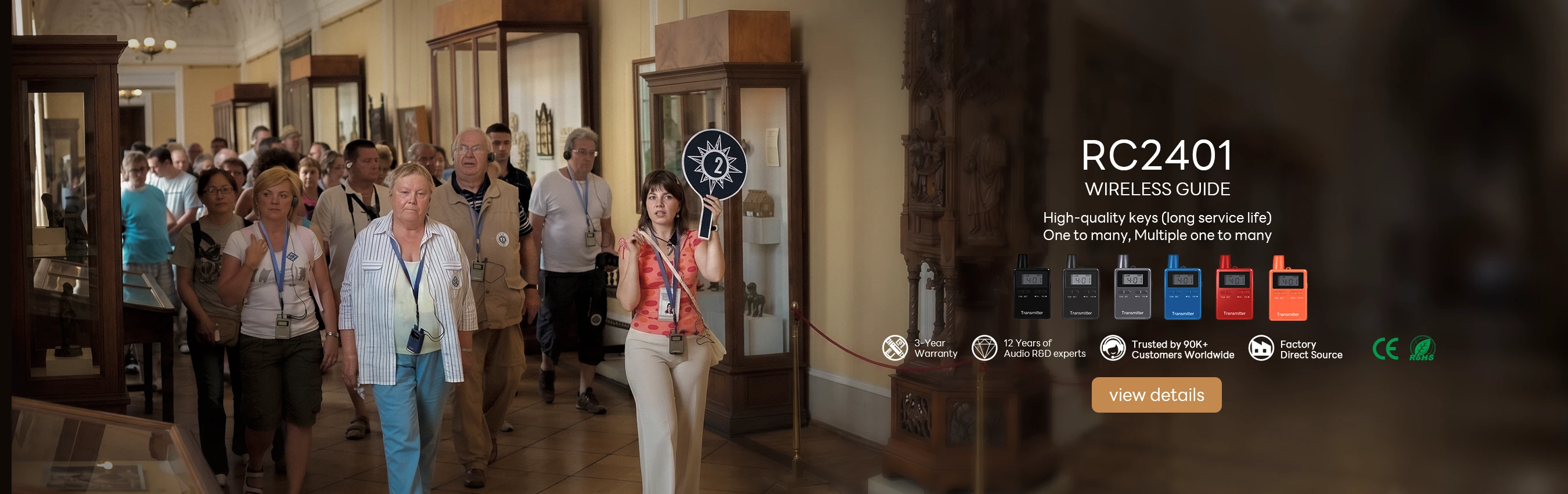
To maximize revenue on the high-density dates that remain open, the RC2408 Long Range Wireless Audio Guide expands concurrent group capacity to 80 selectable channels across the 2403–2483 MHz band at 10 mW output. Engineered in ultra-lightweight 59 g transmitter and 50 g receiver enclosures, it delivers 10 hours of transmitter runtime (1500 mAh battery) and 20 hours of receiver runtime (1000 mAh battery), alongside wideband frequency response (50 Hz–200 kHz TX / 50 Hz–12 kHz RX), one-key channel synchronization, two-way communication support, and CE, FCC, and RoHS certifications under a one-year limited warranty.
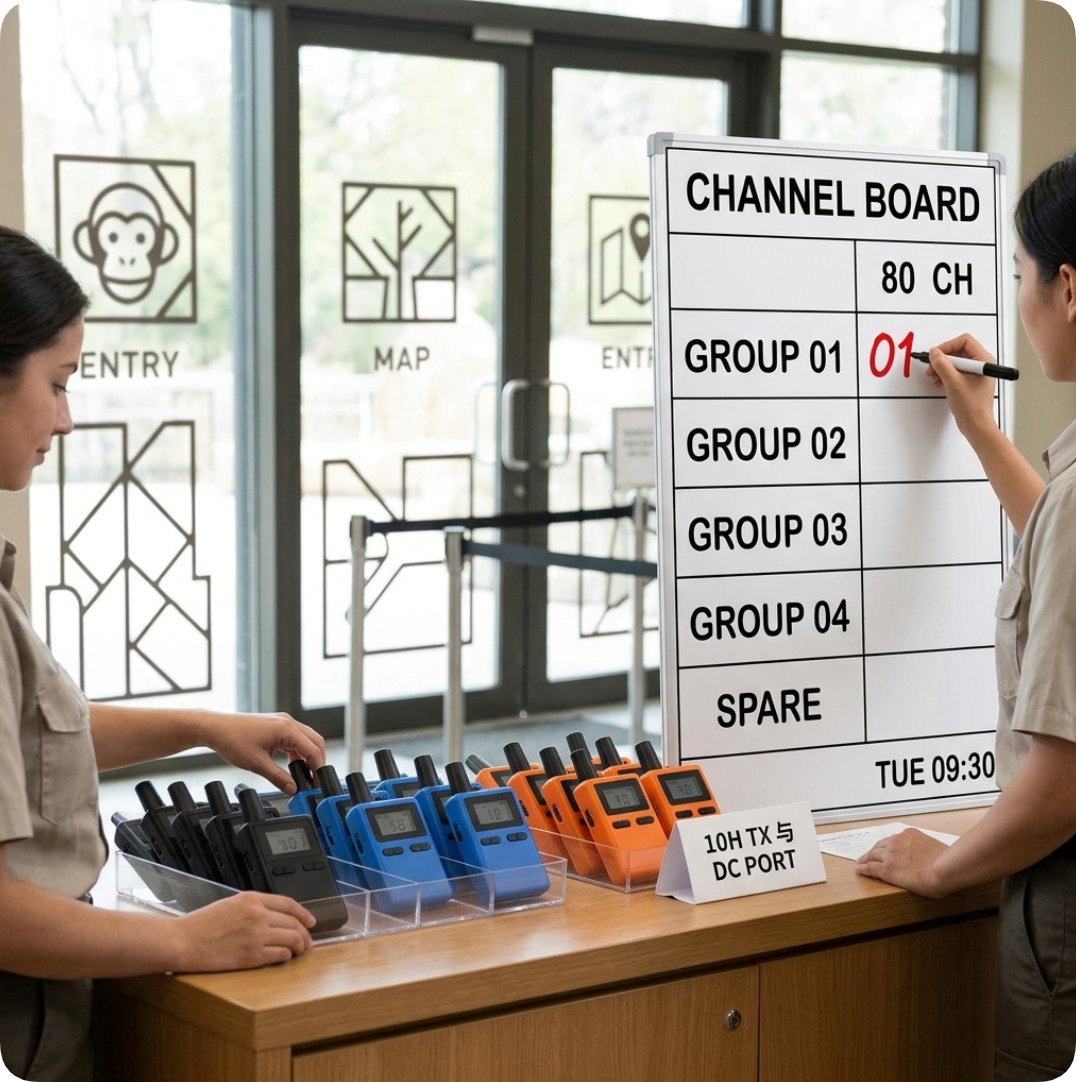
While 80 channels allow dozens of staggered tours to operate simultaneously on peak weekends, its 10-hour transmitter endurance and DC barrel charging port require strict evening check-in discipline. When an evening twilight safari is followed immediately by an 08:30 school excursion the next morning, staff availability to dock, verify, and recharge every transmitter overnight directly determines whether the morning slot is operational.
Accounting for Weather Closures and Maintenance Windows in ROI Models
Inclement weather eliminates full operating days, while routine grounds maintenance restricts specific zones. Extended rainfall forces outdoor savanna walks indoors into reptile houses and aquariums, compressing multiple groups into tight acoustic spaces that demand immediate frequency reassignment. Furthermore, a scheduled Monday maintenance closure never represents zero operational cost: batteries self-discharge in storage, earpieces remain paired, and prior-day inventory reconciliation logs still require administrative processing.
Accurate financial modeling retains closed and weather-blocked dates inside the annual denominator rather than stripping them out. Dividing total capital expenditure, charging labor, and replacement reserves strictly across verified active tour days reveals true per-day equipment cost. An open-air wildlife reserve with seasonal winter closures experiences a substantially smaller active denominator than a climate-controlled conservatory—a structural reality that must be reflected in procurement worksheets.
Dawn Turnaround Constraints: Overnight Charging and Headphone Audits
The charging rota is the sole operational schedule entirely under the equipment team's direct control, tracking kit issuance, evening returns, charging cycles, and earpiece pairing before storage cases lock. An uncharged case at 07:30 cancels an 08:30 VIP tour regardless of clear weather or open exhibits.
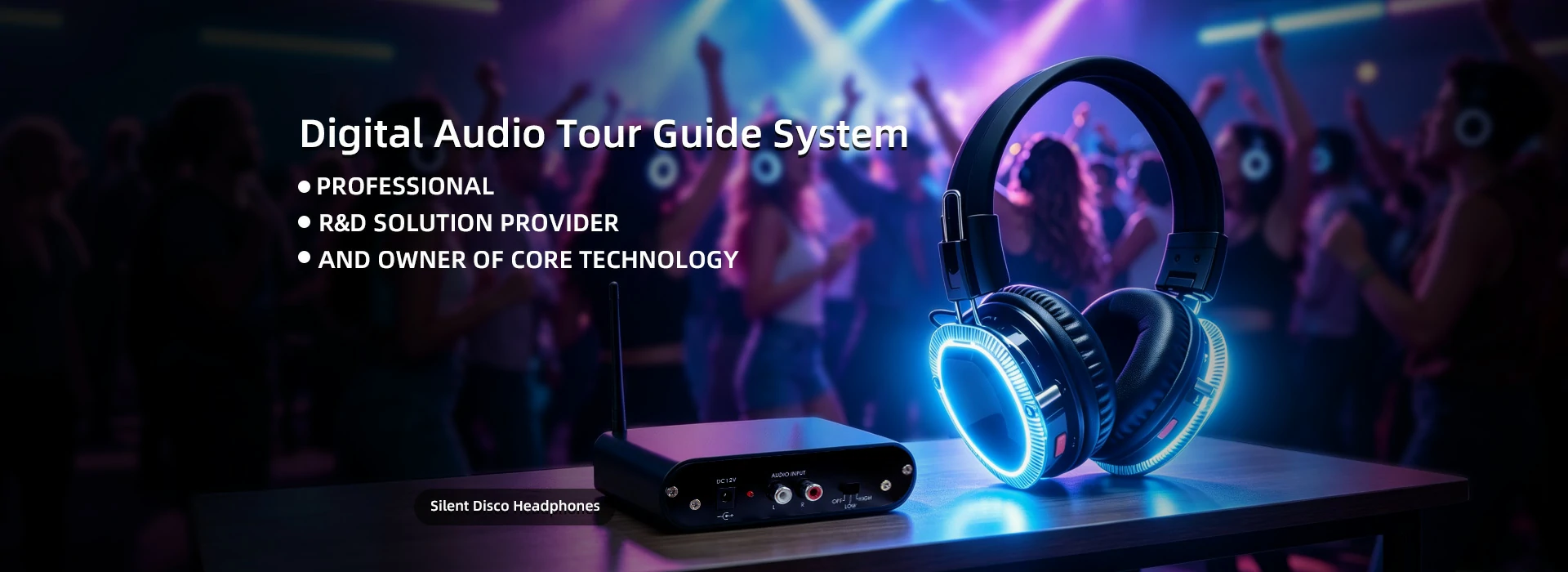
Deploying a Silent Disco Wireless Audio Headphone System for after-dark events or immersive soundscapes introduces the longest turnaround step on the rota. Combining RC-409 foldable stereo headsets with the RC-50RF transmitter, this system delivers 10-color LED channel indicators, built-in 500 mAh rechargeable cells providing 10 hours of playback via a 3-hour fast charge, 40 mm Mylar drivers (30–20,000 Hz response, >75 dB SNR), dual-PLL stability, independent on-ear volume controls, CE/FCC/RoHS compliance, and selectable 200 m low-power or 500 m+ high-power transmission ranges.
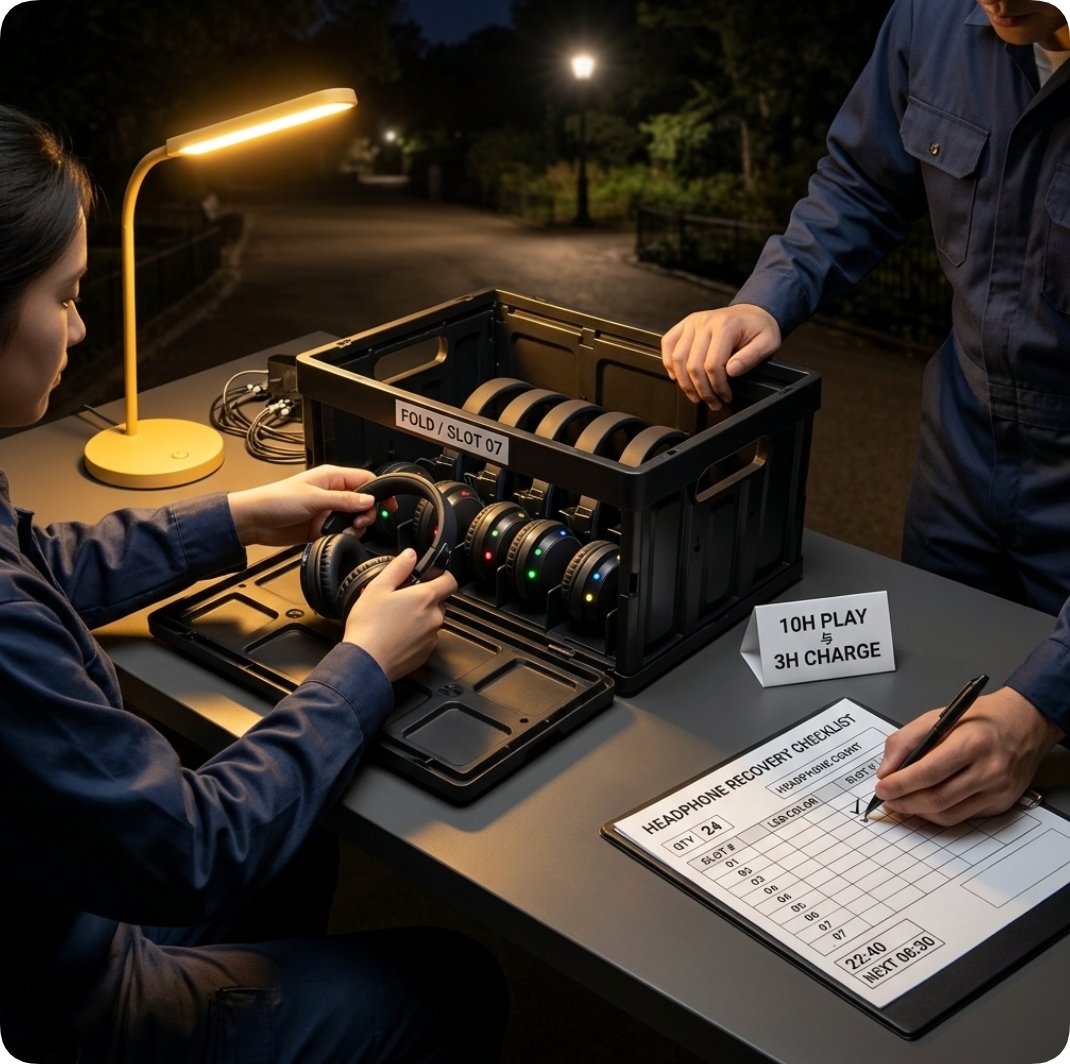
Because every full-size headset must be individually accounted for, sanitized, verified for LED channel state, and folded into charging slots before its three-hour recharge cycle begins, a late-night event frequently eliminates early-morning availability the following day. Because over-ear silent event headsets serve a distinct acoustic role compared to single-ear spoken tour receivers, procurement planners evaluate them on a separate operational line rather than merging incompatible product classes into one table.
Technical Specification Matrix: RC2500 vs. RC2408
Evaluating published datasheet metrics alongside calendar constraints clarifies how each tour guide system impacts daily operations. Extended receiver endurance directly relieves overnight charging pressure, whereas expanded channel capacity multiplies concurrent group throughput. Full family documentation is available on our Wireless Tour Guide System Manufacturer Direct portal.
| Published Specification | RC2500 Digital Tour Guide System | RC2408 Wireless Audio Guide |
|---|---|---|
| Core Frequency Band | 2403–2483 MHz | 2403–2483 MHz |
| Selectable Channels | 50 Channels | 80 Channels |
| Transmission Distance | 1–200 m (Open Ground) | 1–200 m (Open Ground) |
| RF Output Power | 10 mW | 10 mW |
| Transmitter Battery Runtime | 15 Hours | 10 Hours |
| Receiver Battery Runtime | 35+ Hours | 20 Hours |
| Battery Cell Capacity (TX / RX) | 3.7V 1800 mAh / 3.7V 1800 mAh | 3.7V 1500 mAh / 3.7V 1000 mAh |
| Unit Weight (TX / RX) | 104 g / 104 g | 59 g / 50 g |
| Audio Frequency Response | 50 Hz–8 kHz | TX: 50 Hz–200 kHz; RX: 50 Hz–12 kHz |
| Synthesis / Finish / Charging Port | PLL; Black; USB Type-C | PLL; Multi-Color; DC Port |
Additional datasheet parameters directly reinforce environmental planning: the RC2500 operates across -15°C to 50°C, supports up to five simultaneous transmitters per group with unlimited receivers, and carries CE, FCC, and RoHS certifications with a one-year warranty. Meanwhile, the RC2408 adds two-way interactive communication and one-key synchronization, making it ideal for interactive Q&A sessions on crisp outdoor mornings.
Step-by-Step Framework to Audit Usable Operating Days Before Ordering
Follow this four-step audit protocol to establish a reliable equipment utilization baseline:
Gather Historical Raw Logs: Pull unedited group booking grids, animal husbandry closure sheets, and equipment charging logs from a complete prior operating season.
Cross-Match Daily Availability: Align all three logs by calendar date and flag only dates where a group was booked, the route was cleared, and charged hardware was ready.
Isolate Two-of-Three Blank Days: Record dates missing one condition in a separate column, tagging the specific department responsible for the bottleneck.
Calculate True Cost Per Active Day: Divide total hardware acquisition, maintenance, and handling costs by verified active dates, then multiply daily capacity by the system's channel ceiling.
| Operational Calendar | Surface Symptom at Desk | Primary Audit Metric | Common Accounting Misconception |
|---|---|---|---|
| Group Booking Grid | Scheduled coach party with no cleared exhibit path | Last-minute cancellations and weather reschedules | Equating gross reservations with actual hardware runtime |
| Husbandry & Grounds Sheet | Pavilion closed without triggering a ticket refund | Quarantine windows, replanting, feeding shifts | Treating uncancelled route blocks as zero-impact days |
| Weather & Seasonal Closures | Park gates closed during winter or severe storms | Off-season shutdowns and rainout frequencies | Omitting closed dates from the annual ROI denominator |
| Equipment Charging Rota | Uncharged storage case sitting on shelf at 07:30 | Evening check-in counts, charge start times, pairing | Blaming battery chemistry for staffing turnaround gaps |
Frequently Asked Questions (FAQ)
1. How many internal schedules must align to calculate true ROI for a zoo audio guide system?
Three schedules must align on every counted operating day: the visitor services group booking grid, the zoological husbandry and exhibit closure log, and the equipment charging rota. Dates missing any one of these three conditions are recorded as blank days to identify operational bottlenecks accurately.
2. Why are silent disco headphones evaluated separately from the RC2500 and RC2408 tour guide systems?
Silent disco headphones represent a distinct over-ear stereo event class requiring individual headset counting, folding, and a three-hour recharge cycle after late-night programs, whereas the RC2500 and RC2408 are lightweight single-ear spoken tour guide systems engineered for rapid daytime group turnover.
3. Which tour guide model best reduces overnight charging bottlenecks across consecutive tour days?
The RC2500 digital tour guide system eliminates overnight charging bottlenecks most effectively, delivering 35+ hours of receiver battery life, 35+ hours of standby endurance, and modern USB Type-C charging so kits remain ready across consecutive operating days.
4. What denominator provides an accurate return-on-investment calculation for seasonal parks?
Total verified active tour days—the exact count of calendar dates where a charged, inspected kit actually leaves storage for a cleared tour route—provides the only accurate denominator, keeping winter shutdowns and rainout closures visible in cost-per-day calculations.
The video below demonstrates wireless tour guide system channel synchronization, group audio management, and charging case workflows for outdoor attractions.