





Consider a typical testing facility operating twelve examination halls, with thirty candidates per room and two daily sittings before midday. At 07:10, three distinct categories of hardware depart the central store cupboard: self-contained screen-bearing audio players, paired transmitter-and-receiver sets for spoken instructions, and multi-channel radio kits for parallel sessions. None of these devices belong to candidates, yet all resemble personal electronics. Establishing verifiable asset ownership requires rigorous administrative tracking beginning long before devices are powered on. Facilities designing or expanding deployment fleets typically begin by consulting professional resources such as the Wireless Education Audio Guide Systems Supplier overview, quickly discovering that issue-desk protocols and asset control demand more structural planning than basic RF channel configuration.
Why a Prohibited-Item List Requires a Strict Property Control Rule
A ban on personal electronics is legally and operationally enforceable only if authorised centre equipment is unequivocally identifiable at a glance. During high-stakes listening examinations, invigilators cannot inspect device casings, navigate firmware menus, or interrogate candidates regarding hardware functions. Authorised equipment must feature prominent physical property markings, unique kit serial numbers cross-referenced on control sheets held at room entrances, and verifiable logs of individual custody transfer.
This asset control requirement differs fundamentally from acoustic broadcast coverage—a subject explored in detail when analyzing How Many Mouths an Exam Instruction Needs regarding audio distribution across large halls. While acoustic delivery ensures instructions reach every candidate, asset control ensures verifiable provenance. Compliance auditors evaluate these functions under distinct criteria: delivery methodology versus auditable asset custody. A centre that verifies acoustic clarity while neglecting custody logs will fail regulatory audits the moment an unassigned device is discovered on a candidate desk after exam dismissal.
Operational Protocols at the Issue Desk Prior to Doors Opening
The issue desk operates on a strict schedule, opening at 07:10 and closing administrative logs at 07:45—forty-five minutes prior to the initial candidate entrance bell. During this window, issuing officers record three mandatory data points for every deployment kit: a unique kit serial number, the specific physical room designation, and the printed name and signature of the receiving room steward. A fourth administrative line records the content master status for media players carrying pre-recorded audio files.
Three specific operational details ensure this log maintains audit integrity:
Permanent Physical Marking: Kit numbers are engraved or permanently labeled directly onto device housings and matched on accessory pouches, ensuring unassigned hardware remains traceable.
Static Room Designation: Logs reference permanent physical room numbers rather than flexible session codes or invigilator names, maintaining continuity across rotating staff schedules.
Point-of-Delivery Handover: Acceptance signatures are executed at the examination room door rather than the central store cupboard, verifying the exact moment custody transferred.
Pre-recorded audio content masters require dedicated chain-of-custody tracking. Masters are sealed in tamper-evident numbered security bags at 07:45, with seal numbers logged directly against kit assignments. Facilities running multiple daily sittings with distinct audio files manage separate sealed media bags for each batch, providing the exact verification records demanded by examining board auditors.
Asset Tagging and Management for Screen-Bearing Media Players
Among issuing desk assets, screen-equipped media players attract the highest scrutiny from invigilators due to their visual similarity to prohibited personal electronics. The 2.8 Inch Display Automatic Museum Audio Guide functions as a self-contained digital playback unit featuring a 2.8-inch display, a numeric 0–9 keypad for direct file selection, 16-language support, capacity for up to 9,999 audio files across 2GB of internal memory, and an 18-hour continuous runtime powered via standard Micro-USB charging boxes. Because these units operate entirely offline without RF transmission, they raise no wireless spectrum compliance issues; however, their digital screens demand rigorous physical asset tagging.
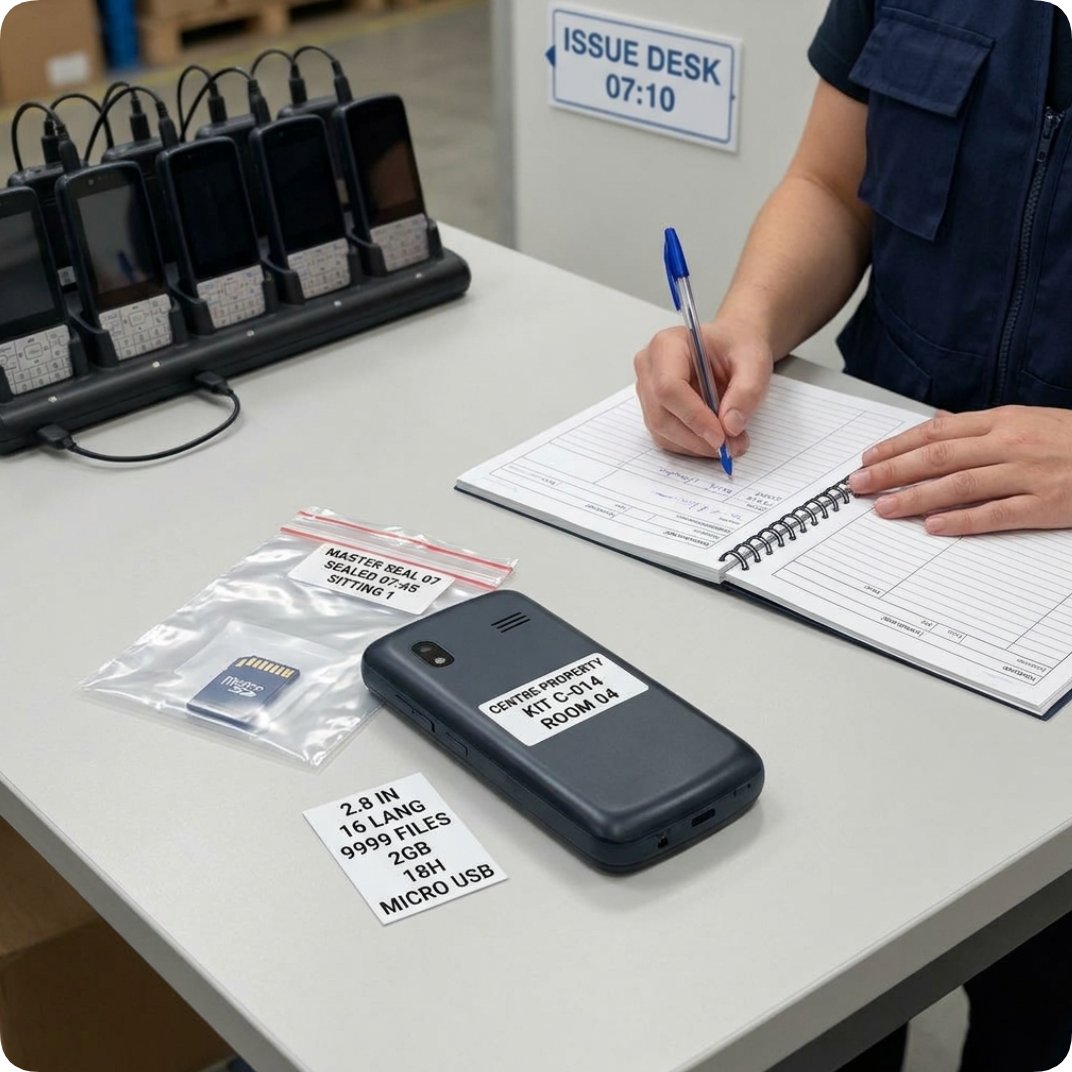
To mitigate confusion during exams, high-visibility property tags are affixed to the rear housing of each player for instant aisle verification, with kit numbers duplicated on earphone storage pouches. Charging infrastructure management is integrated directly into kit logs; multi-port charging stations are signed out as unified components of the deployment kit rather than miscellaneous facility accessories to prevent inventory shrinkage.
Custody Tracking for Paired Wireless Interpretation Headsets
Spoken-instruction deployment kits comprise paired transmitters and receiver banks issued as consolidated units rather than fragmented accessories. The RC2501 Wireless Interpretation Headset System operates within the 2403–2483 MHz frequency band, supporting 50 selectable channels, 13mW RF output, and an operational range up to 200 meters. Transmitters deliver up to 15 hours of operation from 1500mAh lithium cells, while compact 47-gram receivers provide over 35 hours of standby on 1000mAh cells.
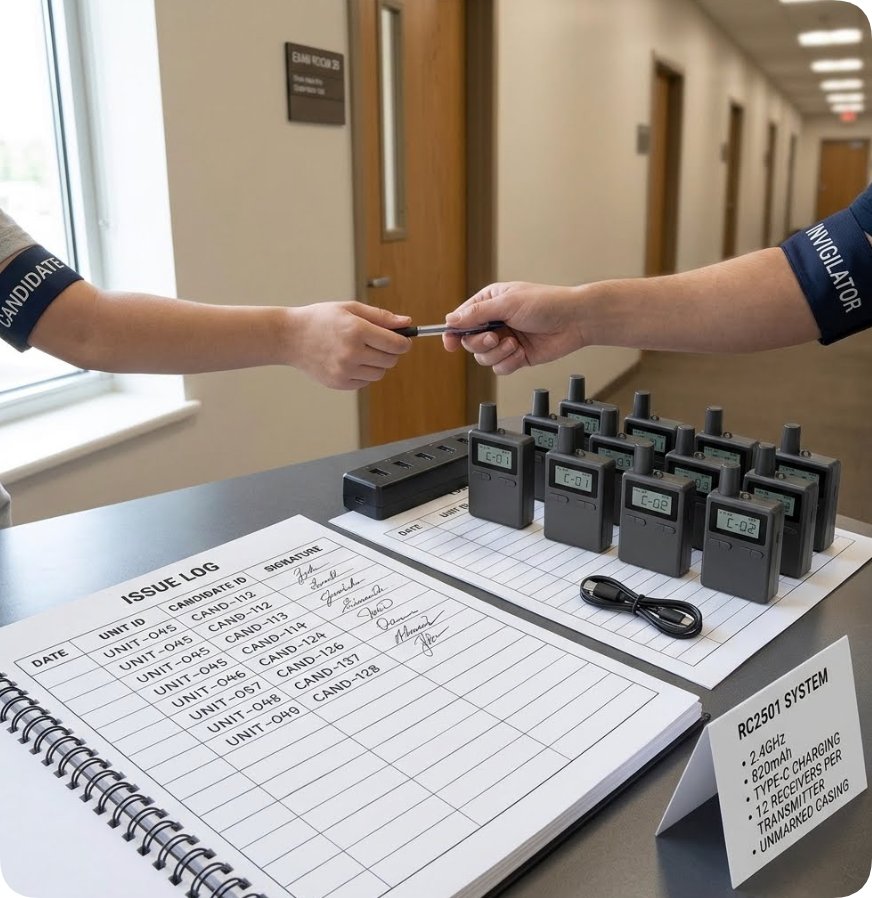
Administrative issue logs record transmitter serial numbers alongside comprehensive receiver inventory ranges on a single unified line. When invigilators recover stray receivers following examination dismissal, serialized numbering allows immediate cross-referencing against room allocation logs. Furthermore, procuring distinct housing colours (such as standard industrial grey or custom facility hues) serves as an effective primary visual property marker during rapid aisle sweeps.
Multi-Channel RF Separation for Parallel Examination Halls
Facilities conducting multiple concurrent examinations require sophisticated RF separation to prevent audio bleed between adjacent testing rooms. The RC2406 80 Channel Tour Guide Transmitter Receiver operates across the 2403–2483 MHz spectrum, providing 80 independent channels, 10mW output power, Phase-Locked Loop (PLL) frequency synthesis, and dedicated channel capacities that allow up to twelve parallel rooms to operate simultaneously without interference.
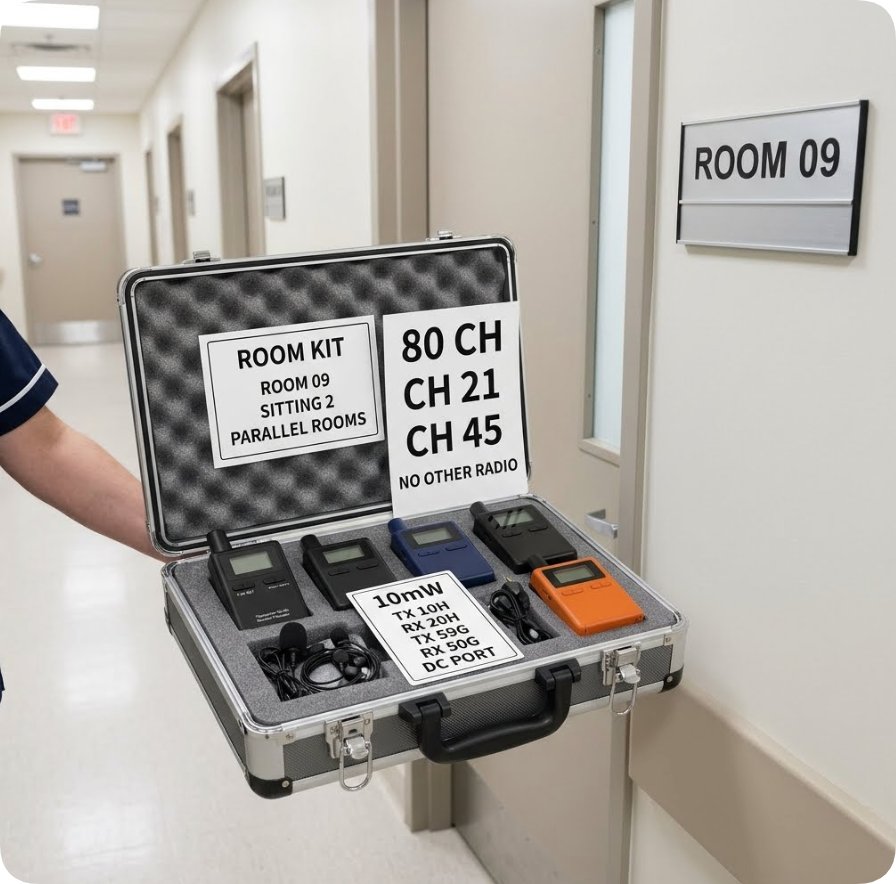
Crucially, operational channels represent dynamic settings rather than permanent asset identifiers. Because channel selections can be altered instantly without modifying physical housings, asset tracking must rely strictly on documented room allocations rather than programmed frequencies. Sourcing hardware directly through professional channels such as a Wireless Tour Guide System Manufacturer Direct supplier ensures correct custom shell markings and bulk configuration consistency.
Comprehensive Hardware Specification Comparison
Evaluating deployment options requires precise technical differentiation across distinct equipment classes. The parameters below consolidate official manufacturer specifications for audit reference:
| Device Classification | Core Technical Parameters | Specification Authority & Source |
|---|---|---|
| 2.8-Inch Semi-Auto Digital Audio Guide | 2.8" screen; 0-9 keypad; 16 languages; 9,999 file capacity; 2GB memory; 18h continuous runtime; Micro-USB interface | Official product documentation (non-RF device) |
| RC2501 Interpretation System | 2403–2483 MHz; 50 channels; 13mW RF output; TX 15h / RX 35+h runtime; TX 47g / RX 47g weight; Type-C charging | Certified engineering specification tables |
| RC2406 Multi-Channel System | 2403–2483 MHz; 80 channels; 10mW RF output; TX 10h / RX 20h runtime; TX 59g / RX 50g weight; DC charging port | Certified engineering specification tables |
Frequently Asked Questions (FAQ)
1. Does attaching a visible property tag to examination hardware replace the requirement for a signed issue slip?
Yes, visual tags allow invigilators to identify authorized equipment in examination aisles instantly, but physical tags must be paired with signed issue slips to record custody acceptance and specific room allocations for complete audit compliance.
2. Which specific device category deployed on examination desks requires the most prominent physical marking?
Yes, screen-bearing media players (such as the 2.8-inch display audio guide) require the most prominent rear-housing property tags and pouch markings because their digital screens resemble prohibited personal electronics most closely.
3. Can administrative staff rely on radio channel numbers as permanent asset identification markers?
Yes, operating channels are entirely dynamic settings that can be reconfigured instantly without altering physical housings; therefore, formal asset ownership must be documented strictly via room assignment columns on daily issue logs.
4. What precise information regarding pre-recorded audio content masters must be entered on morning issue logs?
Yes, morning logs must record the tamper-evident security seal numbers of the media bags holding pre-recorded content masters, cross-referencing seal IDs directly against kit deployment numbers for each testing room.
The video below demonstrates wireless tour guide system setup, asset chain-of-custody tracking, and multi-channel examination audio distribution.