





An Extra Stop Appears Before the Fleet Is Counted
The unannounced addition to the route was an archival records facility featuring steel compact shelving and thick concrete dividing walls. Concurrently, eight colleagues from an auxiliary regional office arrived to join the delegation, expanding total headcount from twenty-six to thirty-four while the foam tray still contained only twenty-six numbered units. Whoever signs out the equipment now faces a compound logistical problem: eight additional listeners and a fourth facility zone omitted from the preliminary channel matrix. A printed sheet prescribing three groups on fixed channels represents the morning as planned, not as it is being executed. The RC085 Portable Tour Guide System Wholesale unit is engineered specifically to handle such structural variance. Operating within the 470–510 MHz Ultra High Frequency (UHF) spectrum, it provides 100 selectable channels and features an LCD smart screen directly on the transmitter body. Furthermore, its support for F1 one-way and F2 two-way operational modes becomes invaluable when a passive facility walkthrough suddenly turns into an active question-and-answer session beside dense steel shelving.
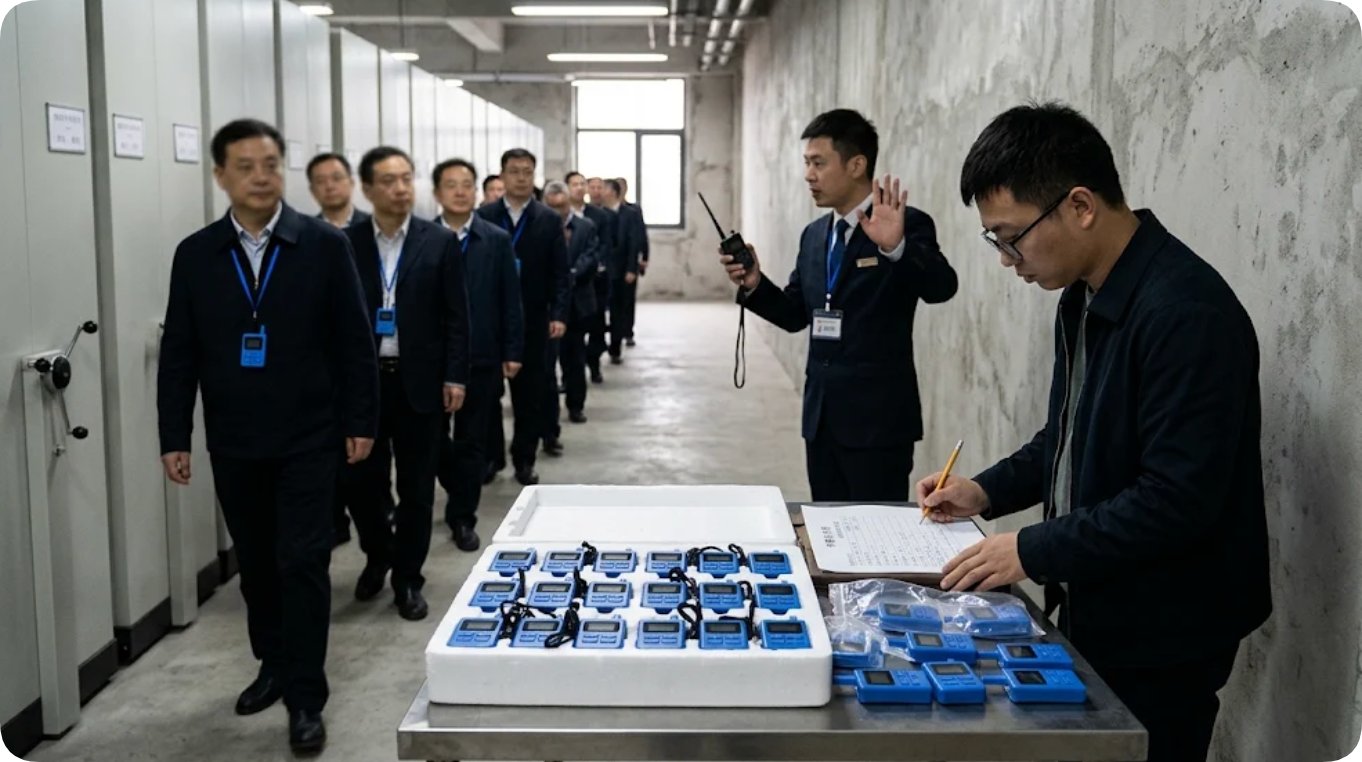
While steel shelving blocks high-frequency signals, UHF propagation penetrates architectural barriers, dense equipment racks, and complex radio frequency (RF) environments far more effectively than 2.4 GHz alternatives. That physical characteristic makes UHF essential when navigating unfamiliar buildings. When the itinerary expands, the eight spare receivers emerge from the storage pouch, lanyard serial numbers are jotted down in pencil on the back of the revised briefing sheet, and the tour guide assigns the newly merged contingent an independent operating channel before the archive doors open.
A New Sheet Never Prints the Channel Allocation
Reissued itineraries look immaculate. They display updated timestamps, new room numbers, added archival stops, and corrected headcount figures. Yet they invariably lack a column designating group channel assignments, transmitter pairing records, or the name of the staff member who authorized the route change at twenty to eleven. That administrative omission represents the hidden cost of itinerary churn. Counting heads takes seconds, but delegation radio plans exist entirely in the guide's memory unless explicitly documented. When two sub-groups traverse a narrow corridor simultaneously, any receiver left unassigned to the new frequency continues monitoring the nearest transmitter, causing audio cross-talk that operators mistakenly diagnose as hardware failure rather than a clerical oversight.
| Itinerary Modification | Required Field Action | Operational Owner | Critical Detail Omitted on Sheet |
|---|---|---|---|
| Fourth facility stop added | Re-inventory receivers and assign dedicated channel for new attendees | Equipment dispatch officer | Active channel matrix and spare pouch allocation |
| Multiple offices merged into single tour | Sync secondary receivers before entering transit corridors | Lead tour guide operating transmitter | Sub-group receiver serial mapping |
| Briefing schedule pulled forward | Verify battery charge levels and room RF congestion | Reception logistics desk | Interim charging window between venue stops |
| Venue room designation updated | Confirm room spatial capacity for total delegation size | Protocol liaison officer | Requirement for dual transmitter deployment |
Pulled Forward: Managing Room Transitions Before Equipment Distribution
When the afternoon briefing session was accelerated to 11:20 AM and relocated from an oak-paneled auditorium to a glass-walled conference pavilion adjacent to heavy enterprise Wi-Fi routers, the primary technical challenge shifted from barrier penetration to RF congestion. Operating in dense wireless spaces requires robust channel isolation. The RC2406 80 Channel Tour Guide Transmitter Receiver set supports 80 discrete channels across the 2403–2483 MHz band utilizing Phase-Locked Loop (PLL) digital frequency synthesis, explicitly designed to support concurrent multi-team deployments. Weighing 59g for the transmitter and 50g for the receiver with a 1500mAh internal cell, it features IPX4 splash resistance and RoHS compliance. The IPX4 rating proves vital when facility transitions expose hardware to inclement weather or damp courtyards.
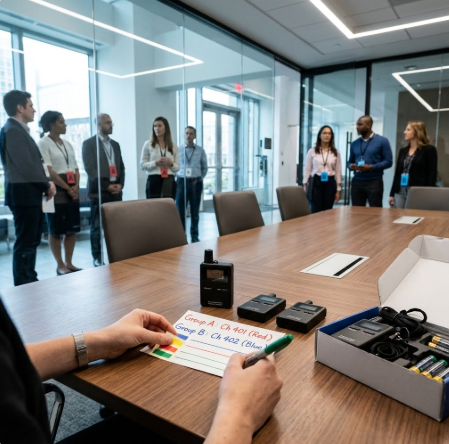
Eighty channels provide massive capacity to segregate independent audio feeds. In a revised itinerary featuring four stops and merged delegations, the tour lead dedicates one channel for the archive walkthrough, a second for the executive briefing, and retains a third as a floating standby channel should a splinter group inspect auxiliary record vaults. Staff require zero background in PLL engineering to jot these three channel designations on an index card taped inside the equipment case lid.
Holding the Delegation During Transit Delays
Because the archival shelving aisle permitted single-file entry, thirty-four delegates formed a stationary holding queue while transport vehicles repositioned. During this standstill, a protocol officer stepped forward twice to broadcast itinerary modifications over the audio link. This scenario highlights the utility of the RC2500 Digital Tour Guide System Price platform. Its architecture incorporates one-key frequency synchronization, a dedicated mute function, 50 selectable channels, and extended battery endurance powered by dual 1800mAh cells—delivering 15 hours of transmitter operation and over 35 hours of receiver runtime backed by USB Type-C fast charging. Both transmitter and receiver weigh a balanced 104g. One-key sync allows late-arriving receivers to join an active group instantly without returning units to the base charging tray, while the mute switch allows guides to pause broadcasts during administrative announcements.

Extended battery longevity is invaluable when delegation tours exceed scheduled timeframes. A kit deployed at 09:00 and returned after an extended fourth stop isn't supporting a standard 90-minute museum walk; it is powering back-to-back briefings interspersed with prolonged transit holding times. Supported by CE, FCC, and RoHS certifications alongside structured warranty backing, ruggedized power reserves ensure operational confidence when lending equipment to auxiliary departments.
Core Specifications Comparison Across the Range
| Technical Dimension | RC085 | RC2406 | RC2500 |
|---|---|---|---|
| Core Frequency Band | 470–510 MHz (UHF) | 2403–2483 MHz (2.4 GHz) | 2403–2483 MHz (2.4 GHz) |
| Selectable Channels | 100 Channels | 80 Channels | 50 Channels |
| RF Output Power | 8–10mW | 10mW | 10mW |
| Transmitter Battery Life | Up to 12 Hours | Up to 10 Hours | Up to 15 Hours |
| Receiver Battery Life | Up to 20 Hours | Up to 20 Hours | 35+ Hours |
| Transmitter Weight | 65g | 59g | 104g |
| Receiver Weight | 60g | 50g | 104g |
| Charging Interface | Standard USB | Proprietary DC Port | USB Type-C |
| Audio Frequency Response | 50 Hz – 12 kHz | TX: 50 Hz – 200 kHz | RX: 50 Hz – 12 kHz | 50 Hz – 8 kHz |
Comparing these technical dimensions reveals distinct operational advantages. While uniform physical dimensions are not published across all three datasheets, recognizing interface differences prevents mid-tour power failures. The RC2406 utilizes an IPX4 splash-resistance rating, whereas the RC085 and RC2500 omit formal ingress ratings from their summary specs. Reviewing broader deployment frameworks via Wireless Audio Guide Application Solutions helps facility managers align band characteristics with their specific architectural blueprints.
Charging Port Compatibility Determines Field Recovery Speed
A revised itinerary rarely grants a dedicated hour for battery replenishment; instead, it provides a ten-minute window while transport vehicles reposition. That brief interval remains usable only if the correct charging cable resides in the accessory pouch. The RC2500 adopts modern USB Type-C, the RC085 utilizes standard USB, while the RC2406 relies on a dedicated DC barrel connector requiring a separate power lead. Standard manufacturer warranty terms cover mainboard defects while excluding consumable accessories like batteries and headsets, making cable management and spare cell rotation critical for logistics officers. Case studies such as A Garden Day Run on Swapped Batteries demonstrate how backup power management dictates the success of extended itineraries.
Frequently Asked Questions (FAQ)
1. Does a revised itinerary change how many receivers should be issued for a delegation visit?
Yes. When unexpected attendees join mid-tour—such as eight regional colleagues joining an initial group of twenty-six—equipment officers must immediately issue supplemental receivers from spare storage pouches and record allocations on the revised briefing manifest to prevent audio dropouts and channel overlap.
2. Which published specification determines how many independent groups can operate within a single facility?
Selectable channel count dictates multi-group capacity. Models offer varying frequencies—such as 100 channels on the RC085, 80 on the RC2406, and 50 on the RC2500—allowing tour leads to assign dedicated channels for specific tour segments while reserving standby channels for splinter groups.
3. Can added receivers join an active tour group without returning equipment to the central office?
The RC2500 supports one-key frequency synchronization, enabling guides to pair spare receivers on-site during transit holds. Systems lacking one-key sync require pre-configured channel assignments managed prior to departure from the sign-out desk.
4. What key environmental protections do these wireless tour guide systems provide in the field?
The RC2406 features an IPX4 splash-resistance rating protecting against moisture and light rain during outdoor facility transitions, while UHF models like the RC085 excel at penetrating dense concrete walls and steel shelving structures.
5. Where can administrators review complete manufacturer specifications and direct wholesale ordering information?
Administrators can access comprehensive product line comparisons and technical documentation directly through the Wireless Tour Guide System Manufacturer Direct portal.
The video below illustrates wireless tour guide system deployment techniques, channel synchronization, and group management in complex venues.