



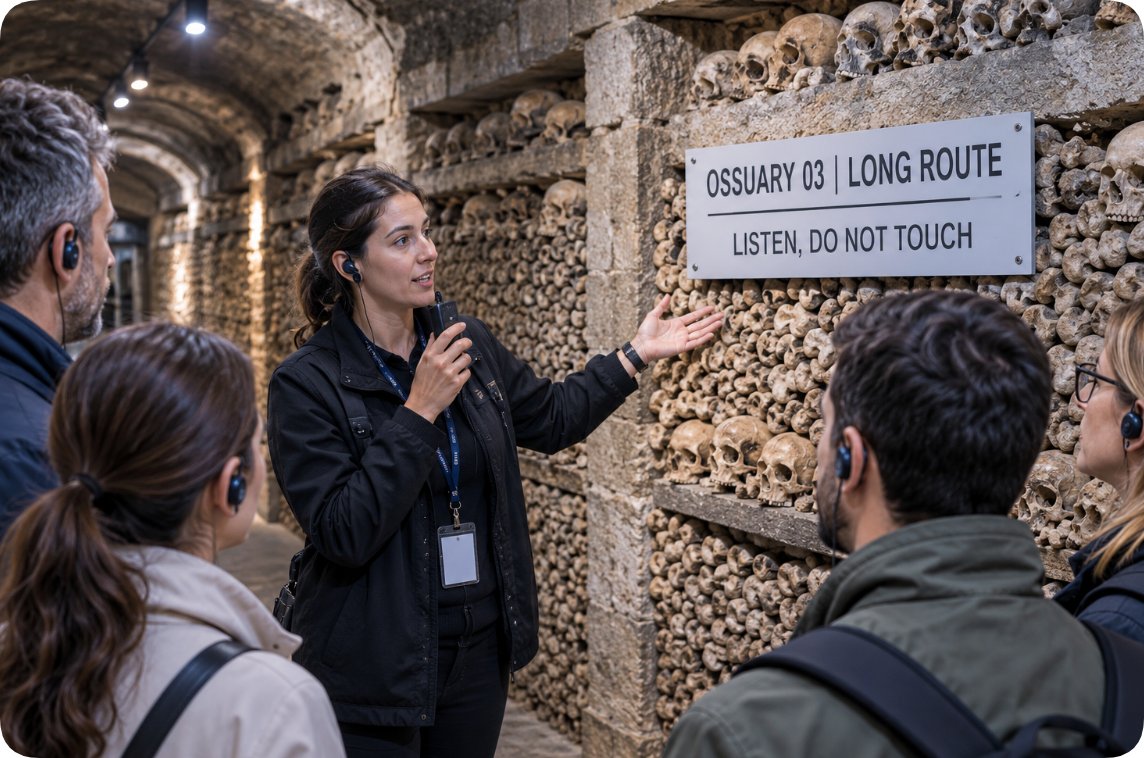
A catacomb presents a very different audio challenge from a conventional museum. Visitors move through narrow underground corridors, stop at ossuary walls and historical niches, and often share the same route with several tour groups. Stone surfaces create reflections that can reduce speech intelligibility, while the limited space makes conventional loudspeakers unsuitable for guided visits. For operators, the choice is not simply between two wireless devices. It is between two different ways of delivering information: recorded commentary triggered automatically at designated locations, or a live guide speaking directly to visitors through individual receivers. The YNGM M7C and Orpheo Mikro LX represent the self-guided approach, while the RICH AGE RC2401, RC2406 and RC2408 provide real-time wireless group communication. Understanding their differences helps catacomb operators select equipment that matches their visitor flow, staffing arrangements, accessibility requirements and daily operating conditions.
1. Why Catacomb Tours Require a Different Audio Strategy
Underground heritage sites place several demands on visitor audio equipment that are less important in ordinary exhibition spaces. A gallery visitor can usually stop in front of an exhibit without obstructing anyone. In a catacomb, the route may be narrow, the walking direction restricted, and the available stopping areas limited to a few designated points.
These conditions create four practical requirements.
Speech intelligibility in reflective spaces
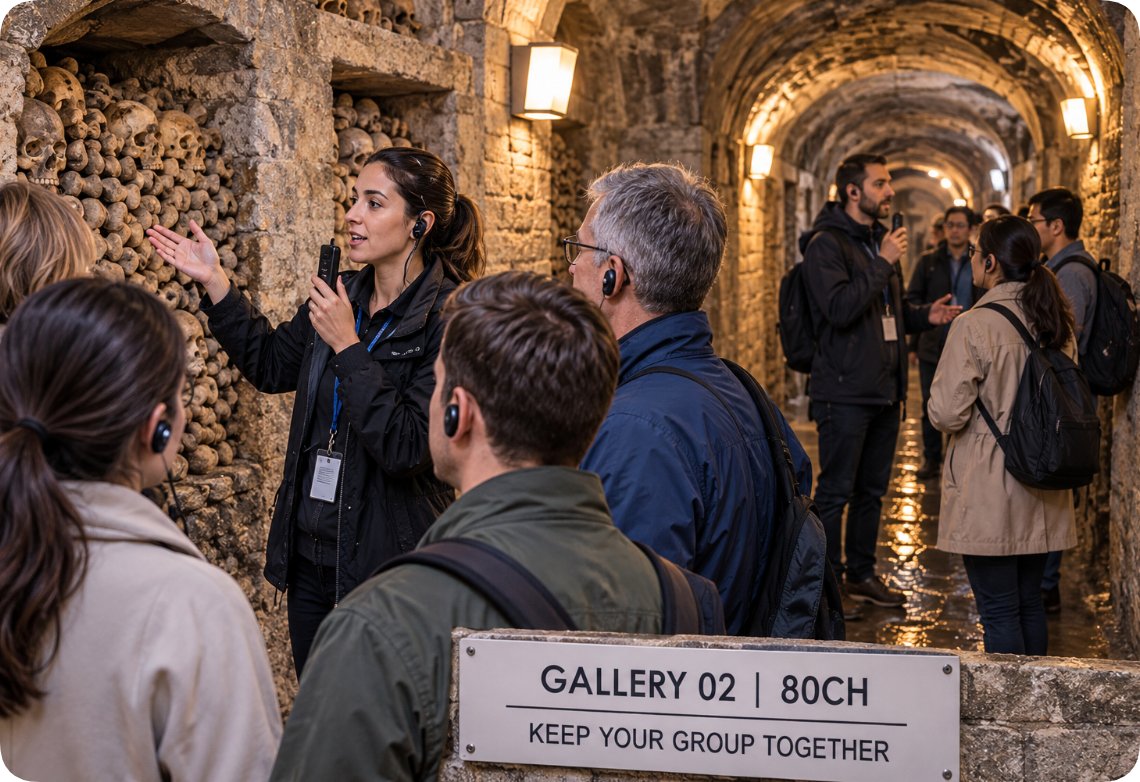
Stone walls, vaulted ceilings and hard floors reflect sound instead of absorbing it. When a guide speaks loudly, reflected sound can overlap with the original speech, making words less distinct. Increasing the volume does not necessarily solve the problem. Individual wireless receivers allow visitors to hear the guide directly without requiring the guide to compete with the acoustic environment.
Multiple groups sharing one route
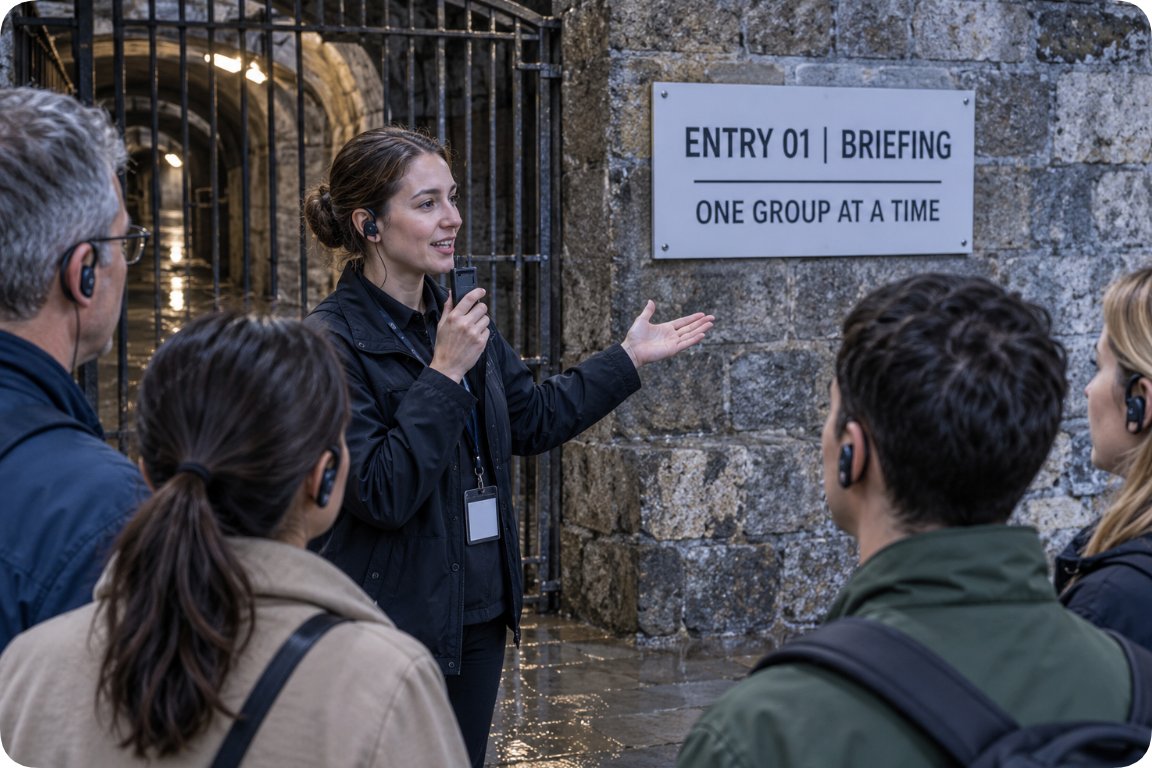
Popular catacombs frequently accommodate scheduled tours, school visits, private groups and independent visitors throughout the day. Two groups may be separated by only a short corridor or a few minutes of walking time. A properly planned channel allocation system helps prevent visitors from hearing another guide's commentary.
Comfort during extended visits
A guided underground visit can last 45 to 90 minutes. Visitors may wear a receiver throughout the entire route, so equipment weight, earphone fit and battery endurance directly influence the experience. Lightweight receivers are particularly useful for older visitors and groups that spend considerable time walking.
Predictable equipment operation
Staff need to distribute devices, check battery levels, assign channels, collect equipment and prepare it for the next session. A system that works technically but requires complicated daily setup can create unnecessary operational pressure. The most suitable solution is one that fits the site's actual visitor management process.
These requirements provide a more useful basis for comparison than transmission distance or channel count alone. The important question is how each system performs within the complete visitor journey.
2. Understanding the Two Self-Guided Audio Systems
YNGM M7C: Automatic Commentary with RFID Activation
The YNGM M7C is a dual-mode audio guide system designed to support both automatic commentary and conventional group guiding. Its main advantage is that recorded information can be delivered at designated visitor locations without requiring a guide to repeat the same explanation for every group.
According to the manufacturer's published product information, the transmitter operates at 2,400–2,490 MHz and supports up to 150 channels, with a stated communication distance of 1–200 meters. Its listed weight is 68.8 g, charging time is approximately 2.5 hours, and operating time is 7–10 hours.
The receiver operates at 2.4 GHz and supports eight languages. The product pages advertise more than 8,000 stored commentary segments, with some listings specifying 9,999 segments. It uses an 800 mAh battery, weighs approximately 50 g and provides at least 15 hours of operation according to the published specifications.
A separate RFID signal transmitter activates the relevant audio content when visitors approach a designated location. The sensing distance is adjustable from approximately 0.5 to 35 meters. This arrangement allows a visitor to approach an ossuary wall or historical display and hear the corresponding explanation without manually selecting a recording.
The manufacturer also offers a UV charging cabinet designed for 30 devices. Its product information claims a 99.99% bacterial reduction within 15 minutes. This figure should be treated as a manufacturer claim rather than an independently established result. Buyers should request the relevant test documentation and confirm the cabinet's operating conditions before relying on it as a hygiene specification.
One purchasing detail deserves attention: published M7C product listings contain differences in channel and storage figures. Buyers should confirm the exact hardware version, channel capacity, language configuration and storage specification in the final quotation and purchase agreement.
Orpheo Mikro LX: A Dedicated Self-Guided Audio Player
The Orpheo Mikro LX takes a different approach. Rather than functioning as a conventional live wireless receiver, it is a standalone multimedia audio guide that stores prerecorded content directly on the device.
Orpheo's published product information describes a handheld unit weighing approximately 125 g and measuring 11.3 × 5.5 × 2.3 cm. Its hardware includes a backlit keypad, a 128 × 96 pixel OLED colour display, MP3 and OGG audio playback, a built-in loudspeaker and two 3.5 mm headphone outputs.
The stated battery life is up to 18 hours, with a full charging time of approximately four hours. A 24-slot charging rack is available for centralized equipment management.
Automatic content activation uses infrared technology. Radio frequency and NFC functions support device tracking, while audio can also be synchronized with video presentations. The casing uses fire-resistant ABS and Magnum plastic, which the manufacturer describes as weatherproof and shockproof.
Another important feature is compatibility with induction loop systems for visitors who use hearing assistance equipment. This makes the Mikro LX particularly relevant to venues that need dedicated accessibility functions alongside multilingual prerecorded content.
Orpheo also identifies catacombs and salt cathedrals among the types of venues using its audio guide solutions. For an operator building a self-guided visitor experience, the Mikro LX provides a more developed content-delivery platform than a basic live-listening receiver.
3. RICH AGE RC2401, RC2406 and RC2408: Three Live Wireless Options
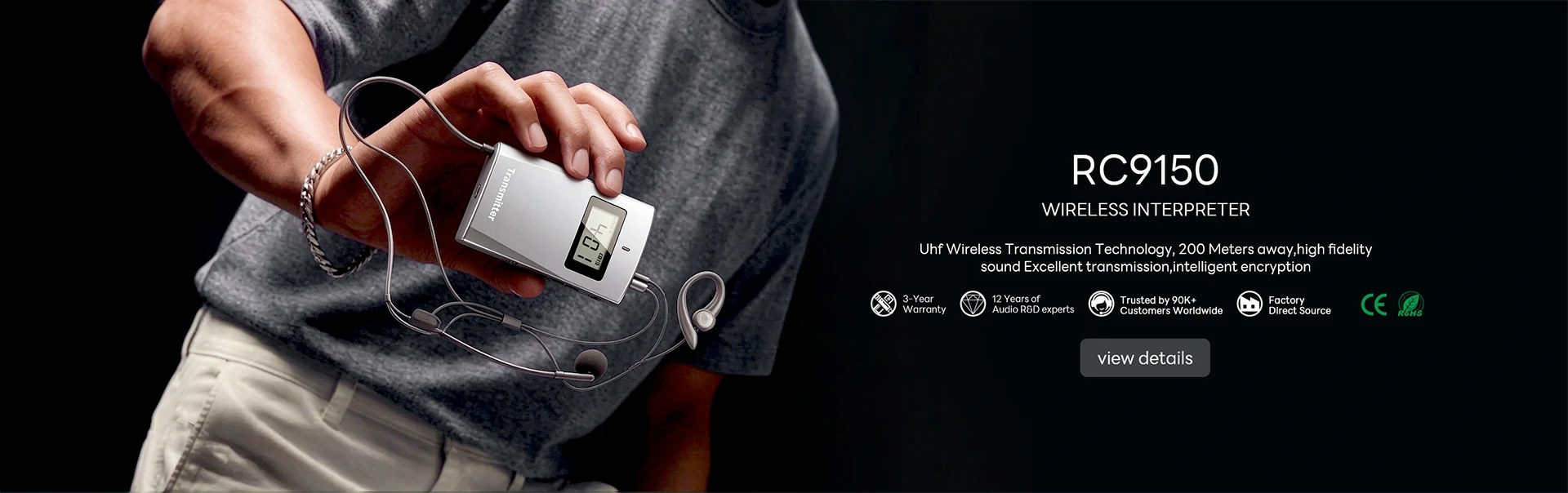
The RICH AGE RC2401, RC2406 and RC2408 are designed for real-time communication between a tour guide and a group of visitors. The guide speaks into a wireless transmitter, and visitors listen through individual receivers.
Unlike an automatic audio guide, these systems do not depend on prerecorded commentary, RFID location triggers or stored language tracks. Their purpose is to transmit the guide's actual voice throughout the visit. This allows the guide to answer questions, explain details that are not included in a standard script, adjust the pace of the presentation and provide instructions when visitors encounter stairs, narrow passages or restricted areas.
All three models share the following core specifications:
Operating frequency: 2,403–2,483 MHz
Stated transmission distance: 1–200 m
RF output power: 10 mW
Frequency control: PLL frequency synthesis
Transmitter battery: 3.7 V, 1,500 mAh
Receiver battery: 3.7 V, 1,000 mAh
Transmitter operating time: approximately 10 hours
Receiver operating time: approximately 20 hours
Transmitter weight: approximately 59 g
Receiver weight: approximately 50 g
Charging connection: DC Port
The main differences are channel capacity and product positioning.
| Specification | RC2401 | RC2406 | RC2408 |
|---|---|---|---|
| Frequency band | 2403–2483 MHz | 2403–2483 MHz | 2403–2483 MHz |
| Available channels | 50 | 80 | 80 |
| Transmission distance | 1–200 m | 1–200 m | 1–200 m |
| Output power | 10 mW | 10 mW | 10 mW |
| Transmitter / receiver battery life | 10 h / 20 h | 10 h / 20 h | 10 h / 20 h |
| Transmitter / receiver weight | 59 g / 50 g | 59 g / 50 g | 59 g / 50 g |
| Frequency response | TX 50 Hz–200 kHz / RX 50 Hz–12 kHz | TX 50 Hz–200 kHz / RX 50 Hz–12 kHz | TX 50 Hz–200 kHz / RX 50 Hz–12 kHz |
| Frequency control | PLL | PLL | PLL |
| Charging connection | DC Port | DC Port | DC Port |
| Product positioning | 50-channel standard solution | 80-channel option for multi-group coordination | 80-channel solution for stable group communication |
The RC2401 is the straightforward choice for smaller venues where the number of simultaneous guided groups is limited. Its 50-channel capacity provides sufficient allocation options for many scheduled tours.
The RC2406 and RC2408 both offer 80 channels. The RC2406 is positioned for installations that place greater emphasis on channel flexibility and interference management, while the RC2408 is positioned as an 80-channel option for stable guided communication. Both provide additional channel capacity compared with the RC2401.
It is important to understand that more channels do not automatically guarantee better audio quality. Actual performance depends on the radio environment, transmitter placement, channel allocation and the number of systems operating simultaneously. A site survey and on-location testing remain essential.
4. Automatic Commentary vs. Live Tour Guide Communication
The most important difference between these systems is not their radio specification. It is the way visitors receive information.
Self-guided systems such as the YNGM M7C and Orpheo Mikro LX deliver prepared content. A visitor listens to an explanation associated with a particular location, exhibit or historical subject. The information remains consistent regardless of which staff member is working that day.
This arrangement is useful for sites with large numbers of independent visitors, multiple language requirements and limited guiding staff. Once the recordings and trigger locations have been configured, visitors can explore at their own pace without requiring a guide to accompany every group.
However, recorded commentary follows a predefined structure. It cannot respond naturally when a visitor asks an unexpected question, requests additional historical context or needs clarification about something visible on the wall. Content updates also require the operator to maintain the recording library and associated trigger configuration.
Live wireless tour guide systems address these situations differently. A guide can explain an unusual historical detail, respond to visitor questions, repeat important safety instructions and adapt the presentation to the group's interests. If visitors stop at an unexpected location, the guide can continue explaining without depending on a programmed audio trigger.
For catacombs with scheduled school visits, specialist heritage tours, private groups and guided educational programs, this flexibility can be more valuable than automated playback.
The two approaches therefore serve different operational purposes. A venue does not need to choose one technology for every visitor. It can use self-guided players for independent exploration and live wireless receivers for organized tours.
For museums considering this combined arrangement, Museum Self Guided Audio Tour Solutions provides a broader reference for integrating visitor audio equipment into museum operations.
5. Channel Planning and Radio Performance in Underground Corridors
Wireless performance deserves particular attention in underground heritage environments. Thick masonry, reinforced structures, metal installations and the layout of connecting corridors can affect radio propagation. Reflections from surrounding surfaces may also create variations in reception as visitors move through the route.
A manufacturer's stated transmission distance is a useful starting specification, but it does not establish the coverage available inside a particular catacomb. The actual result depends on the construction materials, corridor geometry, transmitter location, receiver orientation and nearby radio activity.
For a venue operating several guided groups, channel planning should begin with the visitor schedule rather than the maximum channel count advertised by a supplier.
Assigning channels to different tour groups
Each live tour group should receive a designated channel. Guides should check their transmitter settings before entering the route, and staff should maintain a simple allocation record for scheduled groups.
For example, a small catacomb running one or two guided tours at a time can normally begin with a 50-channel system such as the RC2401. A larger venue with overlapping tours, school visits and private groups can benefit from the additional allocation capacity of the 80-channel RC2406 or RC2408.
Testing reception at important visitor locations
Testing should cover more than the entrance and exit. Staff should check the narrowest passages, deep corridors, stairwells, bends, side chambers and major stopping points. These are the locations where building structure and visitor movement are most likely to affect reception.
During commissioning, a guide should walk the complete route while another staff member listens through a receiver. The test should include normal speaking volume, movement between rooms and the expected number of simultaneous groups.
Keeping spare channels available
Not every available channel should be assigned to a scheduled group. Leaving spare channels gives operators flexibility when an additional tour arrives, a group needs to be divided or an existing allocation must be changed.
The 80-channel capacity of the RC2406 and RC2408 gives larger venues more room to organize these situations. The final channel plan should still be tested under actual operating conditions rather than relying on channel count alone.
For installations requiring a live guide and several parallel visitor groups, the RC2406 80 Channel Tour Guide Transmitter Receiver is a relevant model to evaluate.
6. Receiver Weight, Battery Life and Visitor Comfort
For equipment used throughout a long underground visit, weight and battery endurance are practical purchasing considerations rather than minor technical details.
The RICH AGE RC2401, RC2406 and RC2408 receivers weigh approximately 50 g. Their lightweight design is suitable for visitors who need to wear an audio receiver without carrying a separate screen or manually controlling recorded content. The transmitter weighs approximately 59 g, allowing a guide to carry it during an extended walking tour.
The YNGM M7C receiver is also listed at approximately 50 g, while its transmitter weighs around 68.8 g. The Orpheo Mikro LX is heavier at approximately 125 g because it incorporates a display, keypad, playback hardware and additional self-guided functions.
These differences reflect the purpose of each device. A live receiver primarily needs to deliver audio from the guide. A self-guided player requires additional hardware to store, select and control content.
| System | Transmitter / Player | Receiver | Published battery life |
|---|---|---|---|
| RICH AGE RC2401 / RC2406 / RC2408 | 59 g | 50 g | 10 h / 20 h |
| YNGM M7C | 68.8 g | 50 g | 7–10 h / at least 15 h |
| Orpheo Mikro LX | 125 g handheld player | Not a separate live receiver | Up to 18 h |
Battery specifications should always be interpreted in relation to actual operating conditions. Volume settings, battery age, charging practices and daily usage patterns can affect real-world endurance. Operators should establish a charging routine that leaves sufficient reserve for unexpected additional tours.
For venues with longer routes or extended daily schedules, the RC2408 Long Range Wireless Audio Guide is worth evaluating as part of an 80-channel live guiding setup.
7. Equipment Hygiene and Daily Device Management
Shared audio equipment requires a consistent hygiene procedure, especially at heritage attractions where devices are issued to successive visitors throughout the day.
Receivers, earphones, charging connections and storage containers should be included in a documented cleaning and inspection routine. Operators should pay particular attention to reusable earphone components and any surfaces that come into direct contact with visitors.
The YNGM M7C has an optional UV charging cabinet. Its manufacturer advertises a capacity of 30 devices and a 99.99% bacterial reduction claim within 15 minutes. Venues considering this accessory should request the applicable test reports and confirm which surfaces and microorganisms the stated performance covers.
Orpheo offers a charging rack designed for the Mikro LX, supporting centralized storage and device preparation. Its equipment management approach is useful for venues operating a substantial self-guided player fleet.
RICH AGE does not publish a dedicated UV disinfection cabinet for the RC2401, RC2406 or RC2408 in the specifications covered by this comparison. Operators choosing these models should establish an appropriate cleaning procedure and confirm whether a compatible third-party cabinet can be integrated into their charging and storage workflow.
For a live wireless system, the daily equipment process can remain straightforward:
Check transmitter and receiver battery levels before the first tour.
Inspect earphones, cables and charging connectors.
Clean visitor-contact surfaces according to the venue's hygiene procedure.
Assign and verify the channel for each scheduled group.
Collect receivers after the tour and count returned devices.
Recharge and inspect equipment before the next operating session.
This routine helps reduce missing equipment, prevent avoidable charging problems and maintain consistent service during busy visitor periods.
8. Installation Requirements and Operational Considerations
Technical specifications alone do not determine the long-term suitability of a catacomb audio system. The installation and maintenance requirements can influence total ownership cost just as much as the initial equipment purchase.
Automatic audio guide installation
An RFID or infrared self-guided system requires content preparation and location-based configuration. Each activation point must correspond to the correct recording, and the operator needs a process for updating content when historical information, exhibition layouts or visitor routes change.
Staff should also test the trigger range at each installation point. A trigger that activates too early may play commentary before visitors reach the relevant display. A trigger that activates too late may cause visitors to pass the intended stopping point before hearing the explanation.
Live wireless system installation
A live wireless system requires a different preparation process. The venue needs to establish its channel allocation, test the radio coverage, train guides to operate transmitters and create a process for issuing and collecting receivers.
It does not require individual audio triggers at every historical display or a complete library of prerecorded tracks. This reduces the infrastructure required along the visitor route and makes changes to the spoken presentation easier to implement.
Planning for equipment failure
Both approaches need a practical backup procedure. A self-guided player may have a damaged keypad, an incorrect recording selection or a trigger configuration problem. A live system may experience a depleted battery, an incorrectly assigned channel or reduced reception in a particular corridor.
Operators should keep spare equipment available and train staff to replace a faulty device quickly. For live tours, a guide should know how to switch to a spare transmitter or receiver without interrupting the entire visitor session.
These procedures are particularly important for venues with timed entry slots, where a delay in one group can affect the next scheduled tour.
9. Multilingual Visitors and Accessibility Requirements
Language support is one of the strongest reasons for choosing a self-guided audio platform. The YNGM M7C advertises eight languages, allowing visitors to access prerecorded explanations without requiring a guide who speaks every language represented in the visitor population.
The Orpheo Mikro LX also supports a structured self-guided content experience. Its multimedia playback and induction-loop compatibility provide additional options for venues that need to accommodate different visitor requirements.
Live wireless systems follow a different model. Visitors hear the language spoken by their assigned guide. A venue can operate separate groups in different languages by assigning suitable guides and channels, but the receiver itself does not provide automatic language selection or translation.
The RC2401, RC2406 and RC2408 are live audio communication systems. Their published specifications do not list built-in multilingual recordings, automatic translation, induction-loop compatibility or video synchronization.
Accessibility planning should therefore consider the complete visitor experience, not just the audio device. Venues should evaluate headphone comfort, hearing assistance requirements, available transcripts, visual information and the suitability of the underground route for visitors with different mobility needs.
For venues with a substantial international visitor population, combining self-guided players with live group receivers can provide a more flexible service model than relying on one type of equipment alone.
10. Which Wireless Audio System Should a Catacomb Operator Choose?
The right equipment depends on the visitor service the venue intends to provide. The following selection criteria summarize the practical differences.
Choose YNGM M7C for location-triggered multilingual commentary
The M7C is appropriate for venues that want automatic playback at designated locations, multiple stored languages and an RFID-based visitor experience. Its dual-mode design also supports conventional group guiding. Operators should confirm the exact channel count, memory capacity and charging cabinet configuration before purchasing.
Choose Orpheo Mikro LX for a dedicated self-guided platform
The Mikro LX is suitable for venues that prioritize independent visitor movement, recorded multimedia content, infrared activation, centralized charging and induction-loop compatibility. Its 18-hour published battery life is another relevant consideration for long operating schedules. Buyers should account for the additional hardware and content management required by a standalone player.
Choose RICH AGE RC2401 for straightforward live guided tours
The RC2401 is a practical choice for smaller operations that primarily run one or a limited number of guided groups at a time. Its 50-channel capacity, approximately 50 g receiver and 20-hour stated receiver battery life provide a straightforward solution for real-time group communication.
Choose RICH AGE RC2406 for greater channel allocation flexibility
The RC2406 provides 80 channels and is suitable for venues that need more channel allocation options for overlapping guided groups. Its positioning emphasizes channel flexibility and interference management, making it a relevant candidate for busier underground routes.
Choose RICH AGE RC2408 for an 80-channel live guiding solution
The RC2408 also provides 80 channels and is designed for venues that need to coordinate multiple live guided groups. Its lightweight receiver, 20-hour stated receiver battery life and straightforward DC Port charging arrangement support daily equipment circulation.
For operators who prioritize the guide's live voice, flexible explanations and direct visitor interaction, Wireless Tour Guide System Manufacturer Direct provides an overview of RICH AGE's live wireless tour guide equipment.
For additional product comparisons and purchasing considerations, visit the Tour Guide System Comparison & Buyer Guide.
11. Practical Site Testing Before Purchasing
A catacomb's physical environment can be difficult to reproduce in a supplier's demonstration room. A purchasing decision should therefore include a practical on-site evaluation whenever possible.
Before confirming an equipment order, operators should assess the following points:
Route coverage: Test wireless reception from the entrance to the final visitor stop, including bends, stairways and deeper chambers.
Group separation: Operate multiple transmitters simultaneously and verify that each receiver hears the intended guide.
Audio intelligibility: Test speech at normal guiding volume rather than relying only on maximum volume settings.
Visitor comfort: Ask visitors or staff to wear the receivers during a complete tour and evaluate earphone fit and weight.
Battery endurance: Test the equipment over a realistic daily operating schedule and establish a charging reserve.
Device turnover: Measure the time required to issue, collect, inspect, clean and recharge a full set of equipment.
Accessibility: Confirm whether the selected equipment supports the specific hearing assistance and visitor access requirements of the site.
Supplier documentation: Obtain the final technical specifications, charging details, warranty terms and available after-sales support in writing.
These checks help identify practical problems before they affect visitors. They also provide a more reliable basis for comparing suppliers than evaluating products solely by advertised range, battery life or channel capacity.
12. Frequently Asked Questions About Catacomb Audio Guide Systems
Can a live wireless tour guide system replace an RFID automatic audio guide?
A live wireless tour guide system replaces the need for prerecorded commentary during organized guided tours, but it does not replace automatic location-triggered playback for independent visitors. Live systems transmit a guide's voice in real time, while RFID audio guides play stored explanations when visitors approach designated locations. Venues that serve both independent visitors and scheduled groups benefit from operating both systems for their respective purposes.
Why choose an 80-channel tour guide system instead of a 50-channel model?
An 80-channel system provides more channel allocation options for venues operating multiple groups simultaneously. The RC2406 and RC2408 offer 80 channels, while the RC2401 provides 50. A small venue with limited simultaneous tours can use the RC2401 effectively, whereas a busy catacomb with overlapping school visits, private tours and scheduled groups benefits from the additional flexibility of an 80-channel model. Actual interference performance still depends on the site environment and channel configuration.
Are the YNGM M7C's 150 channels and 9,999 audio segments confirmed specifications?
These figures appear in the manufacturer's published product information. Different M7C listings contain variations in channel and storage specifications, so buyers should confirm the exact model version and configuration in writing before placing an order. The quoted figures should be treated as supplier-published specifications rather than independently verified test results.
Do RICH AGE RC2401, RC2406 and RC2408 receivers support hearing loops or video synchronization?
No. The published specifications for the RC2401, RC2406 and RC2408 describe live wireless audio communication and do not list induction-loop compatibility or video synchronization. The Orpheo Mikro LX specifically lists both functions. Venues that require hearing assistance integration or synchronized multimedia playback should include these requirements in their equipment selection process.
How long can RICH AGE receivers operate on a full charge?
The RC2401, RC2406 and RC2408 receivers have a stated operating time of approximately 20 hours, while their transmitters provide approximately 10 hours. The receiver uses a 3.7 V, 1,000 mAh battery, and the transmitter uses a 3.7 V, 1,500 mAh battery. Actual operating time depends on usage conditions, battery condition and operating settings.
Can 2.4 GHz wireless tour guide systems work inside underground catacombs?
Yes. A 2.4 GHz wireless tour guide system can be used in underground environments, provided that the equipment has sufficient coverage for the actual route. Thick stone walls, reinforced structures, corridor geometry and nearby radio activity can influence reception. Operators should test the complete visitor route, including deep chambers, corners and stairways, before finalizing an installation.
Which system is better for visitors who speak different languages?
A self-guided system such as the YNGM M7C or Orpheo Mikro LX is better suited to delivering prerecorded explanations in multiple languages without requiring a multilingual guide for every group. A live wireless system is suitable when the venue can provide guides who speak the visitors' languages. Combining independent audio players with live guided tours provides broader language coverage across different visitor types.
How many wireless receivers should a catacomb purchase?
The receiver quantity should match the maximum number of visitors in a guided group, with additional units reserved for equipment replacement and unexpected attendance. Operators should also consider the number of groups that may run simultaneously. For example, a venue operating three groups at the same time needs enough receivers for all three groups, plus a practical spare inventory for daily turnover and maintenance.
Do live wireless tour guide systems require RFID installation at every historical display?
No. Live wireless tour guide systems do not require RFID triggers at individual displays. The guide speaks into the transmitter and visitors receive the audio through their receivers. This makes live systems easier to adapt when the tour route changes or guides introduce additional explanations at different locations.
How should a catacomb operator maintain shared wireless receivers?
Operators should inspect, clean and recharge receivers after each operating cycle. Earphones and visitor-contact surfaces should be cleaned according to the venue's hygiene procedure. Staff should also check battery levels, charging connections, channel settings and the total number of returned devices before preparing equipment for the next group.
Conclusion: Match the Audio System to the Visitor Experience
A catacomb audio system needs to do more than transmit sound. It must fit the architecture of the underground route, the number of simultaneous visitor groups, the languages offered, the length of each visit and the staff responsible for equipment management.
The YNGM M7C and Orpheo Mikro LX provide self-guided audio experiences built around recorded content and automatic playback. They are suitable for venues that want visitors to explore independently and receive consistent explanations at designated locations.
The RICH AGE RC2401, RC2406 and RC2408 focus on live group communication. The RC2401 provides 50 channels for straightforward guided tours, while the RC2406 and RC2408 offer 80 channels for venues requiring greater channel allocation flexibility. Their lightweight receivers and stated 20-hour battery life support extended visitor sessions.
For catacomb operators, the best purchasing decision begins with the visitor journey rather than the specification sheet. Test the complete route, establish the number of simultaneous groups, define the required language and accessibility services, and calculate the daily equipment turnover. These practical checks will identify the system that delivers the most suitable combination of audio performance, visitor comfort and operational efficiency.
Looking for a live wireless tour guide solution for your heritage site?
Explore the RICH AGE wireless tour guide system range to compare available models, channel configurations and equipment options for guided visitor applications.