

Why an Audit Walk Runs Only One Way
Food regulatory standards dictate that visitors entering meat-handling zones must don immaculate protective wear, moving progressively from clean zones toward high-risk or processing areas. Facilities maintain dedicated visitor changing facilities with entrance and exit portals arranged to prevent cross-contamination with active processing lines. This physical segregation is a mandatory facility requirement rather than an administrative suggestion. Consequently, any equipment deployment strategy relying on mid-tour returns through restricted doors fails before the tour group even steps onto the floor.
Certification bodies reinforce facility layout designs with rigorous documentation. Inspectors evaluate zone demarcation, cleaning validation logs (as opposed to static cleaning records), approved chemical registers, and lot-coding traceability. Because HACCP and halal assurance frameworks emphasize strict line segregation, an auditor evaluates equipment management at every checkpoint. Equipment utilized on the processing side cannot be casually handed back to incoming groups waiting at the front reception desk.
Three Operational Boundaries Defining Device Selection
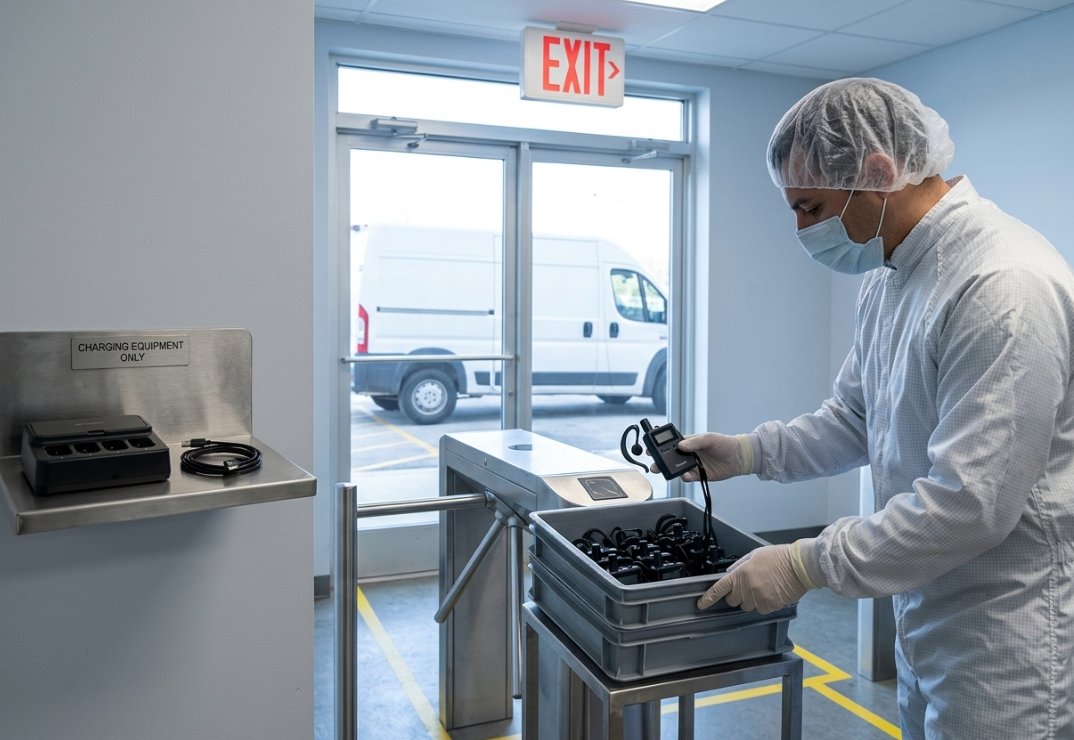
Three distinct custody checkpoints govern equipment logistics. First, the visitor changing room acts as the issuance point where receivers and sealed earpieces are distributed. Second, the clean-side viewing gallery allows guides to broadcast over ambient machinery noise while groups retain lobby access. Third, the production-side barrier prevents any return transit. Selecting a transmitter with inadequate battery endurance forces a mid-tour recharge, creating severe compliance risks if charging stations reside across restricted barriers.
The matrix below outlines operational demands across each facility boundary, focusing on equipment ownership and directional integrity rather than processor speeds.
| Facility Boundary | Items Crossing Threshold | Items Remaining Behind | Mandatory Audit Record |
|---|---|---|---|
| Visitor Changing Room | Receivers, sealed earpieces, group transmitter | Bulk charging cases, spare stock | Numbered unit issuance ledger |
| Clean-Side Gallery | Live guide commentary feed | Production-zone hardware | Channel allocation log |
| Production Processing Line | Assigned tour group units only | Lobby return pathways & charging benches | Post-tour sanitation sign-off |
| Exit Collection Point | Used units in designated bins | Unopened clean inventory | Reconciliation count against issuance list |
Matching issuance counts with collection figures requires reliable equipment endurance. Utilizing high-capacity devices eliminates mid-shift recharges, preventing compliance breaches associated with secondary equipment handling inside sterile zones.
Acoustic Penetration: Steel, Moisture, and Frequency Bands
Processing plants feature dense stainless-steel conveyors, hanging rails, refrigeration units, and high-moisture washdown environments that severely degrade wireless signals. Lower frequency UHF radio waves penetrate heavy machinery and structural obstacles more reliably than standard 2.4 GHz transmissions. The RC8860 Wireless Teaching Microphone System utilizes the 860-870 MHz band with 20 PLL-synthesized channels, 10 mW transmission output, and an open-ground range of up to 200 meters. Weighing 59 g, the transmitter delivers 10 hours of operation from a 1500 mAh cell, while the 50 g receiver operates for 20 hours on a 1000 mAh cell. Furthermore, it features an IPX4 splash-resistance rating, CE, FCC, and RoHS certifications, backed by a one-year limited warranty.

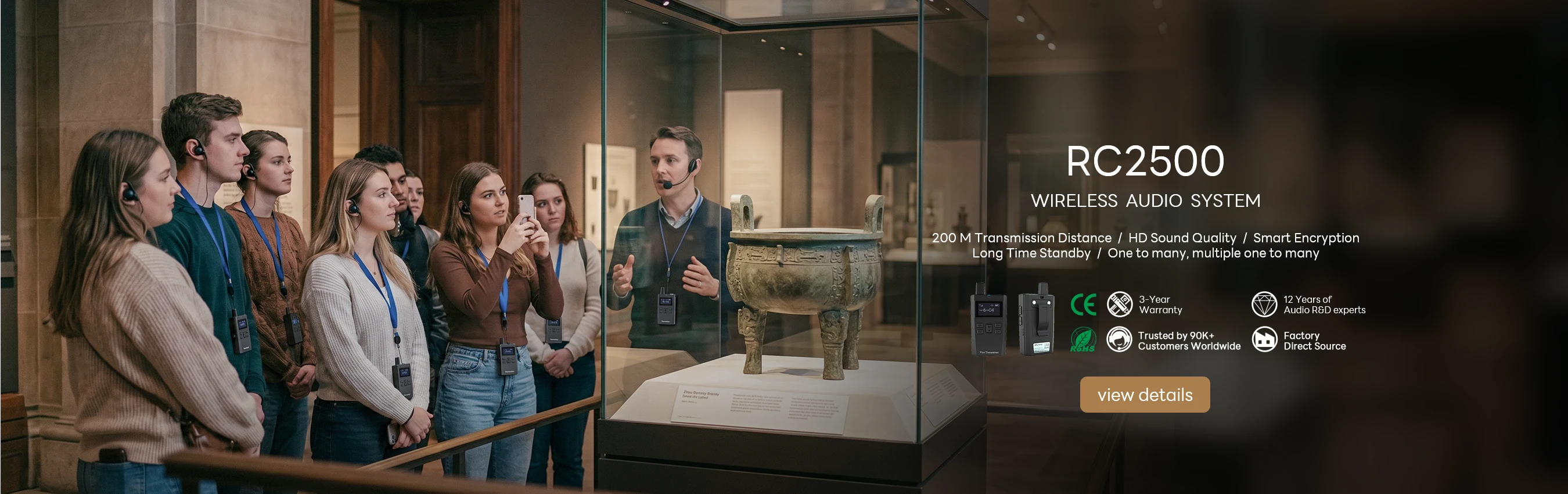
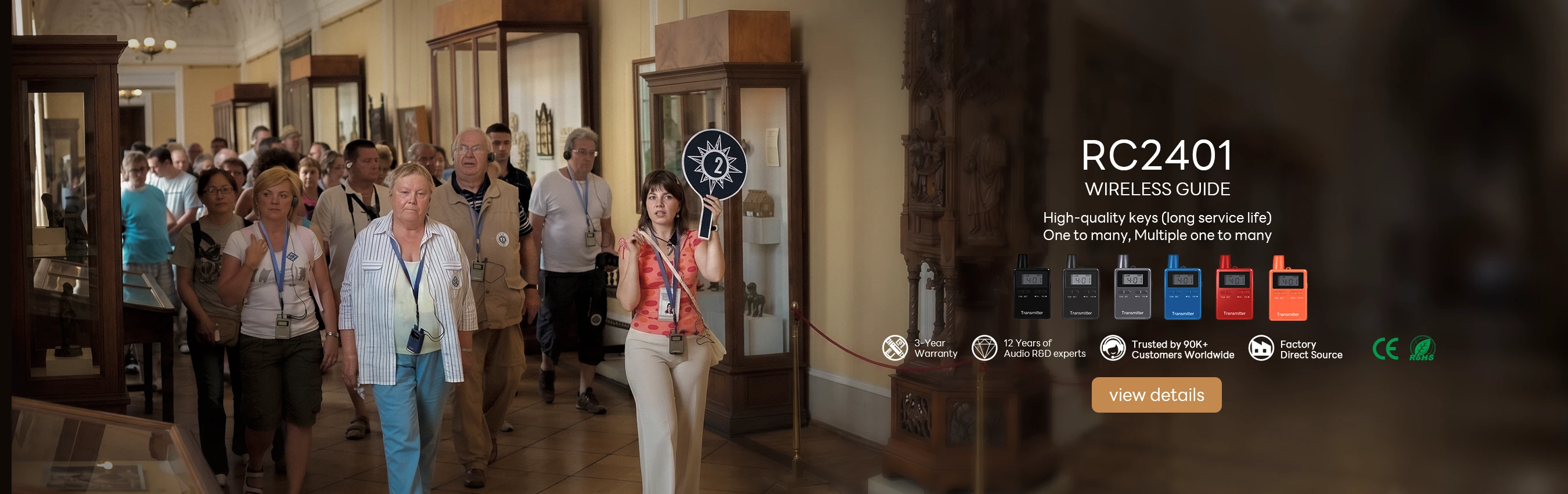
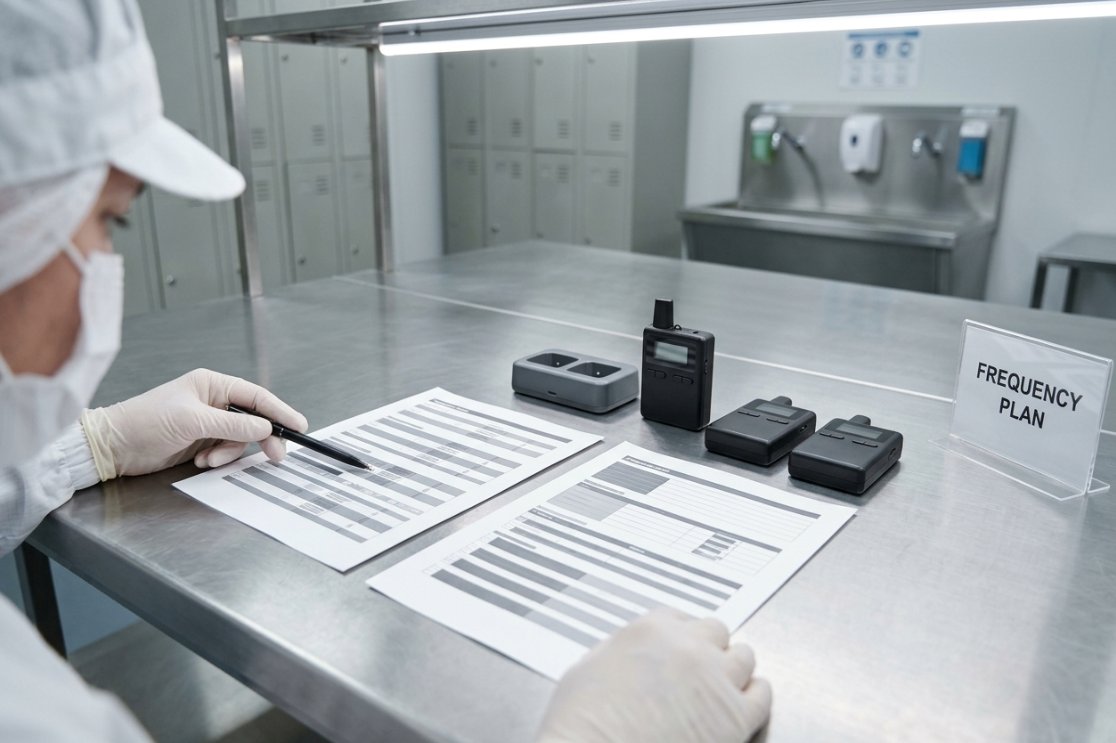
For facilities hosting international delegations where regulatory simplicity supersedes heavy-machinery penetration, the RICH AGE RC2401 Wireless Audio System Factory unit provides a globally accepted 2.4 GHz ISM band solution. Operating across 2403-2483 MHz with 50 selectable channels, 10 mW output, and a 200-meter open-area range, it offers 10-hour transmitter and 20-hour receiver runtimes. This model is ideally suited for clean-side visitor galleries where routing permits flexible movement and licensing paperwork is minimized.
Sustained Endurance for Unidirectional Routes
The RC2501 Wireless Interpretation Headset System is specifically engineered for full-shift audit tours requiring zero mid-route intervention. Operating on the 2403-2483 MHz frequency band with 50 channels and 13 mW output, it delivers up to 15 hours of transmitter runtime and over 35 hours of receiver endurance. Charging via a modern Type-C interface, both units weigh a lightweight 47 g and feature broad audio frequency responses. By maintaining active operation across exhaustive inspection schedules, the charging infrastructure remains securely positioned in the initial changing room.
Comparative Technical Specifications
Evaluating technical datasheets side-by-side highlights core operational differences across frequency bands, channel capacities, and power management.
| Model | Frequency Band | Channels | Open-Field Range | TX Runtime | RX Runtime | Charging Interface |
|---|---|---|---|---|---|---|
| RC8860 | 860-870 MHz UHF | 20 | 1–200 m | 10 h | 20 h | DC Port |
| RC2401 | 2403-2483 MHz | 50 | 1–200 m | 10 h | 20 h | DC Port |
| RC2501 | 2403-2483 MHz | 50 | 1–200 m | 15 h | 35+ h | Type-C |
For comprehensive portfolio evaluations and system matchmaking, facility planners can consult the Wireless Tour Guide System Manufacturer Direct catalog or review comparative insights on the Tour Guide System Comparison & Buyer Guide page.
Frequently Asked Questions (FAQ)
1. How many simultaneous audit groups can operate using the RC8860 UHF system?
The RC8860 provides 20 PLL-synthesized channels, allowing multiple independent groups to tour the plant simultaneously without audio crossover or interference.
2. Does the RC2501 receiver require recharging midway through an inspection tour?
No, the RC2501 receiver delivers over 35 hours of continuous operation on a single charge, easily outlasting extended multi-shift facility audits without returning to the changing room.
3. Which model offers splash resistance for washdown environments?
The RC8860 carries an official IPX4 splash-resistance rating, making it exceptionally reliable in high-moisture processing and cleaning areas.
4. Are Richitek tour guide systems designed for unidirectional broadcast communication?
Yes, our featured models operate as high-clarity one-way broadcast systems, ensuring listeners remain focused on guide commentary while questions are addressed at designated stopping points.
The video below demonstrates wireless tour guide system deployment, frequency pairing, and plant tour management workflows.