





Operational Reality Check: An industrial emergency response drill is not a standard factory tour, yet it shares a critical demand: a distinct audience. Evaluators, visiting regulatory officers, trainees awaiting rotation, and plant personnel who need immediate situation updates gather near staging areas awaiting clear briefings. Transmitting safety information over wailing siren tests via shouted commands inevitably fails. High-noise environments require disciplined wireless audio architecture.
Managing complex exercises requires evaluating how a communication system performs when a site is partitioned into strict safety zones, responder radio frequencies are heavily congested, and every visiting observer must be accounted for before the next drill evolution begins. Sourced directly through a Wireless Tour Guide System Manufacturer Direct channel, specialized briefing hardware solves specific perimeter communication challenges without interfering with incident command channels.
Zone Mapping and OSHA HAZWOPER Control Boundaries
Under OSHA's HAZWOPER framework (29 CFR 1910.120), active emergency response scenes are formally divided into three strict control zones. The Hot Zone represents areas of actual or suspected contamination where only certified personnel wearing appropriate personal protective equipment (PPE) may enter. The Warm Zone accommodates decontamination corridors and equipment staging. The Cold Zone serves as the clean support perimeter housing the Incident Command Post (ICP), staging areas, medical triage, and safety briefing assemblies. State emergency management mandates strict access control points at each perimeter, restricting exposure zones exclusively to personnel actively executing mitigation.
This regulatory division dictates exact physical boundaries for visitor and observer briefings. Guide systems belong firmly in the Cold Zone and at escort-controlled Warm Zone boundaries; they never convert standard receivers into tactical responder radios. Their true operational value is allowing a single safety officer to brief twenty to sixty observers simultaneously without shouting over alarms, ensuring entire groups receive identical instructions instantly.
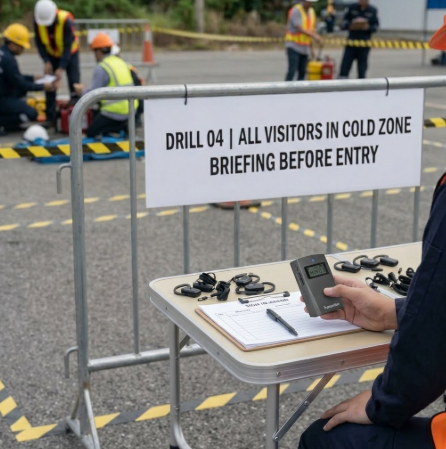 Cold Zone adherence: conducting visitor and observer safety briefings behind established perimeter tape lines.
1. RC9150: High-Capacity Audio Distribution for Staging Areas
The RC9150 2.4G High Fidelity Audio Guide is engineered for large observer briefings and command-post staging. Operating within the 2403–2483 MHz spectrum with 100 selectable channels and 10 mW output power, it delivers reliable audio across a 1–200 meter range. Both transmitters and receivers utilize robust 3.7V 1800 mAh rechargeable lithium cells, yielding an impressive endurance rating of 15 hours for transmitters and 35+ hours for receivers. Charging is handled efficiently via universal Type-C ports.
One hundred selectable channels provide vital frequency headroom when simultaneous drill evolutions occur—assigning dedicated audio lanes to entry-team observers, decontamination watchers, and visiting agency officials without cross-talk. While its 97.5-gram weight makes it ideal for stationary staging areas and fixed briefing rooms rather than active crawling through hot zones, its battery endurance ensures uninterrupted operation across multi-hour exercises. For a detailed comparative breakdown, consult the RC9150 vs RC085 Technical Comparison.
2. RC2501: Ergonomic Mobility for Active Safety Evaluators
Safety evaluators operate under high physical mobility—patrolling warm-zone perimeters, inspecting access control logs, and moving between observation posts. The RC2501 Wireless Interpretation Headset System is purpose-built for mobile auditing. Operating on a 2.4 GHz, 50-channel platform with 10 mW output and a 1–200 meter range, both transmitter and receiver weigh an ultralight 47 grams. Receivers deliver 35+ hours of operation, while transmitters provide 15 hours via Type-C charging.
Minimizing equipment weight on long shifts is crucial. Evaluators already carry clipboards, radios, and PPE; a 47-gram receiver on a lanyard eliminates neck fatigue and prevents the temptation to remove earpieces during critical observation windows. Its 50 channels offer ample segregation for single-lane drill evaluations. For seated briefing environments or classroom training architectures, review Classroom Teaching Audio System Solutions.
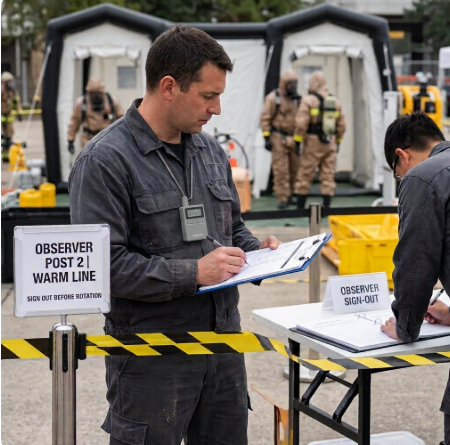 Mobile evaluation: utilizing lightweight 47-gram RC2501 receivers for extended perimeter monitoring.
3. RC085: UHF Spectrum Alternatives for Congested Facilities
In modern industrial plants, 2.4 GHz airspace is frequently saturated with corporate Wi-Fi, telemetry, and automated guided vehicles. The RC085 Portable Tour Guide System Wholesale provides a dedicated alternative by operating within the 470–510 MHz UHF band. It features 100 channels, 8–10 mW output power, and a 1–200 meter range. Transmitters weigh 65 grams (12-hour runtime) and receivers weigh 60 grams (20-hour runtime), supporting lavalier microphones with high sensitivity (-102 dBm).
Utilizing UHF frequencies bypasses heavy 2.4 GHz congestion in complex manufacturing facilities. However, safety managers must verify regional spectrum regulations, as 470–510 MHz licensing requirements vary by country. Furthermore, because the RC085 charges via standard USB rather than Type-C, mixed fleets require organized cable management during pre-shift staging.
Comparative Analysis: Alternative Market Systems
Evaluating specialized emergency briefing systems involves analyzing competitor offerings to understand specific functional strengths:
Dilan DL-R322 (Sichuan Jileda): A robust 2.4 GHz competitor featuring unlimited channels, 130m range, 25-hour receiver life, and a featherlight 16-gram receiver weight. It introduces advanced administrative features including one-key master shutdown, one-key mic mute, and out-of-range "left behind" visitor alerts. While these fleet management tools simplify large-scale event teardown, organizations must weigh them against ruggedness and specific accountability protocols.
Quiet Events Ultra2 Pro "Switch": Designed primarily for silent discos, corporate expos, and multi-channel parties, this headphone system operates across 920–926 MHz and 657–663 MHz. Delivering 18-hour battery life and 40 mm drivers, it excels in entertainment venues. However, it lacks dedicated group-pairing workflows, transmitter connection counters, and fleet charging cases required for structured emergency drill administration.
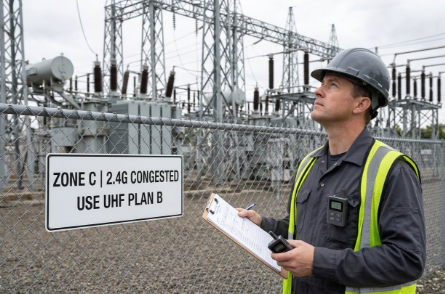 Fleet management: establishing structured receiver issuance and return checkpoints at access control points.
Configuring a Professional Emergency Drill Audio Plan
Deploying a foolproof drill communication package involves disciplined hardware allocation and strict operational protocols:
Master Briefer Unit: Designate the RC9150 for fixed staging briefings, maintaining generous channel reserves for unexpected inter-agency arrivals.
Mobile Evaluators: Issue lightweight RC2501 units to roving safety officers patrolling warm-zone perimeters.
Interference Mitigation: Deploy the UHF-based RC085 in heavy substation environments where metallic structures compromise 2.4 GHz propagation.
Access Control Integration: Issue receivers strictly at access control checkpoints against signed visitor logs, ensuring spare units remain charged and ready within the Cold Zone.
Frequently Asked Questions
1. Can a tour guide receiver replace the emergency radios issued to active responders?
No. Emergency communications must operate strictly on dedicated incident command channels with established protocols. Guide systems are exclusively designed to distribute briefings to observers in support zones. When an evacuation signal sounds, briefers immediately halt transmissions so participants can follow official plant safety procedures.
2. How many audio channels should be reserved for a drill featuring three simultaneous evolutions?
Plan one channel per active group, one for command-post visitors, and at least two additional spares. While 50-channel models easily handle this requirement, utilizing high-capacity units like the RC9150 allows safety officers to assign dedicated frequency blocks while preserving ample contingency headroom for arriving mutual-aid agencies.
3. Do industrial facilities require a license to operate 470–510 MHz tour guide systems?
Yes, regulatory compliance depends strictly on national telecommunications authorities. Because spectrum laws vary across international jurisdictions, safety managers must verify local licensing requirements with national regulatory bodies before deployment, whereas 2.4 GHz models operate under general ISM band exemptions.
4. Why do manufacturers publish receiver and transmitter operating hours separately?
Because receivers and transmitters deplete batteries on distinct schedules. During active drills, receivers remain powered on continuously to monitor safety instructions, whereas transmitters operate intermittently. Separating these metrics prevents unexpected device failures during extended training exercises. For complete system overviews, visit the Wireless Tour Guide System Manufacturer Direct hub.