





Why Staircase Locks Divide Visitor Groups and Acoustic Paths
Staircase chambers open directly into one another, allowing vessels to traverse five stacked basins while tour groups scatter across upper viewing areas, intermediate landings, and tail-end towpaths. A guided cohort of twenty-five people becomes physically partitioned by masonry, iron railings, and rushing water within minutes. Operating noise from paddle gear clanks and bywash spray drowns out unamplified speech precisely when technical explanations are required.
Employing high-output public address horns is impractical near residential canal-side properties and public footpaths. Consequently, heritage operators station secondary narrators at lower levels, assigning distinct radio channels to each elevation. For broader municipal applications encountering similar spatial challenges, structured deployments are detailed under City Sightseeing Tour Audio Solutions.
Frequency Allocation and Spectrum Planning for Dual Elevations
Managing dual narrators requires clean, non-interfering frequency channels, particularly during peak summer operations involving passing boaters and volunteer groups. The RC2500 and RC2468 feature 50 selectable channels within the 2403–2483 MHz band, whereas the RC085 provides 100 channels on UHF 470–510 MHz. OKAYO's WT-480 supplies 16 preset UHF channels, and the Bluehertz SPL-1360 Magnetic provides 99 digital channels.
While 16 channels suffice for basic setups, high-density environments benefit from broader channel pools to avoid interference from third-party transmitters. Open-field transmission ranges provided in manufacturer datasheets must be re-evaluated inside wet stone chambers and metallic gate structures.
Performance Analysis of Flagship and Compact Transceivers
The RC2500 Digital Tour Guide System Price model incorporates one-key frequency synchronization, dedicated mute functionality, 50 channels across 2403–2483 MHz, Type-C charging ports, CE, FCC, and RoHS certifications. Its dual 1800mAh cells deliver up to 15 hours of transmitter runtime and over 35 hours for receivers. One-key syncing enables lower-level narrators to onboard new batches of receivers without manual menu navigation. Weighing 104g, the receiver is engineered for stationary gateway positioning rather than lightweight mobility.
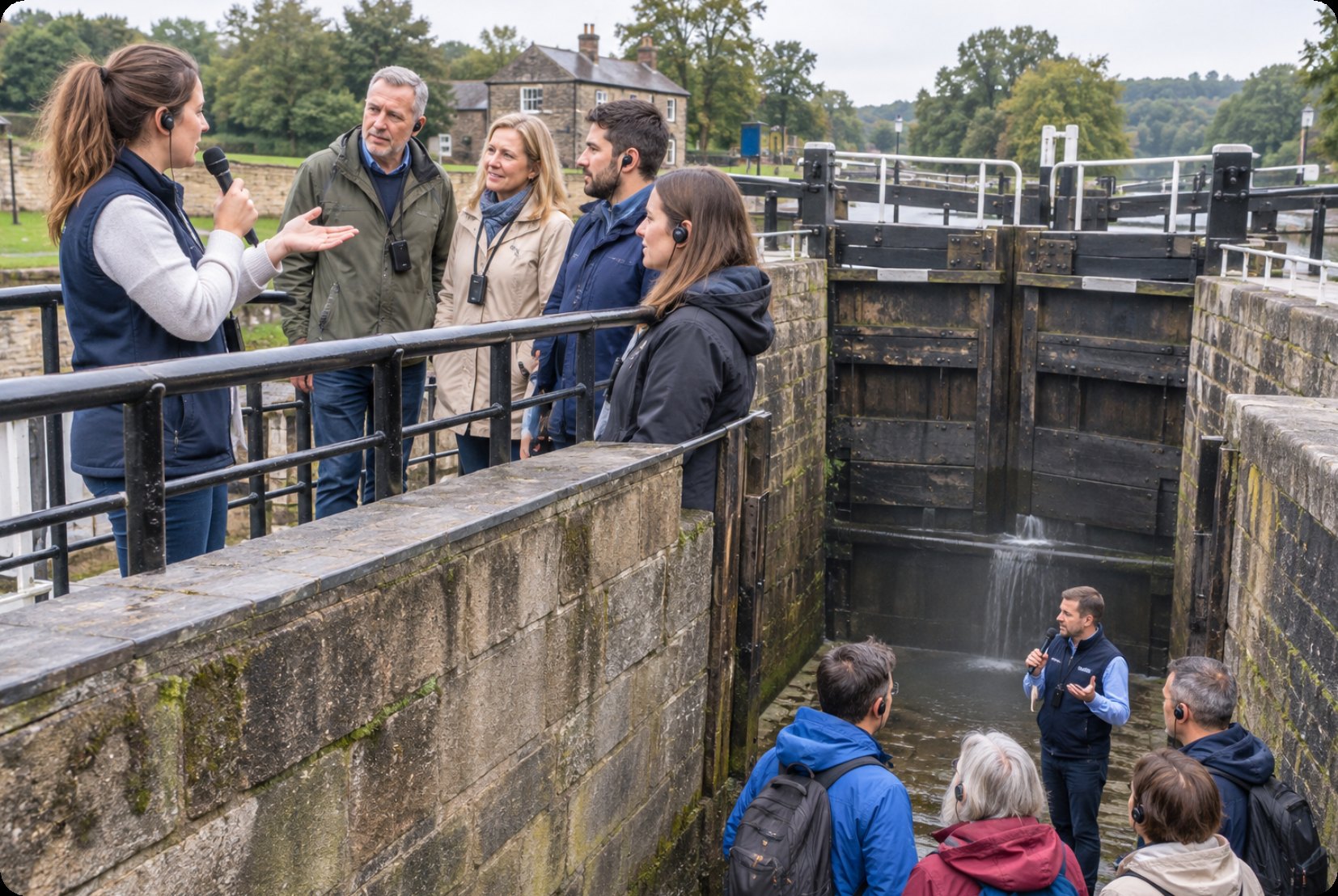
Multi-level lock infrastructure requiring robust digital signal penetration
Conversely, the OKAYO WT-480 relies on manual channel selection across 16 preset UHF channels using two replaceable AA cells, offering deployment flexibility where mains power is unavailable during continuous touring cycles. The Bluehertz SPL-1360 Magnetic offers 99 channels with magnetic contact charging and a 96-hour factory repair turnaround commitment.
Ergonomics and Mass Considerations for Extended Towpath Walking
Visitor comfort during lengthy transit segments is directly tied to device weight. The RC2468 Lightweight Tour Guide Headsets Bulk features an 18g ear-hook receiver design running on 2403–2483 MHz with 50 channels. Its 1500mAh transmitter supports up to 10 hours of operation, while the 300mAh receiver provides approximately 8 hours.
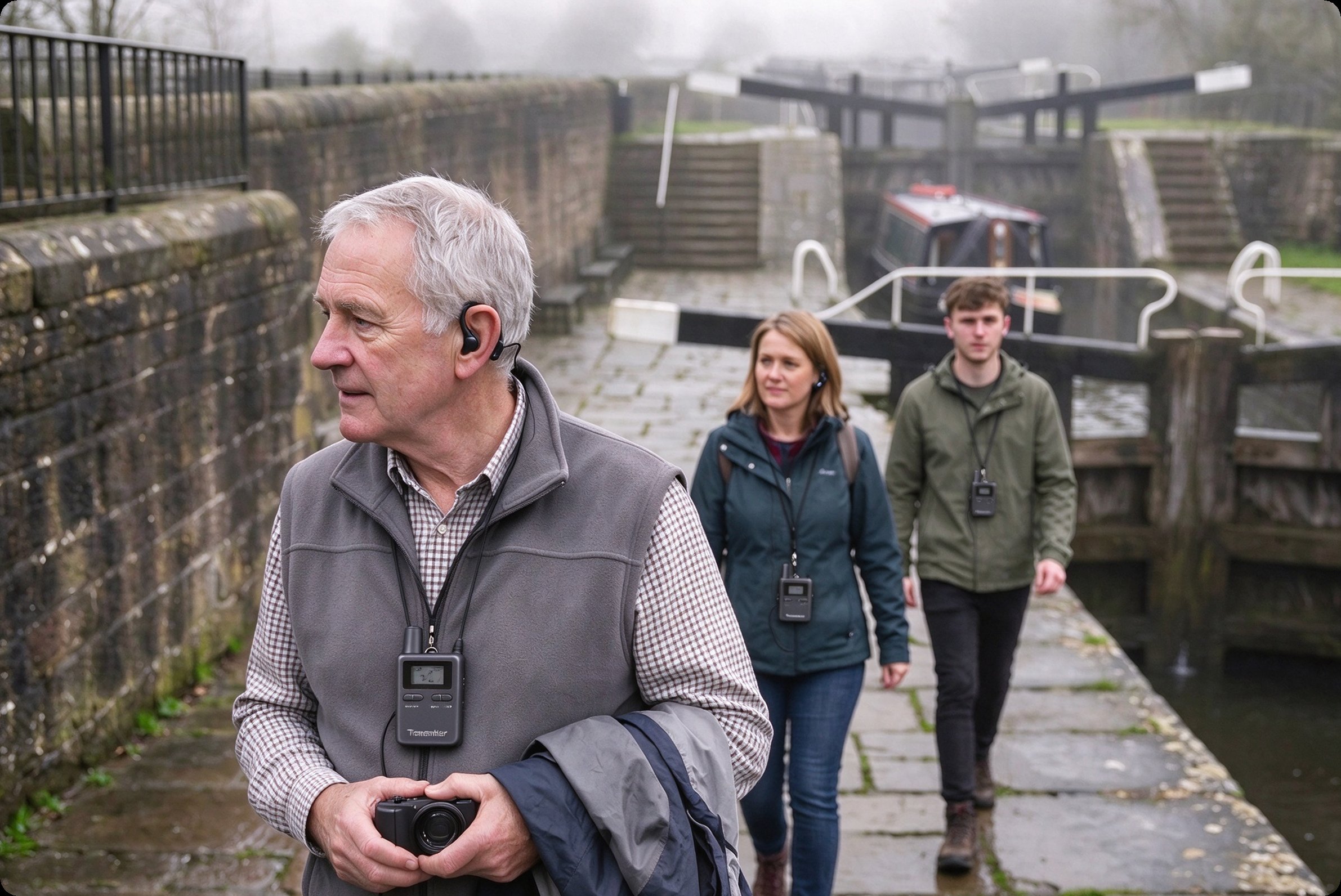
Towpath transit routes demanding featherweight ear-hook receiver ergonomics
At 18g, the RC2468 receiver minimizes user fatigue compared to heavier 104g or 51g alternatives, though operators managing back-to-back all-day schedules must account for its 8-hour receiver runtime limitation.
Environmental Resistance, Power Management, and UHF Licensing
Lock flights present wet, spray-heavy environments where devices encounter moisture and accidental drops on stone surfaces. While Bluehertz explicitly designates its SPL-1360 as drop and weather-resistant with UV-C disinfection compatibility, Richitek standard models do not list formal IP ingress ratings on their specification pages. Operators should request empirical test data for wet-weather deployments.
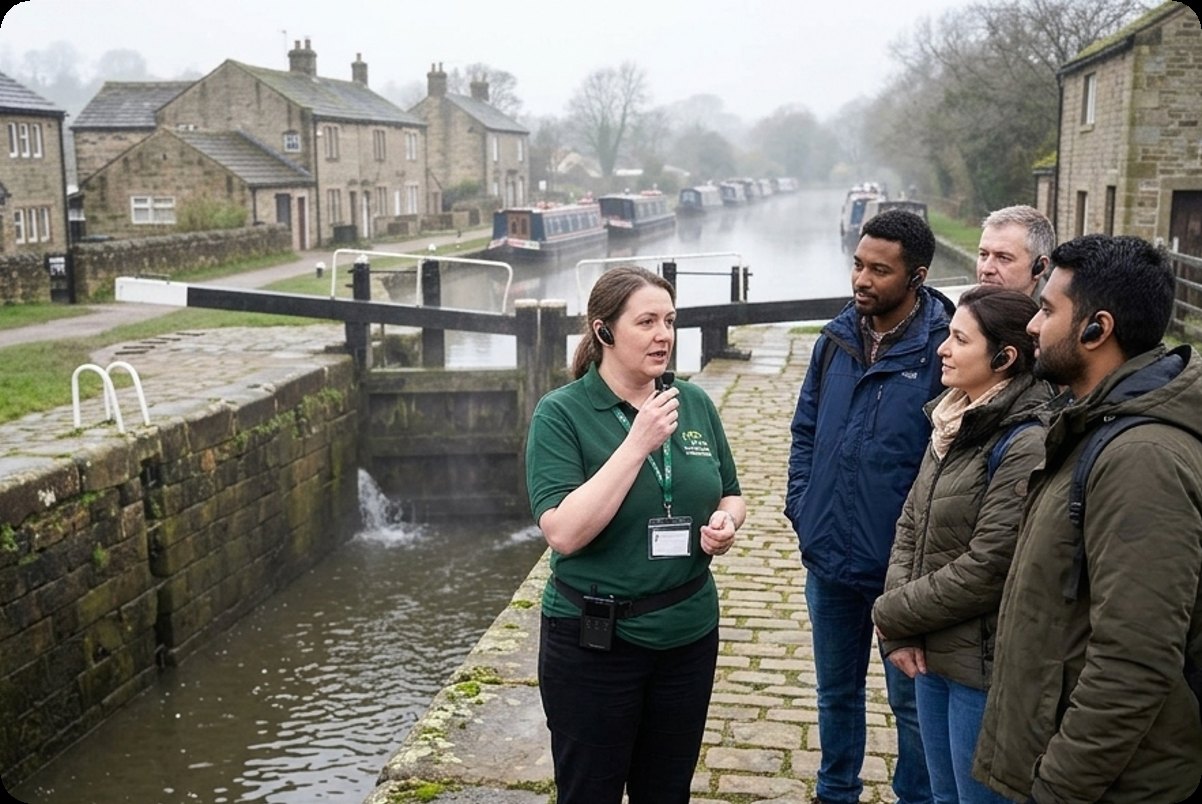
UHF digital transceiver deployment supporting heavy industrial and masonry penetration
The RC085 Portable Tour Guide System Wholesale unit operates within the 470–510 MHz UHF band, providing 100 channels, F1/F2 two-way communication modes, and 8–10mW output power. UHF frequencies offer robust penetration through thick iron lock gates and masonry, though operators must verify regional regulatory compliance since sub-band allocations vary internationally. For comprehensive factory direct portfolios, review the Wireless Tour Guide System Manufacturer Direct catalog.
Comparative Technical Specification Matrix
| Kit Model | Frequency Band | Channel Capacity | Runtime (TX / RX) | Charging Architecture | Published Weather Statement |
|---|---|---|---|---|---|
| RC2500 | 2403–2483 MHz | 50 Channels | 15h / 35+h | Type-C, two 1800mAh cells | None specified on product page |
| RC2468 | 2403–2483 MHz | 50 Channels | 10h / 8h approx. | Micro USB, 1500mAh / 300mAh | None specified on product page |
| RC085 | 470–510 MHz UHF | 100 Channels | 12h / 20h | USB, 1200mAh / 1000mAh | None specified on product page |
| OKAYO WT-480 | 794–865 MHz UHF | 16 Preset Channels | 20+h (AA cells) | 2, 12, or 30-slot chargers | None specified on product page |
| Bluehertz SPL-1360 | Digital (Band unstated) | 99 Channels | 19h | Magnetic contact (90 mins) | Drop and weather resistant |
Operational Verification Protocols for Heritage Site Deployments
| Flight Milestone | Potential Point of Failure | Required Specification Countermeasure | Pre-Deployment Field Check |
|---|---|---|---|
| Top Sluice Operation | Upper/lower narrators forced onto shared channel | Independent channel separation with one-key sync | Record both operational channels on controller pass |
| Chamber Water Level Rise | Turbulence masking narrative audio | Instant mute button and high-fidelity digital stream | Conduct audio intelligibility test from lower landing |
| Towpath Transits | Heavy receiver fatigue over multi-hour tours | Optimized lightweight housing and secure ear-hooks | Weigh sample units with lanyards attached |
| Vessel Queue Management | Depleted batteries during tight turnaround windows | Extended runtime cells or rapid cell replacement | Verify full-charge benchmarks against shift length |
| End-of-Shift Staging | Unaccounted units or moisture ingress damage | Numbered charging slots and structured warranty coverage | Audit slot counts and dry-wipe housings daily |
Additional benchmark insights spanning varied topography are available via the Tour Guide System Comparison & Buyer Guide.
Frequently Asked Questions
1. Can a single transmitter reach visitors stationed both above and below a large lock gate?
No. Massive wooden-and-iron gates, wet masonry walls, and deep stone chambers severely disrupt open-field radio propagation. Operators must deploy dual transmitters on separate channels, synchronizing user groups at respective staging landings.
2. Is UHF radio spectrum licence-free for commercial canal site operations?
No. While models like the RC085 utilize specific UHF blocks (470–510 MHz) and competing systems operate on alternative ranges, national frequency allocations differ significantly by sub-band and country. Operators must confirm local regulatory compliance in writing prior to procurement.
3. What are the full recharge timeframes across Richitek transceiver models?
Richitek standard datasheets outline physical connection types—such as Type-C for the RC2500, Micro USB for the RC2468, and USB for the RC085—while auxiliary brands like Bluehertz quote specific 90-minute magnetic recharge windows. Procurement teams should request exact factory recharge benchmarking for operational scheduling.
4. Which receiver model provides optimal ergonomics for extensive towpath walking routes?
The RC2468 ear-hook receiver weighs only 18 grams, offering substantial weight reduction compared to the 60g RC085, 51g Bluehertz unit, or 104g RC2500 flagship, minimizing user strain during continuous walking tours.