





Why Steel Plant Safety Rules Dictate One-Way Live Commentary
Visitor protocols at major steelmakers—such as Shaanxi Iron and Steel's No. 2 blast furnace guidelines—explicitly prohibit guests from speaking directly with on-shift operators to prevent hazardous distractions, routing all questions through the designated escort. That operational boundary defines the required audio architecture. A real-time, one-way broadcast that reaches every visitor simultaneously without forcing guides to shout over rolling lines is an essential safety control. Our Factory Tour Noise Reduction Audio Solutions architecture is engineered specifically around this single-speaker industrial workflow, using high channel density, directional microphone pickup, and ruggedized housings to maintain speech clarity across high-decibel production zones.
PPE Ergonomics: Pairing Receivers with Hard Hats and Earplugs
When facility rules mandate foam earplugs or earmuffs in high-decibel zones, receiver ergonomics become just as critical as acoustic output. Bulky over-ear headphones conflict with helmet chin straps and hearing protection. An ultra-lightweight 50-gram ear-hook receiver like the RC2406 or RC2408—or the 47-gram RC2501—rests comfortably over the outer ear without displacing foam plugs or pressing against hard hat suspensions. By contrast, the OKAYO WT-480 receiver weighs 130 grams with AA batteries installed, clipping to a belt and relying on a separate wired headphone cord that can snag on PPE jackets. Eliminating dangling leads and cranial pressure points keeps visitors focused on footing and overhead crane warnings.
RF Spectrum Management: 80 Channels Amid Heavy Industrial Motors
Heavy manufacturing environments punish consumer-grade wireless systems. Variable-frequency drives (VFDs), induction furnaces, and overhead bridge cranes generate broad electromagnetic noise while multiple tour groups—auditors, VIP buyers, and safety inspectors—often tour adjacent bays simultaneously. The RC2406 80 Channel Tour Guide Transmitter Receiver operates across the global licence-free 2403–2483 MHz ISM band with 80 selectable channels and 10 mW RF output. Having 80 discrete channels allows facility coordinators to run eight or ten simultaneous tours while leaving empty guard channels between groups to prevent cross-talk. Its 1500 mAh transmitter delivers 10 hours of continuous operation alongside a 20-hour, 50-gram receiver powered by a 1000 mAh lithium cell.

Battery Architecture: Sealed Lithium Packs vs. AA Cells in Conductive Dust
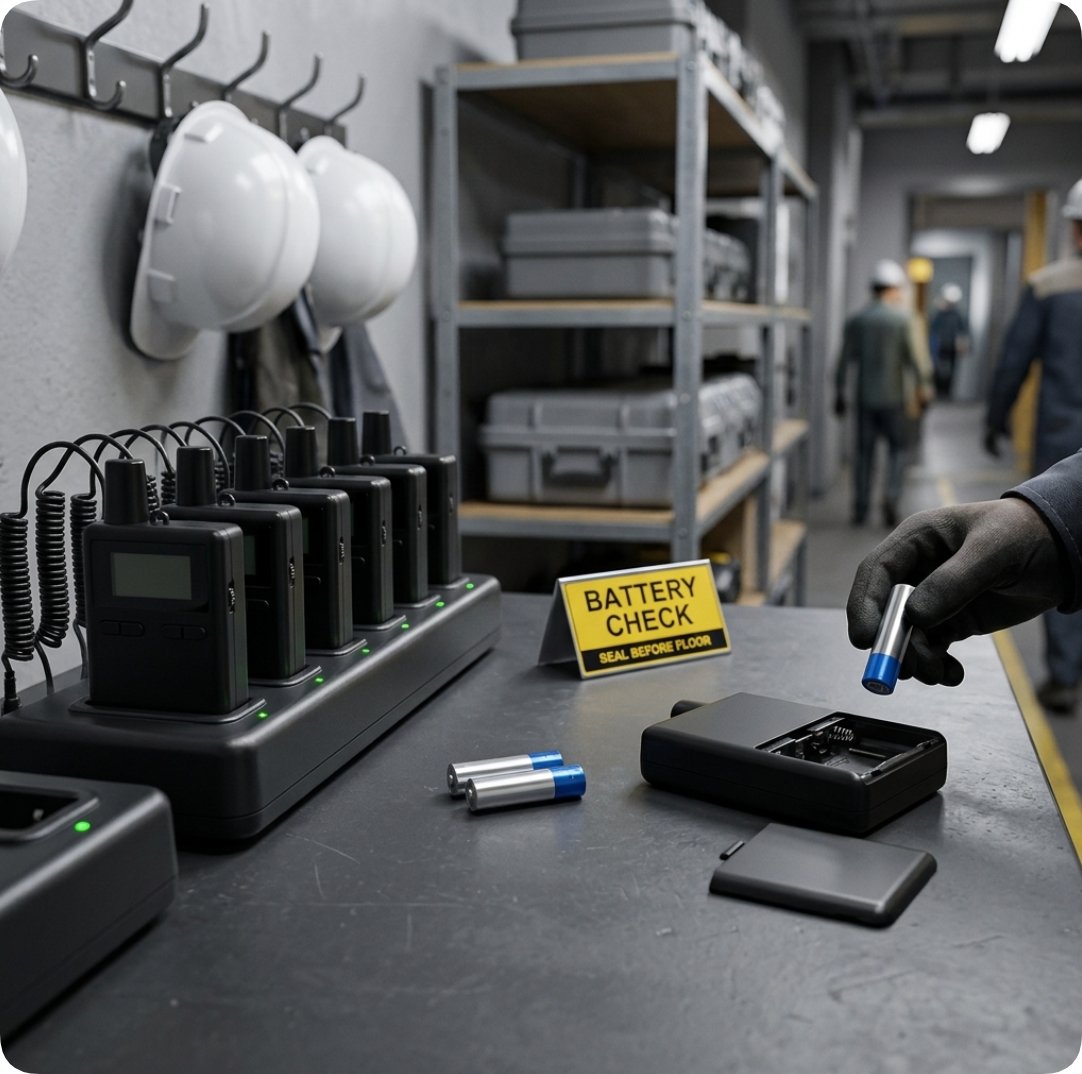
The OKAYO WT-480 utilizes UHF PLL synthesis across regional allocations—863–865 MHz in Europe and 794–806 MHz in Asia—offering 16 preset channels with dealer guidance capping simultaneous groups at six. Its signature power design relies on two replaceable AA batteries delivering 20+ hours of runtime, enabling quick alkaline swaps when charging docks are unavailable. However, steel plants generate fine metallic and carbon dust that accumulates inside open battery compartments, corroding spring terminals and causing intermittent power drops. By comparison, the RC2408 Long Range Wireless Audio Guide encloses a 1500 mAh transmitter battery and 1000 mAh receiver battery inside a fully sealed housing, blocking conductive particulate ingress while delivering 10-hour transmitter and 20-hour receiver endurance.
Live Escort Guidance vs. Pre-Recorded Audio Playback (SOOLAI AG-600)
The SOOLAI AG-600 represents an automated playback category rather than a live escort system. Supporting 99 languages with up to 4,096 MP3 tracks per language (expandable from 4 GB to 32 GB), it triggers commentary automatically via 13.56 MHz RFID tags (5 cm range), infrared beams (10 m), or 2.4 GHz RF zones (up to 100 m across 16 power steps). While effective for static exhibition galleries overlooking a plant, pre-recorded playback faces two critical limitations on an active furnace floor: static tracks cannot adapt when a tapping schedule shifts or an aisle closes for maintenance, and locked maximum volume presets cannot dynamically boost speech clarity when a hot strip mill surges in ambient noise.
Microphone Placement and Noise Cancellation in High-Decibel Zones
Acoustic signal-to-noise ratio begins at the microphone capsule. Built-in lapel mics worn at chest height capture ambient machinery rumble alongside speech. The RC2501 Wireless Interpretation Headset System pairs an optional boom headworn or lavalier microphone (-38 dBm sensitivity) with an intelligent noise-canceling DSP stage, positioning the mic element centimeters from the guide's mouth to isolate vocal frequencies from background machinery. While the WT-480 also includes an external headset mic jack, the RC2501 adds 13 mW RF transmit power, 15 hours of transmitter battery life, 35+ hours of receiver runtime, and modern USB Type-C charging.
Cross-Brand Functional Matrix for Heavy Industry Tours
Comparing all five models across operational roles highlights how each platform handles multi-group scheduling, setup speed, and shop-floor acoustics:
| System Model | Audio Mode | Content Delivery | Deployment Workflow | High-Noise Performance Factor |
|---|---|---|---|---|
| Rich Age RC2406 / RC2408 | One-way live guide | Real-time spoken commentary | One-click channel sync across 80 channels | 80 channels provide wide guard spacing between concurrent groups |
| Rich Age RC2501 | One-way live guide | Live commentary with optional headset mic | One-click sync across 50 channels, Type-C charging | Close-talk headset mic + noise-canceling DSP cuts machinery roar |
| OKAYO WT-480 | One-way live guide | Real-time spoken commentary | 16 preset UHF channels (max 6 concurrent groups) | Country-specific UHF band; 100 m line-of-sight range |
| SOOLAI AG-600 | Automated playback | Pre-recorded MP3 (99 languages, 4,096 tracks each) | RFID tag, infrared beam, or RF zone trigger | Locked maximum volume cap limits audibility near rolling lines |
Direct Specification Breakdown: RC2406 vs. RC2408 vs. RC2501
Procurement managers comparing Rich Age datasheets will notice that the RC2406 and RC2408 share identical core RF, battery, weight, and DC charging specifications—differing primarily in housing color options and inventory availability—while both carry CE, FCC, and RoHS certifications backed by a one-year limited warranty and lifetime technical support. The RC2501 steps up to 13 mW RF power, 35+ hour receiver battery life, 47-gram ultralight housings, and USB Type-C charging.
| Technical Specification | RC2406 | RC2408 | RC2501 |
|---|---|---|---|
| Frequency Band | 2403–2483 MHz | 2403–2483 MHz | 2403–2483 MHz |
| Selectable Channels | 80 Channels | 80 Channels | 50 Channels |
| RF Output Power | 10 mW | 10 mW | 13 mW |
| Transmitter Battery & Runtime | 10 Hours (1500 mAh) | 10 Hours (1500 mAh) | 15 Hours (1500 mAh) |
| Receiver Battery & Runtime | 20 Hours (1000 mAh) | 20 Hours (1000 mAh) | 35+ Hours (1000 mAh) |
| Unit Weight (TX / RX) | 59 g / 50 g | 59 g / 50 g | 47 g / 47 g |
| Charging Interface | DC Port | DC Port | USB Type-C |
Ambient Thermal Thresholds and Hot-Zone Hardware Zoning
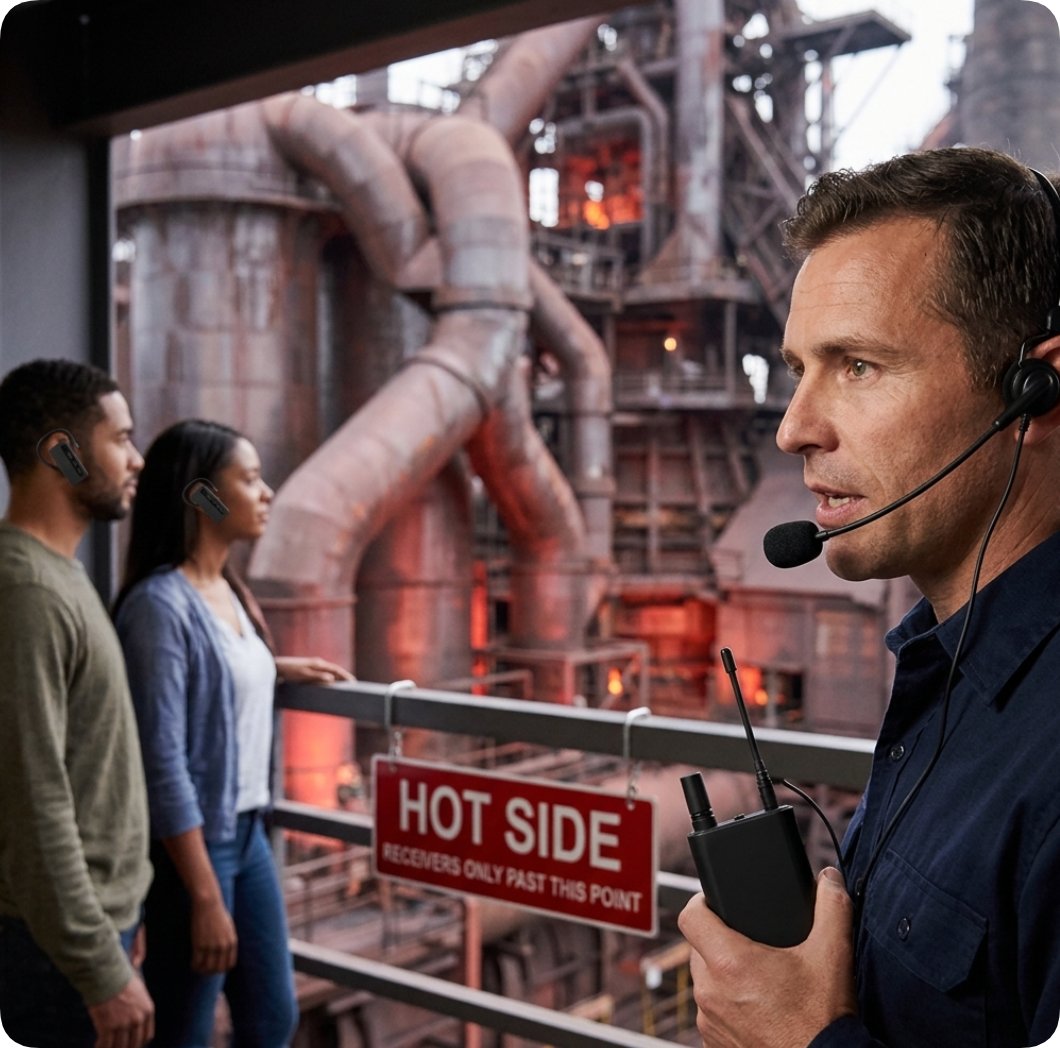
Operating temperature ratings determine where equipment can safely stage during summer campaigns. The RC2501 specifies an operating window of -10°C to 45°C, while the SOOLAI AG-600 extends to -10°C to 60°C—offering an extra 15 degrees of thermal margin near continuous casters or reheating furnaces (whereas the OKAYO WT-480 publishes no ambient temperature ceiling). Because radiant heat directly beside molten metal exceeds all portable electronics ratings, industrial safety teams separate equipment zones: charging cases and reserve transmitters remain inside air-conditioned control rooms, guides broadcast from shielded observation walkways, and only lightweight 47-gram receivers accompany visitors along hot-side perimeter rails. Explore full industrial model lineups on our Wireless Tour Guide System Manufacturer Direct catalog.
Three Decision Criteria for Selecting Your Steel Mill Tour Fleet
Selecting the optimal system comes down to three concrete operational filters:
Live Escort Control vs. Static Playback: Active melt shops and rolling mills require live human commentary to adapt instantly to crane movements and safety holds, ruling out pre-recorded players like the AG-600 on the shop floor.
Concurrent Group Channel Density: Plants hosting more than six simultaneous groups require 80-channel systems (RC2406 or RC2408) to maintain interference-free guard channels, whereas smaller fleets benefit from the RC2501's 13 mW output and headset noise cancellation.
PPE Compatibility and Dust Sealing: Sealed lithium housings protect battery contacts from conductive iron dust, while 47–50 gram ear-hook receivers integrate seamlessly beneath hard hats and over foam earplugs.
For additional side-by-side industrial evaluations, browse our Tour Guide System Comparison & Buyer Guide.
Frequently Asked Questions (FAQ)
1. Are these five tour guide systems designed for one-way escort commentary rather than two-way visitor talk-back?
Yes. All five units deliver dedicated one-way live audio or automated playback with zero visitor talk-back buttons, enforcing steel mill safety rules that prohibit distracting operators on shift while keeping Q&A centralized at designated safe assembly zones.
2. How many concurrent tour groups can operate simultaneously on one factory floor without cross-talk?
The RC2406 and RC2408 support up to 80 selectable channels and the RC2501 provides 50 channels, enabling plants to run eight to ten simultaneous tours with empty guard channels between groups—far exceeding the six-group ceiling of the 16-channel OKAYO WT-480.
3. Do the Rich Age RC2406, RC2408, and RC2501 require regional radio frequency licensing?
No. All three Rich Age systems operate on the globally licence-free 2403–2483 MHz ISM frequency band, eliminating regional frequency registration and customs delays that affect country-specific UHF systems like the OKAYO WT-480 (863–865 MHz EU / 794–806 MHz Asia).
4. How should steel plants deploy wireless audio hardware near high-heat furnace and caster walkways?
Facilities keep charging docks and spare transmitters inside air-conditioned control rooms while issuing lightweight 47-to-50-gram receivers to visitors along shielded walkways, staying safely within the RC2501's -10°C to 45°C operating envelope.
The video below demonstrates wireless tour guide system setup, channel synchronization, and noise-canceling headset operation for industrial factory tours.