

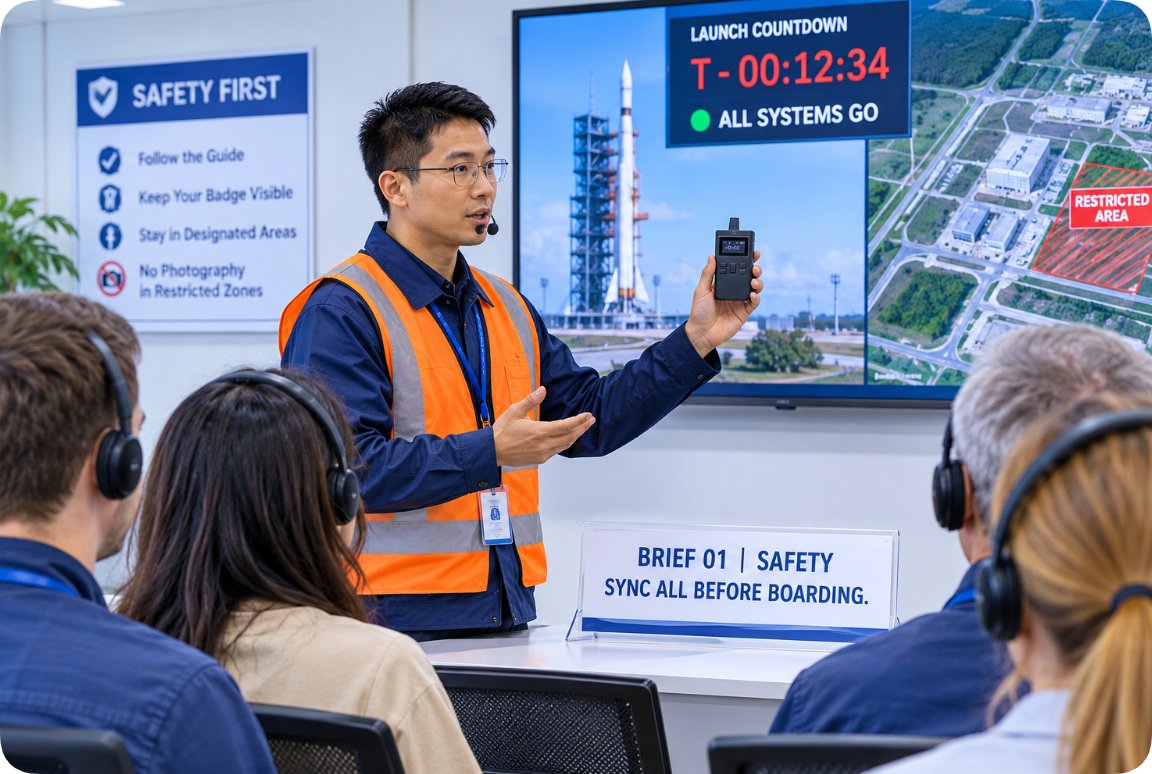
Public launch viewing days look like entertainment from the perimeter, yet for site operations they function as controlled safety briefings with hundreds of visitors in motion. Safety instructions must cut through crowd chatter, shuttle traffic, and open-air wind while guests move from security checkpoints to transport buses, viewing mounds, and visitor facilities without crossing restricted zones. Relying on a handheld megaphone fails the moment wind shifts or a group stretches out. A dedicated wireless tour system keeps safety directives and commentary in every guest's ear across each stage of the visit.
This technical comparison evaluates three RICH AGE models—the RC2500, RC2401, and RC2468—alongside two established reference systems: the Tourtalk TT 100 and the Globibo UHF001T+081R. Because spaceport tours combine indoor briefings, vehicle transfers, long walks, and open-air viewing areas, no single specification fits every role. Where a competing unit offers stronger channel capacity, dual-presenter control, or longer line-of-sight reach, those trade-offs are addressed directly.
🚀 What Public Launch Viewing Days Actually Demand From Audio Gear
Outdoor group tours typically break down in two ways: visitors at the back lose audio clarity, or stragglers drift away and miss directional cues. Spaceport tours introduce a third operational risk. Pre-viewing safety rules—where to stand, what equipment remains off-limits, and when to hold behind safety lines—must be delivered clearly at safe volume levels, often across multiple visitor languages.
Multi-stage movement creates a second pressure point. Guests check in at a visitor center, ride buses past integration or assembly facilities, climb or walk to an outdoor viewing mound, and return through retail or exhibition areas. Repeating perimeter rules at every stop wastes valuable schedule time and invites interruptions. Keeping a single synchronized channel active from check-in to departure protects both pacing and safety compliance.
Practical lessons from Industrial Plant Tour Noise Cancelling Headsets carry directly into spaceport operations, with even stricter attention to perimeter control. Staff need fast hand-out and collection workflows between waves of visitors, plus hardware that handles wind, dust, and full-day outdoor schedules without fuss.
📻 Three RICH AGE Models Matched to Spaceport Tour Roles
Rather than treating every visitor group identically, RICH AGE assigns distinct models to different operational profiles across a spaceport day:
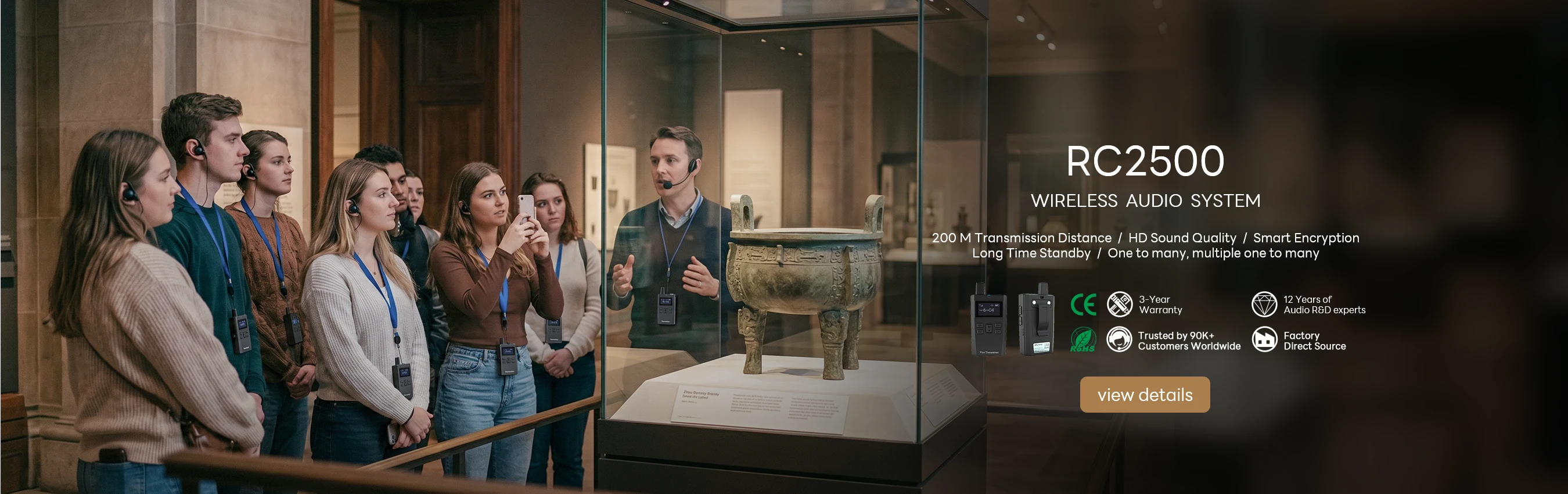
RC2500 — Full-Day Flagship With One-Key Group Control
The RC2500 Wireless Tour Guide System operates across 2403–2483 MHz with 50 channels and 10 mW output, weighing 104 g per unit with USB Type-C charging. Its transmitter runs up to 15 hours and its receiver exceeds 35 hours—the longest receiver runtime in this lineup. For busy launch days, one-key channel sync, group mute, and group shutdown simplify turnarounds: guides lock every receiver onto the right channel at start-up and silence or power down units cleanly before groups re-enter indoor visitor spaces.
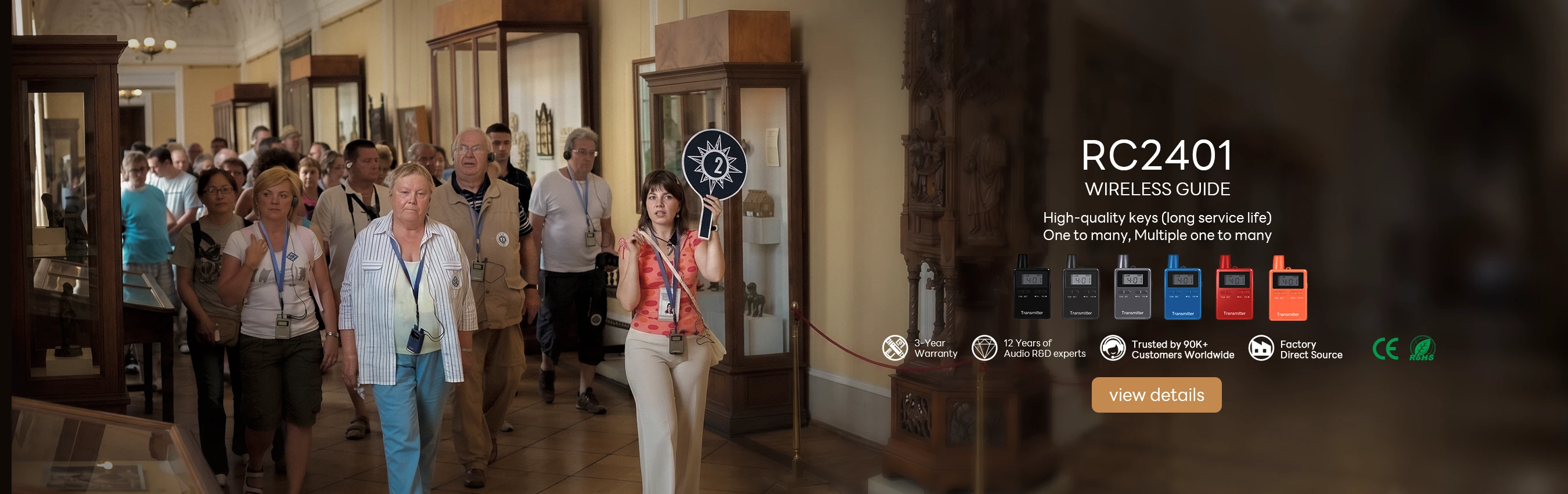
RC2401 — Straightforward 50-Channel Group Operation
The RICH AGE RC2401 Wireless Audio Guide System provides core 2.4 GHz performance on 2403–2483 MHz with 50 channels and 10 mW output, rated for 10 hours of transmitter use and 20 hours of receiver use. Weighing 59 g for the transmitter and 50 g for the receiver with DC port charging, it omits flagship one-key group controls in exchange for lower tier cost on scheduled, shorter routes with smaller groups.
RC2468 — 18 g Ear-Hook Receiver for Long Walking Routes
The RC2468 Ultra-Light 2.4G Wireless Tour Guide System pairs a 59 g transmitter and 50 channels with an 18 g ear-hook receiver that sits directly on the ear rather than hanging from a lanyard. Rated for 10 hours transmit and roughly 8 hours receive, it delivers high comfort on walking segments, while its shorter receiver battery life makes it best suited to half-day tours unless spare charged units are staged at collection points for all-day events.
🎧 Tourtalk TT 100: Higher Channel Density and Dual-Presenter Flexibility
The Tourtalk TT 100 operates digitally on 2.4 GHz with 100 selectable channels and supports up to 20 simultaneous groups in the same venue. Each unit weighs 75 g with a single AA battery, delivers roughly 10–11 hours of published runtime, and operates between -10 °C and +50 °C at up to 10 mW RF output. Key hardware features include an integrated microphone, lapel mic input, aux input, mute switch, channel lock, an LCD status readout, a 3.5 mm socket compatible with neck loops, and a dual-presenter mode allowing two speakers to share a group or hand off Q&A duties.
That 100-channel ceiling doubles the 50 channels on the RICH AGE models compared here, giving multilingual spaceports broader channel separation when many language tracks run concurrently. Pairing a safety officer with a tour guide via dual-presenter mode is also practical during high-security briefings, and the neck-loop-ready 3.5 mm jack supports assistive listening needs.
Published range is the main constraint to weigh: Tourtalk specifies up to 30 m depending on site conditions, which works well in visitor centers or tight galleries but leaves less margin along wide outdoor viewing mounds. By comparison, the Wireless Tour Guide System Manufacturer Direct comparison lists a 1–200 m specification across the RC2500, RC2401, and RC2468 on 2.4 GHz—providing a wider link budget on open ground without implying uninterrupted 200 m audio inside dense crowds.
📡 Globibo UHF001T+081R: Long-Range UHF and Spectrum Licensing Considerations
Pairing the Globibo UHF001T transmitter with the 081R receiver provides a dedicated UHF option rated at 794–806 MHz with PLL synthesis, 64 preset channels, a 250 kHz channel step, 10 mW output, 50 Hz–12 kHz audio response, and up to 200 m line-of-sight range. The transmitter runs up to 14 hours on two AA batteries at 98 g, while the 50 g receiver uses an internal lithium battery rated for 10–14 hours.
Globibo also documents an 800–823 MHz variant with 99 channels and up to 300 m line-of-sight range, yet spectrum rules apply to both options. Documentation for the transmitter notes that UHF frequencies may require licensing or face restrictions in specific countries or controlled sites—explicitly citing factories, airports, and military zones—making pre-purchase frequency coordination essential at an active spaceport where telemetry, range safety, and aviation or ground radios already share airspace and infrastructure.
Operating across 2403–2483 MHz lets the RC2500, RC2401, and RC2468 stay on a license-exempt 2.4 GHz band in the markets we serve without site-specific UHF frequency permits. While UHF line-of-sight figures can match or exceed a single 1–200 m 2.4 GHz link under clear conditions, staying on a single 2.4 GHz band simplifies cross-zone movement; review model-by-model channel and weight specs in the Tour Guide System Comparison | Find the Best Model for Your Application guide when sizing a fleet.
⚖️ Specification Comparison Across All Five Systems
The comparison table below summarizes published manufacturer specifications, using the 794–806 MHz UHF001T+081R pairing so both transmitter and receiver models are explicitly identified.
| Specification | RC2500 | RC2401 | RC2468 | Tourtalk TT 100 | Globibo UHF001T+081R |
|---|---|---|---|---|---|
| Frequency Band | 2403–2483 MHz | 2403–2483 MHz | 2403–2483 MHz | 2.4 GHz | 794–806 MHz |
| Channels | 50 | 50 | 50 | 100 | 64 |
| Published Range | 1–200 m | 1–200 m | 1–200 m | Up to 30 m | Up to 200 m line of sight |
| Transmitter Battery Life | 15 h | 10 h | 10 h | 10–11 h (AA) | Up to 14 h (2x AA) |
| Receiver Battery Life | 35+ h | 20 h | ~8 h | 10–11 h (AA) | 10–14 h |
| Receiver / Unit Weight | 104 g | 50 g | 18 g ear-hook | 75 g (unit, with battery) | 50 g |
| Frequency Licensing | Not required in our served markets | Not required in our served markets | Not required in our served markets | Licence-free | May be required at airports, military areas |
Two details in the table warrant closer attention when planning a spaceport deployment. Tourtalk's 75 g specification reflects a complete unit fitted with its AA battery rather than a bare receiver weight, so it aligns differently from the 50 g RC2401 receiver and 18 g RC2468 ear-hook receiver. Meanwhile, the RC2468's ~8-hour receiver runtime is the shortest figure in this set; operators running full-day launch events should keep pre-charged spare receivers ready at check-in or collection stations.

🛡️ Acoustic Peaks, Safety Briefings, and Fleet Turnaround
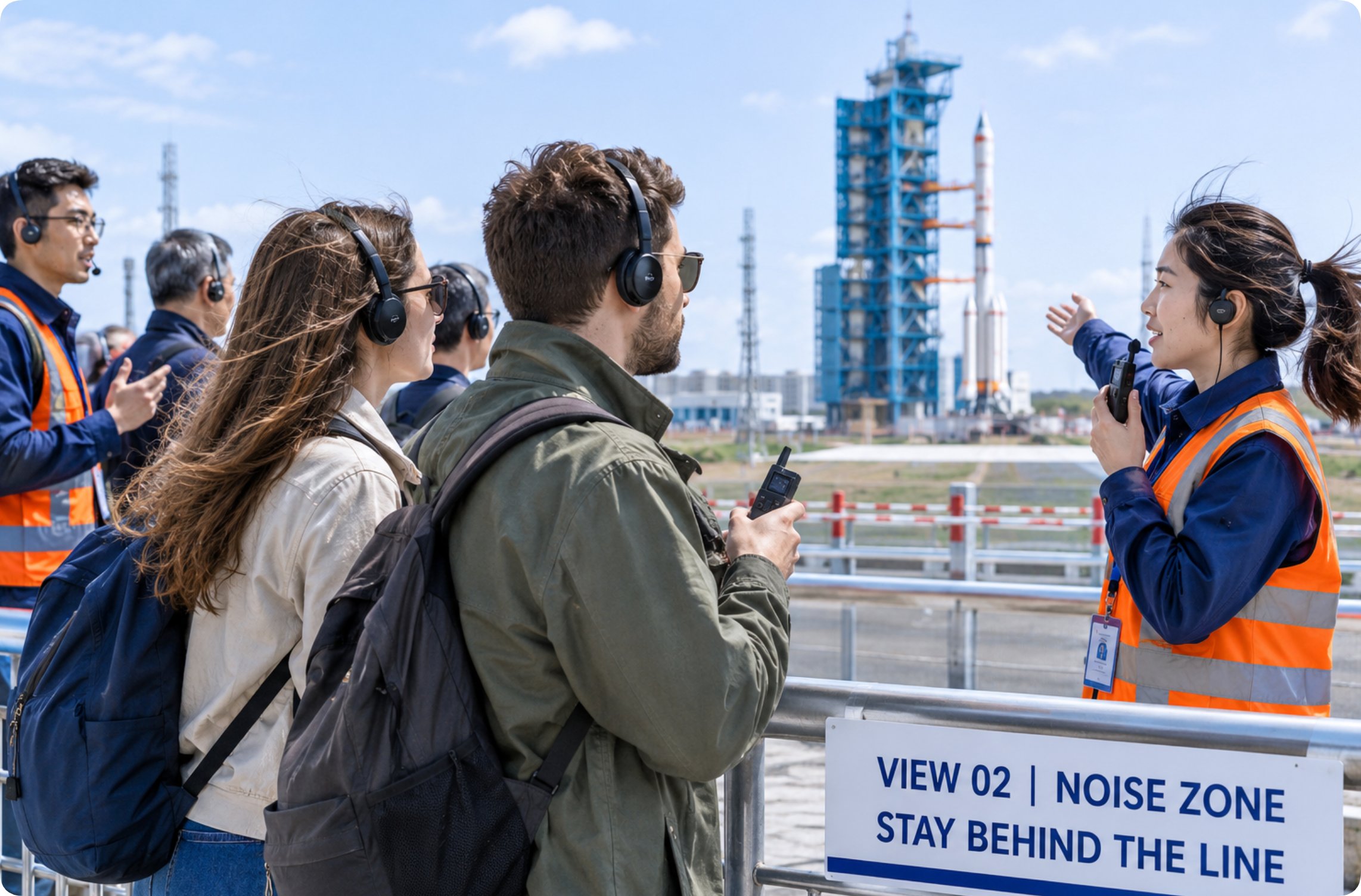
Launch viewing sites experience sharp acoustic bursts during static fires, test runs, or liftoffs. No tour receiver replaces certified hearing protection during peak engine noise, nor should a tour system try to out-shout high-decibel spikes. Its operational value comes in the countdown window beforehand: delivering clear, consistent safety instructions at controlled levels so every visitor understands perimeter boundaries before engines ignite, then allowing guests to watch quietly once viewing begins.
Shift turnover is equally decisive when multiple visitor waves cycle through in a single afternoon. Hardware that guests put on intuitively and staff can gather, mute, or shut down quickly saves more time than unused extra channels. One-key group shutdown on the RC2500 streamlines end-of-tour wrap-up, while the ear-hook design on the RC2468 cuts down on tangled lanyards and lengthy fitting instructions on walking routes.
❓ Frequently Asked Questions
Does a spaceport tour require a frequency licence for these systems?
No individual frequency licence is required for the RC2500, RC2401, or RC2468 in the markets we serve because all three operate on 2403–2483 MHz. The Tourtalk TT 100 likewise uses licence-free 2.4 GHz operation, whereas Globibo notes that UHF frequencies may require licensing or face restrictions at controlled sites such as factories, airports, and military zones, making spectrum checks essential before deploying UHF gear on a spaceport.
Which model fits a two-hour public launch tour best?
The RC2468 fits a two-hour walking tour directly with its 18 g ear-hook receiver and ~8-hour receiver runtime. The RC2500 is the right choice whenever staff want one-key group sync, mute, and shutdown across repeated tour waves despite its 104 g unit weight, while the Tourtalk TT 100 fits programs that need 100 channels for parallel language tracks.
Can two speakers address the same visitor group on one channel?
Yes when selecting a system with dedicated dual-presenter support such as the Tourtalk TT 100, which allows two speakers to work with one group or share Q&A duties. In the standard configurations covered here, the RC2500, RC2401, and RC2468 operate as single-guide broadcast systems rather than dual-presenter units, so dual-speaker workflows must be specified upfront during system selection.
How far apart can a guide and visitors be during an outdoor launch briefing?
Published range ratings are 1–200 m on 2.4 GHz for the RC2500, RC2401, and RC2468; up to 200 m line of sight for the Globibo UHF001T+081R (or up to 300 m line of sight on its 800–823 MHz option); and up to 30 m for the Tourtalk TT 100. Because open viewing mounds with scattered visitors behave differently from unobstructed line-of-sight tests, treat published distances as upper limits and keep groups within comfortable visual and RF range of the guide.
How should operators plan battery life for full-day spaceport events?
Match each model's published runtime to your shift length and stage charged spares for multi-wave days: the RC2500 provides 15 hours transmit and 35+ hours receive via USB Type-C, the RC2401 provides 10 hours transmit and 20 hours receive via DC charging, the Globibo UHF001T+081R provides up to 14 hours transmit (2x AA) and 10–14 hours receive, the Tourtalk TT 100 provides roughly 10–11 hours per unit (AA), and the RC2468 provides 10 hours transmit and ~8 hours receive.