
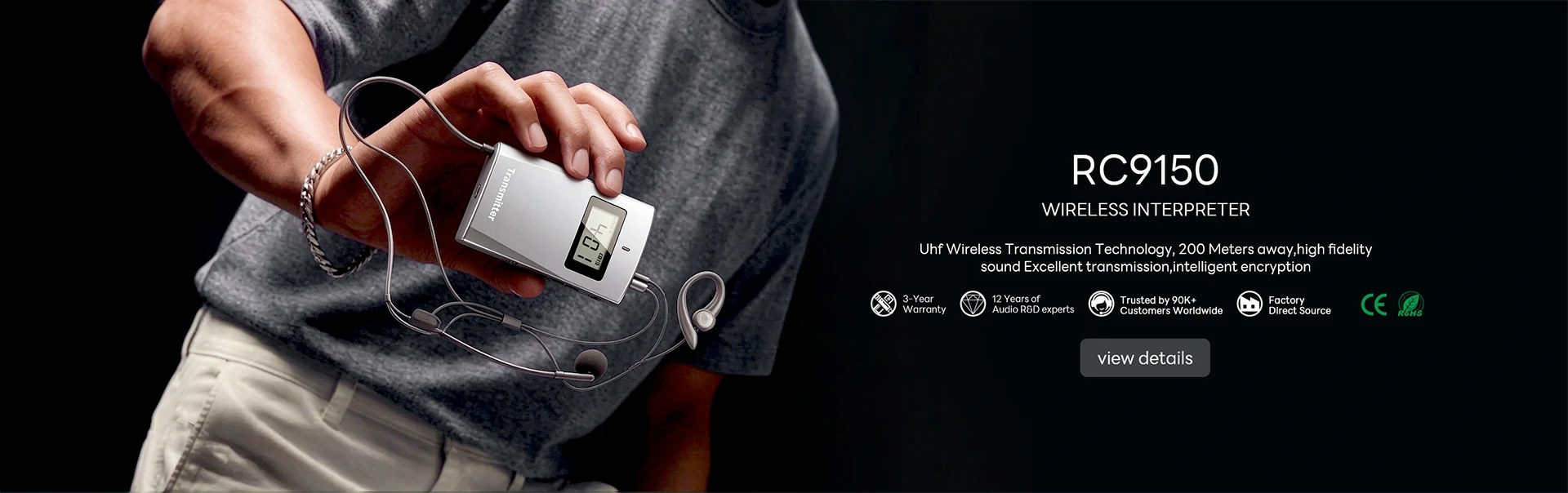
A stadium presents a demanding radio environment for wireless tour guide equipment. Reinforced concrete concourses, steel seating tiers, floodlight ballasts, broadcast crews, and thousands of visitor smartphones, wearables, and wireless devices share the same physical footprint. A system that looks straightforward on a datasheet can still face interference or channel limits on match days if frequency band availability, simultaneous group counts, and charging or return logistics are not planned ahead of time.
Evaluating options through our Wireless Tour Guide System Manufacturer Direct lineup alongside competing 2.4 GHz models—RC8860 (UHF 860–870 MHz, 20 channels), RC2406 (2.4 GHz 2403–2483 MHz, 80 channels), and RC085 (UHF 470–510 MHz, 100 channels) versus YINGMI 008E and YINGMI E8 in 2.4 GHz—shows why band selection, realistic concurrent group capacity, and shift turnaround matter more than nominal channel numbers alone.
Spectrum Rules and Regional Availability Before Audio Tuning
Selecting a wireless frequency band involves regulatory and coordination checks alongside acoustic needs. The three Richitek models span distinct frequency allocations—UHF 470–510 MHz on RC085, UHF 860–870 MHz on RC8860, and 2403–2483 MHz on RC2406—while YINGMI 008E (2404–2478 MHz) and YINGMI E8 (2400–2490 MHz) operate within the unlicensed 2.4 GHz ISM band.
UHF allocations in the 470–510 MHz or 860–870 MHz bands often require local compliance verification or coordination with broadcast and wireless microphone users depending on jurisdiction, whereas 2.4 GHz hardware simplifies cross-border licensing but shares dense crowd and venue Wi-Fi/Bluetooth traffic. Conducting an on-site RF check before purchasing avoids compliance surprises or crowded-channel bottlenecks on event days.
RC8860: 20 UHF Channels (860–870 MHz) for Focused Tours
The RC8860 Wireless Teaching Microphone System operates on UHF 860–870 MHz with 20 channels, 10 mW output power, up to 200 m range, 50 Hz–12 kHz frequency response, PLL control, and DC charging. Published battery ratings provide 10 hours on the 59 g transmitter (3.7 V 1500 mAh) and 20 hours on the 50 g receiver (3.7 V 1000 mAh).
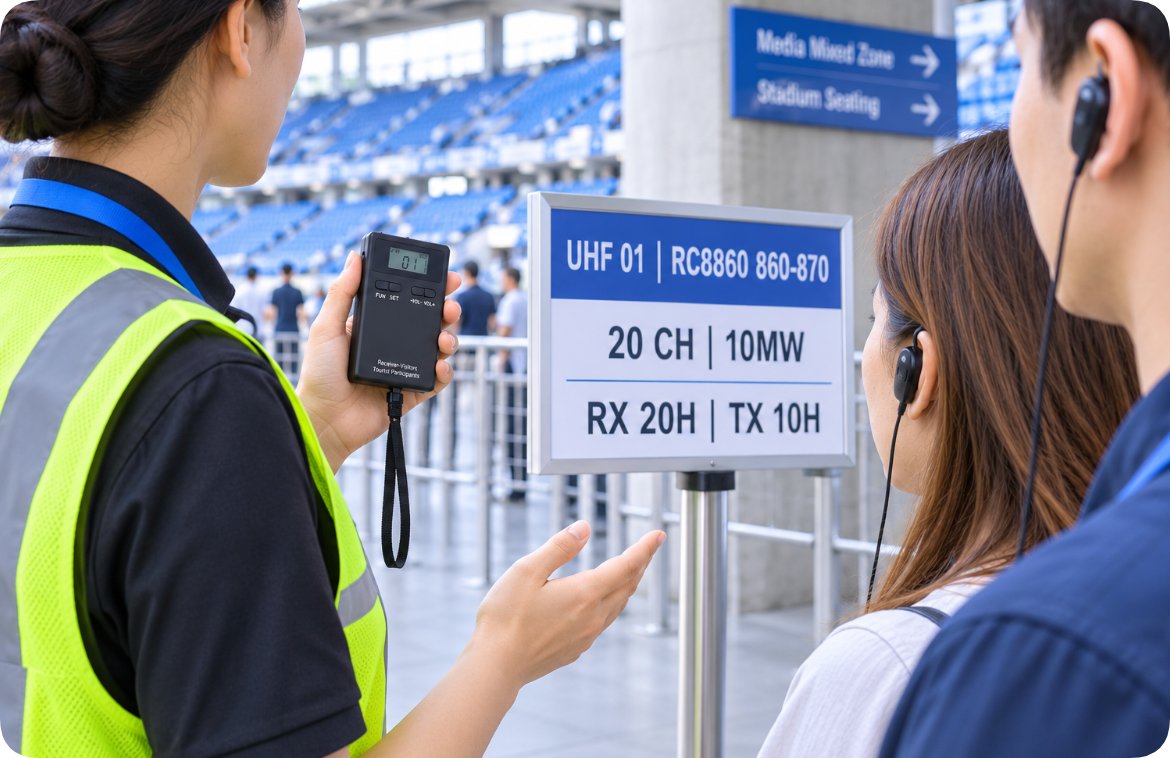
With 20 channels, RC8860 fits smaller guided programmes—such as VIP hospitality walkthroughs, sponsor previews, or press routes—where a handful of groups run at once rather than large multi-language concourse operations requiring primary and backup channels across many parallel tours.
RC2406: 80 Channels on 2.4 GHz (2403–2483 MHz)
The RC2406 80 Channel Tour Guide Transmitter Receiver provides 80 channels in the 2403–2483 MHz band at 10 mW and up to 200 m range, with a 10-hour transmitter (59 g, 1500 mAh) and 20-hour receiver (50 g, 1000 mAh), PLL control, DC charging, and published frequency response of 50 Hz–200 kHz (TX) and 50 Hz–12 kHz (RX).
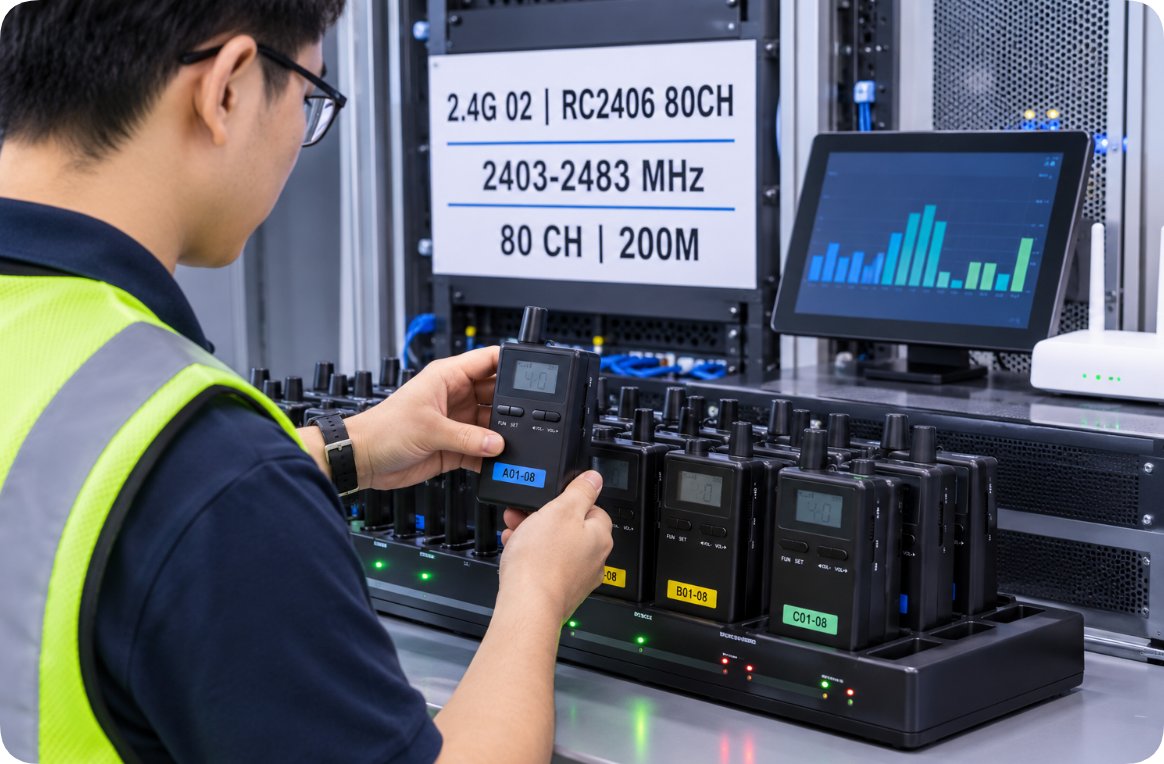
Eighty channels give operations teams more room to separate groups and keep spare channels for testing or reassignments than a 20-channel layout. Testing channels along concourses, turnstiles, and media zones during busy hours helps identify clean frequencies before tours depart.
RC085: 100 UHF Channels (470–510 MHz) and Headset/Lapel Mic Option
The RC085 Portable Tour Guide System Wholesale operates across UHF 470–510 MHz with 100 channels, 8–10 mW output, 1–200 m range, 50 Hz–12 kHz response, PLL control, USB charging, a 12-hour transmitter (65 g, 3.7 V 1200 mAh), and a 20-hour receiver (60 g, 1000 mAh). It also publishes an optional headset or lapel microphone (~−102 dBm microphone sensitivity), enabling hands-free narration in noisy concourses or hospitality spaces.
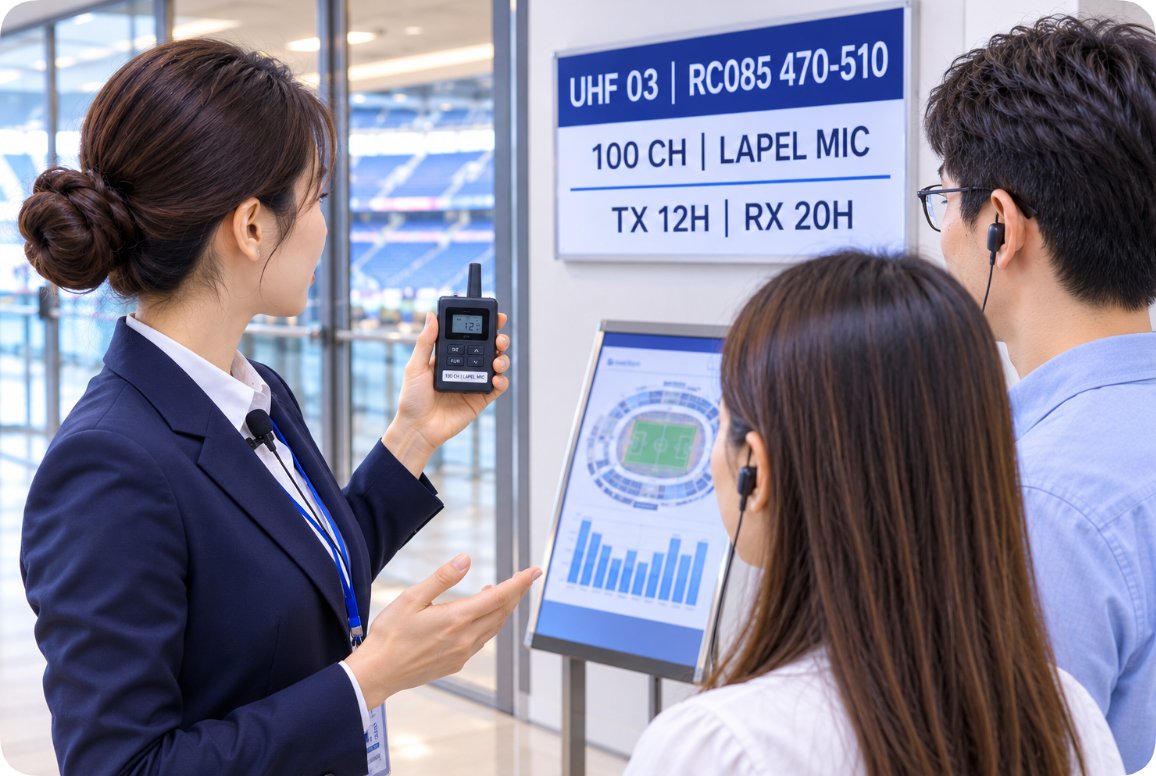
Because 470–510 MHz allocations vary by country and can overlap broadcast or wireless microphone assignments, venues should confirm local spectrum clearance before deploying RC085 across international or broadcast-heavy events.
How YINGMI 008E and YINGMI E8 Compare on 2.4 GHz
YINGMI 008E specifies 2404–2478 MHz, up to 9999 selectable channels, up to 250 m transmitter / 200 m receiver range, 12-hour transmitter and up to 100-hour receiver ratings at 62 g each, plus a 50-slot contact charging box, aluminium case, and multi-port USB charger. YINGMI E8 specifies 2400–2490 MHz, 200 channels, 200 m range, 8-hour battery life per unit, a 68.8 g transmitter and 18 g ear-hook receiver, 2.5-hour recharge time, and main-sub dual-talk support.
As discussed in City Sightseeing Tour Audio Solutions, features such as multi-slot charging boxes, lightweight 18 g ear-hook receivers, or dual-talk group modes offer clear workflow conveniences. However, both YINGMI units operate in the shared 2.4 GHz band, and selectable IDs or standby-rated receiver hours do not replace real-world RF channel verification or fleet return routines.
Published Specification Comparison Across All Five Models
The table below consolidates published band, channel, endurance, weight, and charging specifications across the three Richitek units and two 2.4 GHz rivals:
| System | Band | Channels | TX / RX Battery Life | TX / RX Weight | Charging |
|---|---|---|---|---|---|
| RC8860 | UHF 860–870 MHz | 20 | 10 h / 20 h | 59 g / 50 g | DC port |
| RC2406 | 2.4 GHz (2403–2483 MHz) | 80 | 10 h / 20 h | 59 g / 50 g | DC port |
| RC085 | UHF 470–510 MHz | 100 | 12 h / 20 h | 65 g / 60 g | USB |
| YINGMI 008E | 2.4 GHz (2404–2478 MHz) | 9999 selectable | 12 h / up to 100 h | 62 g / 62 g | 50-slot contact box / USB |
| YINGMI E8 | 2.4 GHz (2400–2490 MHz) | 200 | 8 h each unit | 68.8 g / 18 g ear-hook | 2.5 h recharge |
Concurrent Group Capacity, Receiver Wearability, and Match-Day Turnaround
Planning for parallel stadium tours requires reserving primary channels, backup channels, and test slots rather than dividing total channel counts by tour count. Furthermore, receiver weight and form factor—50 g or 60 g clip-on units, 62 g bodypacks, or an 18 g ear-hook—affect visitor comfort and whether devices stay worn across stairs and concourses or get held in hands where they can be misplaced.
Across broader Wireless Audio Guide Application Solutions and 2.4GHz vs UHF Wireless Tour Guide System evaluations, matching hardware to event cadence—whether occasional weekly tours or high-frequency match-day departures—alongside consistent checkout/return and charging routines keeps multi-group operations dependable.
Frequently Asked Questions
1. Does a high selectable channel count guarantee thousands of simultaneous stadium tours?
No; selectable channel fields or IDs do not expand available RF spectrum or eliminate crowd/venue interference, so stadium venues size concurrent groups through practical channel spacing and on-site testing.
2. Do UHF bands on RC8860 (860–870 MHz) and RC085 (470–510 MHz) require local checks?
Yes; UHF allocations vary by country and may require regional compliance checks or coordination with broadcast and wireless microphone users, whereas 2.4 GHz units use unlicensed ISM spectrum.
3. Why should stadium teams evaluate charging docks and return workflows alongside battery life?
Long battery ratings still require organized collection, counting, and recharging between events, making compatible chargers or multi-slot docks essential to match-day turnaround.
4. Which model in this comparison publishes an optional headset or lapel microphone?
The RC085 publishes an optional headset or lapel microphone with approximately −102 dBm microphone sensitivity, supporting hands-free tour delivery in busy venue zones.