.webp)
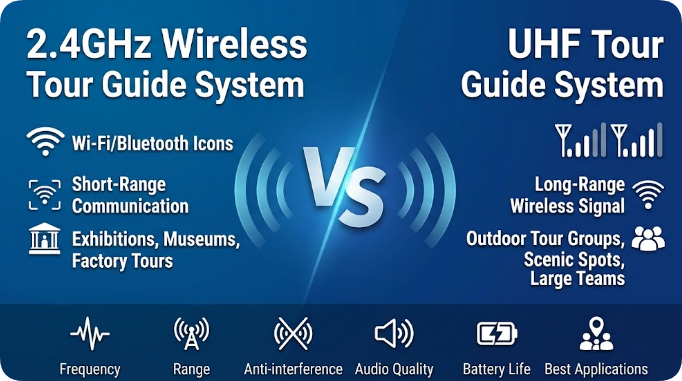
When choosing a professional wireless tour guide system for international procurement, 2.4GHz and UHF are the two primary transmission frequencies. Each spectrum has distinct advantages in global regulatory compliance, obstacle penetration, channel density, and battery runtime. This comprehensive technical guide provides a data-driven breakdown to help global buyers select the optimal audio hardware for museums, industrial plant tours, and large-scale corporate hospitality events.
1. 2.4GHz vs UHF: Key Technology Differences
Frequency Characteristics & Compliance
2.4GHz Systems operate within the 2403MHz to 2483MHz spectrum, which is a globally unlicensed ISM (Industrial, Scientific, and Medical) band. It requires zero regulatory approval, allowing international multi-national companies to deploy the exact same equipment seamlessly across Europe, the USA, and Asia without customs friction.
UHF (Ultra High Frequency) Systems utilize specialized regional bands such as 470–510MHz or 860–870MHz. Because UHF spectrum laws vary strictly by destination country, specific configurations must be matched to local radio communication compliance rules to prevent overlapping with local broadcasting services.
Signal Stability & Interference Resistance
2.4GHz Spectrum: While shared with consumer Wi-Fi and Bluetooth, professional hardware deploys intelligent Frequency-Hopping Spread Spectrum (FHSS) algorithms and digital encryption to completely isolate the audio stream from local network congestion.
UHF Spectrum: Operates entirely away from Wi-Fi wave interference. Its longer radio wavelengths provide exceptional signal diffraction, allowing waves to bend smoothly around thick brick walls and heavy machinery.
Range & Structural Coverage
2.4GHz Spectrum: Delivers flawless, line-of-sight audio clarity up to 150-200 meters. It is highly optimized for multi-group indoor operations, high-density museums, and convention centers.
UHF Spectrum: Maintains robust, long-range connection profiles even in heavy industrial complexes with intricate concrete and steel partitions, mitigating signal dropouts in non-line-of-sight conditions.
Audio Quality Profiles
2.4GHz systems utilize advanced digital audio packet processing, meaning they deliver a crisp, CD-quality vocal transmission with an absolute baseline of zero background analog hiss. Traditional UHF systems use analog or hybridized modulation, which provides warm vocal dynamics but can capture faint environmental RF white noise near the outer perimeter of its range.
2. Which System Fits Your Application?
Choose 2.4GHz if you require:
High-density simultaneous group tours within the same exhibition hall without signal cross-talk.
Flawless global mobility for international travel agencies with hassle-free customs clearance.
Ultra-lightweight ear-hook style receivers for maximum VIP guest ergonomics and zero fatigue.
No frequency licensing requirements or regional regulatory restrictions.
Choose UHF if you require:
Deep signal penetration through heavy industrial infrastructure and metallic production machinery.
Long-distance walking tours across sprawling outdoor landscapes or agricultural open zones.
Extended multi-day battery standbys and higher transmitter RF power output tolerances.
3. Real Product Comparison Cases
According to the technical standards in our engineering documentation "Wireless Tour Guide System Full Series Comparison & Selection Guide", here is how different models are optimized for target industrial deployment environments:
RC2402 vs RC2408 (Multi-group Tour Systems)
RC2402: An entry-level, highly cost-effective 2.4GHz digital tour guide system packed with 50 channels, perfect for standard indoor museum paths and guided gallery walks.
RC2408: An upgraded 2.4GHz version offering 80 concurrent channels, specifically engineered to support major exhibition centers where dozens of simultaneous tour groups operate side-by-side.
Best Application: Academic summits, indoor museum guiding, art exhibitions, and corporate presentation tours.
View RC2402 Technical Specifications | View RC2408 Technical Specifications
RC2500 vs RC2501 (Industrial & High-Stability Systems)
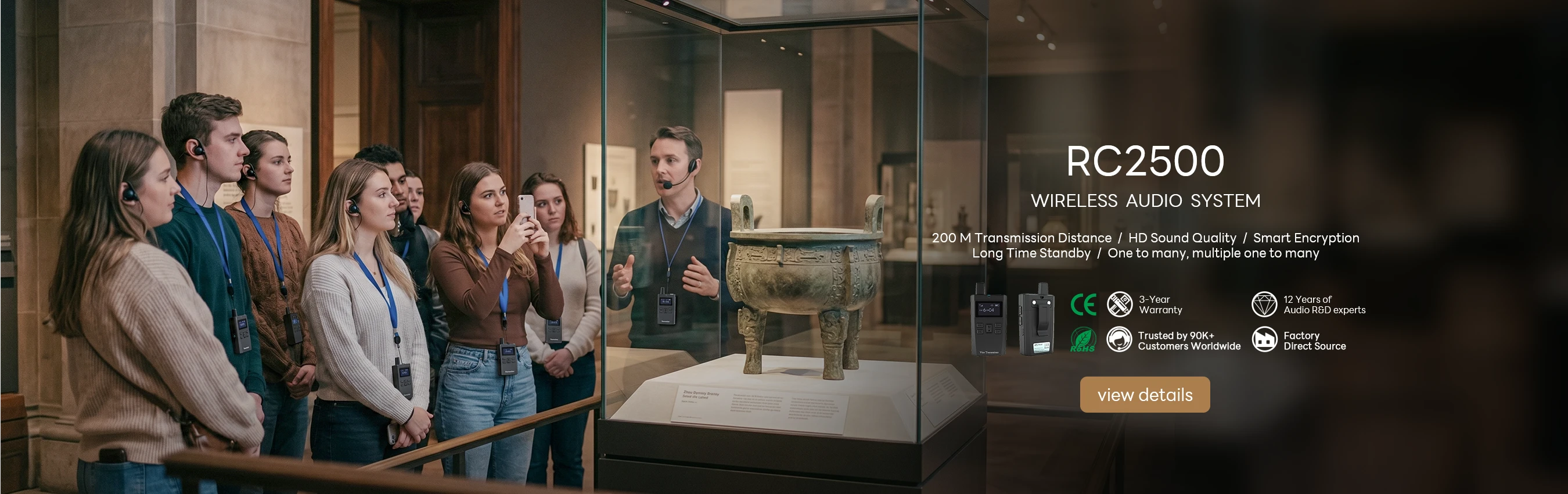
RC2500: A heavy-duty, high-power (20mW) 2.4GHz system. It boasts an extended 15-hour transmitter runtime and an elite 40+ hour receiver capacity powered by a robust 1800mAh lithium battery for continuous industrial shifts.
RC2501: An enhanced digital version running 50 channels on a 13mW output, optimizing battery efficiency to deliver a specialized 25-hour transmitter runtime and 40-hour receiver standby.
Best Application: Large-scale heavy machinery plant tours, logistics warehouse inspections, and multi-day corporate audits.
View RC2500 Technical Specifications | View RC2501 Technical Specifications
RC085 vs RC8860 (High-End UHF Deployment Systems)
RC085 (470-510 MHz): A premium UHF layout featuring 100 discrete channels. Its specialized low-frequency band provides the ultimate signal diffraction inside heavily partitioned automotive assembly plants.
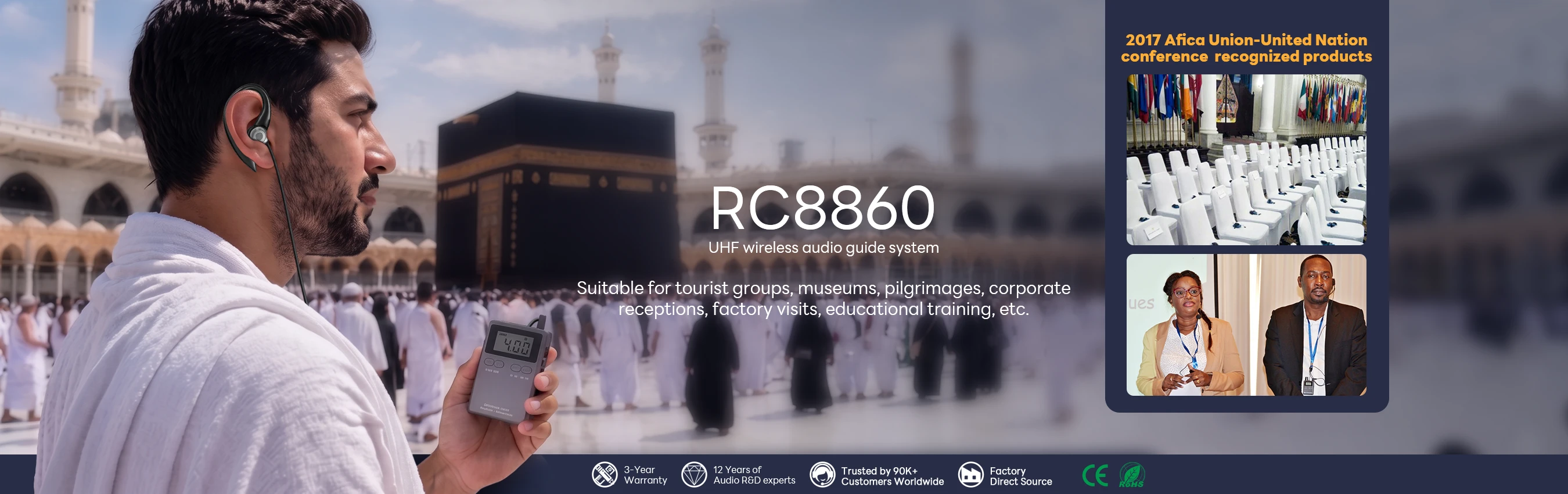
RC8860 (860-870 MHz): A highly reliable, 20-channel UHF alternative tailored specifically for European telecommunication allocations, featuring a 59g compact bodypack structure.
Best Application: Automotive smart factories, VIP state-level reception visits, and high-noise steel manufacturing complexes.
View RC085 Technical Specifications | View RC8860 Technical Specifications
4. Summary: Quick Decision Guide
| Technical Feature | 2.4GHz Digital Architecture | UHF Professional Architecture |
|---|---|---|
| Primary Environment | Indoor Layouts / Crowded Museums / International Conventions | Industrial Facilities / Sprawling Factories / Outdoor Sites |
| Interference Mitigation | High (Smart digital frequency hopping & encryption) | Exceptional (Bypasses consumer Wi-Fi wave pools entirely) |
| Obstacle Penetration | Standard Line-of-Sight (Prone to heavy concrete damping) | Superior (Longer waves wrap smoothly around physical barriers) |
| Audio Signal Output | Pure Digital Sound (Zero background white noise/hiss) | High Stability Analog or Digital Hybrid Processing |
| Global Compliance | 100% License-Free and Legal Worldwide | Strictly Regional (Requires target frequency mapping) |
5. FAQ: 2.4GHz vs UHF Wireless Systems
Q1: Can 2.4GHz and UHF equipment be deployed simultaneously in the same facility?
Yes. Because they operate on entirely different frequency wave pools, a facility can deploy 2.4GHz systems for quiet, high-density indoor VIP boardroom briefings while using UHF systems for high-noise outdoor production line tracks without any risk of signal overlap.
Q2: Will local corporate Wi-Fi drop the connection of a 2.4GHz tour guide system?
No. While they share the 2.4GHz ISM band, Richitek industrial guide hardware utilizes dedicated commercial-grade micro-channels and high-speed digital modulation to stay isolated from standard local office internet networks.
Q3: How do I choose the correct UHF frequency for international shipping?
Our engineering team pre-configures models like the RC085 (470-510MHz) and RC8860 (860-870MHz) to match standard free-use wireless allocations. We recommend consulting with our procurement managers to align shipments with your destination country's telecommunication laws.
6. Explore More Industrial Audio Solutions
If you are planning a multi-channel receiver setup or an enterprise hardware upgrade, explore our dedicated resource networks:
Analyze deep model breakdowns: RC2401 vs RC2406 Comprehensive Comparison Analysis
Browse our full catalog: All Professional Wireless Tour Guide System Models
Deploy targeted project frameworks: High-Noise Factory Tour Wireless Audio Solutions
Conclusion
Whether your project demands global 2.4GHz digital compliance or deep-penetration UHF frequencies, we offer end-to-end Audio Guide System OEM/ODM Manufacturer capabilities to fit your industrial standards.
Neither frequency is universally superior; instead, they are engineered to solve different structural and environmental challenges. By matching your facility's physical layout, group density requirements, and global logistics plans to either our 2.4GHz Digital Series or our UHF Deep-Penetration Series, you guarantee seamless, uninterrupted communication for your visitors. Contact Richitek today to request a tailored sample kit or a formal quote for your upcoming project.