
A leading China factory specializing in Wireless Tour Guide Systems, Church Audio Guides, and Translation Headphones with premium OEM/ODM solutions.

Tel:+86 18922879583

Email:tiger.wang@richitek.com

RC2468, RC2406 and RC9150: Three Vetoes a Historic House Puts on Tour Audio

A historic house is a small building that has been furnished carefully and wired for 1905. Period rooms are compact, plaster walls sit back to back, and a single staircase carries every visitor up and down. There may be one power outlet in the docent's room and nothing else. Many visitors, meanwhile, are past the age where an unaided voice reaches the back of a room, and the building cannot be rewired for loudspeakers without touching its fabric. In that setting, a wireless tour guide system for historic house tours is not a nice-to-have; it is the only way a group of twenty can hear a whispered commentary without the neighbors in the next room hearing it too.

Open the equipment drawer of such a house today and you will often find three generations of kit sharing felt dividers. The RC2468, RC2406 and RC9150 make an interesting trio precisely because they answer the same building in three different ways. The house, in effect, issues three vetoes: it vetoes loud volume, it vetoes occupied hands, and it vetoes mid-tour charging. Each generation of hardware took one of those vetoes seriously, and the spec differences between these three units trace that work.

A Building That Argues With Volume

The first veto is acoustic. A furnished parlor with wooden floors and bare plaster reflects sound instead of absorbing it, so a raised docent voice arrives at the back row as a smear and leaks through the doorway as an interruption. Amplifying the voice only makes both problems worse. Modern wireless kit resolves the conflict by removing distance from the equation: the speaker talks at conversational level, and the radio, not the lungs, carries the words. At ten milliwatts of output power, none of these three transmitters is trying to fill a hall; all three are built for rooms where volume itself is the trespass.

Thin Walls Turn Channels Into a Floor Plan

The second pressure on the hardware is adjacent groups. Houses route visitors room by room, and on a busy afternoon two parties stand on either side of a partition that was never soundproofed. What keeps the commentaries apart is channel arithmetic. The RC2406 80-channel tour guide system treats channels as a floor plan: one block of channels for the ground floor, another for the chambers above, a reserve for a school group that arrives unannounced. Fifty channels still works for a single party, but eighty gives the steward room to run parallel visits without negotiation. A numbering scheme that ties channel blocks to rooms has a second use on busy days: hand a latecomer a spare receiver, check which block the party is on, and the visitor rejoins the group mid-sentence. All of it rides on a PLL-synthesized signal that stays where it is put.
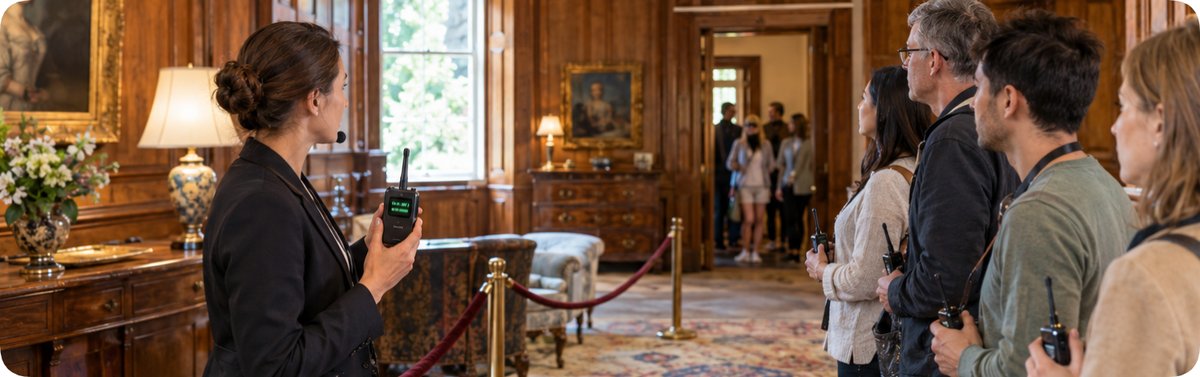
RC2406-historic_residence

Banisters, Rope Barriers and an 18-Gram Receiver

The third veto is physical. On a narrow spiral stair, one hand belongs to the banister; at a rope barrier, the other hand may be holding a ticket leaflet. A receiver that demands a grip becomes a small accident. The RC2468 ultra-light ear-hook receiver answers with eighteen grams worn over the ear, leaving both hands exactly where the house wants them. The handheld units keep their own case: at fifty grams the RC2406 receiver disappears into a coat pocket between rooms, and its transmitter matches the RC2468 at fifty-nine grams, light enough to carry up and down the stair all day without a shoulder bag.
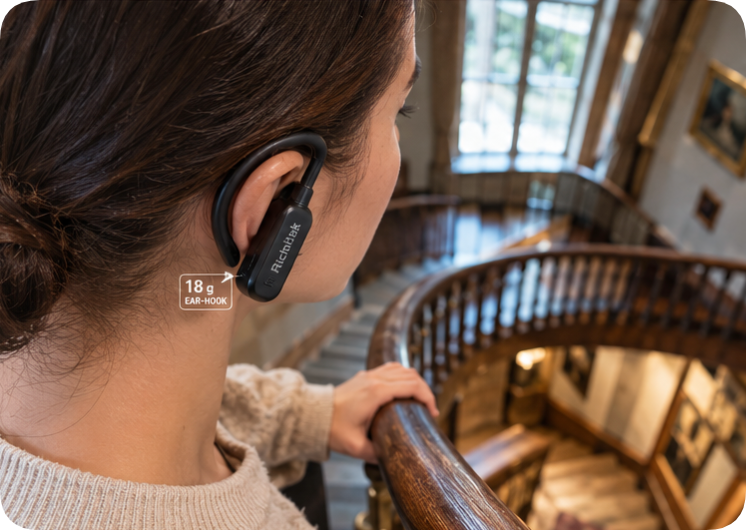
RC2468-historic_residence

One Outlet Downstairs, 35 Hours of Standby

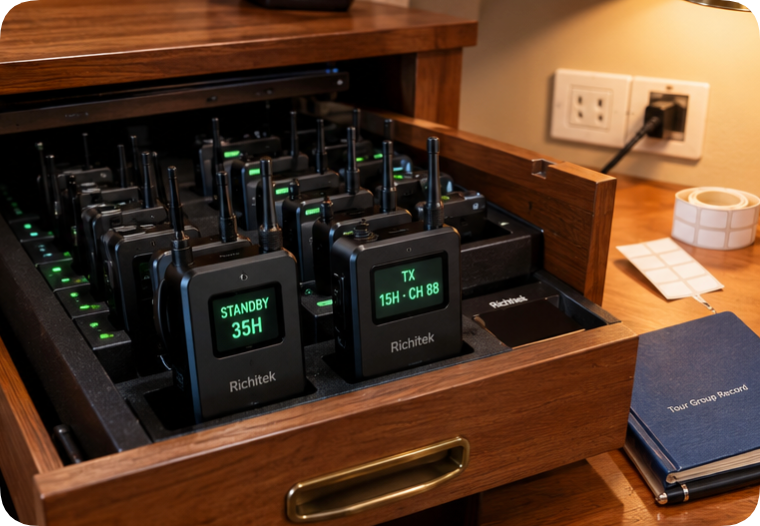
Heritage buildings were never wired for audio gear, so the charging plan runs through one cabinet near the docent's desk. The RC9150 long-standby audio guide was designed for exactly that constraint: thirty-five-plus hours of receiver standby on an 1800 mAh cell, fifteen hours of transmitter life, and a Type-C port that tops the set up between visiting days. Its receiver holds ninety-seven point five grams, the heaviest of the three, which is the trade a large cell asks for. Where the daily route is short and the cabinet is locked at five, standby hours buy more comfort than gram counts ever will. A five-hour route leaves most of the cell untouched, so the set returns to its shelf in the evening instead of to a charger at noon.
RC9150-historic_residence

📡 The Radio Layer All Three Still Share

What makes the trio a single evolutionary story is what has not changed. All three transmit on 2403-2483 MHz, at ten milliwatts, across one to two hundred meters, under PLL control. The radio layer settled a decade ago; every revision since has happened around it. Channels multiplied, receivers changed shape, cells grew, and charging ports moved from barrel plugs to Micro USB to Type-C, while the underlying link stayed frozen. That is why a mixed fleet like this one works without drama: the three units may belong to different design generations, but they speak the same radio language in the same rooms.

What Each Veto Bought

Set the three side by side and the compromises line up cleanly.

DimensionRC9150RC2468RC2406
Band2403-2483 MHz2403-2483 MHz2403-2483 MHz
Channels1005080
Transmitter battery life15 h10 h10 h
Receiver battery life35+ h8 h approx.20 h
Transmitter weight97.5 g59 g59 g
Receiver weight97.5 g18 g ear-hook50 g
Frequency response20Hz-8kHzTX 50Hz-200kHz / RX 50Hz-12kHzTX 50Hz-200kHz / RX 50Hz-12kHz
Charging portType-CMicro USB 5V/1ADC port

The columns read as three different settlements with the same building. RC9150 paid in weight and bought endurance; RC2468 paid in battery hours and bought freedom of the hands; RC2406 paid in neither and bought headroom, keeping twenty hours of receiver life while doubling the early channel count. No column is a strict upgrade over another, because each one signed off on a different veto. The frequency response row adds a footnote of its own: the two lighter receivers voice the same band, so a visitor handed a different unit at the door hears the same character, only nearer or farther.

Which Unit Waits in Which Room

Assignment follows the architecture rather than the brochure. The entrance hall and the garden front, where parties form and expand, suit the RC9150 and its hundred channels. The upper chambers and the stair, where railings demand free hands, suit the RC2468 and its ear-hook receivers. The long gallery and any day with two school groups booked together suit the RC2406, whose eighty channels absorb a second party at short notice. Houses that rotate the three through different roles report less channel juggling, because each unit is stationed where its strongest spec is the binding constraint. Cross-training matters more here than capacity planning: a volunteer who knows which block of channels belongs to which floor can absorb a surprise party in a minute, without moving a single box between rooms.

🔮 What the Next Refurbishment Should Budget For

A renovation is the natural moment to retire the compromises. Put a charging shelf with labeled slots into the docent's cabinet, since the drawer now holds a barrel plug, a Micro USB cable and a Type-C lead side by side. Log receiver battery dates, because an eighteen-gram ear-hook cell wears differently from an 1800 mAh pack. And keep one channel block reserved for the neighbors, since the house next door may start running tours too. The kit already outlives the veto that shaped it; the wiring plan should catch up.

Planning audio for a furnished property starts with the building, not the brochure. Compare the full tour guide system range, or browse more tour solutions for rooms where the architecture still has the final word.


2026年10月06日 09:41
ꄘ click: 12

RC2468, RC2406 and RC9150: Three Vetoes a Historic House Puts on Tour Audio

time: 2026年10月06日 click:12

A historic house is a small building that has been furnished carefully and wired for 1905. Period rooms are compact, plaster walls sit back to back, and a single staircase carries every visitor up and down. There may be one power outlet in the docent's room and nothing else. Many visitors, meanwhile, are past the age where an unaided voice reaches the back of a room, and the building cannot be rewired for loudspeakers without touching its fabric. In that setting, a wireless tour guide system for historic house tours is not a nice-to-have; it is the only way a group of twenty can hear a whispered commentary without the neighbors in the next room hearing it too.

Open the equipment drawer of such a house today and you will often find three generations of kit sharing felt dividers. The RC2468, RC2406 and RC9150 make an interesting trio precisely because they answer the same building in three different ways. The house, in effect, issues three vetoes: it vetoes loud volume, it vetoes occupied hands, and it vetoes mid-tour charging. Each generation of hardware took one of those vetoes seriously, and the spec differences between these three units trace that work.

A Building That Argues With Volume

The first veto is acoustic. A furnished parlor with wooden floors and bare plaster reflects sound instead of absorbing it, so a raised docent voice arrives at the back row as a smear and leaks through the doorway as an interruption. Amplifying the voice only makes both problems worse. Modern wireless kit resolves the conflict by removing distance from the equation: the speaker talks at conversational level, and the radio, not the lungs, carries the words. At ten milliwatts of output power, none of these three transmitters is trying to fill a hall; all three are built for rooms where volume itself is the trespass.

Thin Walls Turn Channels Into a Floor Plan

The second pressure on the hardware is adjacent groups. Houses route visitors room by room, and on a busy afternoon two parties stand on either side of a partition that was never soundproofed. What keeps the commentaries apart is channel arithmetic. The RC2406 80-channel tour guide system treats channels as a floor plan: one block of channels for the ground floor, another for the chambers above, a reserve for a school group that arrives unannounced. Fifty channels still works for a single party, but eighty gives the steward room to run parallel visits without negotiation. A numbering scheme that ties channel blocks to rooms has a second use on busy days: hand a latecomer a spare receiver, check which block the party is on, and the visitor rejoins the group mid-sentence. All of it rides on a PLL-synthesized signal that stays where it is put.

RC2406-historic_residence

Banisters, Rope Barriers and an 18-Gram Receiver

The third veto is physical. On a narrow spiral stair, one hand belongs to the banister; at a rope barrier, the other hand may be holding a ticket leaflet. A receiver that demands a grip becomes a small accident. The RC2468 ultra-light ear-hook receiver answers with eighteen grams worn over the ear, leaving both hands exactly where the house wants them. The handheld units keep their own case: at fifty grams the RC2406 receiver disappears into a coat pocket between rooms, and its transmitter matches the RC2468 at fifty-nine grams, light enough to carry up and down the stair all day without a shoulder bag.

RC2468-historic_residence

One Outlet Downstairs, 35 Hours of Standby

Heritage buildings were never wired for audio gear, so the charging plan runs through one cabinet near the docent's desk. The RC9150 long-standby audio guide was designed for exactly that constraint: thirty-five-plus hours of receiver standby on an 1800 mAh cell, fifteen hours of transmitter life, and a Type-C port that tops the set up between visiting days. Its receiver holds ninety-seven point five grams, the heaviest of the three, which is the trade a large cell asks for. Where the daily route is short and the cabinet is locked at five, standby hours buy more comfort than gram counts ever will. A five-hour route leaves most of the cell untouched, so the set returns to its shelf in the evening instead of to a charger at noon.

RC9150-historic_residence

📡 The Radio Layer All Three Still Share

What makes the trio a single evolutionary story is what has not changed. All three transmit on 2403-2483 MHz, at ten milliwatts, across one to two hundred meters, under PLL control. The radio layer settled a decade ago; every revision since has happened around it. Channels multiplied, receivers changed shape, cells grew, and charging ports moved from barrel plugs to Micro USB to Type-C, while the underlying link stayed frozen. That is why a mixed fleet like this one works without drama: the three units may belong to different design generations, but they speak the same radio language in the same rooms.

What Each Veto Bought

Set the three side by side and the compromises line up cleanly.

DimensionRC9150RC2468RC2406
Band2403-2483 MHz2403-2483 MHz2403-2483 MHz
Channels1005080
Transmitter battery life15 h10 h10 h
Receiver battery life35+ h8 h approx.20 h
Transmitter weight97.5 g59 g59 g
Receiver weight97.5 g18 g ear-hook50 g
Frequency response20Hz-8kHzTX 50Hz-200kHz / RX 50Hz-12kHzTX 50Hz-200kHz / RX 50Hz-12kHz
Charging portType-CMicro USB 5V/1ADC port

The columns read as three different settlements with the same building. RC9150 paid in weight and bought endurance; RC2468 paid in battery hours and bought freedom of the hands; RC2406 paid in neither and bought headroom, keeping twenty hours of receiver life while doubling the early channel count. No column is a strict upgrade over another, because each one signed off on a different veto. The frequency response row adds a footnote of its own: the two lighter receivers voice the same band, so a visitor handed a different unit at the door hears the same character, only nearer or farther.

Which Unit Waits in Which Room

Assignment follows the architecture rather than the brochure. The entrance hall and the garden front, where parties form and expand, suit the RC9150 and its hundred channels. The upper chambers and the stair, where railings demand free hands, suit the RC2468 and its ear-hook receivers. The long gallery and any day with two school groups booked together suit the RC2406, whose eighty channels absorb a second party at short notice. Houses that rotate the three through different roles report less channel juggling, because each unit is stationed where its strongest spec is the binding constraint. Cross-training matters more here than capacity planning: a volunteer who knows which block of channels belongs to which floor can absorb a surprise party in a minute, without moving a single box between rooms.

🔮 What the Next Refurbishment Should Budget For

A renovation is the natural moment to retire the compromises. Put a charging shelf with labeled slots into the docent's cabinet, since the drawer now holds a barrel plug, a Micro USB cable and a Type-C lead side by side. Log receiver battery dates, because an eighteen-gram ear-hook cell wears differently from an 1800 mAh pack. And keep one channel block reserved for the neighbors, since the house next door may start running tours too. The kit already outlives the veto that shaped it; the wiring plan should catch up.

Planning audio for a furnished property starts with the building, not the brochure. Compare the full tour guide system range, or browse more tour solutions for rooms where the architecture still has the final word.
×

Contact us

email:
name:
subject:
content: