
.webp)
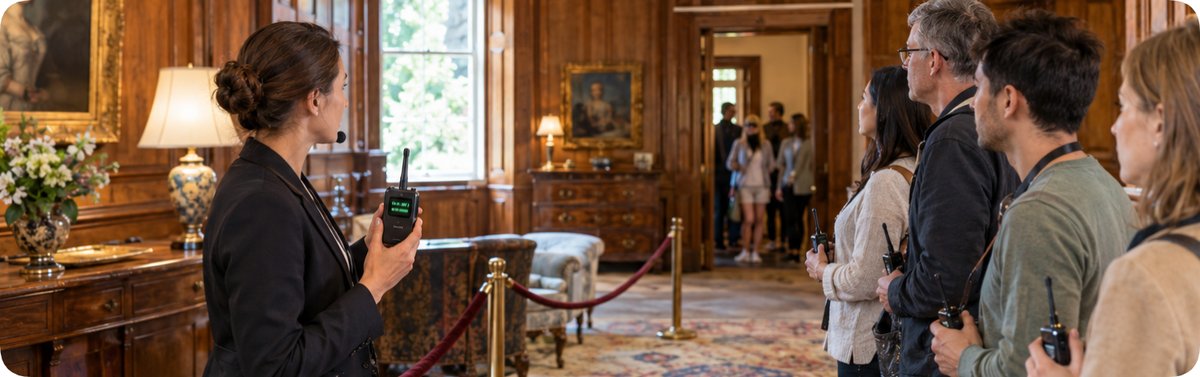
A city that wants tour operators and investors on its side rarely wins them in a conference room alone. The real pitch happens on a conference and event route that moves: a briefing at city hall, a walk through the historic quarter, a stop at the visitor center, and back onto the vehicle before the next appointment. Installing audio for a day like that is not a venue job; it is a routing job. The kit changes hands several times before lunch, and every handover is a place where the system can quietly fail. This piece follows one such pitch route and shows where the RC2406, the RC8860 and a 2.8-inch audio guide each get bolted onto it.
⚙️ Why a Pitch Route Is an Install Sequence
Treat the stop list as the installation document and the day becomes manageable. Each stop adds equipment, removes it, or hands it to a different person, and the hardware choices follow from that pattern rather than from any single room's acoustics. A route with three stops and two moving groups is a frequency question. A stop where visitors wander without a guide is a playback question. A stone-built quarter with thick walls is a propagation question. None of these is hard on its own, but they interlock: a channel chosen for stop one can follow the group to stop two only if nobody else holds it there. Writing the route down as an install sequence, with a line per stop, is what keeps the morning from turning into twelve phone calls. The sheet does not need to be formal. Three columns — stop, device, channel — catch ninety percent of the decisions, and the last column is the one people forget: who carries what between stops. A route that leaves that question to chance discovers, usually at the second stop, that both groups' receivers traveled in the same case.
The Stop List Sorts the Frequencies
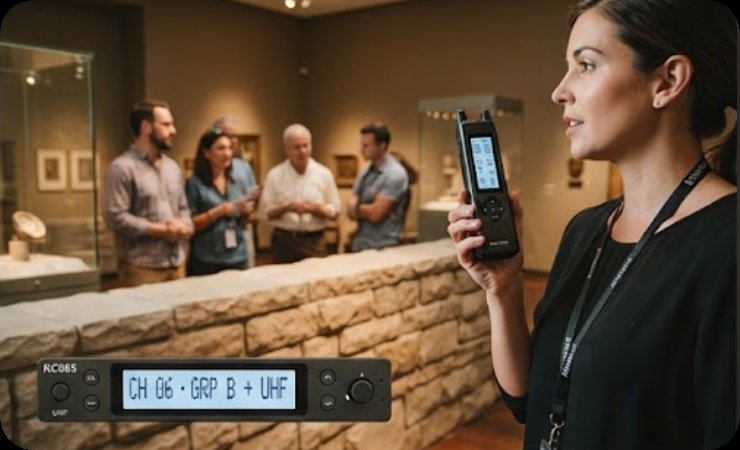
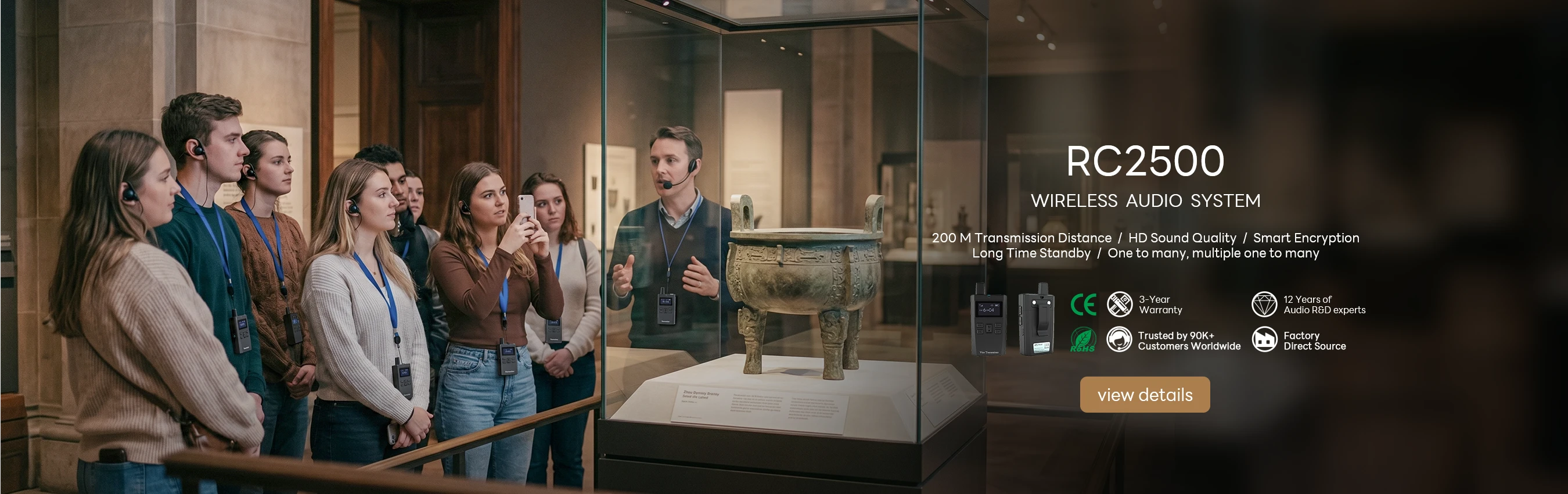
Cities rarely pitch one delegation at a time. A familiarization day can run two or three groups in parallel — one on the business park loop, one in the historic center — and the RC2406 absorbs that overlap. It works the 2.4GHz ISM band from 2403 to 2483MHz with 80 PLL-managed channels, so each group takes a channel and keeps it without crosstalk, and transmission reaches up to 200 meters in open areas. One-click pairing matters more on a moving route than in a fixed hall: between stops, a group re-pairs in seconds while standing at the curb. The whole transmitter weighs 50g, so the guide who carries it from the vehicle through three security checks never notices it, and the 1500mAh battery runs a full day without a lunchtime swap. IPX4 splash resistance covers the rain that arrives mid-route. The channel headroom also buys insurance against the city itself: a conference hotel running its own Wi-Fi gear, a delivery driver's headset, a shop's Bluetooth speaker — none of them will claim all 80 channels, and the route sheet only ever needs a handful. Assign channels per group rather than per stop, and the same number follows its delegation all day, which is one less thing to re-announce at every transfer.

Stone Walls Want the Lower Band
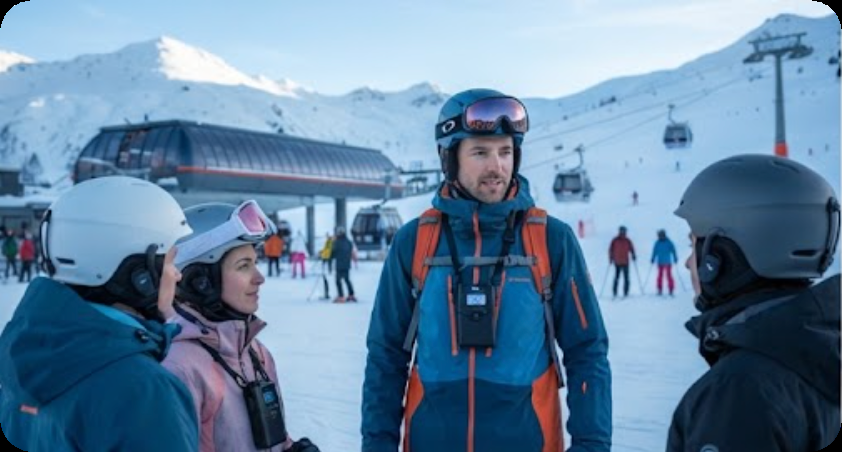
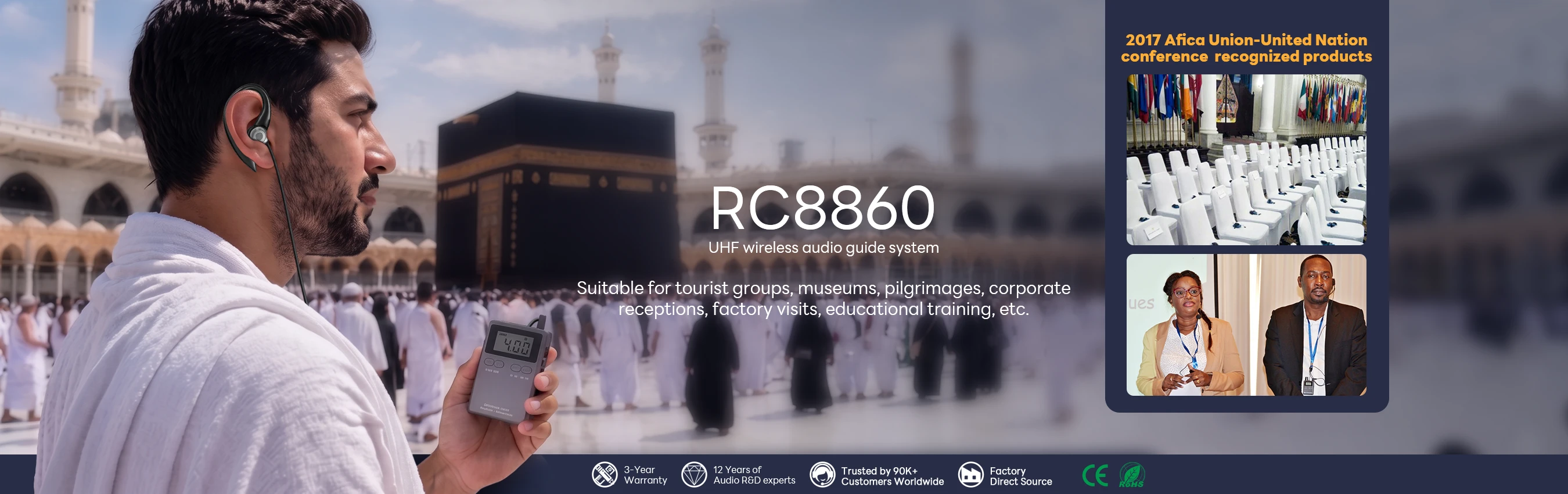
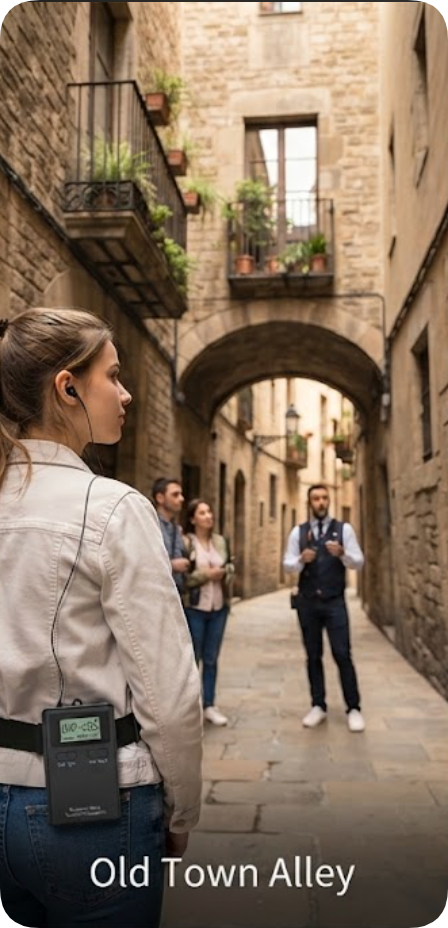
The historic quarter is where 2.4GHz systems earn their bad reputation. Thick masonry, vaulted passages and iron balconies scatter high-frequency signals, and a group that straggles down a side street drops out first. The RC8860 runs the 860-870MHz UHF band instead, which bends around obstacles and penetrates walls far better, with 20 PLL channels for separation and the same 200-meter open-area reach. Endurance suits a long walking loop: the transmitter's 1500mAh cell delivers 10 hours and the receiver's 1000mAh cell 20 hours, so a route that starts at nine and ends at dinner never pauses for batteries. At 59g for the transmitter and 50g for the receiver, pockets stay light, and the IPX4 rating shrugs off the fountain spray and light rain that old-town routes attract.
🎨 Exhibit Points That Speak for Themselves
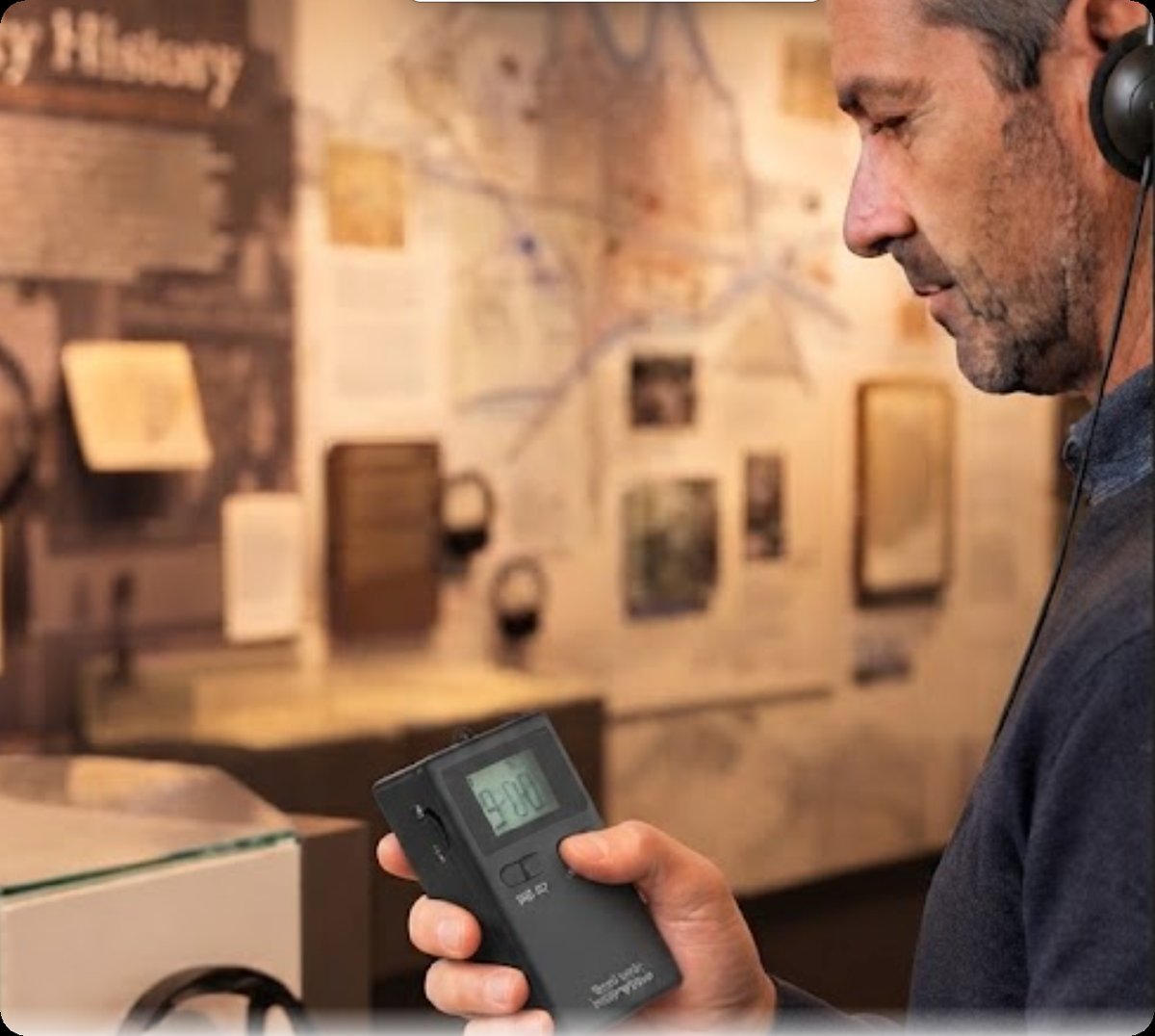
The visitor center stop has no guide at all, and that is the point of it: visitors are meant to browse. A 2.8-Inch Semi-Auto Digital Audio Guide turns the exhibit hall into a self-running station. Visitors type a two-digit number on the 0-9 keypad and the track plays immediately; dedicated buttons handle play, pause and volume. The unit holds 2GB of content, up to 9999 audio files and 16 languages, so the same fleet serves the Spanish delegation in the morning and the Korean one after lunch without a re-flash. The 18-hour battery covers the longest opening day from a morning charge over its Micro USB port, and earphones come included with each unit. Installation here is a numbering exercise: hang a player at each point, match the keypad number to the exhibit list, and the room runs itself.
What Changes at Each Transfer Point
A route is a chain of transfer points, and each one changes something small. At the vehicle, receivers leave their charging case and get counted aloud. At city hall, the first group pairs and the second group waits on a different channel. At the quarter's entrance, the route swaps systems — live guiding hands over to the UHF loop, and the guide announces the change before anyone puts an earpiece away. At the visitor center, live equipment stops and the keypad players take over, which means the escort collects transmitters rather than receivers. Writing down what changes at each point — channel, device, carrier — is the difference between a thirty-second handover and a ten-minute one. Routes fail at transfers, not at transmitter towers. The expensive transfer is the one nobody wrote down: the driver opens the luggage bay at the wrong stop, the case goes to the museum while the group walks into the quarter, and the morning stalls while someone jogs back. Naming a carrier for each leg — the escort for receivers, the guide for its own transmitter, the venue contact for the keypad players' spares — costs one line on the sheet and removes the whole category.
Three Units on One Route Sheet
On paper the day compresses to one row per unit, and the roles stop overlapping.
| Unit | Role on the route | Band or playback | Endurance | Field notes |
|---|---|---|---|---|
| RC2406 | Live guiding across parallel groups | 2.4GHz, 80 PLL channels, 200m | 1500mAh, full day | 50g, IPX4, one-click pairing |
| RC8860 | Historic-quarter walking loop | UHF 860-870MHz, 20 PLL channels | TX 10h / RX 20h | 59g TX, 50g RX, IPX4 |
| 2.8-inch guide | Self-service exhibit points | 0-9 keypad, 16 languages, 9999 files | 18 hours | 2GB memory, earphones included |
No row substitutes for another. The moment a route tries to make one unit do all three jobs, transfers stretch and the schedule slips into lunch.
Charging Follows the Bus
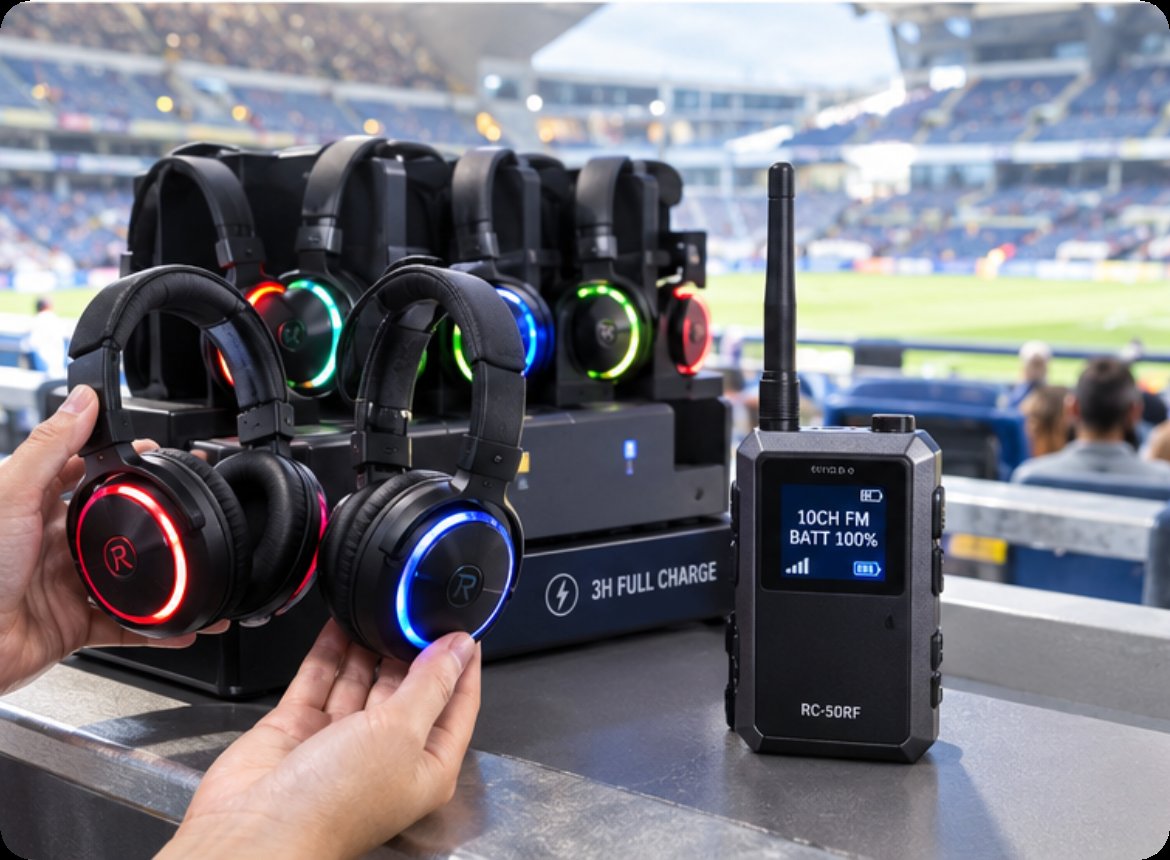
On a one-day route there is no charge closet waiting at each stop, so power logistics ride with the vehicle. The escort's case carries a charged spare set, and the vehicle's power outlet refills whatever came back empty during the briefing stop. The arithmetic is forgiving by design: the RC8860's 20-hour receiver and the 2.8-inch guide's 18-hour day both outlast the route, so only the RC2406's transmitter — running continuously since morning — is a realistic refill candidate at midday. Collecting receivers at each door matters as much as charging them; a unit left on a chair at city hall reappears, if at all, after the delegation has landed at the next stop. The case inventory sheet travels with the keys, and both get checked before the vehicle moves.
Verify It at Door-Opening Time
The night before belongs to paperwork; the verification that counts happens at door-opening time on the day. Channels are confirmed against the stop list while the groups are still in the lobby. Spare receivers are counted out loud and written on the route sheet, not remembered. The visitor center's keypad numbers are read against the exhibit list at a walk-through pace, because a track that plays the wrong number teaches visitors to stop trusting the devices. Two minutes per stop at opening, plus the transfer notes from the route sheet, is the whole discipline. It also leaves a record. When the same city hosts another familiarization season next year, last season's route sheet — channels used, spares consumed, transfer points that ran long — is the draft of the next install, and the installation shrinks to editing it. To compare these three units against the rest of the range, browse the wireless tour guide system line-up, or review our wireless tour guide system solutions before the next route is drawn.