
.webp)
A campus demonstration is the easiest test a wireless tour guide system will ever pass. One guide, one route, one morning, and every unit goes back into the same case at noon. The real examination begins later, when admissions releases the kits to a student society, the alumni office borrows half of them, and nobody keeps a single log of where each receiver slept. An order written for the demonstration day will miss that life entirely.
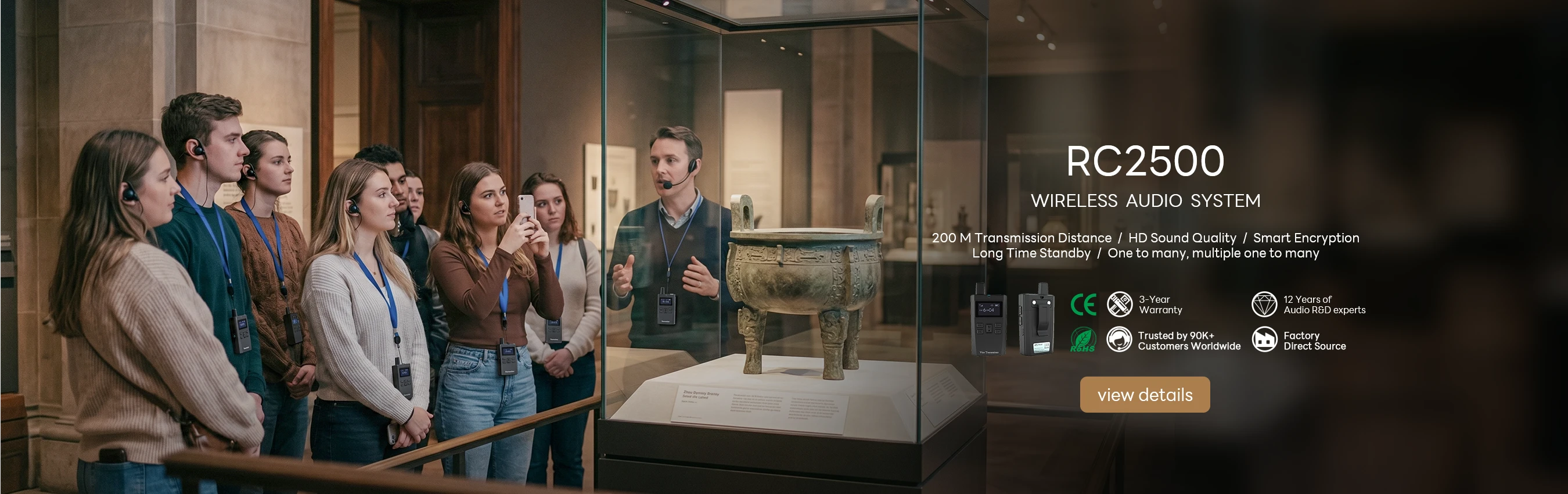
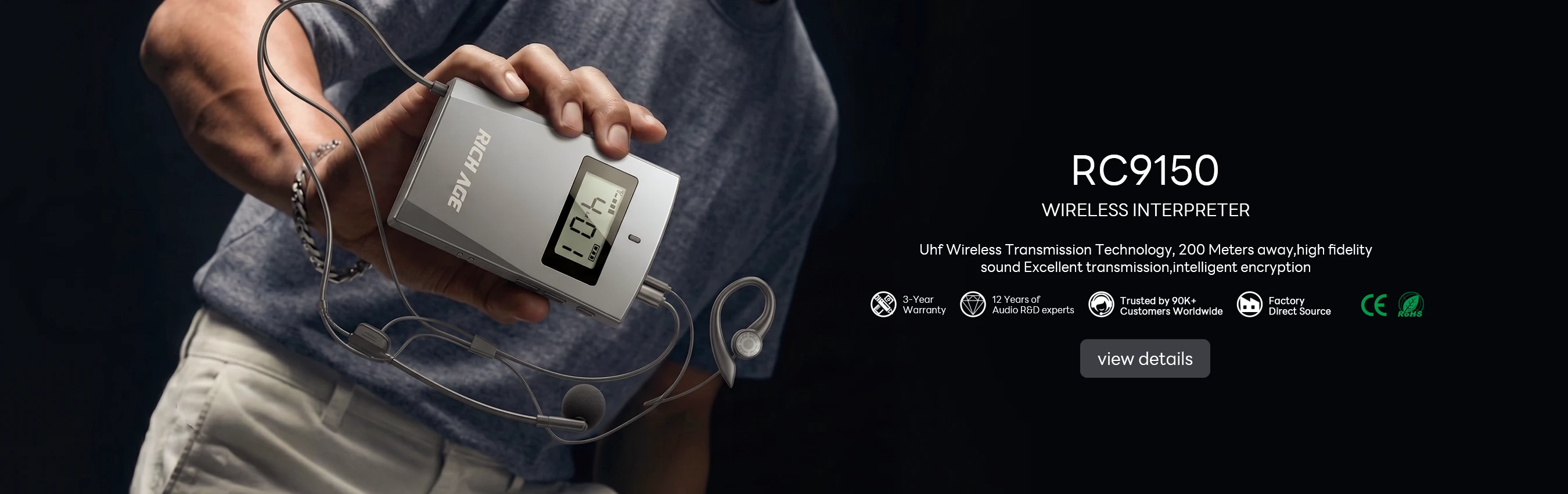
This article reads a campus purchase through the lending desk rather than the showroom, using three models that sit at different points of the same range: the RC2408, the RC9150 and the RC2500. The question is not which unit sounds best on a quiet lawn; it is which specification lines matter once equipment rotates among five offices and returns at random hours.
🗺️ The Tour Ends, the Kit Scatters
In a factory or a museum, a tour guide system usually lives in one place and serves one route. On a campus the same case serves an admissions open house, a parents' weekend, a visiting delegation and a summer orientation programme, often in the same month. Each office that borrows the kit adds its own handling, its own storage spot and its own idea of what "fully charged" means. A procurement sheet that only counts transmitters and receivers is pricing the demonstration, not the circulation. The lines below are the ones that keep paying off after the second borrow, and every one of them maps to a specification a supplier can state in writing. For how universities deploy the equipment across departments, see campus tour guide solutions.
One Charging Cabinet, Three Plug Types
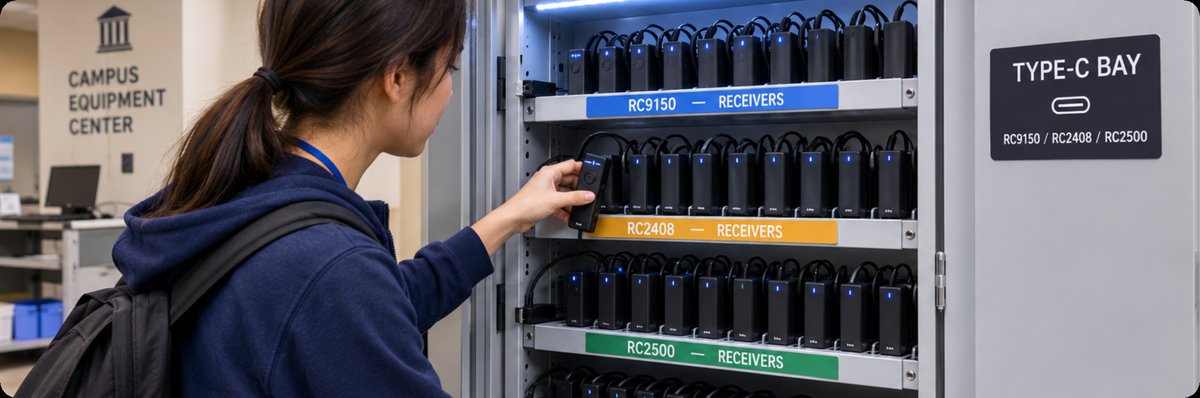
Charging is where mixed fleets quietly become complicated. The RC9150 wireless audio guide system charges over Type-C, and so does the RC2500, while the RC2408 uses a DC port. In a lending pool that means the cabinet cannot be planned around a single cable type: bays need sorting by model, spare cables need labelling per plug, and a volunteer who restocks at night needs to know which units go on which shelf. Two fleets, one all-Type-C and one all-DC, each cost less to maintain than a blended one. If the pool is blended anyway, the mixing should happen on paper first, with the charging row of the order naming the port per model, so the cabinet layout is decided before delivery rather than improvised after it.
Color Coding a Pool That Several Offices Share
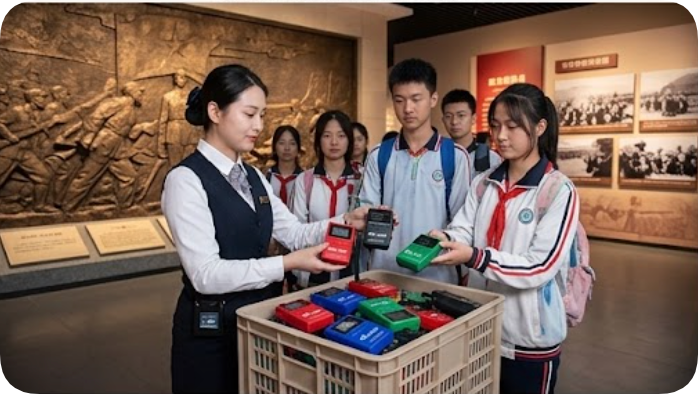
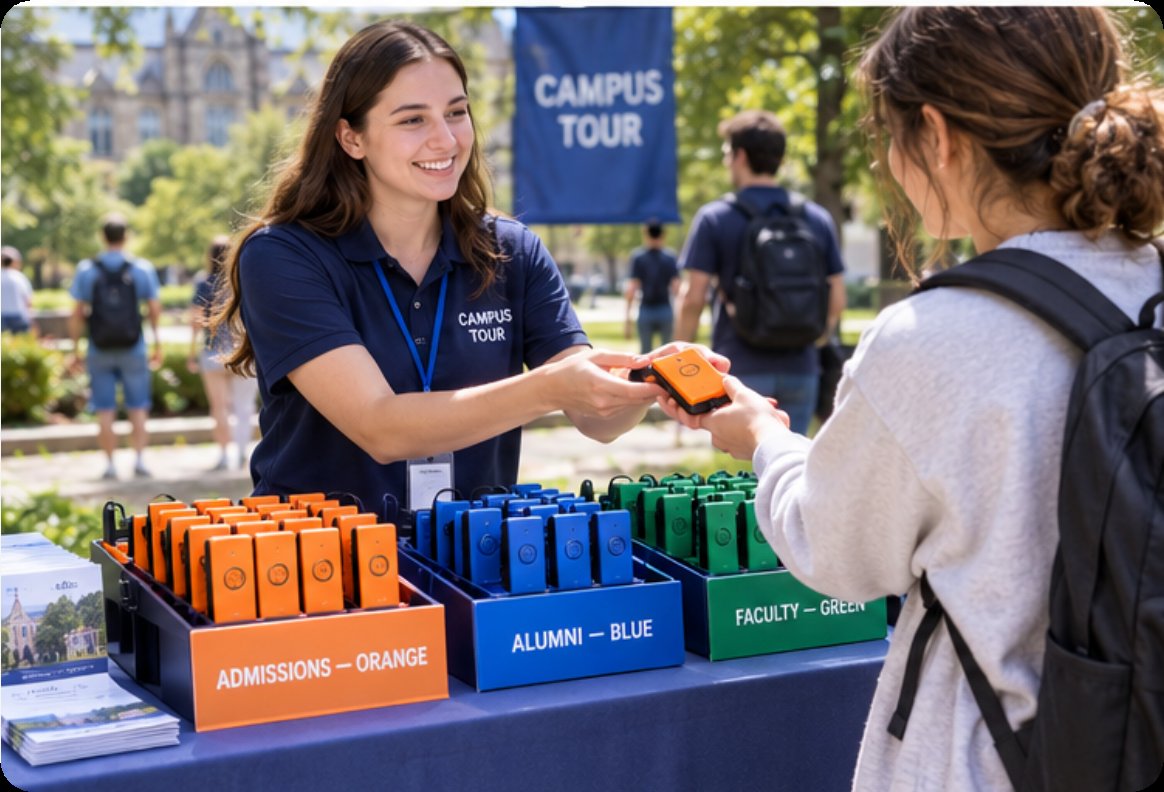
Ownership on a campus is distributed, and colour is the cheapest way to make it visible. The RC2408 wireless tour guide system ships in multiple colours for volume orders, which lets an admissions set wear one colour while the alumni office keeps another, so a unit that wandered across departments identifies itself at a glance. The RC2500, by contrast, comes in black only, which suits a single-owner fleet but gives a shared pool nothing to sort by. Colour also survives where labels fail: a sticker peels off in a coat pocket, but a moulded shell keeps its colour for the life of the unit. Writing the colour split into the original order costs nothing at quotation time and saves a relabelling project every term after.
🔋 Battery Rows for a Semester, Not a Monday
Demonstration-day thinking prices batteries for one morning; circulation thinking prices them for a week away from a plug. Here the range splits cleanly. The RC9150 and the RC2500 run 15 hours on the transmitter and 35-plus on the receiver, with standby figures to match, so a kit borrowed on Monday and returned on Friday never visits a charger in between. The RC2408 runs 10 hours transmitting and 20 receiving on its 1500mAh and 1000mAh cells, which covers any single event comfortably but rewards a mid-week top-up if the borrow stretches. Neither figure is better in the abstract; the question is how long your longest borrower keeps a case. Writing the recharge interval into the loan policy, next to the battery row, turns a specification into a routine the whole campus can follow.
🎯 The Weight a Student Guide Wears All Term
The demonstrator wears a transmitter for half an hour; the student guide wears one every Tuesday all semester. The RC2408 transmitter weighs 59g with a 50g receiver, and that difference compounds over a three-hour shift in a way a demonstration never shows. The RC9150 balances at 97.5g on both units, and the RC2500 at 104g, trading some lightness for the larger 1800mAh cells that power those long standby figures. Neck straps soften all three, but the order sheet should still record the gram row per model, because a pool that mixes weights will send the heavy units to whoever asks last rather than whoever walks farthest. For roaming recruitment walks across a large campus, the lighter pair earns its keep; for a fixed welcome-desk kit, the difference fades.
Channels When Three Groups Cross on the Quad
Campus geography creates the one interference pattern a showroom cannot simulate: three tours departing the same lawn within ten minutes. The RC9150 offers 100 channels, the RC2408 carries 80 with interference resistance built in, and the RC2500 holds 50. All three work on 2.4 GHz across a 1-200 metre range, so the channel count is what decides how many parallel groups a single lawn can host before pairing starts to hunt. An admissions office that runs one daily tour fits any of the three; an orientation week that launches six groups at once should write the channel row into the order and assign ranges per team in advance. The spec costs nothing to state, and it is the line that keeps two guides from inheriting each other's commentary.
One-Button Reset Before the Kit Returns
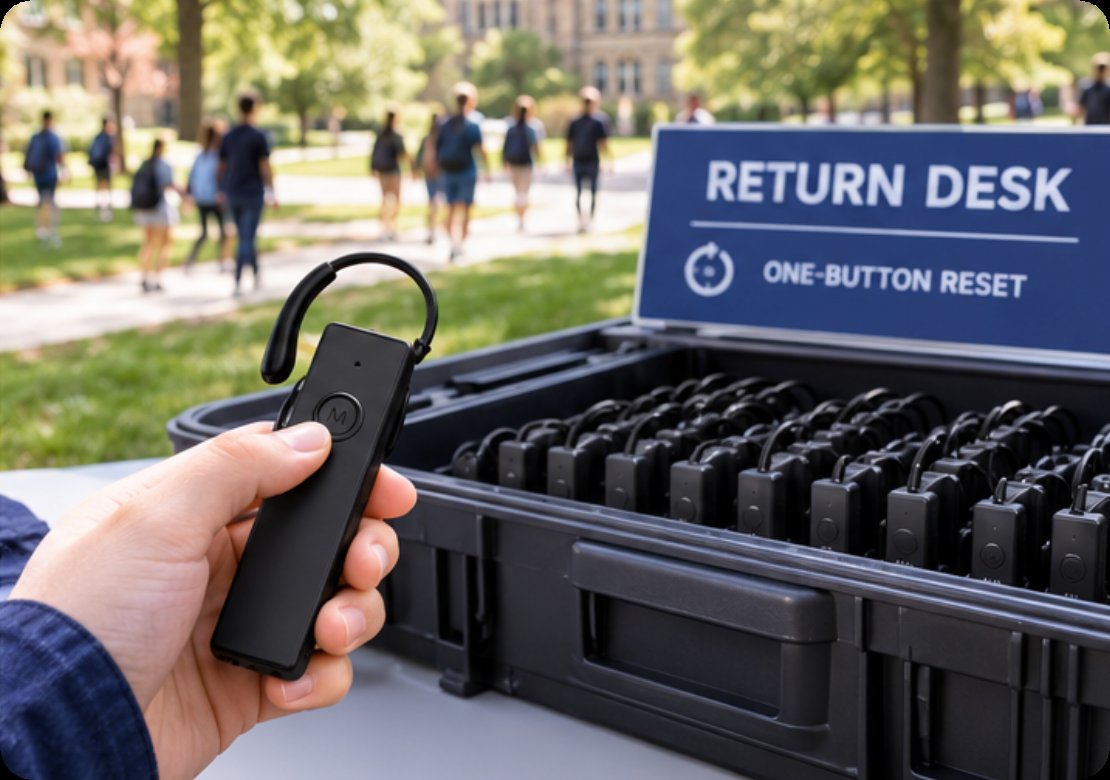
Every lending pool lives or dies by what happens at return, and the person at the return desk is usually a volunteer, not a technician. The RC2500 wireless tour guide system pairs one-button synchronisation, shutdown and mute, which compresses the reset ritual to a gesture a first-week student can perform without a manual. Fleets without that row rely on whoever remembers the menu sequence, and every forgotten reset seeds the next borrow with yesterday's channel and volume. The specification to add under the reset row is simple: what state must a unit be in before it re-enters the case, and how many presses does reaching that state take. A supplier who can answer in one sentence has designed for the lending desk, not just the showroom.
| Specification row | RC2408 | RC9150 | RC2500 |
|---|---|---|---|
| Channels | 80 | 100 | 50 |
| Transmitter / receiver battery life | 10h / 20h | 15h / 35+h | 15h / 35+h |
| Transmitter / receiver weight | 59g / 50g | 97.5g / 97.5g | 104g / 104g |
| Charging port | DC port | Type-C | Type-C |
| Colour options for volume orders | Multiple | Grey TX / black RX | Black only |
| Reset handling | Menu based | Menu based | One-button sync, off and mute |
What the Deposit Column Overlooks
A deposit is meant to price risk, but on a campus the expensive failures are not the dramatic ones. What actually drains a pool is slower: a DC-port unit shelved on a Type-C bay and found flat on event morning, a colour-coded receiver that came back with its department sticker replaced by another office's tape, a transmitter returned with yesterday's channel still set. None of that shows up as a broken unit, so none of it lands on the deposit line. The rows that do cover it are the unglamorous ones already discussed: the port column, the colour column, the reset row. Pricing those into the original order is what makes the deposit almost never worth collecting.
Richitek builds and supplies wireless tour guide equipment for campus programmes and every other route a visitor walks; browse our wireless tour guide system range to compare the full line, or explore our solutions to match a kit to your borrowing pattern. Send us your term calendar and your busiest tour week, and we will mark up the specification rows that carry the rotation.