
.webp)
At a red education base, the morning is a relay of batches. One school party finishes the memorial hall at ten, another arrives at half past, and the same pool of guide units changes hands all day. When audio goes wrong in the afternoon, the equipment usually takes the blame — yet the hardware is fine. What actually failed is a setting that the ten o'clock group left behind and nobody cleared: a channel chosen for a schedule that no longer exists, a volume cap sized for younger ears, a microphone still routed through an accessory that went back in a drawer.
That is the strange property of a wireless tour guide system in high-turnover venues: the gear has no memory of the visitors, but it keeps every memory of their configuration. Ten-milliwatt transmitters, a two-hundred-meter link budget and twenty-hour receiver batteries are identical at opening time and closing time — what differs is the state someone left on the unit. The RC2402 wireless tour guide system, the RC8860 UHF tour guide system and the RC085 100-channel tour guide system are the three units our red-venue customers deploy most, and each one carries a different kind of leftover state worth knowing about.

A Red Base Lives on Batch Turnover
Start with the rhythm of the venue. A typical red education base runs batches through on the hour, with ten to fifteen minutes between groups for a headset count and a quick wipe-down. In that window nobody has time for a configuration session; the guide expects to pick up a transmitter, hand out receivers, and start talking. The system design respects that: transmitters pair to receivers at power-on, channels are selected on the unit itself, and every setting persists in non-volatile memory precisely so that a battery swap mid-tour does not lose the setup. The transmitters carry 3.7V 1500mAh packs — enough for a full day of two-hour batches — and the persistence is deliberate: a guide who replaces a depleted transmitter at the lunch break should hear the same channel come up without touching a menu. Persistence is a feature — until the next batch inherits it as a problem.
Fifty Channels Carry a Memory
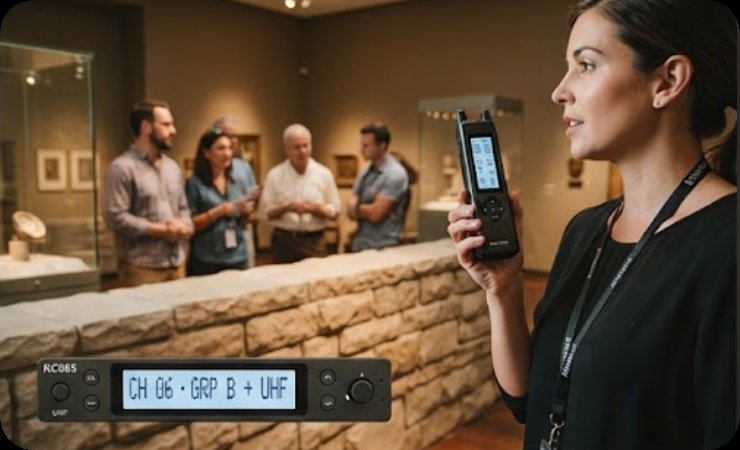
The RC2402 is the base 2.4G standard unit of the fleet, with fifty channels across 2403-2483 MHz and the familiar PLL control. Its leftover-state signature is the channel dial. Suppose the morning guide chose channel 38 because two batches were running in parallel through different halls; the afternoon guide inherits channel 38 without knowing why, walks into a hall where a third party is also on 38 — a rented headset fleet from another supplier, perhaps — and hears interference that "was not there yesterday." The unit is healthy. The fix costs ten seconds: step the channel with the toggle, confirm the hiss disappears, note the new number for the next group. Fifty channels give a venue the room to publish a simple time-slot plan and stay out of each other's way.
Twenty Channels on a Crowded Morning
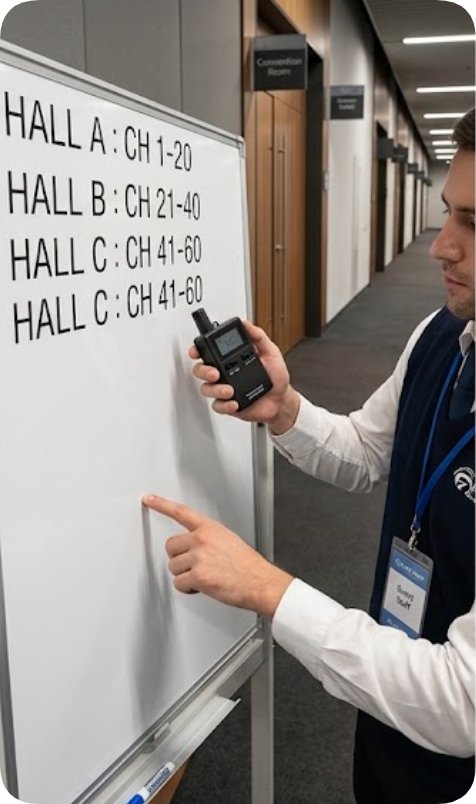
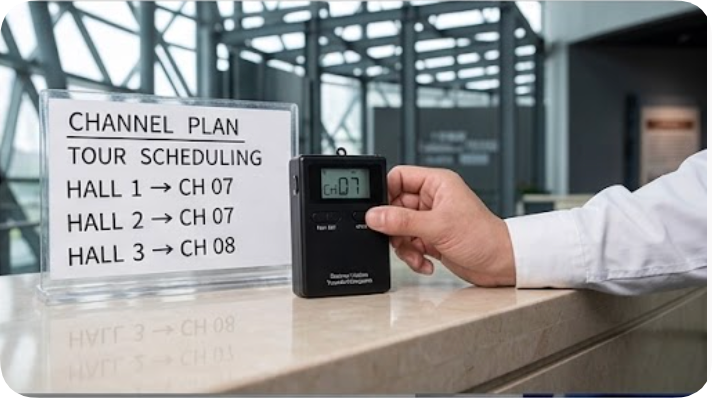
The RC8860 plays a different game. It transmits in the 860-870 MHz UHF band with strong rejection of the congestion that plagues 2.4 GHz in busy indoor halls, which is exactly why red bases with steel-frame exhibition wings like it. The trade is arithmetic: twenty channels instead of fifty. On a morning when three batches overlap, the venue plan matters twice as much, because a leftover channel from the previous day now collides with a neighbour on a band that cannot spread the load. The habit that prevents it takes one person: whoever closes the morning writes the channel on the whiteboard at the desk, and whoever opens the afternoon wipes it back to the venue default before the first visitor clips a unit on.
The Microphone Left in Accessory Mode
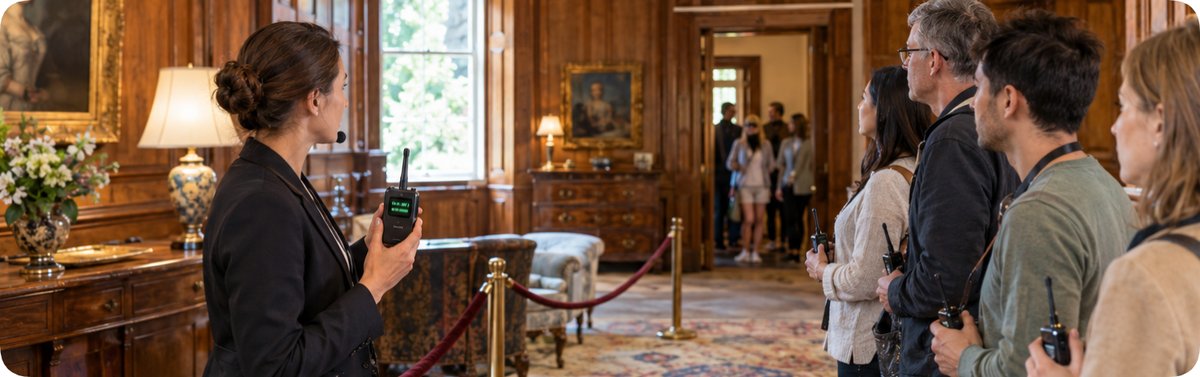
The RC085 is the specialist of the trio: one hundred channels in the 470-510 MHz band, receiver sensitivity around -102 dBm, and optional headset and lapel microphones that turn one transmitter into a lecture platform. Those accessories are also its leftover state. A morning session that used the lapel mic may have the transmitter still expecting an external microphone; the afternoon guide speaks into the built-in mic and hears thin, distant audio, or nothing at all, and reports a "dead transmitter." A wearable mic pushed back into the case still clipped to its cable produces the mirror image: audio that fades when the cable moves. Both clear in seconds once the check exists — unplug, confirm built-in mic works, re-seat the accessory firmly — but only if the batch handoff names it.
Pairing Lists Nobody Cleared at Noon
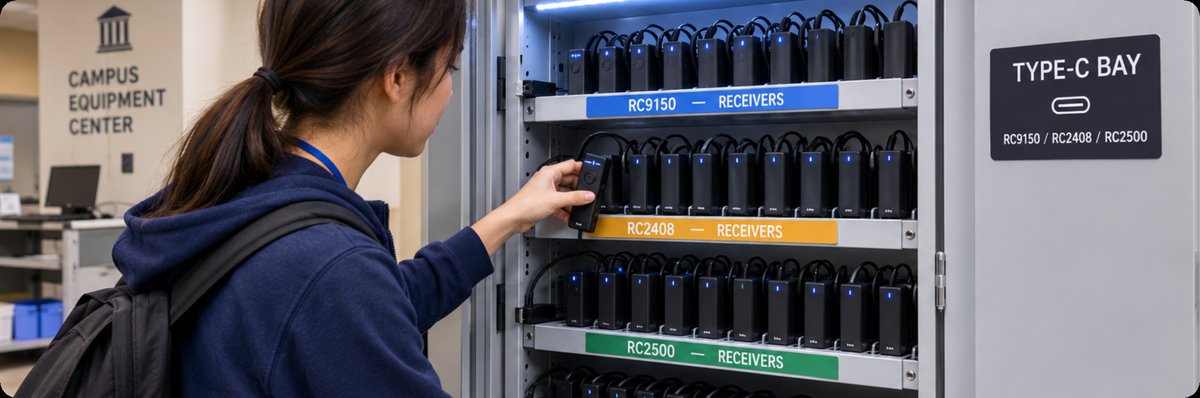
Every unit here pairs by PLL-locked channel and ID, and a busy day leaves pairing state scattered across the pool: a receiver bound to a transmitter that went into a different charging slot, a spare unit paired for the staff rehearsal at eight, a demonstrator unit used to show a visiting official how the system works. None of it is broken, and all of it surfaces the same way — a receiver that stays silent in a working hall because it is listening to a transmitter across the building. The venue answer is procedural, not technical: receivers return to the charging bank in numeric order, the two or three demonstration units live in a separate pouch, and spares get re-paired to the day's transmitter before the doors open, not during a failure.
📱 Volume Caps Set for Small Children
Volume is the leftover nobody suspects because it is doing its job. A batch of primary-school pupils gets receivers capped low — sensible for young ears. The next batch is a retirees' association, and now half the group says the units are too quiet, the guide compensates by shouting, and the complaint lands as "weak receivers." Receiver battery life on all three models runs twenty hours, so low output is almost never a power question; it is yesterday's cap. The check takes as long as clipping a unit on: set a receiver to the venue's standard level, listen to a phrase, and only then hand it out. The RC2402 and RC8860 at 50 grams per receiver make that check easy enough to do on every unit of every batch.
| Unit | Band / Channels | Battery Life (TX/RX) | Leftover State to Clear |
|---|---|---|---|
| RC2402 | 2.4G, 50 ch | 10 h / 20 h | Channel dial from the morning plan |
| RC8860 | UHF 860-870 MHz, 20 ch | 10 h / 20 h | Channel on a narrow, busy band |
| RC085 | UHF 470-510 MHz, 100 ch | 12 h / 20 h | Mic accessory mode and cables |
A State Card Taped Inside the Case
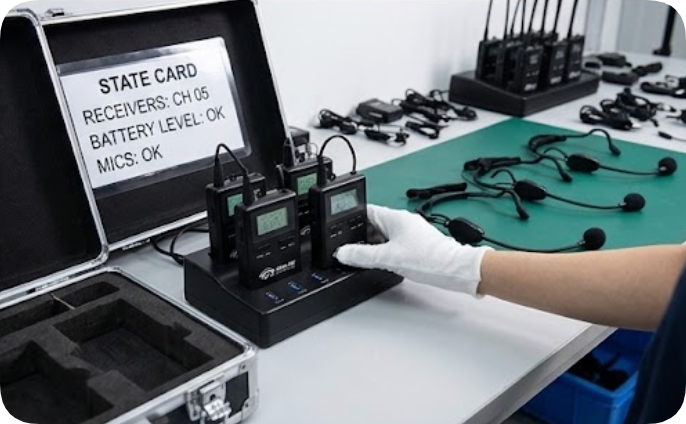
The fix that outlasts training is paper. Red bases that stay out of trouble laminate one card and tape it inside every carry case: the venue's default channel per hall, the pairing order for spares, the standard listening level, and the three-second accessory check for the RC085. Any guide — staff or substitute — restores the fleet to a known state in under a minute between batches. The card also settles the charging question before it becomes a complaint: the RC2402 and RC8860 charge over a DC port, the RC085 over USB, and a case that mixes three cable types without a label is where a "broken" unit usually spends the night. The hardware did not change; the handoff discipline did. Troubleshooting at high-turnover venues is mostly archaeology of the previous group's decisions, and a card turns archaeology into a habit.
If you operate a red education site, the education audio guide system page shows how the fleet fits hourly batch flows, and the full tour guide system range covers the wider fleet including the units described here. For deployment patterns across other venue types, the solutions section collects the running series. Two practical notes for the first conversation: the RC085 transmitter takes either headset or lapel microphones if your docents prefer hands-free delivery, and all three receivers clip in under a second, which matters when a batch of sixty is waiting. Bring your batch schedule and hall map, and the channel plan writes itself.