
.webp)
A pilgrimage city does not run on a fixed timetable, and that is exactly what makes staffing it difficult. The working day is carved into blocks by the five prayer windows, and each block moves the crowd somewhere new: a courtyard at dawn, a shaded hall at noon, a long return flow in the evening. Crews that plan the day around those windows spend less time herding people and more time simply being audible where it matters. The wireless tour guide system for Hajj and Umrah exists for precisely this rhythm, but the equipment alone does not decide anything.
The real question is which device belongs in which window, and how many hands each one needs. Answer that first and the roster almost writes itself. Richitek's range covers three very different answers: the RC2401 two-way radio set, a 2.8-inch semi-auto audio guide with a numeric keypad, and a silent disco headphone system built for one-way broadcast. This walkthrough puts all three into a single pilgrimage day, window by window, and shows where each earns its place in the rota.
Two Radios and a Keypad
The RC2401 is the workhorse of the three. It runs on the 2.4 GHz band with 50 channels and a working range of 1 to 200 meters, pairing a 59-gram transmitter worn by the guide with 50-gram receivers handed to visitors. Battery life stands at 10 hours for the transmitter and 20 hours for each receiver, which means a unit issued before the first window is usually still talking at the last one. Because it is a live two-way link, it suits the moments when a group leader must speak and be answered. The RC2401 Wireless Audio Guide System carries the whole interactive part of the day.
The Window Before Dawn
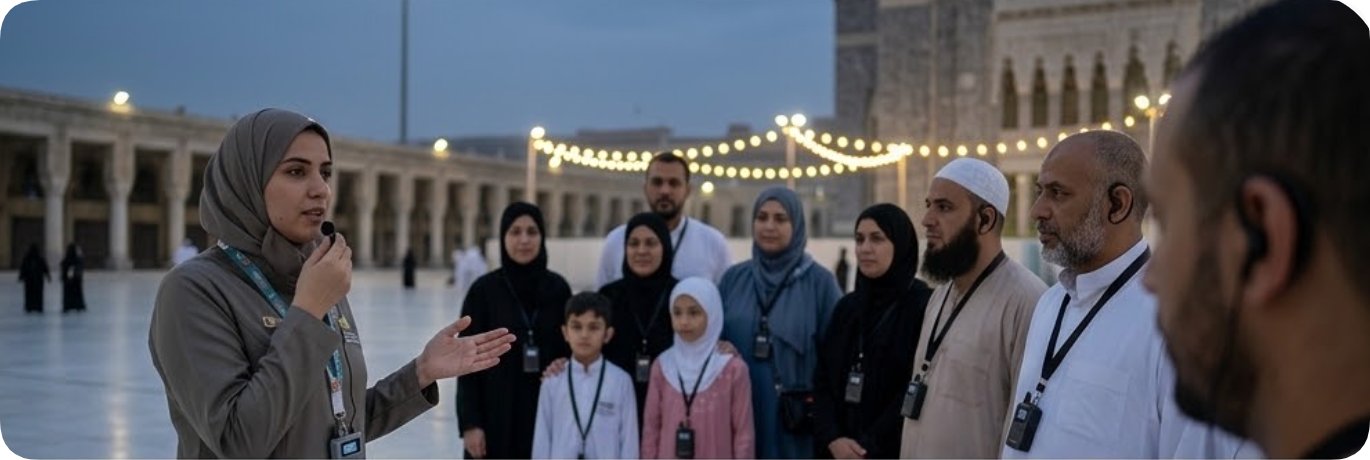
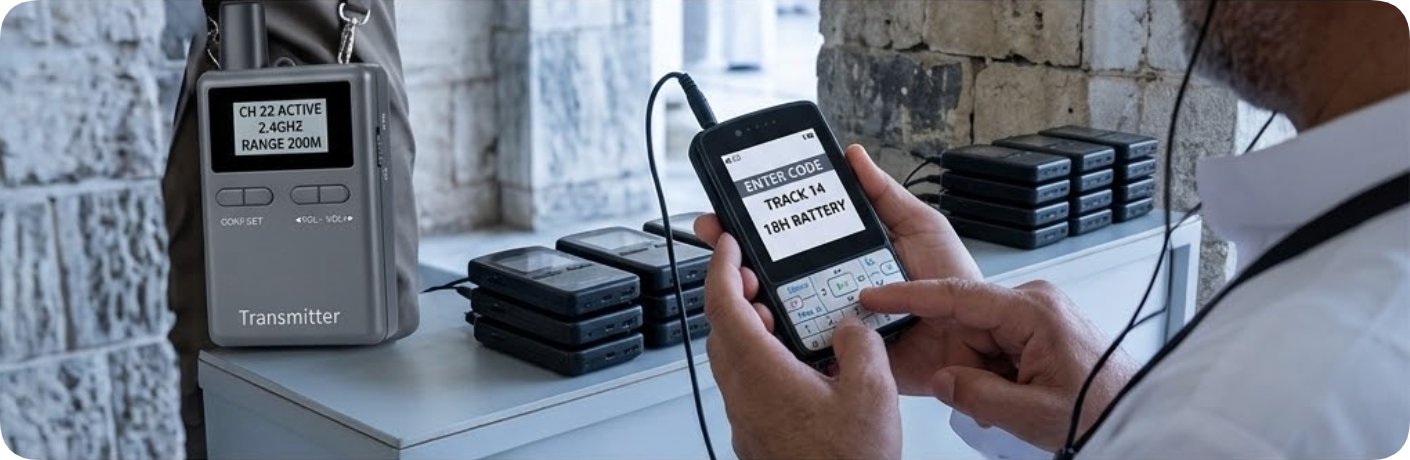
The first window opens well before sunrise, and it behaves nothing like a daytime tour. Visitors move in family clusters rather than tour groups, stops are short, and nobody wants a narrated lecture at that hour. Voices carry strangely in the cool air, loudspeakers are unwelcome near worshippers, and the crowd doubles in size as the moment approaches. Here the 2.8-Inch Semi-Auto Digital Audio Guide does the quiet work. Its 0-9 numeric keypad lets a pilgrim key in a location code and hear the matching clip on demand, with no guide speaking at all. The unit weighs about 100 grams and its battery holds around 18 hours, so a dawn issuance survives the full day without a swap. Staffing for this window is minimal: one issuer per checkpoint, no narrator required.
Midday Heat and the Shaded Hall
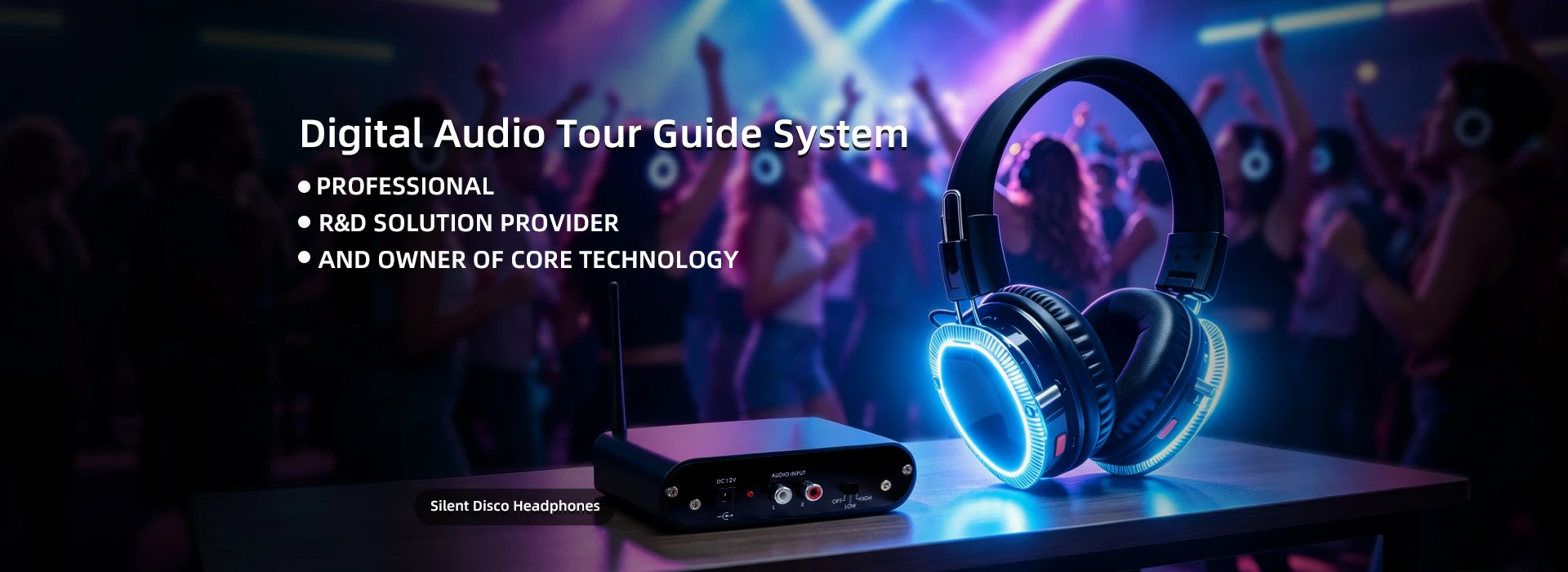
By midday the crowd compresses into covered halls, and the sound problem inverts. Instead of helping a small group hear one guide, the task is letting hundreds of people share one message without adding to the noise floor. The Silent Disco Wireless Headphone System was built for this inversion. Its 10-channel UHF link carries an FM stereo signal from an RC-50RF transmitter to every headphone at once, reaching about 200 meters at low power and well beyond 500 meters in high-power mode. Each headphone glows a different LED color, which doubles as a visual wayfinding cue in a dim hall. A 10-hour battery covers the whole indoor block.
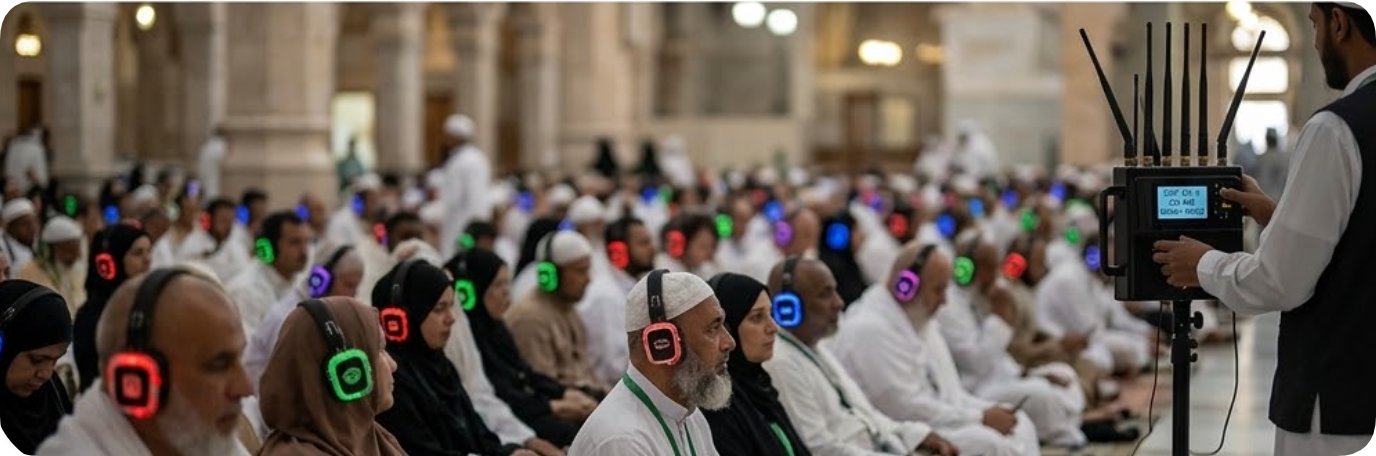
The Evening Return Flow
The last window is the hardest one to staff, because it is not an event but a drain, and drains do not appear on any printed schedule. Thousands of visitors move toward gates and transport at roughly the same time, and any guide who tries to hold a traditional group shape will lose it within minutes. Crews handle this with the RC2401 worn in reverse: team leads carry transmitters, marshals carry receivers, and instructions travel over the same 50-channel link that served tourists at noon. Channel separation keeps marshal teams from cross-talking with one another as the flow splits at junctions. Nobody narrates anything; the link is purely operational, and it works because the hardware was already in hand from the day shift. The lesson crews repeat after every season is simple: the evening drain is a logistics problem wearing the clothes of a guiding problem, and it rewards teams who rehearse the hand-back before the crowd ever moves.
🔋 Battery Carts in the Gaps
Between windows sit the gaps, and the gaps are where rosters are won. A receiver rated for 20 hours does not need a cart, but the silent disco stock does if a second event follows, and any unit issued at dawn deserves a top-up check at the noon changeover. The practical pattern is one charging cart per window transition, staffed by the same issuer who hands out units. Because the RC2401 charges over a DC port while the other devices use their own supplies, a labeled tray per device type prevents the most common gap-time failure: a unit that left the cart looking charged and was not. Crews who log the count at every hand-back catch a fading battery before a visitor does, and the thirty seconds that logging costs is repaid many times over by the complaints it prevents.
What Each Band Buys You
The three devices occupy three different slices of the spectrum, and that separation is a feature rather than an accident. The RC2401's 2.4 GHz allocation gives it 50 channels for fine-grained group separation at short range. The silent disco system's UHF slot trades channel count for raw penetration and range, which is what a large open space actually needs. The keypad guide uses no live link at all, which makes it immune to congestion and the simplest device to hand to a stranger. Matching band to block keeps each link clean and keeps the licensing conversation simple. It also quietly reduces training time, because a crew member who understands why a device sits on its own frequency stops treating the three kits as interchangeable and starts issuing them with intent.
One Table, Four Windows
| Device | Battery Life | Radio Link | Role in the Day |
|---|---|---|---|
| RC2401 | TX 10h / RX 20h | 2.4 GHz, 50 channels, 1-200m | Two-way guiding and marshal comms |
| 2.8-Inch Audio Guide | approx. 18h | None; keypad-triggered playback | Self-service commentary at checkpoints |
| Silent Disco Headphones | approx. 10h | UHF, 10 channels, 200-500m+ | One-way broadcast to a crowd |
Read the table as a window map rather than a spec sheet. The two-way column matters most at dawn and in the evening drain; the broadcast column owns the packed indoor block; the keypad column fills everything in between. Weight differences are modest across all three, ranging from about 50 grams per receiver to roughly 100 grams for the keypad unit, so carrying comfort rarely decides the choice.
Matching the Kit to the Flow of Pilgrims
Provisioning a pilgrimage day is less about buying more of one device and more about issuing the right one at the right gate. A useful baseline for a mid-size operation is a two-way set per guide team, a crate of keypad guides at every major checkpoint, and one silent disco stack reserved for the largest indoor gathering. Anything more than that invites idle stock, and idle stock is how charging carts overflow with units nobody rotated. The Hajj Pilgrimage Tour Case shows how that split performs across a full season. When the mix is right, crews stop chasing groups and start running the windows. To compare the full range behind this plan, visit Richitek's wireless tour guide systems and match each model to the block it will own.