A leading China factory specializing in Wireless Tour Guide Systems, Church Audio Guides, and Translation Headphones with premium OEM/ODM solutions.

Tel:+86 18922879583

Email:tiger.wang@richitek.com

RC2500, RC2402 and RC8860: Stadium Compliance Runs on Three Signed Lines

In a museum, compliance for a wireless tour guide system is mostly a short conversation: license-free spectrum, moderate group sizes, and certificates in a drawer. A stadium refuses that conversation. The venue runs its own radio traffic, its own safety command chain, and its own noise floor, and each of those carries a signature. Nothing about the kit itself changes; the paperwork around it triples.

That is why a stadium tour gets planned like a crowd-scale operation rather than a gallery walk. Three people sign three different lines before the first visitor walks through the turnstiles: the venue's frequency coordinator, the safety officer, and the tour lead who checks listening levels on a walk-round. Each line has its own logic, and each one points at a different unit in the bag.

🏟️ A Stadium Asks Who Answers for the Sound

Before the first signature, it helps to see why a stadium splits the question in three. One risk is spectrum: the air over a bowl is already busy, and a tour kit that wanders across it gets shut down mid-event. One risk is crowd handling: a route that works for twenty visitors fails at two hundred. One risk is hearing: crowd noise pushes guides to raise levels until the message is loud but no longer safe. No single document covers all three, which is why the venue asks for three signatures instead of one.

📡 The Radio Line: Coordination Before the Season

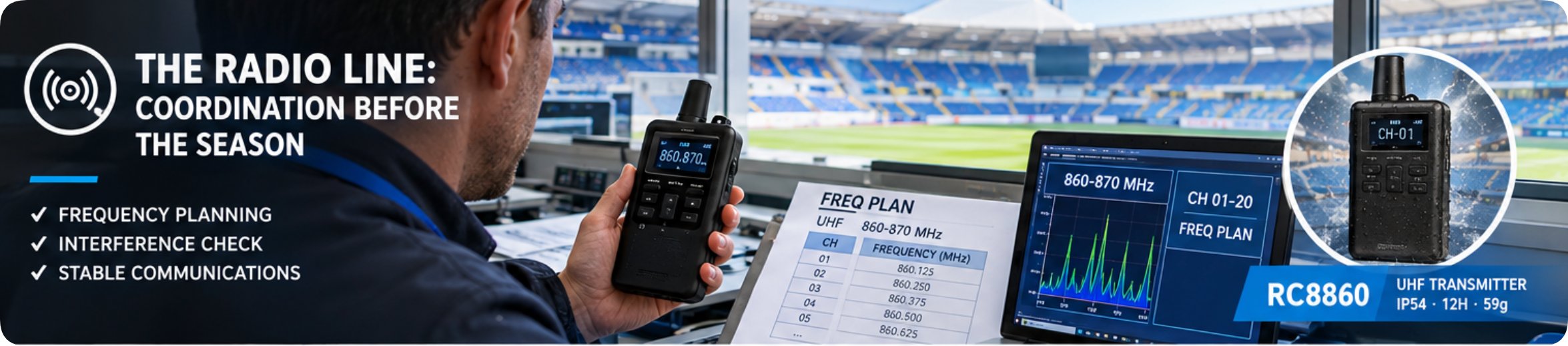
The first signature belongs to the venue's frequency coordinator. A stadium is never radio-silent: broadcast trucks, the PA rack, steward radios, kick-off timing systems and half a dozen contractor sets all share the air around the bowl. A kit on the 860-870 MHz band enters that picture only through coordination — the coordinator maps the twenty available channels against everything else the venue already runs, locks the result into a signed sheet, and freezes it before the season's first event. Ask for that sheet rather than a promise; a plan on paper is the only version that survives staff turnover.

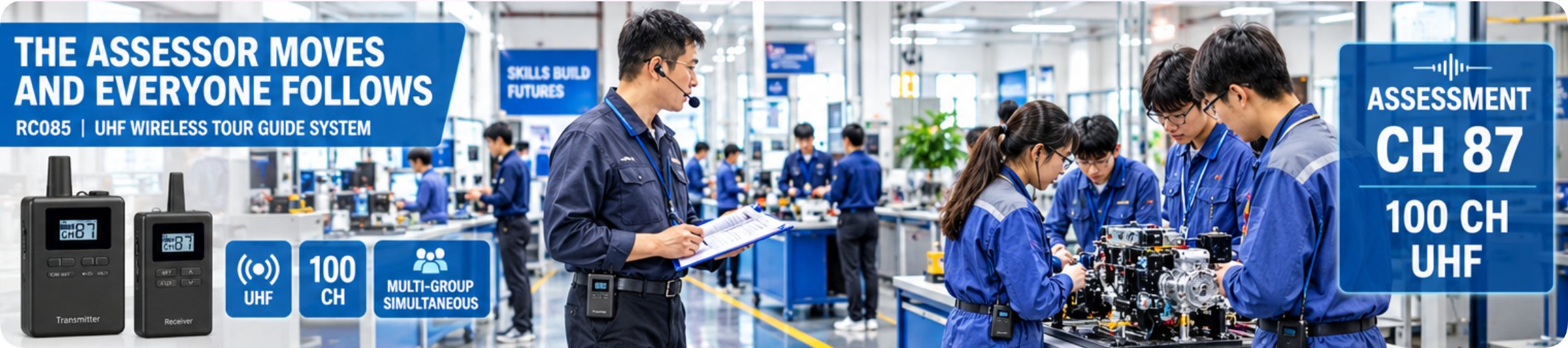
The RC8860 is the unit that line was written for. It transmits on 860-870 MHz UHF, carries CE and RoHS certifications for EU export, and holds twenty channels — deliberately few, because a coordinated plan wants fixed, documented frequencies rather than a wide pool to wander across. The transmitter runs about ten hours per charge and the receiver about twenty, enough to cover an event day and the reset afterward without a mid-shift swap. At fifty grams the receiver stays light through a full stadium route, and the housing shrugs off the rain and rail grease that come with open stands. See the RC8860 UHF transmitter for the full band and certification data.
RC8860-sports_stadium

The Crowd Line: Group Sizes Fixed at the Operations Meeting

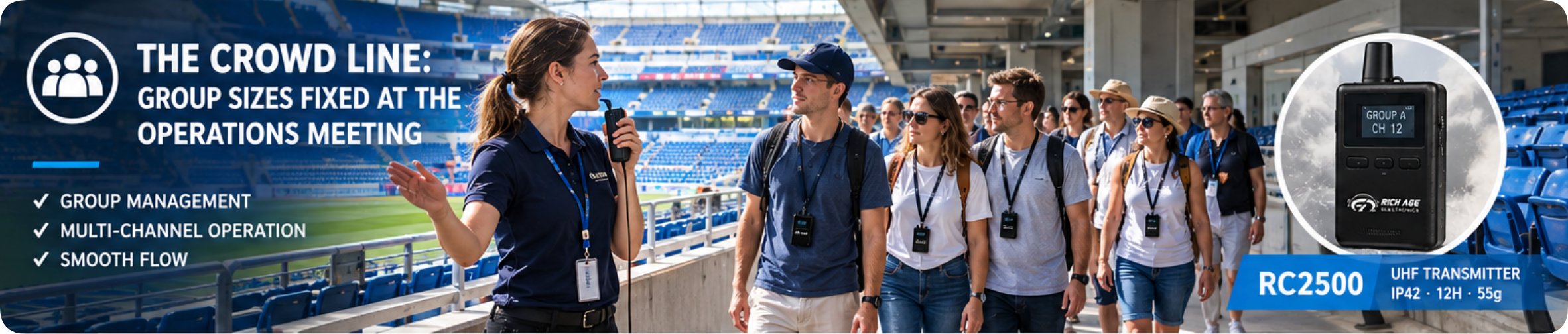
The second signature sits with the safety officer, and it is signed at the operations meeting, not at the gate. This line fixes how many visitors move in one group, which channel each group holds, and what happens when two tours overlap near a concourse pinch point. The 2.4 GHz band makes that conversation easier: it is license-free worldwide, so the plan scales across borders without a fresh application, and fifty channels give a multi-group layout room to separate concurrent tours cleanly. What the officer signs is numbers — routes, headcounts, channels — and those numbers have to match what the kit can actually hold.

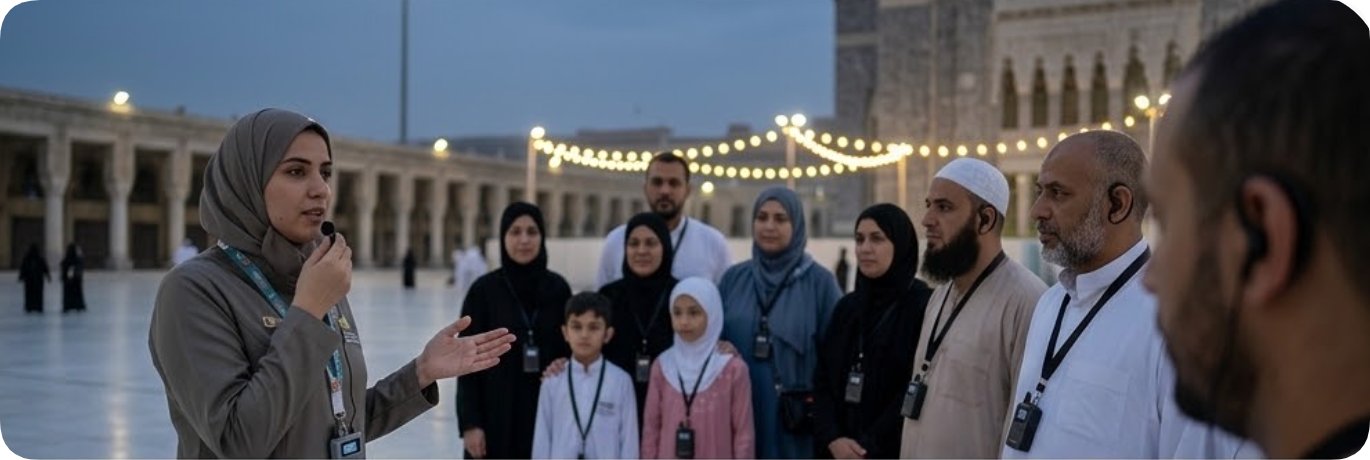
The RC2500 carries the crowd line. Its fifty channels run on the 2403-2483 MHz band with PLL-locked stability, and the battery figures are the reason it anchors all-day programmes: about fifteen hours on the transmitter and thirty-five or more on the receiver, both drawn from an 1800 mAh cell. At 104 grams the unit sits solidly in the hand for a full shift, which matters when a guide is managing a group through hours of noise and stairs. The full certification set — CE, EMC, LVD, RED and RoHS — is on file for export, so the same documents travel with the kit across borders. Full details are on the RC2500 wireless tour guide system page.
RC2500-sports_stadium

The Listening Line: Levels Checked on a Walk-Round

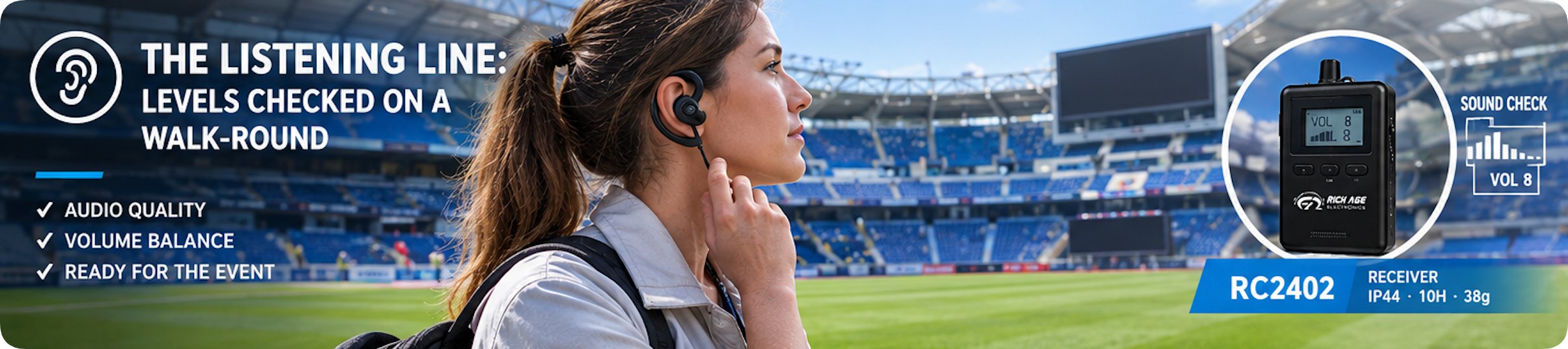
The third signature is the quietest one, and it belongs to whoever leads the tour. Before gates open, they cover the route on foot with a receiver in hand and check what the ear actually gets: is the level intelligible over the crowd's own roar, does the earpiece hold at speed, and does the volume stay honest when the noise floor drops between events. Every unit in this comparison transmits at ten milliwatts, delivered close to the ear, so intelligibility comes from fit and level control rather than raw power. The walk-round turns a hearing-safety policy into a recorded check instead of a hope.

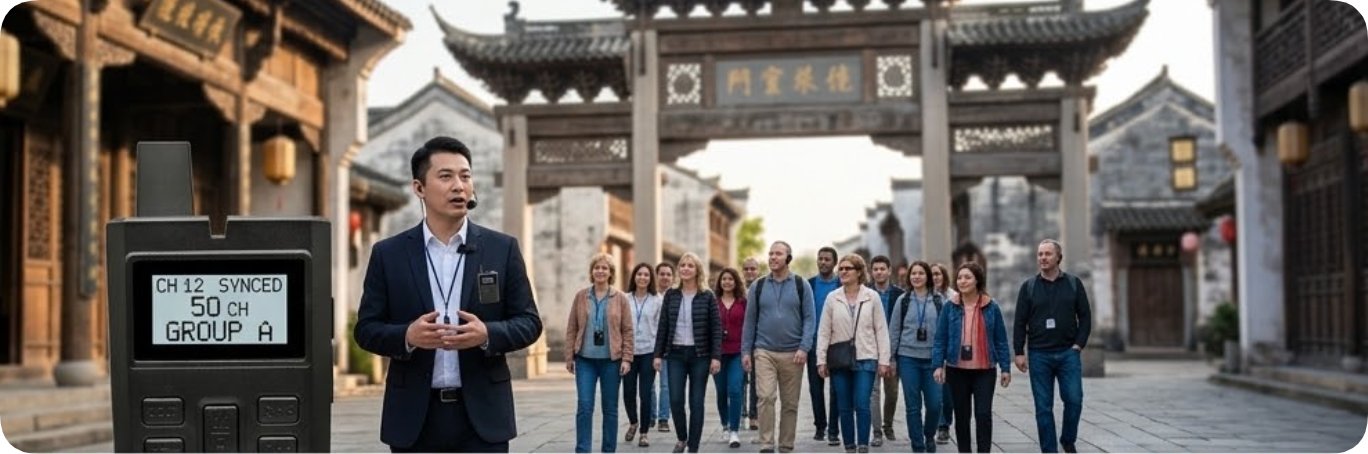
The RC2402 is the practical tool for that check. It runs on the same license-free 2.4 GHz band with fifty channels, pairs a ten-hour transmitter with a twenty-hour receiver, and keeps the receiver at fifty grams so the level a listener hears on the walk-round is the level they keep for the whole visit. The transmitter and receiver ship in multiple colors, which helps a crew assign units per group without printing labels. Like the RC2500, it carries CE, EMC, LVD, RED and RoHS certifications, so the listening line's evidence sits in the same export file as the rest. Specifications are listed on the RC2402 receiver page.
RC2402-sports_stadium

What Goes on the Signed Sheet

Put together, the sheet a stadium expects is short. Three rows: one for spectrum, one for crowd handling, one for listening levels. Each row names a person, a moment, and a limit — the coordinator before the season, the officer at the operations meeting, the tour lead on the walk-round. Suppliers who understand this bring documents to the meeting instead of promises: certification copies, battery figures, channel counts. Deployments at crowd scale live or die on that preparation, and venues remember which suppliers handed over a filled sheet and which handed over nothing but claims.

The Whole Sheet in One Table

The same three lines, condensed for your next venue meeting:

The lineWho signs, and whenWhat the check coversThe unit that carries it
The Radio LineThe venue's frequency coordinator, before the season's first eventEvery frequency the tour kit may touch, mapped against the stadium's own UHF trafficRC8860 — 860-870 MHz, 20 channels, CE and RoHS on file
The Crowd LineThe safety officer, at the pre-season operations meetingGroup size per route, channel per group, and the escalation path when plans changeRC2500 — 50 channels on the license-free 2.4 GHz band, 35+ hour receiver battery
The Listening LineThe tour lead, on the walk-round before gates openReceiver volume against crowd noise, ear fit, and the level each unit actually deliversRC2402 — 50 channels, 10-hour transmitter and 20-hour receiver battery

Where the Paperwork Meets the Kit

None of these signatures require a special edition of the hardware; they require knowing which numbers to put in front of which person. The radio line wants band data and channel counts. The crowd line wants battery life and weight, because both decide how many groups one kit can carry through one event. The listening line wants output power and receiver fit. A single fleet covering all three keeps the operation simple — one transmitter layout, one receiver habit, one charging case per line item, and one set of export documents that serves every row of the sheet.

Sign the Plan, Then Pack the Kit

If your season includes stadium work, start the paperwork early: ask the venue who owns each line, and bring the unit data that answers it. The full range, including the three units above, is covered on our wireless tour guide system pages with specification sheets and export documentation. More deployment notes are collected under our tour guide solutions. Send us your route, your group sizes and your event calendar, and we will return the three-line sheet filled in — the signatures after that belong to your venue.
2026年10月12日 09:24
ꄘ click: 12

RC2500, RC2402 and RC8860: Stadium Compliance Runs on Three Signed Lines

time: 2026年10月12日 click:12

In a museum, compliance for a wireless tour guide system is mostly a short conversation: license-free spectrum, moderate group sizes, and certificates in a drawer. A stadium refuses that conversation. The venue runs its own radio traffic, its own safety command chain, and its own noise floor, and each of those carries a signature. Nothing about the kit itself changes; the paperwork around it triples.

That is why a stadium tour gets planned like a crowd-scale operation rather than a gallery walk. Three people sign three different lines before the first visitor walks through the turnstiles: the venue's frequency coordinator, the safety officer, and the tour lead who checks listening levels on a walk-round. Each line has its own logic, and each one points at a different unit in the bag.

🏟️ A Stadium Asks Who Answers for the Sound

Before the first signature, it helps to see why a stadium splits the question in three. One risk is spectrum: the air over a bowl is already busy, and a tour kit that wanders across it gets shut down mid-event. One risk is crowd handling: a route that works for twenty visitors fails at two hundred. One risk is hearing: crowd noise pushes guides to raise levels until the message is loud but no longer safe. No single document covers all three, which is why the venue asks for three signatures instead of one.

📡 The Radio Line: Coordination Before the Season

The first signature belongs to the venue's frequency coordinator. A stadium is never radio-silent: broadcast trucks, the PA rack, steward radios, kick-off timing systems and half a dozen contractor sets all share the air around the bowl. A kit on the 860-870 MHz band enters that picture only through coordination — the coordinator maps the twenty available channels against everything else the venue already runs, locks the result into a signed sheet, and freezes it before the season's first event. Ask for that sheet rather than a promise; a plan on paper is the only version that survives staff turnover.

The RC8860 is the unit that line was written for. It transmits on 860-870 MHz UHF, carries CE and RoHS certifications for EU export, and holds twenty channels — deliberately few, because a coordinated plan wants fixed, documented frequencies rather than a wide pool to wander across. The transmitter runs about ten hours per charge and the receiver about twenty, enough to cover an event day and the reset afterward without a mid-shift swap. At fifty grams the receiver stays light through a full stadium route, and the housing shrugs off the rain and rail grease that come with open stands. See the RC8860 UHF transmitter for the full band and certification data.

RC8860-sports_stadium

The Crowd Line: Group Sizes Fixed at the Operations Meeting

The second signature sits with the safety officer, and it is signed at the operations meeting, not at the gate. This line fixes how many visitors move in one group, which channel each group holds, and what happens when two tours overlap near a concourse pinch point. The 2.4 GHz band makes that conversation easier: it is license-free worldwide, so the plan scales across borders without a fresh application, and fifty channels give a multi-group layout room to separate concurrent tours cleanly. What the officer signs is numbers — routes, headcounts, channels — and those numbers have to match what the kit can actually hold.

The RC2500 carries the crowd line. Its fifty channels run on the 2403-2483 MHz band with PLL-locked stability, and the battery figures are the reason it anchors all-day programmes: about fifteen hours on the transmitter and thirty-five or more on the receiver, both drawn from an 1800 mAh cell. At 104 grams the unit sits solidly in the hand for a full shift, which matters when a guide is managing a group through hours of noise and stairs. The full certification set — CE, EMC, LVD, RED and RoHS — is on file for export, so the same documents travel with the kit across borders. Full details are on the RC2500 wireless tour guide system page.

RC2500-sports_stadium

The Listening Line: Levels Checked on a Walk-Round

The third signature is the quietest one, and it belongs to whoever leads the tour. Before gates open, they cover the route on foot with a receiver in hand and check what the ear actually gets: is the level intelligible over the crowd's own roar, does the earpiece hold at speed, and does the volume stay honest when the noise floor drops between events. Every unit in this comparison transmits at ten milliwatts, delivered close to the ear, so intelligibility comes from fit and level control rather than raw power. The walk-round turns a hearing-safety policy into a recorded check instead of a hope.

The RC2402 is the practical tool for that check. It runs on the same license-free 2.4 GHz band with fifty channels, pairs a ten-hour transmitter with a twenty-hour receiver, and keeps the receiver at fifty grams so the level a listener hears on the walk-round is the level they keep for the whole visit. The transmitter and receiver ship in multiple colors, which helps a crew assign units per group without printing labels. Like the RC2500, it carries CE, EMC, LVD, RED and RoHS certifications, so the listening line's evidence sits in the same export file as the rest. Specifications are listed on the RC2402 receiver page.

RC2402-sports_stadium

What Goes on the Signed Sheet

Put together, the sheet a stadium expects is short. Three rows: one for spectrum, one for crowd handling, one for listening levels. Each row names a person, a moment, and a limit — the coordinator before the season, the officer at the operations meeting, the tour lead on the walk-round. Suppliers who understand this bring documents to the meeting instead of promises: certification copies, battery figures, channel counts. Deployments at crowd scale live or die on that preparation, and venues remember which suppliers handed over a filled sheet and which handed over nothing but claims.

The Whole Sheet in One Table

The same three lines, condensed for your next venue meeting:

The lineWho signs, and whenWhat the check coversThe unit that carries it
The Radio LineThe venue's frequency coordinator, before the season's first eventEvery frequency the tour kit may touch, mapped against the stadium's own UHF trafficRC8860 — 860-870 MHz, 20 channels, CE and RoHS on file
The Crowd LineThe safety officer, at the pre-season operations meetingGroup size per route, channel per group, and the escalation path when plans changeRC2500 — 50 channels on the license-free 2.4 GHz band, 35+ hour receiver battery
The Listening LineThe tour lead, on the walk-round before gates openReceiver volume against crowd noise, ear fit, and the level each unit actually deliversRC2402 — 50 channels, 10-hour transmitter and 20-hour receiver battery

Where the Paperwork Meets the Kit

None of these signatures require a special edition of the hardware; they require knowing which numbers to put in front of which person. The radio line wants band data and channel counts. The crowd line wants battery life and weight, because both decide how many groups one kit can carry through one event. The listening line wants output power and receiver fit. A single fleet covering all three keeps the operation simple — one transmitter layout, one receiver habit, one charging case per line item, and one set of export documents that serves every row of the sheet.

Sign the Plan, Then Pack the Kit

If your season includes stadium work, start the paperwork early: ask the venue who owns each line, and bring the unit data that answers it. The full range, including the three units above, is covered on our wireless tour guide system pages with specification sheets and export documentation. More deployment notes are collected under our tour guide solutions. Send us your route, your group sizes and your event calendar, and we will return the three-line sheet filled in — the signatures after that belong to your venue.
×

Contact us

email:
name:
subject:
content: