

A municipal gallery in the city's old quarter gave us one of the cleanest comparison briefs we have handled this year. One building, four exhibition rooms, a mezzanine print study area, and three very different visitor flows: free-entry weekends that push two hundred people through the doors, ticketed preview evenings capped at sixty, and a school programme that arrives in groups of thirty-five every Thursday morning. The curatorial team had shortlisted three kits — the RC2406 80-Channel 2.4G Tour Guide System, the RC8860 Tour Guide Transmitter, and the RC085 Digital Tour Guide System — and asked a question that deserves a public answer: on one quiet floor, does the frequency band actually change the experience, or is it a spec-sheet footnote? The patterns we logged match what our museum and gallery teams see on similar floors.
We spent a week on site with all three kits, and the honest summary is that each one wins a different session on the calendar. The band is not a footnote; it decides which problems the gallery never has to think about again. This article walks through what we measured, where each system belongs, and how the team ended up splitting the purchase rather than choosing a single winner.
📡 One Floor Plan, Three Wireless Answers
The building itself sets the terms. Thick masonry walls from the 1920s, a marble-clad staircase that acts like a reflector, and a lift shaft cutting vertically through the middle of the floor plan. RF behaviour in such a space is unpredictable in a useful way: the same system can feel flawless in Room II and struggle on the mezzanine, purely because of what stands between the transmitter and the receiver. That is why the trial was run session by session rather than as a single afternoon test, and why the conclusions below are tied to specific rooms rather than to the building as a whole.
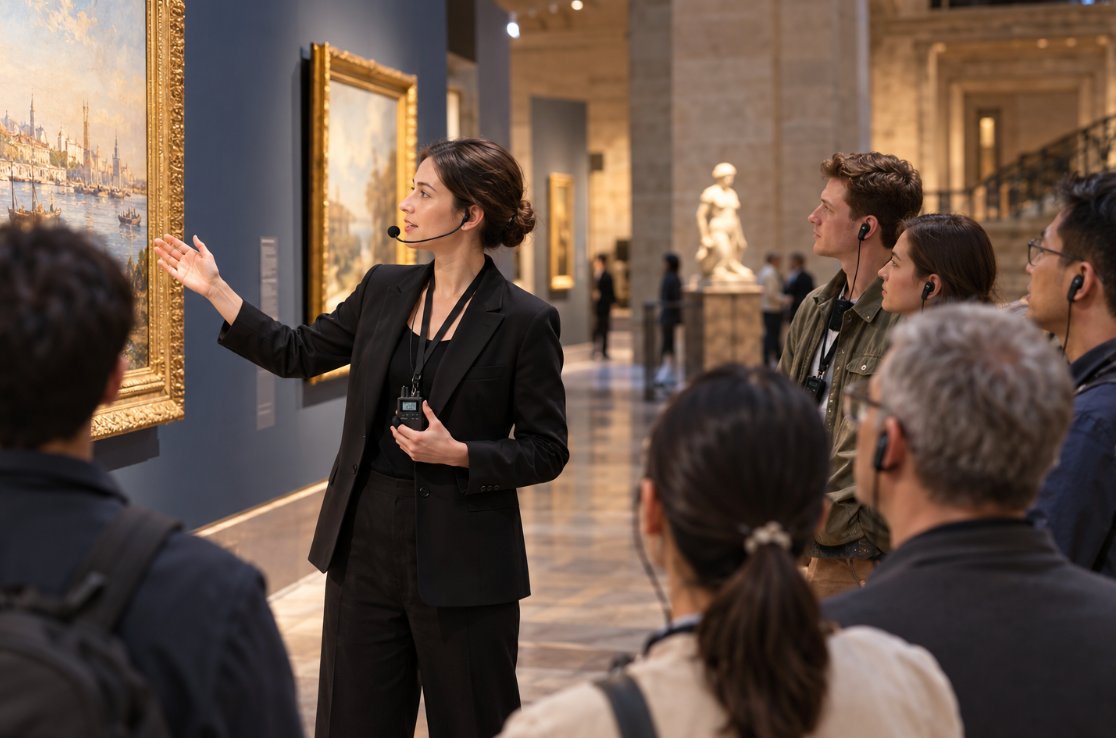
The 2.4G Case for Crowded Preview Days
The RC2406 80-Channel 2.4G Tour Guide System owns this slot. Preview evenings are the gallery's hardest RF moment: sixty visitors packed into two rooms, every phone on the visitors' own 2.4 GHz connections, staff tablets streaming condition reports. The RC2406 is built for exactly this congestion. Its 80 channels give the operations team room to move a tour onto a clean channel on the fly, and the 2403-2483 MHz band with its interference-managed design held narration clean through the densest preview we joined. The transmitter runs ten hours on its 3.7V 1500mAh pack and the receivers twenty hours on 1000mAh, which comfortably covers a double-header evening; at 59 grams for the transmitter and 50 grams per receiver, the front-of-house staff forget they are wearing the demo units.
The trade-off worth naming is range discipline. The 1-200 metre rating assumes clear conditions, and in practice the RC2406 prefers its transmitter to stay within sight of the group. In a gallery, where a docent is never more than a room away from the audience, that constraint simply does not bite — which is why this kit owns the preview slot in the final plan.
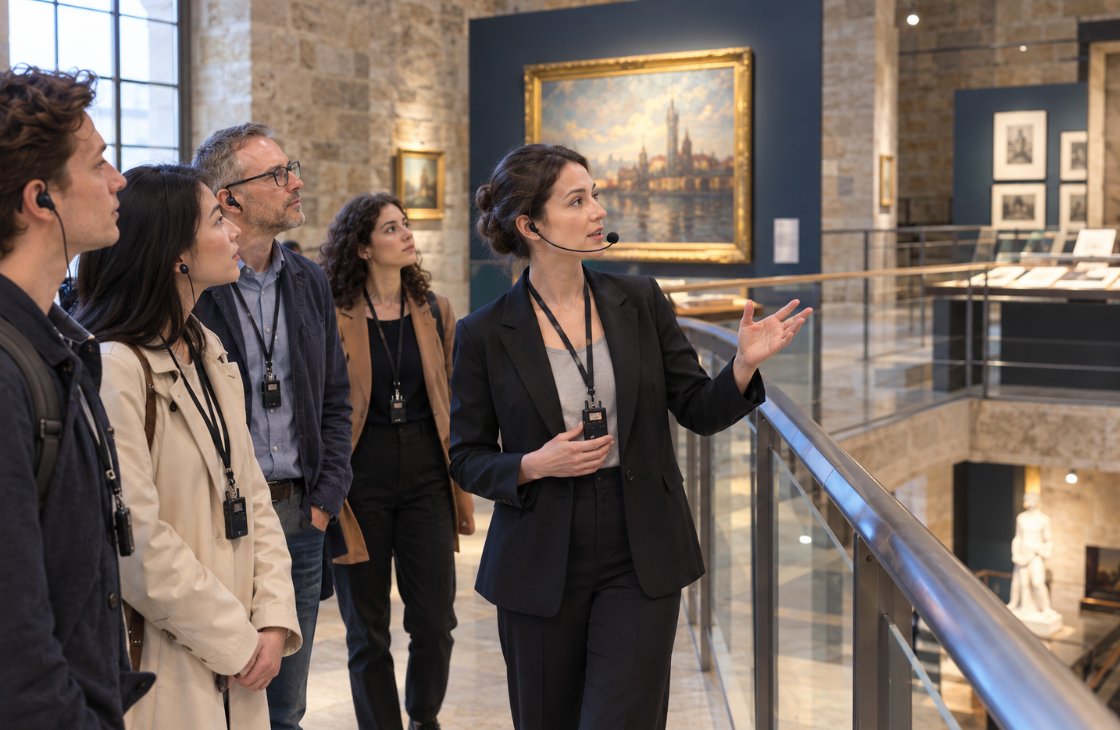
Where the UHF 860-870 Band Earns Its Keep
The RC8860 Tour Guide Transmitter answers a different problem: penetration. Its 860-870 MHz UHF signal reads through the masonry that scatters 2.4 GHz, and the week's most telling moment came on the mezzanine, where a 2.4 GHz receiver dropped syllables whenever the guide stepped into the print study alcove. The RC8860 carried the same walk without a stutter, running its twenty channels across the UHF segment with the same 10mW courtesy that keeps gallery audio unobtrusive. Battery figures match the RC2406 — ten hours transmit, twenty receive — so swapping the two kits between sessions costs the team no charging discipline at all.
Twenty channels is the number to examine honestly. For one tour at a time, it is generous; for the Thursday school programme, when two groups and a staff briefing share the floor, the operations team counts margins more carefully. That arithmetic is what pushed the gallery toward a third kit rather than a second batch of the same one.
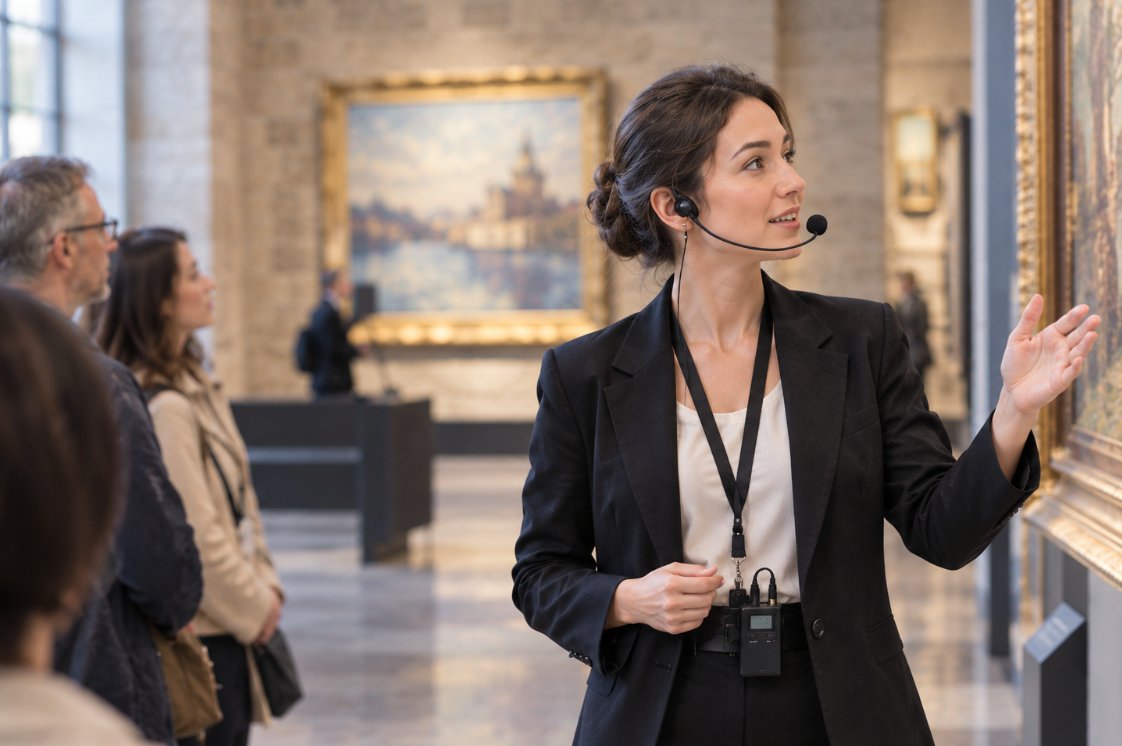
🏨 The 470-510 Option With the Longest Guest List
The RC085 Digital Tour Guide System is the specialist in the trio. Its 470-510 MHz band with 100 channels makes it the only one of the three that can run three simultaneous tours, a staff briefing and a broadcast-feed rehearsal without anyone re-negotiating spectrum, and its 12-hour transmitter endurance outlasts the other two on the gallery's long Saturday. The specification that quietly decided its role, though, sits in the audio chain: sensitivity around -102dBm and an optional headset or lavalier microphone, which turned out to matter for the lecture programme, where a guide narrating for ninety minutes wants hands free and voice consistent.
The costs of that capability are real but small in this setting. The transmitter weighs 65 grams against 59 for the others, its 3.7V 1200mAh pack charges over USB rather than the DC port the other two use, and the receivers keep the same 20-hour, 1000mAh, 50-gram profile the staff already know. In a gallery that already labels its equipment drawers, one more cable type is a shelving decision, not a burden.
| Dimension | RC2406 | RC8860 | RC085 |
|---|---|---|---|
| Band | 2.4G, 2403-2483 MHz | UHF, 860-870 MHz | UHF, 470-510 MHz |
| Channels | 80 | 20 | 100 |
| Output power | 10mW | 10mW | 8-10mW |
| Battery life (TX / RX) | 10h / 20h | 10h / 20h | 12h / 20h |
| Transmitter weight | 59g | 59g | 65g |
| Receiver weight | 50g | 50g | 60g |
| Charging port | DC port | DC port | USB |
| Best-fit session | Crowded preview evenings | Masonry-heavy walks, mezzanine | Multi-tour days, lecture programme |
🎨 Side by Side on the Gallery Floor
The table above compresses a week of paired walks, but three field observations deserve prose. First, the output power parity — 10mW on two kits, 8-10mW on the third — is why none of the systems ever felt intrusive in a room where visitors stand a metre from the art; loudness was never the variable, fidelity was. Second, the frequency response split matters more in a gallery than the numbers suggest: narration with sibilant detail survives a 50Hz-12kHz receiver path, and all three kits deliver exactly that on the receiver side. Third, the 1-200 metre range rating is identical across the trio, which means the real differentiator indoors is never distance — it is what the signal must pass through, and that is a band question every time.
🔋 Battery and Charging Realities Behind the Checklist
Operations teams live with the charging shelf, not the spec sheet, so the practical picture is worth spelling out. Two of the three kits share identical battery architecture — 3.7V 1500mAh transmitters, 3.7V 1000mAh receivers, DC-port charging — which lets the gallery standardise one charging routine for the RC2406 and RC8860 fleet. The RC085's transmitter runs a smaller 1200mAh pack but stretches it across twelve hours, and its USB charging means the loaner drawer needs exactly one labelled cable type. The gallery's final arrangement puts both UHF kits on a nightly rotation and leaves the 2.4G preview kit on permanent charge between weekend sessions, and nobody touches a charger during opening hours. The full tour guide system range shares most of this architecture, which is what makes such mixed fleets manageable.
How We Would Split the Three Kits
The purchase the gallery actually made follows the calendar rather than any league table. The RC2406 covers preview evenings and weekend free entry, where eighty channels and congestion management earn their keep. The RC8860 owns the school programme's architectural walk, because children move fast and the masonry between rooms is exactly where its band shines. The RC085 handles multi-tour Thursdays and the lecture programme, where one hundred channels and the lavalier option close out the schedule's last conflicts. A single-kit buyer with only one of these sessions should simply buy for that session; the three-kit split only pays when the calendar looks like this one — varied, dense, and unforgiving of dropped syllables in front of irreplaceable paintings.
For teams mapping their own floor plans, the solutions library collects the session-by-session patterns this article could only sample — concert halls, archives, teaching collections.