


Following a city walking tour season, a customer shared three photographs capturing different stages of deployment: an assembly bench with lanyard-fitted units and packed boxes, a side-by-side transmitter and receiver setup showing lit channel readouts, and four walkers standing on a historic cobbled street. None of these stills is a staged studio shot of a tour group listening mid-lecture, yet read together they trace a practical delivery chain from batch preparation to street-level operation.
Evaluating the RC2408 accurately means assigning each image only the evidentiary weight it can support while keeping published hardware specifications grounded in official RC2408 Long Range Wireless Audio Guide data—operating on 2403–2483 MHz (2.4 GHz) with 80 selectable channels, a 1–200 m transmission range, 10 mW output power, 59 g transmitter / 50 g receiver weight, and 10 h transmitter / 20 h receiver runtime.
💡 Assigning Each Customer Frame a Clear Evidentiary Role
Customer-supplied photos tell a more credible story when each frame is matched to what it actually depicts rather than stretched to prove unrelated metrics. In this delivery sequence, the assembly bench speaks to batch readiness and accessory preparation, the paired transmitter-receiver visual illustrates hardware pairing and channel display layout, and the cobbled street scene reflects the walking environment where urban tours take place.
Following the chronological flow of an order—assembly, configuration, and field deployment—keeps technical claims transparent for tour operators and procurement teams comparing wireless tour guide fleets.
🏭 Frame One: Batch Assembly and Lanyard Preparation at the Bench
The first photograph captures a production bench lined with foam trays holding black units fitted with lanyards alongside stacked white cartons, cables, tape, and a checklist. For walking tour operators launching seasonal routes on tight turnarounds, receiving pre-fitted batch hardware with lanyards already attached saves setup time before departure.
With the RC2408 transmitter weighing 59 g and the receiver weighing 50 g, hanging units from lanyards keeps guides' and walkers' hands free along uneven city streets without weighing down clothing during multi-hour routes.

🖥️ Frame Two: Paired Transmitter and Receiver Setup Visual
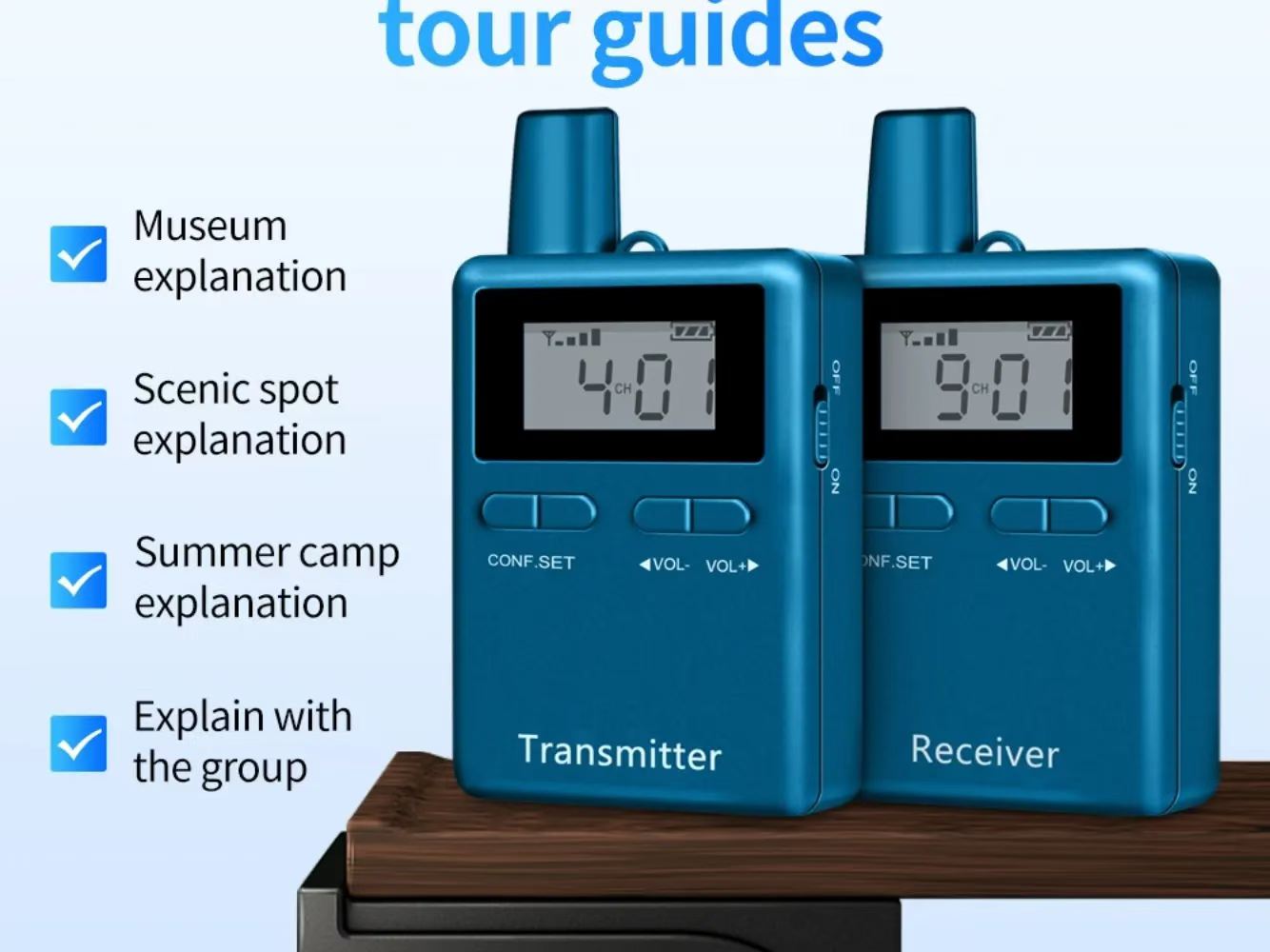
The second image presents a blue transmitter and blue receiver side by side with illuminated channel displays, labeled controls, and application icons including scenic spot explanation. Treating this graphic as a setup reference rather than a specification limit prevents confusion: a single channel number shown on an LCD screen reflects the active channel at that moment, whereas the RC2408 provides 80 selectable channels across 2403–2483 MHz using PLL synthesis.
In day-to-day operations, pairing a guide transmitter (10 h runtime on a 3.7V 1500 mAh battery) with listener receivers (20 h runtime on a 3.7V 1000 mAh battery, charged via DC port) supports full-day city walking schedules across distinct channels when multiple groups operate simultaneously.
Frame Three: Historic Cobbled Street Context and Practical Limits
The third photograph shows four visitors standing along a narrow cobbled street lined with stone facades, flags, and shop signage, with lanyards worn around necks. Narrow historic lanes naturally stretch walking formations as groups pause around architectural details or pass pedestrians; a 1–200 m rated wireless link helps keep trailing guests connected without forcing guides to shout.
At the same time, an informal street photo does not record live audio logs, exact group counts, or channel separation in crowded alleys. Pairing visual context with structured route planning—as outlined in our City Sightseeing Tour Audio Solutions guide—keeps field expectations realistic.

Published RC2408 Specifications vs. What Photos Show
The table below separates verified RC2408 specification values from what each visual frame demonstrates in a city walking deployment.
| Specification / Factor | Published RC2408 Value | Evidence in the Three Frames |
|---|---|---|
| Frequency Band & Control | 2403–2483 MHz (2.4 GHz), PLL synthesis | RF band and synthesis method are specified on the product page rather than read from photos. |
| Selectable Channels | 80 selectable channels | Frame Two shows active channel readouts on lit displays, illustrating multi-channel operation. |
| Operating Range & Output Power | 1–200 m range, 10 mW output | Frame Three depicts a narrow cobbled city street where groups spread out along walking routes. |
| Weight & Lanyard Handling | TX 59 g / RX 50 g | Frame One shows lanyard attachment on a prepared batch; Frame Three shows lanyards worn on a street walk. |
| Battery Runtime & Charging | TX 10 h (3.7V 1500 mAh) / RX 20 h (3.7V 1000 mAh), DC port | Frame One shows bench cables; runtime endurance comes from published battery capacity specs. |
| Frequency Response | TX 50 Hz–200 kHz / RX 50 Hz–12 kHz | Acoustic bandwidth is defined by hardware specifications rather than visual inspection. |
Planning a City Walking Fleet from Batch to Route
Operators sizing a city tour fleet start with peak group headcount plus spare receivers, match transmitters to concurrent departures across the 80 available channels, and factor in the 20-hour receiver runtime when scheduling consecutive walking sessions. To compare channel counts and battery specs across nearby models, review the RC2402 vs RC2408 Technical Comparison, the RC2406 vs RC2408 Technical Comparison, and the full Wireless Tour Guide System Manufacturer Direct lineup.
You can also explore multi-group channel scheduling in RC8860, RC2401 and RC2500: A Channel Plan for an Open Day That Never Stops and browse more deployments under Wireless Audio Guide Application Solutions.
Frequently Asked Questions
1. How many selectable channels does the RC2408 support compared to what a display readout shows?
The RC2408 supports 80 selectable channels across the 2403–2483 MHz (2.4 GHz) band, whereas any single channel number visible on a display shows the specific channel selected at that moment rather than total channel capacity.
2. Why is pre-fitting lanyards at the assembly bench helpful for city walking tours?
Preparing units with lanyards prior to packing lets tour staff issue ready-to-wear receivers (50 g) and transmitters (59 g) quickly before departures, keeping hands free on city streets.
3. How long do the RC2408 transmitter and receiver run on a full charge?
Published specifications rate the RC2408 transmitter for 10 hours on a 3.7V 1500 mAh battery and the receiver for 20 hours on a 3.7V 1000 mAh battery, charged via a DC port.
4. What transmission range does the RC2408 offer for walking groups along city streets?
The RC2408 specifies a 1–200 m transmission range with 10 mW output power, giving walking groups room to move along narrow streets and stops while maintaining clear audio reach.