A leading China factory specializing in Wireless Tour Guide Systems, Church Audio Guides, and Translation Headphones with premium OEM/ODM solutions.

Tel:+86 18922879583

Email:tiger.wang@richitek.com

RC9150, RC2468 and RC2500: The Person-Hours Behind an Official Visit

A government delegation visit produces no ticket revenue, and its cost structure hides in a place most procurement sheets never itemize: staff time. When a municipal bureau receives an inspection group, three kinds of paid hours disappear into the itinerary — the docent who narrates the exhibition hall, the liaison officer who walks the delegation from briefing room to workshop floor, and whoever steps in when a visiting official asks a question the schedule never anticipated. Facilities teams budget for the hardware easily; the recurring payroll line is harder to see, and it repeats every single month.

The arithmetic that matters here is not what a tour guide system costs, but how many staff hours it returns. A government and conference reception setup changes the shape of that equation in a specific way: one speaker reaches every ear directly, so the walked-and-repeated tour stops being the only delivery method. This article walks through three systems side by side — the RC9150, the RC2468 and the RC2500 — and counts what each one does to the three staff roles a visit always hires.

Three Staff Roles a Government Delegation Always Hires

Before comparing devices, it helps to separate the three jobs that consume hours during an official visit. The first is narration: someone must explain the exhibition wall, the production line or the command center, and with an unamplified voice that person speaks at project-heavy volume for forty minutes at a stretch. The second is shepherding: a liaison keeps the group moving, counts heads at each stop, and physically positions visitors so they can hear. The third is repetition: because unaided speech carries maybe fifteen meters in a noisy hall, large delegations get split, and the same briefing is delivered two or three times to two or three clusters.

Each of the three systems below attacks a different part of that payroll. One extends reach so the split-and-repeat cycle collapses. One removes the weight burden that makes staff resist wearing equipment all day. One absorbs a schedule where delegations arrive in waves and the same kit must reset between groups in minutes. None of them eliminates the people — protocol still matters, and a machine cannot answer a minister's question — but all three shrink the hours those people spend on mechanical work.

RC9150: Two Hundred Meters of Reach, Fewer Bodies in the Corridor

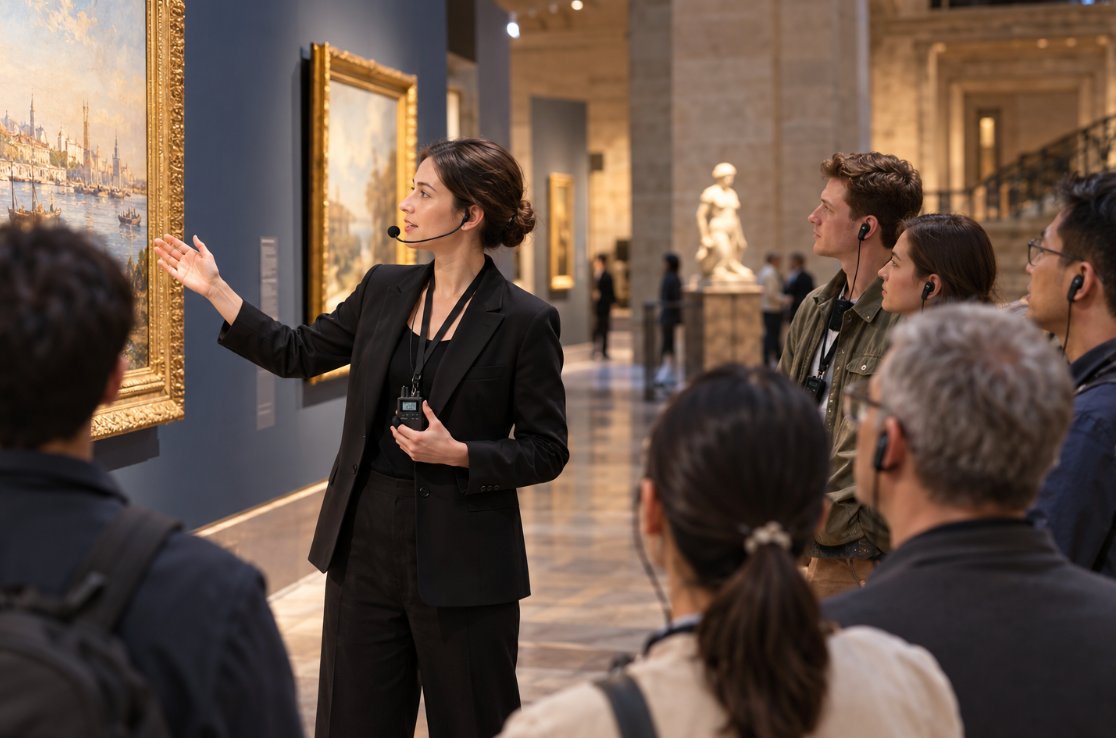
The RC9150 transmitter pushes a 10 mW signal across a 1–200 meter range on the 2.4 GHz band, and that reach translates directly into a staffing decision. With coverage that wide, the liaison no longer needs to compress a delegation into a tight cluster around one speaking body; visitors can spread across a full assembly hall or a long production corridor and still hear the narration clearly. The split-and-repeat pattern — three subgroups, three deliveries of the same script — collapses into one delivery.

docent addressing a dispersed official delegation across a government reception hall

One hundred channels matter here too, because government compounds rarely host a single group at a time. A training class in the east wing, a delegation in the main hall and a media crew in the lobby can run on three separate channels without crosstalk. The transmitter runs 15 hours on its 3.7V 1800 mAh battery and the receiver holds 35 hours and more, so a kit prepped in the morning survives an entire reception day plus the debrief. Both units weigh 97.5 grams, charge over Type-C, and the transmitter comes in grey with black receivers — a neutral pairing that suits institutional settings. The full specification lives on the RC9150 2.4G Wireless Audio Guide System page.

RC2468: What the Lightest Receiver Changes for the Liaison

The RC2468 attacks a different problem: the liaison who wears a receiver for six hours and quietly resents it. Its ear-hook receiver weighs 18 grams — light enough that staff forget it is there — while the transmitter stays at 59 grams in a jacket pocket. Fifty channels on the same 2.4 GHz band handle the parallel-group case, and the 1–200 meter range keeps a wandering delegation connected as it moves from gate to workshop.

liaison officer wearing a lightweight ear-hook receiver while holding a folder in a lobby

The honest trade-off is endurance. The transmitter runs 10 hours, but the receiver manages approximately 8 hours on its 3.7V 300 mAh cell — enough for a morning itinerary and an afternoon walkthrough, with the caveat that a full-day, two-delegation schedule should include a midday top-up over its USB charging port. For offices that host one delegation per day, that budget fits comfortably. For a reception center cycling three groups daily, the RC9150 or RC2500 carries the day better. The lighter receiver ships in black with multi-color transmitter options in bulk orders, and its details are on the RC2468 Ultra-Light 2.4G Tour Guide System page.

RC2500: Long Standby Across a Day of Consecutive Groups

The RC2500 is the flagship option for a reception calendar that never empties. Its transmitter and receiver each run 15 hours of active use and more than 35 hours on standby, powered by 3.7V 1800 mAh cells — so a kit signed out at 8:00 for a provincial delegation, returned at noon, and signed out again at 14:00 for a sister-city group never sees a charger before evening. Both units weigh 104 grams and charge over Type-C.
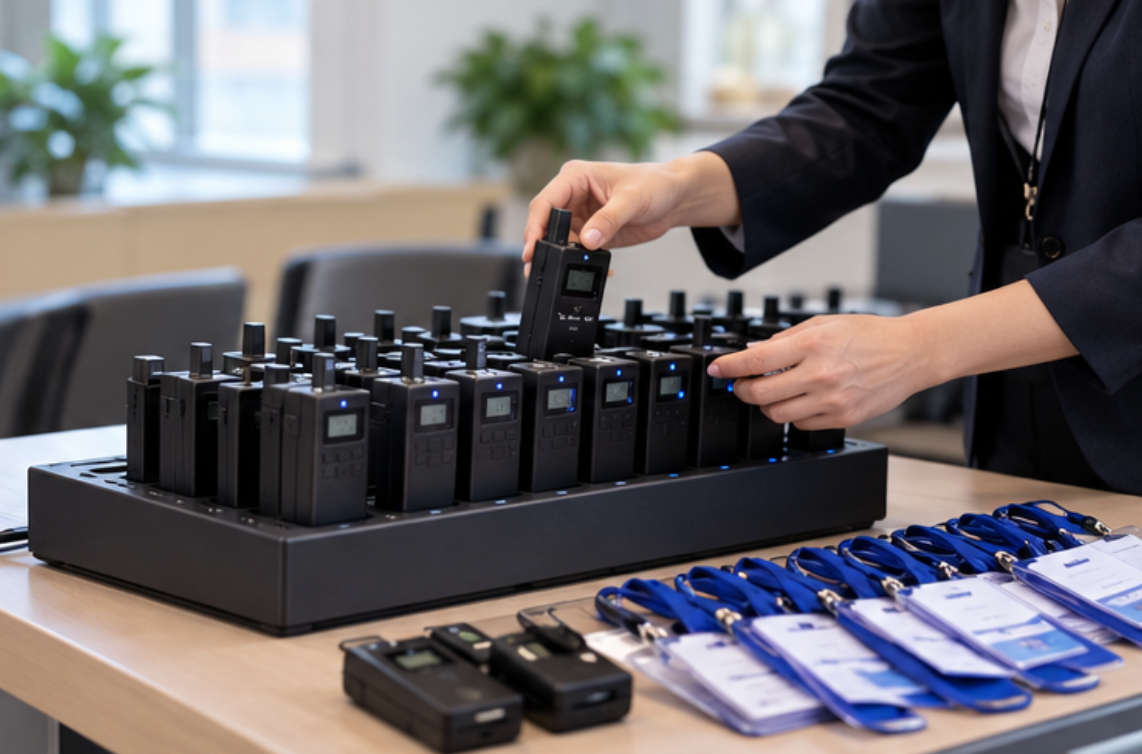
staff resetting a row of receivers on a Type-C charging dock beside visitor badges

Its operational design shows up in the details reception staff care about: one-key sync pairs a new receiver to the transmitter without a menu dive, one-key mute lets the docent silence the channel instantly when a phone call interrupts the walkthrough, and one-key power-off lets an attendant shut down fifty units in the time it takes to collect them. Fifty channels cover concurrent groups. The receivers come in black only, with customization available in bulk. Specifications are on the RC2500 Wireless Tour Guide System page.

The Hardware Table Behind the Math

The table below lines up the three systems on the fields that drive the staffing calculation — reach, channel capacity, endurance through a reception day, and the physical burden staff actually carry.

FieldRC9150RC2468RC2500
Frequency band2403–2483 MHz2403–2483 MHz2403–2483 MHz
Channels1005050
Transmission range1–200 m1–200 m1–200 m
Output power10 mW10 mW10 mW
Transmitter battery life15 h10 h15 h
Receiver battery life35 h and more8 h approx.35 h and more
Transmitter / receiver weight97.5 g / 97.5 g59 g / 18 g ear-hook104 g / 104 g
Charging portType-CUSBType-C
Standout reception trait100 channels; wide-hall coverage18 g receiver; all-day wearOne-key sync, mute, power-off

Read as a staffing tool, the table says something the spec columns alone do not: endurance and channel count are what let a small reception team absorb a crowded calendar without adding headcount to the payroll, and reach is what lets a single narrator hold a full hall instead of splitting the group.

Where 50 Channels Absorb a Crowded Visit Calendar

Channel count reads like a technical detail until the delegation schedule collides. A bureau that receives an inspection team at 9:30, a sister-city group at 11:00 and a media visit at 15:00 is running three overlapping receptions across shared corridors. On separate channels, each docent narrates at full clarity while the groups pass one another in the atrium without a syllable of bleed. The RC9150's one hundred channels give that kind of facility generous headroom; the RC2468 and RC2500 at fifty channels still cover three concurrent groups with capacity to spare, and each group's kit stays paired to its own transmitter throughout.

The same logic applies inside a single visit. When a delegation divides — officials to the command center, technical staff to the pilot line — two channels under one coordinator keep both halves moving on schedule, and the liaison stops running between clusters to relay questions. That is roughly an hour of recovered walking time per visit, which is precisely the line item this article started with.

⚖️ Keeping Receivers Alive Between Morning and Afternoon Groups

Charging discipline decides whether the endurance column in the table survives contact with a real schedule. The two Type-C systems — RC9150 and RC2500 — recharge from a multi-port hub in the reception office, and their 35-plus-hour receiver standby means a kit returned at noon does not need a top-up before the afternoon group signs it out. The RC2468's receiver, at roughly 8 hours of runtime, rewards a different habit: a scripted midday docking routine while the delegation is at lunch, timed against the itinerary rather than against a low-battery warning.

Facilities that adopt one charging cart per reception floor find the reset between groups takes under ten minutes — collect, dock, glance at indicators, restock sanitizing wipes. That ten-minute window replaces the twenty minutes staff used to spend re-pairing devices or hunting for the ones with dead cells, and it keeps the kit in circulation rather than in a drawer.

What the Budget Line Looks Like After the Kit Arrives

Twelve months in, the offices that see the clearest return describe the same shift: the hardware was a one-time purchase, but the hours it returned recur monthly. Docents stop re-delivering the same briefing three times. Liaisons walk the route once instead of three. The interpreter who used to trail the group repeating every sentence into a megaphone now speaks once, into a transmitter, and the delegation hears it directly. The full tour guide system range covers configurations beyond these three, but the payroll logic is identical across them.

For reception offices drafting next year's budget, the comparison above is the useful abstraction: pick the endurance profile that matches the visit calendar, the channel count that matches the collision rate, and the weight class that matches how long staff wear the kit. The reception scenario library maps those choices onto the other venues a bureau serves. What never returns to the budget is the split-group repetition — and that is the entire point.

Frequently Asked Questions

1. How many staff hours does a tour guide system actually return on one government visit?

A typical forty-minute walkthrough with an unamplified voice costs one docent-delivery plus one to two repeat deliveries for split subgroups, plus continuous shepherding. With a transmitter-and-receiver kit the repeat deliveries disappear and shepherding drops to head-count checks at doorways — reception teams we work with count the recovered time at roughly forty minutes to one hour per visit, per group.

2. Can three reception groups run at the same time without interference?

Yes — assign each group its own channel. The RC9150 carries 100 channels and the RC2468 and RC2500 carry 50 each, all on the 2.4 GHz band, so concurrent groups sharing one corridor or atrium do not bleed into each other. Channels are set on the transmitter and each receiver pairs to its group's unit.

3. Which of the three systems fits a facility that receives two delegations per day, every day?

The RC2500 or the RC9150. Both run 15-hour transmitters with 35-plus-hour receiver standby, so consecutive morning and afternoon groups never wait on a charger. The RC2468's receiver runs approximately 8 hours, which fits a one-delegation-per-day calendar but needs a scripted midday top-up under heavier rotation.

4. Does the 18-gram ear-hook receiver stay comfortable through a full-day itinerary?

Comfort is the RC2468's core argument — at 18 grams the ear-hook disappears into a workday, which is why liaison officers who wear a receiver from gate briefing to closing remarks keep it on. The trade-off is battery, not weight: plan the midday docking window described above, and the wearing experience never becomes the complaint.


2026年10月26日 09:50
ꄘ click: 41

Get the spec sheet, MOQ and a factory-direct quote

Tell us the venue, the group size and how many languages you need. An engineer at our Shenzhen factory replies within one business day with the matching model, a written quote, lead time and the CE / RoHS / ISO 9001 documents.

Talk to an engineer WhatsApp +86 189 2287 9583

Prefer email? tiger.wang@richitek.com  |  OEM / ODM, custom tooling and neutral packaging available  |  send the enquiry through our contact page

Shenzhen Rich Age Electronics Co., Ltd. (Richitek) - manufacturing wireless tour guide systems, church translation headsets and museum audio guide equipment since 2007.

RC9150, RC2468 and RC2500: The Person-Hours Behind an Official Visit

time: 2026年10月26日 click:41

A government delegation visit produces no ticket revenue, and its cost structure hides in a place most procurement sheets never itemize: staff time. When a municipal bureau receives an inspection group, three kinds of paid hours disappear into the itinerary — the docent who narrates the exhibition hall, the liaison officer who walks the delegation from briefing room to workshop floor, and whoever steps in when a visiting official asks a question the schedule never anticipated. Facilities teams budget for the hardware easily; the recurring payroll line is harder to see, and it repeats every single month.

The arithmetic that matters here is not what a tour guide system costs, but how many staff hours it returns. A government and conference reception setup changes the shape of that equation in a specific way: one speaker reaches every ear directly, so the walked-and-repeated tour stops being the only delivery method. This article walks through three systems side by side — the RC9150, the RC2468 and the RC2500 — and counts what each one does to the three staff roles a visit always hires.

Three Staff Roles a Government Delegation Always Hires

Before comparing devices, it helps to separate the three jobs that consume hours during an official visit. The first is narration: someone must explain the exhibition wall, the production line or the command center, and with an unamplified voice that person speaks at project-heavy volume for forty minutes at a stretch. The second is shepherding: a liaison keeps the group moving, counts heads at each stop, and physically positions visitors so they can hear. The third is repetition: because unaided speech carries maybe fifteen meters in a noisy hall, large delegations get split, and the same briefing is delivered two or three times to two or three clusters.

Each of the three systems below attacks a different part of that payroll. One extends reach so the split-and-repeat cycle collapses. One removes the weight burden that makes staff resist wearing equipment all day. One absorbs a schedule where delegations arrive in waves and the same kit must reset between groups in minutes. None of them eliminates the people — protocol still matters, and a machine cannot answer a minister's question — but all three shrink the hours those people spend on mechanical work.

RC9150: Two Hundred Meters of Reach, Fewer Bodies in the Corridor

The RC9150 transmitter pushes a 10 mW signal across a 1–200 meter range on the 2.4 GHz band, and that reach translates directly into a staffing decision. With coverage that wide, the liaison no longer needs to compress a delegation into a tight cluster around one speaking body; visitors can spread across a full assembly hall or a long production corridor and still hear the narration clearly. The split-and-repeat pattern — three subgroups, three deliveries of the same script — collapses into one delivery.

docent addressing a dispersed official delegation across a government reception hall

One hundred channels matter here too, because government compounds rarely host a single group at a time. A training class in the east wing, a delegation in the main hall and a media crew in the lobby can run on three separate channels without crosstalk. The transmitter runs 15 hours on its 3.7V 1800 mAh battery and the receiver holds 35 hours and more, so a kit prepped in the morning survives an entire reception day plus the debrief. Both units weigh 97.5 grams, charge over Type-C, and the transmitter comes in grey with black receivers — a neutral pairing that suits institutional settings. The full specification lives on the RC9150 2.4G Wireless Audio Guide System page.

RC2468: What the Lightest Receiver Changes for the Liaison

The RC2468 attacks a different problem: the liaison who wears a receiver for six hours and quietly resents it. Its ear-hook receiver weighs 18 grams — light enough that staff forget it is there — while the transmitter stays at 59 grams in a jacket pocket. Fifty channels on the same 2.4 GHz band handle the parallel-group case, and the 1–200 meter range keeps a wandering delegation connected as it moves from gate to workshop.

liaison officer wearing a lightweight ear-hook receiver while holding a folder in a lobby

The honest trade-off is endurance. The transmitter runs 10 hours, but the receiver manages approximately 8 hours on its 3.7V 300 mAh cell — enough for a morning itinerary and an afternoon walkthrough, with the caveat that a full-day, two-delegation schedule should include a midday top-up over its USB charging port. For offices that host one delegation per day, that budget fits comfortably. For a reception center cycling three groups daily, the RC9150 or RC2500 carries the day better. The lighter receiver ships in black with multi-color transmitter options in bulk orders, and its details are on the RC2468 Ultra-Light 2.4G Tour Guide System page.

RC2500: Long Standby Across a Day of Consecutive Groups

The RC2500 is the flagship option for a reception calendar that never empties. Its transmitter and receiver each run 15 hours of active use and more than 35 hours on standby, powered by 3.7V 1800 mAh cells — so a kit signed out at 8:00 for a provincial delegation, returned at noon, and signed out again at 14:00 for a sister-city group never sees a charger before evening. Both units weigh 104 grams and charge over Type-C.

staff resetting a row of receivers on a Type-C charging dock beside visitor badges

Its operational design shows up in the details reception staff care about: one-key sync pairs a new receiver to the transmitter without a menu dive, one-key mute lets the docent silence the channel instantly when a phone call interrupts the walkthrough, and one-key power-off lets an attendant shut down fifty units in the time it takes to collect them. Fifty channels cover concurrent groups. The receivers come in black only, with customization available in bulk. Specifications are on the RC2500 Wireless Tour Guide System page.

The Hardware Table Behind the Math

The table below lines up the three systems on the fields that drive the staffing calculation — reach, channel capacity, endurance through a reception day, and the physical burden staff actually carry.

FieldRC9150RC2468RC2500
Frequency band2403–2483 MHz2403–2483 MHz2403–2483 MHz
Channels1005050
Transmission range1–200 m1–200 m1–200 m
Output power10 mW10 mW10 mW
Transmitter battery life15 h10 h15 h
Receiver battery life35 h and more8 h approx.35 h and more
Transmitter / receiver weight97.5 g / 97.5 g59 g / 18 g ear-hook104 g / 104 g
Charging portType-CUSBType-C
Standout reception trait100 channels; wide-hall coverage18 g receiver; all-day wearOne-key sync, mute, power-off

Read as a staffing tool, the table says something the spec columns alone do not: endurance and channel count are what let a small reception team absorb a crowded calendar without adding headcount to the payroll, and reach is what lets a single narrator hold a full hall instead of splitting the group.

Where 50 Channels Absorb a Crowded Visit Calendar

Channel count reads like a technical detail until the delegation schedule collides. A bureau that receives an inspection team at 9:30, a sister-city group at 11:00 and a media visit at 15:00 is running three overlapping receptions across shared corridors. On separate channels, each docent narrates at full clarity while the groups pass one another in the atrium without a syllable of bleed. The RC9150's one hundred channels give that kind of facility generous headroom; the RC2468 and RC2500 at fifty channels still cover three concurrent groups with capacity to spare, and each group's kit stays paired to its own transmitter throughout.

The same logic applies inside a single visit. When a delegation divides — officials to the command center, technical staff to the pilot line — two channels under one coordinator keep both halves moving on schedule, and the liaison stops running between clusters to relay questions. That is roughly an hour of recovered walking time per visit, which is precisely the line item this article started with.

⚖️ Keeping Receivers Alive Between Morning and Afternoon Groups

Charging discipline decides whether the endurance column in the table survives contact with a real schedule. The two Type-C systems — RC9150 and RC2500 — recharge from a multi-port hub in the reception office, and their 35-plus-hour receiver standby means a kit returned at noon does not need a top-up before the afternoon group signs it out. The RC2468's receiver, at roughly 8 hours of runtime, rewards a different habit: a scripted midday docking routine while the delegation is at lunch, timed against the itinerary rather than against a low-battery warning.

Facilities that adopt one charging cart per reception floor find the reset between groups takes under ten minutes — collect, dock, glance at indicators, restock sanitizing wipes. That ten-minute window replaces the twenty minutes staff used to spend re-pairing devices or hunting for the ones with dead cells, and it keeps the kit in circulation rather than in a drawer.

What the Budget Line Looks Like After the Kit Arrives

Twelve months in, the offices that see the clearest return describe the same shift: the hardware was a one-time purchase, but the hours it returned recur monthly. Docents stop re-delivering the same briefing three times. Liaisons walk the route once instead of three. The interpreter who used to trail the group repeating every sentence into a megaphone now speaks once, into a transmitter, and the delegation hears it directly. The full tour guide system range covers configurations beyond these three, but the payroll logic is identical across them.

For reception offices drafting next year's budget, the comparison above is the useful abstraction: pick the endurance profile that matches the visit calendar, the channel count that matches the collision rate, and the weight class that matches how long staff wear the kit. The reception scenario library maps those choices onto the other venues a bureau serves. What never returns to the budget is the split-group repetition — and that is the entire point.

Frequently Asked Questions

1. How many staff hours does a tour guide system actually return on one government visit?

A typical forty-minute walkthrough with an unamplified voice costs one docent-delivery plus one to two repeat deliveries for split subgroups, plus continuous shepherding. With a transmitter-and-receiver kit the repeat deliveries disappear and shepherding drops to head-count checks at doorways — reception teams we work with count the recovered time at roughly forty minutes to one hour per visit, per group.

2. Can three reception groups run at the same time without interference?

Yes — assign each group its own channel. The RC9150 carries 100 channels and the RC2468 and RC2500 carry 50 each, all on the 2.4 GHz band, so concurrent groups sharing one corridor or atrium do not bleed into each other. Channels are set on the transmitter and each receiver pairs to its group's unit.

3. Which of the three systems fits a facility that receives two delegations per day, every day?

The RC2500 or the RC9150. Both run 15-hour transmitters with 35-plus-hour receiver standby, so consecutive morning and afternoon groups never wait on a charger. The RC2468's receiver runs approximately 8 hours, which fits a one-delegation-per-day calendar but needs a scripted midday top-up under heavier rotation.

4. Does the 18-gram ear-hook receiver stay comfortable through a full-day itinerary?

Comfort is the RC2468's core argument — at 18 grams the ear-hook disappears into a workday, which is why liaison officers who wear a receiver from gate briefing to closing remarks keep it on. The trade-off is battery, not weight: plan the midday docking window described above, and the wearing experience never becomes the complaint.


Get the spec sheet, MOQ and a factory-direct quote

Tell us the venue, the group size and how many languages you need. An engineer at our Shenzhen factory replies within one business day with the matching model, a written quote, lead time and the CE / RoHS / ISO 9001 documents.

Talk to an engineer WhatsApp +86 189 2287 9583

Prefer email? tiger.wang@richitek.com  |  OEM / ODM, custom tooling and neutral packaging available  |  send the enquiry through our contact page

Shenzhen Rich Age Electronics Co., Ltd. (Richitek) - manufacturing wireless tour guide systems, church translation headsets and museum audio guide equipment since 2007.

×

Contact us

email:
name:
subject:
content: