A leading China factory specializing in Wireless Tour Guide Systems, Church Audio Guides, and Translation Headphones with premium OEM/ODM solutions.

Tel:+86 18922879583

Email:tiger.wang@richitek.com

An Istanbul City Walk Case Study with the RC8860, RC2500 and RC2501

Istanbul is widely regarded as one of the most challenging European cities for wired tour commentaries, yet it serves as an ideal testing ground for mixed wireless audio systems. A licensed walking tour operator managing three distinct routes across the city provided the field photographs featured in this case study: a daytime landmark loop through historic European-side streets, a Bosphorus promenade route with handovers at the ferry terminal, and an evening food-street tour operating after retail closing hours. Spanning tram noise, water reflections, dense night crowds, and narrow pavements, these routes encounter greater acoustic variety in a single day than most operators face in a month. While the photographs document actual routes and wearing habits, official specification claims are drawn directly from product pages, keeping visual evidence and hardware data strictly separated.

The Routes the Operator Actually Runs

The landmark route consists of a two-hour loop weaving past nineteenth-century European facades where groups reassemble for architectural narratives. The promenade route tracks the waterfront from the ferry stop toward the old harbor—flat, open, and exposed to dense ambient radio signals. Inverting the daytime rhythm, the evening food-street route navigates illuminated, crowded alleyways at a pace dictated by culinary stalls rather than monuments. Operators planning multi-route urban tourism businesses can review walking-tour system layouts on the city tours solutions page before finalizing operational schedules.

Landmark Stops Where the Group Reassembles

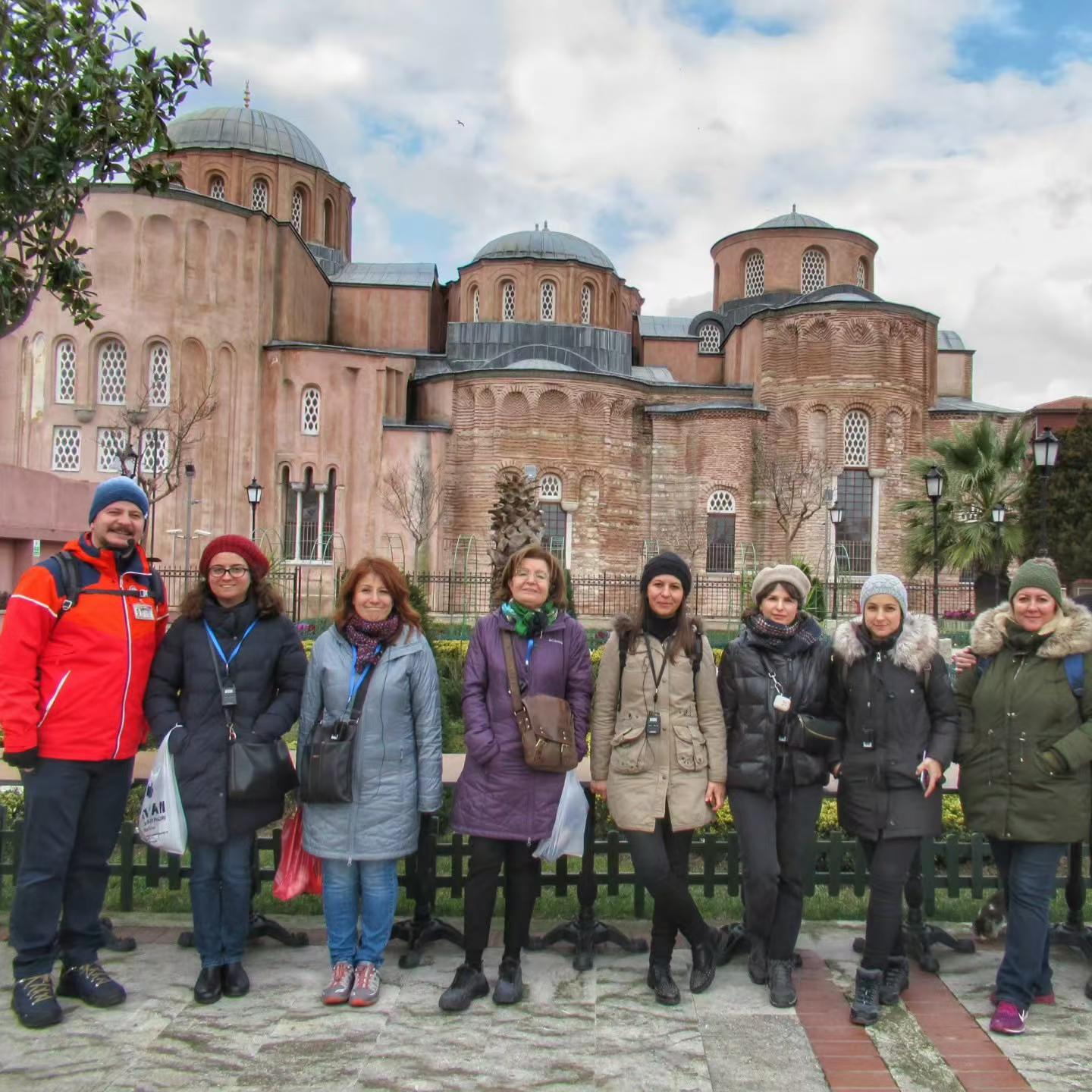
Field photography from the landmark route highlights the core operational habit holding the itinerary together: participants gather before historic facades wearing lanyard-mounted receivers while the guide maintains close proximity to prevent stragglers from drifting into traffic. Reassembly represents the most vulnerable moment on urban walking tours following street crossings, requiring rapid headcount verification before commentary resumes. The operator enforces a protocol where headcounts are conducted directly over the audio system—guide first, followed by listeners in sequence—transforming a scattered group of thirty into an accounted roster within seconds. Hardware comfort takes precedence over maximum range specifications since receivers remain deployed continuously across multiple stops.
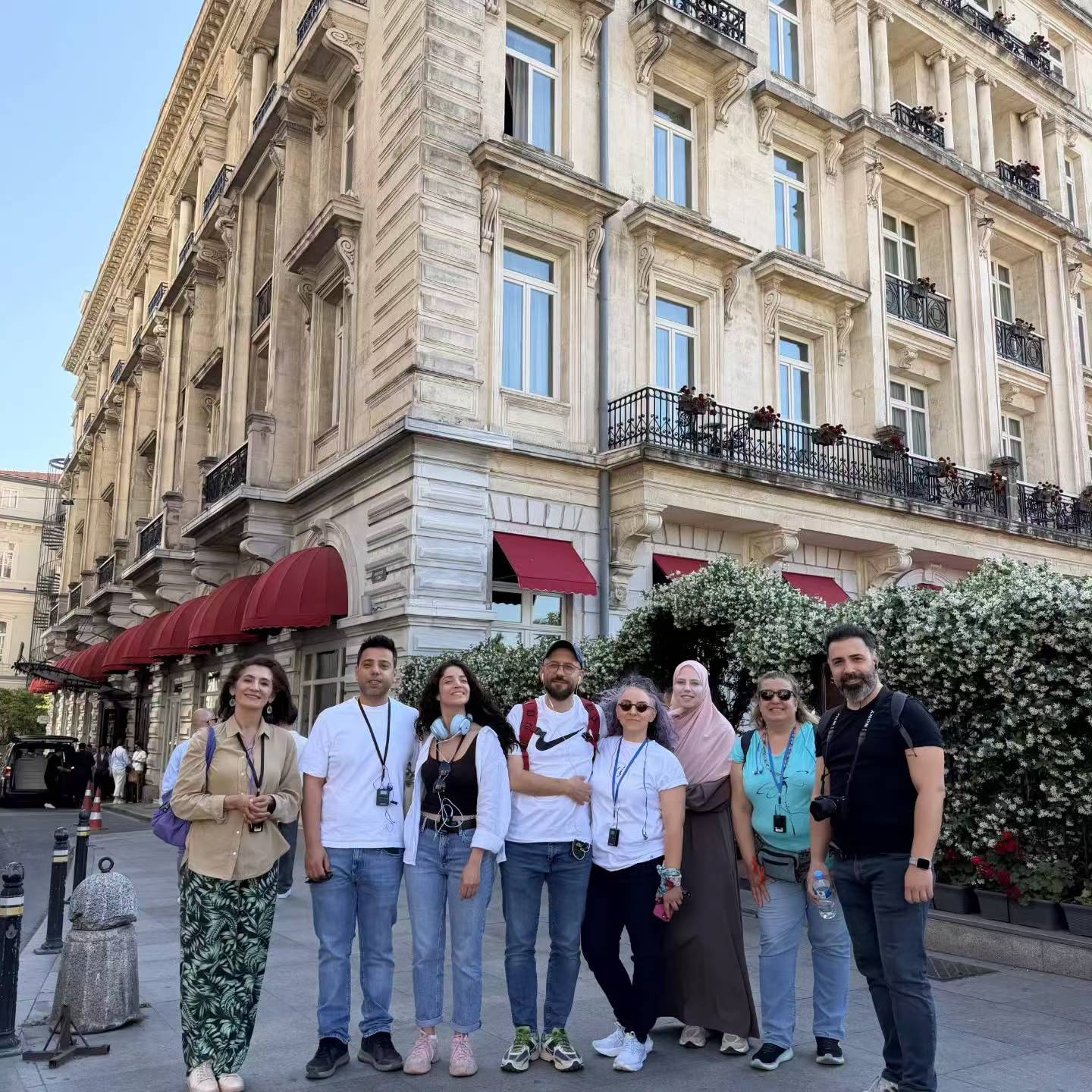
Istanbul city walk group reassembling in front of a landmark facade on lanyard receivers

The Promenade Handover That Keeps Departures Apart

The promenade route introduces unique logistical hurdles: its departure point coincides with the arrival of the preceding tour, requiring ferry terminal handovers where incoming receivers immediately become outgoing equipment. Guides personally manage the complete bundle of lanyard units alongside body-slung transmitters rather than leaving storage cases unattended on railings. While manual hand-to-hand distribution takes slightly longer than crate swaps, direct device verification eliminates mid-season inventory losses. Given the RF-heavy waterfront environment featuring open water reflections and visitor mobile traffic, published transmission ranges of 1–200m serve as a conservative baseline rather than a target threshold.
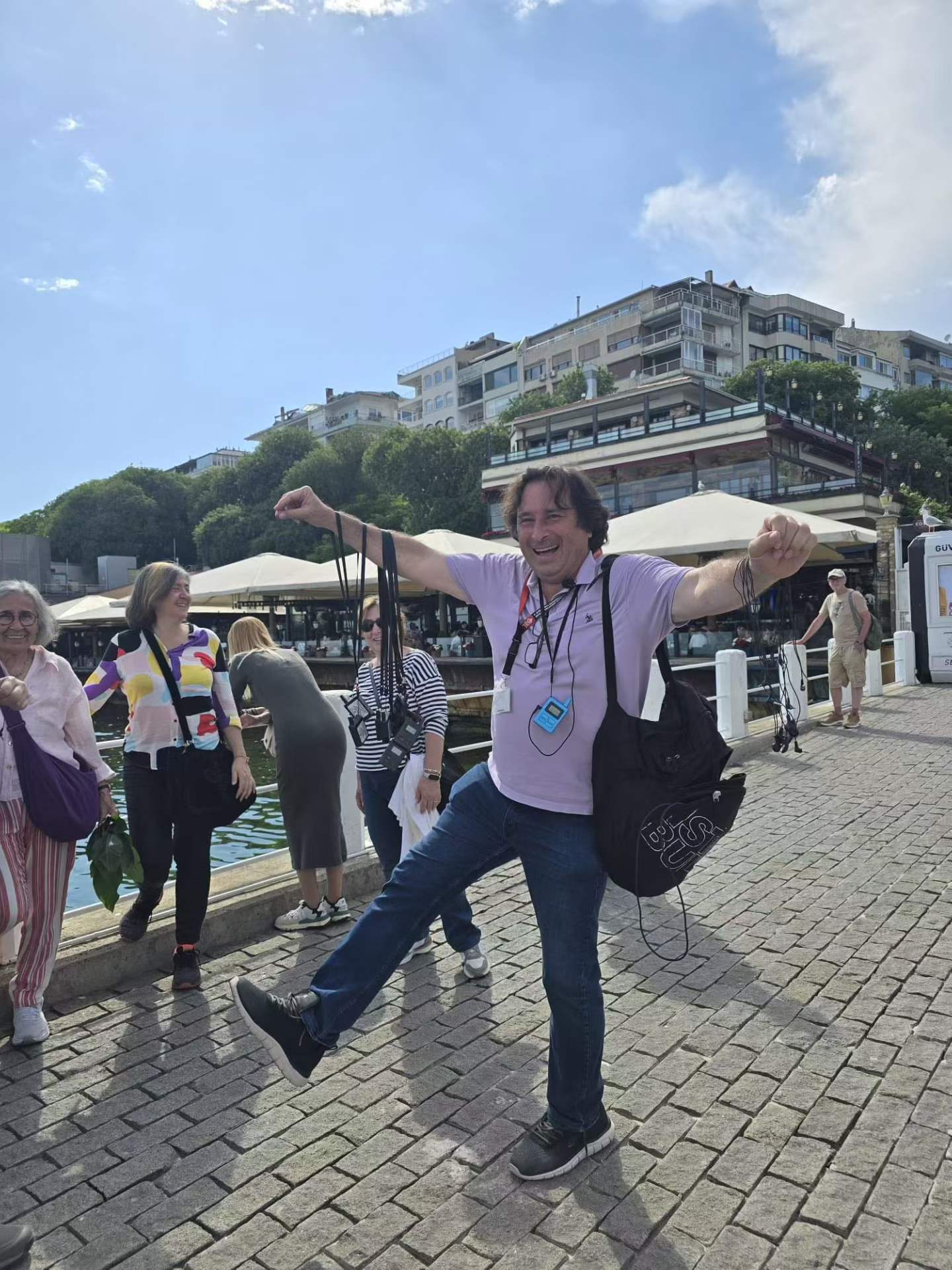
Guide carrying a bundle of lanyard receivers along the Bosphorus promenade between departures

The Evening Line and the Earphone Habit

Evening food-street tours operate at a pace dictated by market queues. Regular participants quickly adopt optimal cable management habits: routing earphone cords down the front of jackets while chest-mounted receivers hang freely on lanyards, keeping hands unencumbered for refreshments and personal belongings in dense crowds. Guides incorporate specific evening safety briefings—instructing participants to keep cable paths oriented toward walls on narrow pavements to prevent snagging on passersby. Operating in the loudest acoustic environment of the schedule, guides rely on direct, close-proximity voice delivery directly into earpieces rather than raising voices over ambient street noise.
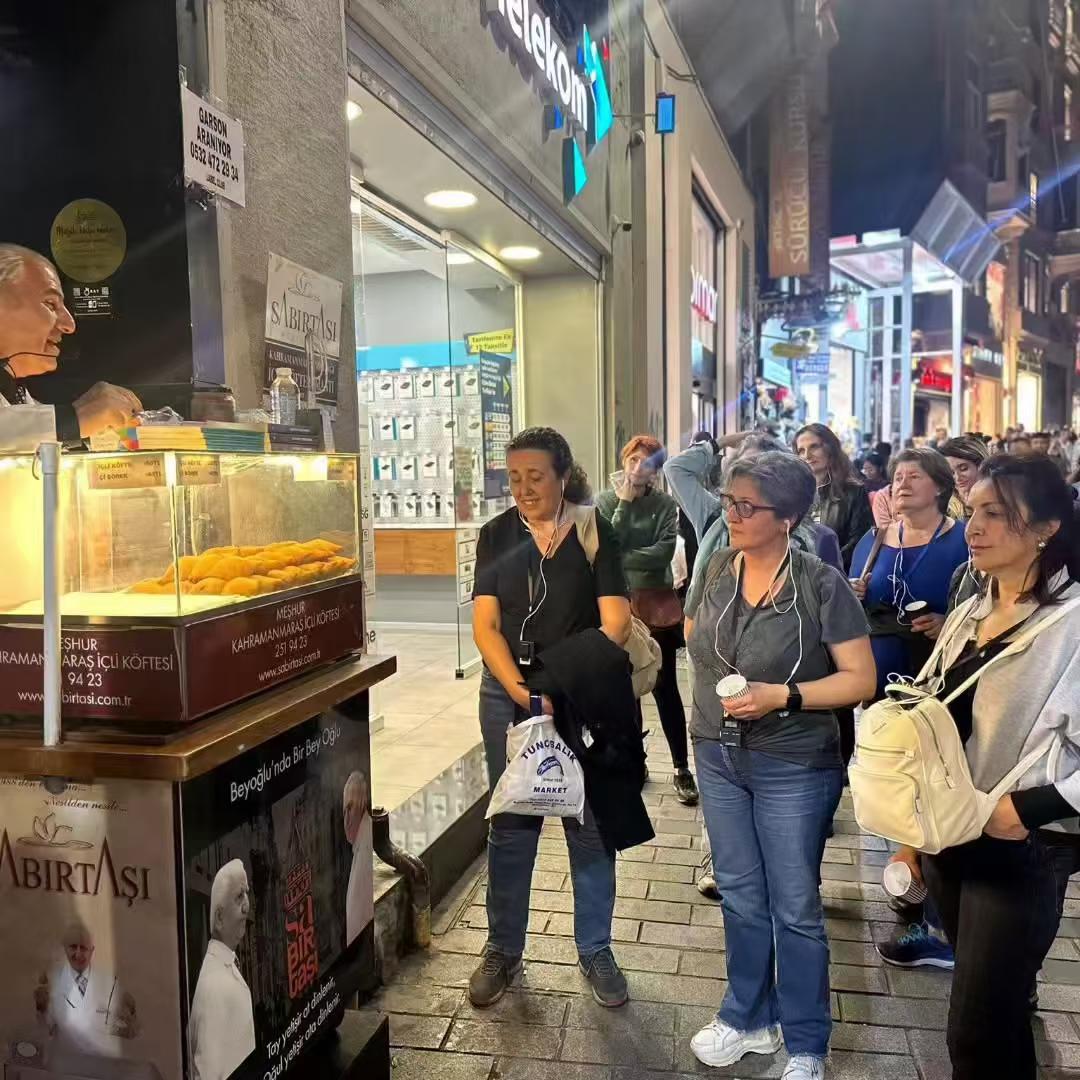
Evening food-street group listening on earphones and chest-worn receivers in Istanbul

⛪ One-Touch Mute Past Prayer Hours: RC2500

Calls to prayer are seamlessly integrated into tour schedules, serving as primary use cases for the RC2500 Wireless Tour Guide System. Featuring dedicated one-touch mute and power-off controls adjacent to the transmission button, guides routinely silence channels before approaching mosque courtyards or shop doorways to prevent private remarks from broadcasting to thirty participants. Operating across 50 channels within the 2403–2483 MHz band, the system comfortably absorbs three concurrent departures across all routes alongside reserve units for cruise ship surges. Weighing 104g for both transmitter and receiver, it is the heaviest unit in the fleet, retained specifically for its tactile mute functionality.

The Busiest Hour Belongs to UHF: RC8860

During peak late-afternoon congestion—characterized by school dismissals, tour buses, and heavy mobile device usage—departures transition to the RC8860 Tour Guide Transmitter. Utilizing the 860–870 MHz UHF band free from smartphone interference and crowded 2.4G traffic, logs confirm zero channel crowding even when competing groups operate nearby. While offering a more compact capacity of 20 channels compared to 2.4G models, the RC8860 handles peak operational hours effectively. Delivering 10mW output power over a 1–200m working range, its lightweight design (59g transmitter, 50g receiver) makes it the lightest receiver in the fleet.

Forty-Seven Grams at the Front of the Line

Worn by lead guides across all three routes, the RC2501 Wireless Tour Guide System provides an ergonomic advantage with its 47g transmitter and 47g receiver weight profile. Across extensive shifts running from morning landmarks to evening food tours, reducing collar weight from 104g to 47g significantly minimizes fatigue for speakers. Operating on the 2.4G band with 50 channels, 13mW output power, 15-hour transmitter runtime, and over 35 hours of receiver standby, it shares Type-C charging compatibility with the RC2500. Optional headset and lavalier microphones support hands-free operation during crowded evening walks.

Comparison DimensionRC8860RC2500RC2501
Core frequency band860-870 MHz (UHF)2403-2483 MHz (2.4G)2403-2483 MHz (2.4G)
Number of channels205050
Transmitter weight59g104g47g
Receiver weight50g104g47g
Receiver battery life20h35+h35+h
Charging portDC PortType-CType-C

For broader equipment comparisons, operators can explore the complete Richitek tour guide system line and review overarching options via solutions overview resources.

Frequently Asked Questions

1. Can UHF and 2.4G units work the same city without interfering with each other?

Yes. The RC8860 operates on 860–870 MHz—a band untouched by mobile hotspots and standard 2.4G tour radios—while the RC2500 and RC2501 share the 2403–2483 MHz band with 50 distinct channels. Channel congestion only arises when multiple operators stack numerous 2.4G groups simultaneously, which is why peak-traffic departures are assigned to UHF.

2. Is twenty channels enough when fifty is available on the other units?

For this operator, yes. Running three concurrent routes plus registered spares utilizes fewer than ten of the RC8860's twenty channels. Fifty-channel systems become essential when operators run multiple simultaneous groups on 2.4G during heavy cruise ship periods, matching the deployment profile of the RC2500 and RC2501.

3. Why hand-carry the receivers between promenade departures?

Because ferry terminals are highly congested, and unattended storage cases risk loss. Direct hand-to-hand transfer ensures accountability rests with guides rather than boxes, contributing directly to the operator's record of zero lost units.

4. The photographs show the units without readable model badges. How do the models in this article relate to the images?

Visual documentation and specification data are kept deliberately separate. Photographs capture actual routes, handover habits, and wearing styles, while specifications are drawn directly from official product documentation. Unidentifiable badges are explicitly noted rather than assumed.
2026-11-02 16:17
ꄘ click: 42

Get the spec sheet, MOQ and a factory-direct quote

Tell us the venue, the group size and how many languages you need. An engineer at our Shenzhen factory replies within one business day with the matching model, a written quote, lead time and the CE / RoHS / ISO 9001 documents.

Talk to an engineer WhatsApp +86 189 2287 9583

Prefer email? tiger.wang@richitek.com  |  OEM / ODM, custom tooling and neutral packaging available  |  send the enquiry through our contact page

Shenzhen Rich Age Electronics Co., Ltd. (Richitek) - manufacturing wireless tour guide systems, church translation headsets and museum audio guide equipment since 2007.

no data

An Istanbul City Walk Case Study with the RC8860, RC2500 and RC2501

time: 2026年11月02日 click:42
Istanbul is widely regarded as one of the most challenging European cities for wired tour commentaries, yet it serves as an ideal testing ground for mixed wireless audio systems. A licensed walking tour operator managing three distinct routes across the city provided the field photographs featured in this case study: a daytime landmark loop through historic European-side streets, a Bosphorus promenade route with handovers at the ferry terminal, and an evening food-street tour operating after retail closing hours. Spanning tram noise, water reflections, dense night crowds, and narrow pavements, these routes encounter greater acoustic variety in a single day than most operators face in a month. While the photographs document actual routes and wearing habits, official specification claims are drawn directly from product pages, keeping visual evidence and hardware data strictly separated.

The Routes the Operator Actually Runs

The landmark route consists of a two-hour loop weaving past nineteenth-century European facades where groups reassemble for architectural narratives. The promenade route tracks the waterfront from the ferry stop toward the old harbor—flat, open, and exposed to dense ambient radio signals. Inverting the daytime rhythm, the evening food-street route navigates illuminated, crowded alleyways at a pace dictated by culinary stalls rather than monuments. Operators planning multi-route urban tourism businesses can review walking-tour system layouts on the city tours solutions page before finalizing operational schedules.

Landmark Stops Where the Group Reassembles

Field photography from the landmark route highlights the core operational habit holding the itinerary together: participants gather before historic facades wearing lanyard-mounted receivers while the guide maintains close proximity to prevent stragglers from drifting into traffic. Reassembly represents the most vulnerable moment on urban walking tours following street crossings, requiring rapid headcount verification before commentary resumes. The operator enforces a protocol where headcounts are conducted directly over the audio system—guide first, followed by listeners in sequence—transforming a scattered group of thirty into an accounted roster within seconds. Hardware comfort takes precedence over maximum range specifications since receivers remain deployed continuously across multiple stops.

Istanbul city walk group reassembling in front of a landmark facade on lanyard receivers

The Promenade Handover That Keeps Departures Apart

The promenade route introduces unique logistical hurdles: its departure point coincides with the arrival of the preceding tour, requiring ferry terminal handovers where incoming receivers immediately become outgoing equipment. Guides personally manage the complete bundle of lanyard units alongside body-slung transmitters rather than leaving storage cases unattended on railings. While manual hand-to-hand distribution takes slightly longer than crate swaps, direct device verification eliminates mid-season inventory losses. Given the RF-heavy waterfront environment featuring open water reflections and visitor mobile traffic, published transmission ranges of 1–200m serve as a conservative baseline rather than a target threshold.

Guide carrying a bundle of lanyard receivers along the Bosphorus promenade between departures

The Evening Line and the Earphone Habit

Evening food-street tours operate at a pace dictated by market queues. Regular participants quickly adopt optimal cable management habits: routing earphone cords down the front of jackets while chest-mounted receivers hang freely on lanyards, keeping hands unencumbered for refreshments and personal belongings in dense crowds. Guides incorporate specific evening safety briefings—instructing participants to keep cable paths oriented toward walls on narrow pavements to prevent snagging on passersby. Operating in the loudest acoustic environment of the schedule, guides rely on direct, close-proximity voice delivery directly into earpieces rather than raising voices over ambient street noise.

Evening food-street group listening on earphones and chest-worn receivers in Istanbul

⛪ One-Touch Mute Past Prayer Hours: RC2500

Calls to prayer are seamlessly integrated into tour schedules, serving as primary use cases for the RC2500 Wireless Tour Guide System. Featuring dedicated one-touch mute and power-off controls adjacent to the transmission button, guides routinely silence channels before approaching mosque courtyards or shop doorways to prevent private remarks from broadcasting to thirty participants. Operating across 50 channels within the 2403–2483 MHz band, the system comfortably absorbs three concurrent departures across all routes alongside reserve units for cruise ship surges. Weighing 104g for both transmitter and receiver, it is the heaviest unit in the fleet, retained specifically for its tactile mute functionality.

The Busiest Hour Belongs to UHF: RC8860

During peak late-afternoon congestion—characterized by school dismissals, tour buses, and heavy mobile device usage—departures transition to the RC8860 Tour Guide Transmitter. Utilizing the 860–870 MHz UHF band free from smartphone interference and crowded 2.4G traffic, logs confirm zero channel crowding even when competing groups operate nearby. While offering a more compact capacity of 20 channels compared to 2.4G models, the RC8860 handles peak operational hours effectively. Delivering 10mW output power over a 1–200m working range, its lightweight design (59g transmitter, 50g receiver) makes it the lightest receiver in the fleet.

Forty-Seven Grams at the Front of the Line

Worn by lead guides across all three routes, the RC2501 Wireless Tour Guide System provides an ergonomic advantage with its 47g transmitter and 47g receiver weight profile. Across extensive shifts running from morning landmarks to evening food tours, reducing collar weight from 104g to 47g significantly minimizes fatigue for speakers. Operating on the 2.4G band with 50 channels, 13mW output power, 15-hour transmitter runtime, and over 35 hours of receiver standby, it shares Type-C charging compatibility with the RC2500. Optional headset and lavalier microphones support hands-free operation during crowded evening walks.

Comparison DimensionRC8860RC2500RC2501
Core frequency band860-870 MHz (UHF)2403-2483 MHz (2.4G)2403-2483 MHz (2.4G)
Number of channels205050
Transmitter weight59g104g47g
Receiver weight50g104g47g
Receiver battery life20h35+h35+h
Charging portDC PortType-CType-C

For broader equipment comparisons, operators can explore the complete Richitek tour guide system line and review overarching options via solutions overview resources.

Frequently Asked Questions

1. Can UHF and 2.4G units work the same city without interfering with each other?

Yes. The RC8860 operates on 860–870 MHz—a band untouched by mobile hotspots and standard 2.4G tour radios—while the RC2500 and RC2501 share the 2403–2483 MHz band with 50 distinct channels. Channel congestion only arises when multiple operators stack numerous 2.4G groups simultaneously, which is why peak-traffic departures are assigned to UHF.

2. Is twenty channels enough when fifty is available on the other units?

For this operator, yes. Running three concurrent routes plus registered spares utilizes fewer than ten of the RC8860's twenty channels. Fifty-channel systems become essential when operators run multiple simultaneous groups on 2.4G during heavy cruise ship periods, matching the deployment profile of the RC2500 and RC2501.

3. Why hand-carry the receivers between promenade departures?

Because ferry terminals are highly congested, and unattended storage cases risk loss. Direct hand-to-hand transfer ensures accountability rests with guides rather than boxes, contributing directly to the operator's record of zero lost units.

4. The photographs show the units without readable model badges. How do the models in this article relate to the images?

Visual documentation and specification data are kept deliberately separate. Photographs capture actual routes, handover habits, and wearing styles, while specifications are drawn directly from official product documentation. Unidentifiable badges are explicitly noted rather than assumed.
Get the spec sheet, MOQ and a factory-direct quote

Tell us the venue, the group size and how many languages you need. An engineer at our Shenzhen factory replies within one business day with the matching model, a written quote, lead time and the CE / RoHS / ISO 9001 documents.

Talk to an engineer WhatsApp +86 189 2287 9583

Prefer email? tiger.wang@richitek.com  |  OEM / ODM, custom tooling and neutral packaging available  |  send the enquiry through our contact page

Shenzhen Rich Age Electronics Co., Ltd. (Richitek) - manufacturing wireless tour guide systems, church translation headsets and museum audio guide equipment since 2007.

no data
×

Contact us

email:
name:
subject:
content: