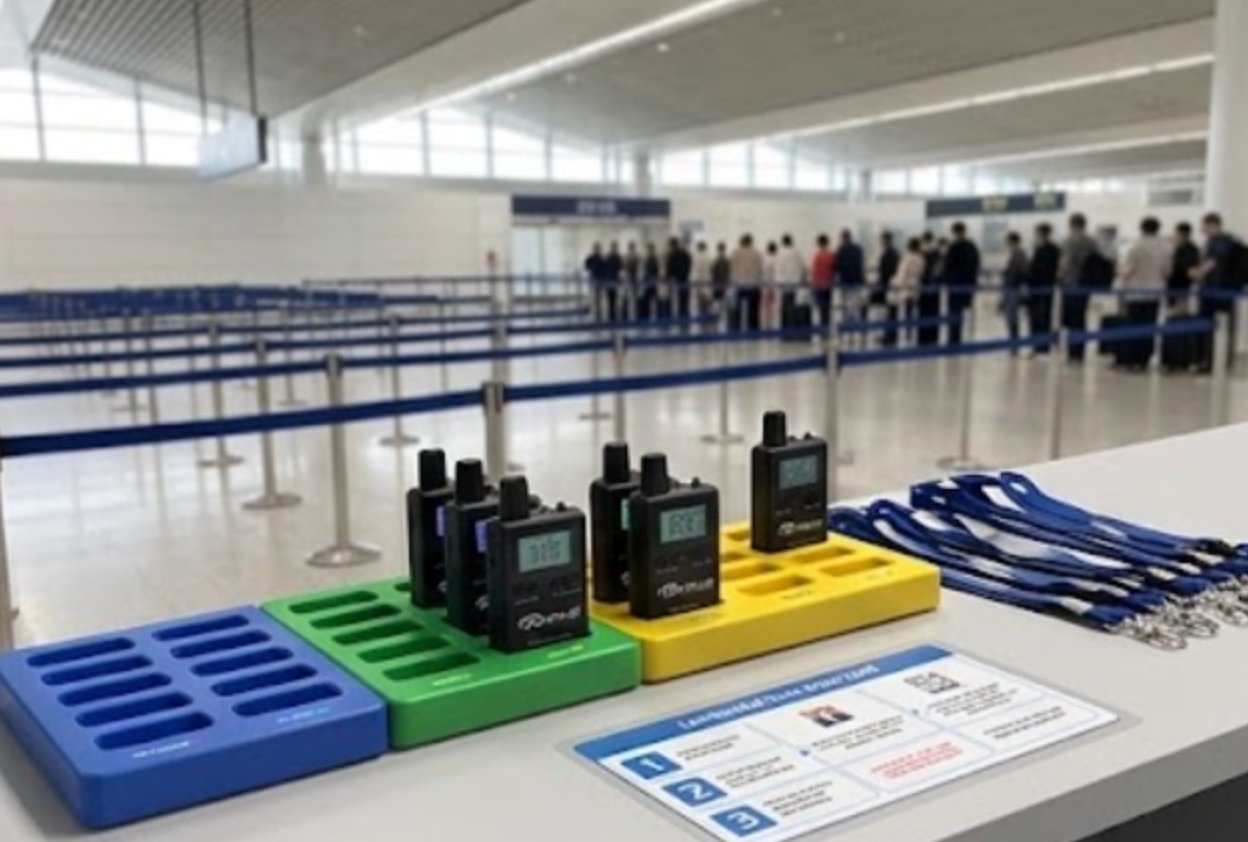

Every autumn, an international student orientation program turns a storage room into a lending library. Several hundred new arrivals collect a receiver on the same three days, carry it through campus tours, dorm move-ins and first lectures, then hand it back at semester's end so the next cohort can do the same. The equipment is rarely broken by a single dramatic failure. It drifts: a charging cable goes home with the wrong student, a label peels off a shell, a unit surfaces in a laundry room in November. Orientation-season audio equipment survives on custodianship, and custodianship is a schedule, not a hope.
This article follows one fleet through a full lending cycle at a fictional but typical university: an intake built on the RC2406 wireless tour guide system, a graduate seminar set built on the RC2501, and a student-activities club that lends a Silent Disco Wireless Headphone System for campus nights. Three products, three custodians, one handover chain that either holds or quietly leaks units all term.
What the Orientation Desk Logs Before Move-In Day
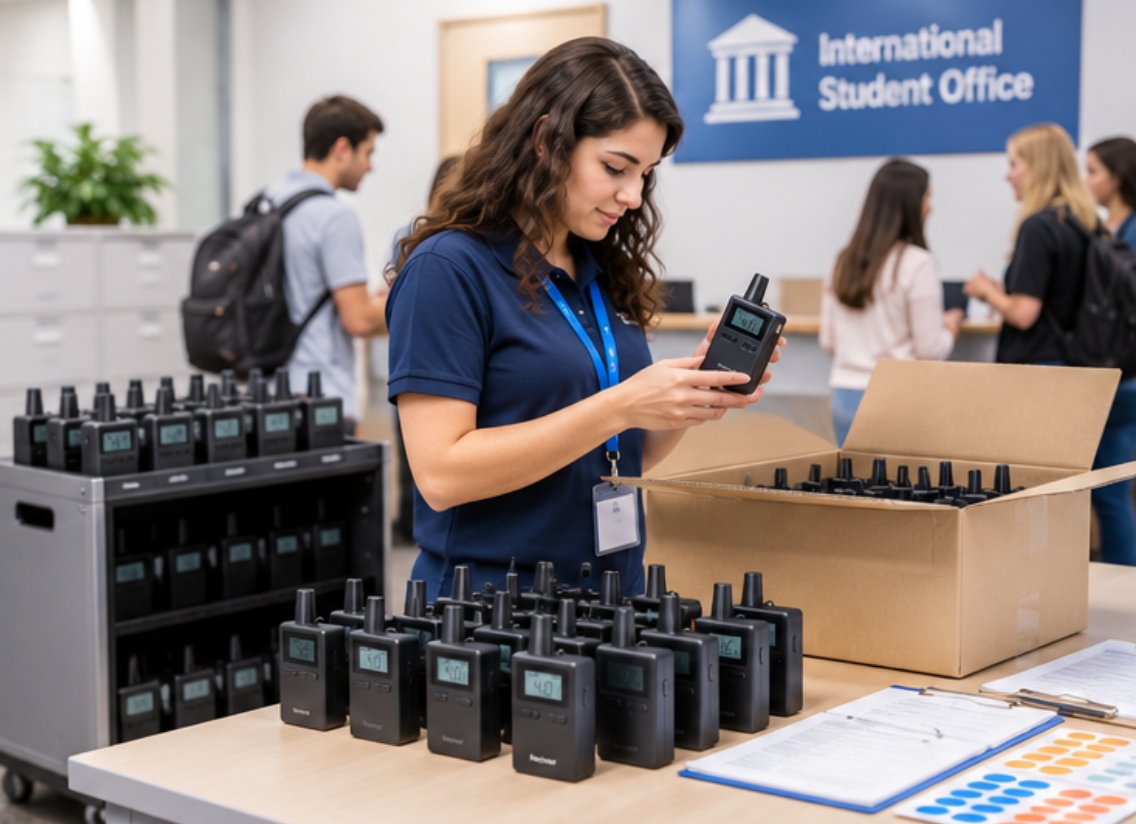
The first custodian is the international office itself, and its work happens before any student arrives. Staff unpack cartons of the RC2406 and register every unit against a laminated sheet: shell color, channel bank, charger type. The RC2406 ships in multiple shell colors on large orders, and the desk exploits that — blue shells for engineering faculty walks, orange shells for the dormitory circuit, so a unit found on a table announces which group it escaped from without anyone reading a serial number.
The technical case for the RC2406 at intake scale is channel density. Eighty channels in the 2403-2483 MHz band mean six orientation groups can run simultaneous commentary in one quadrangle without cross-talk, and the PLL-synthesized lock holds when a second group's transmitter passes within range. Each transmitter runs 10 hours per charge and each receiver 20 hours, so a full-day intake program fits inside one overnight charge on a standard cart. The desk's only grumble is the DC Port: charging cables for this fleet cannot be borrowed from the phone-charging basket at the help desk, so the cart keeps its own labeled spares.
Nine Weeks in a Dorm: the Type-C Habit That Keeps RC2501 Going
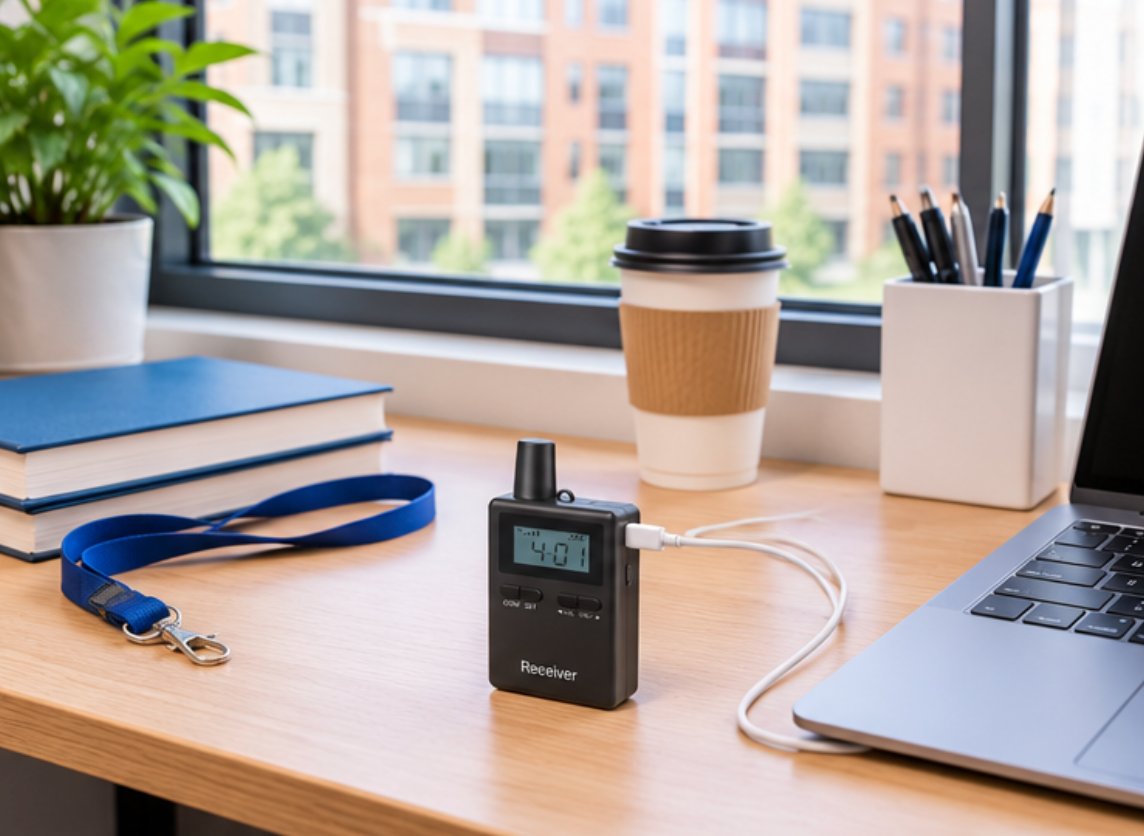
The second custodian is the student, and the graduate seminar receivers have the easiest life on campus for one unglamorous reason: the RC2501 charges over Type-C, the same cable that already lives on every desk in a residence hall. A unit that charges with the cord a student owns is a unit that comes back charged. The receiver's 35-plus-hour runtime turns charging from a nightly chore into a weekly errand, and the 15-hour transmitter covers a full teaching day with margin.
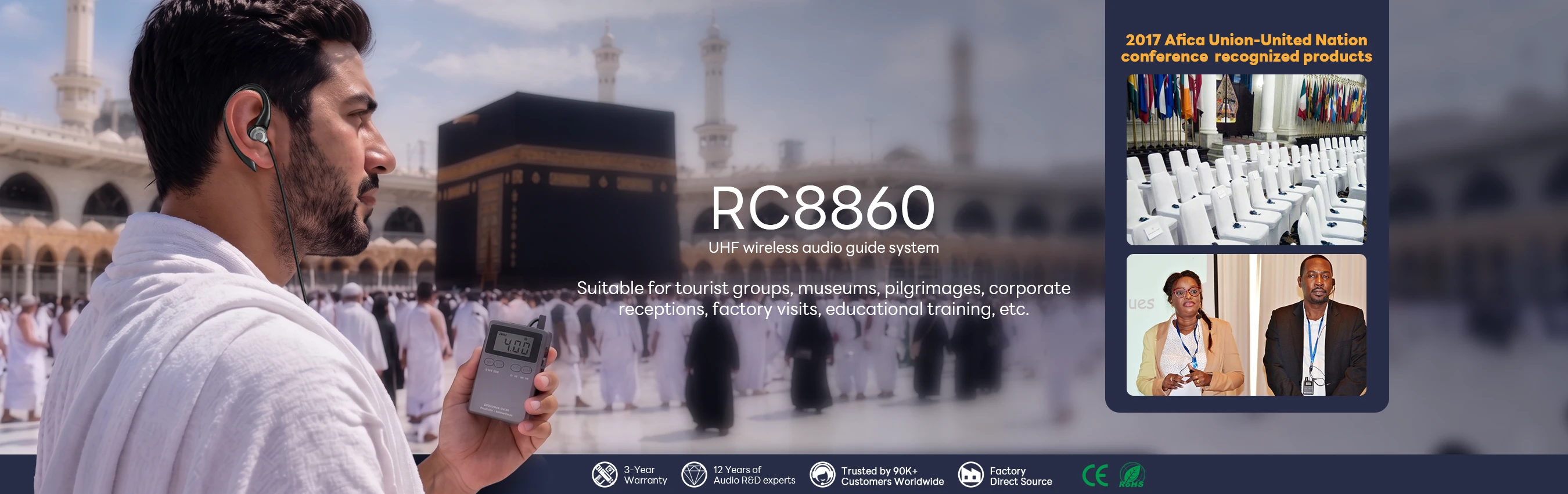
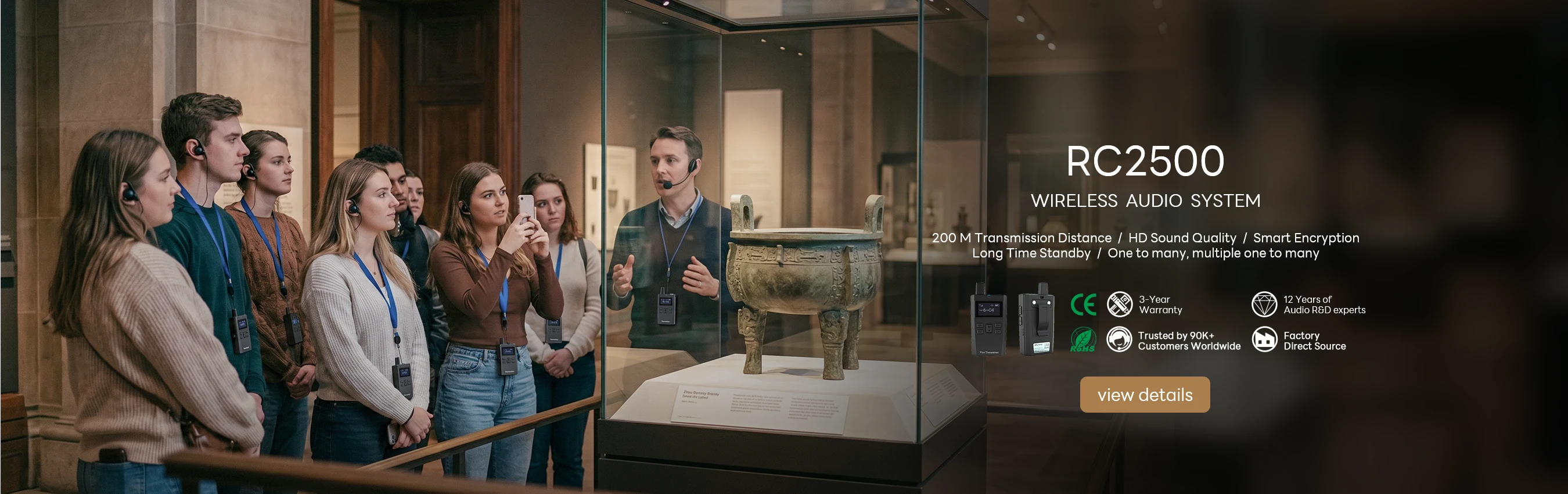
Weight matters more in week nine than in week one. At 47 grams, transmitter and receiver alike, the RC2501 is the lightest unit in the RC line, and seminar leaders who clip a receiver to a lanyard for three-hour field sessions notice the difference by the walk home. The optional headset and lavalier microphone inputs, supported by a receiver sensitivity of about -38dBm, get used in practice more than the spec sheet suggests: teaching assistants record walking commentary once, then replay the same track to each seminar section, and the wide 20Hz-200kHz frequency response keeps recorded voices intelligible over street noise on the route between buildings.
⚖️ Folded Flat Into a Storage Case Between Silent Disco Nights
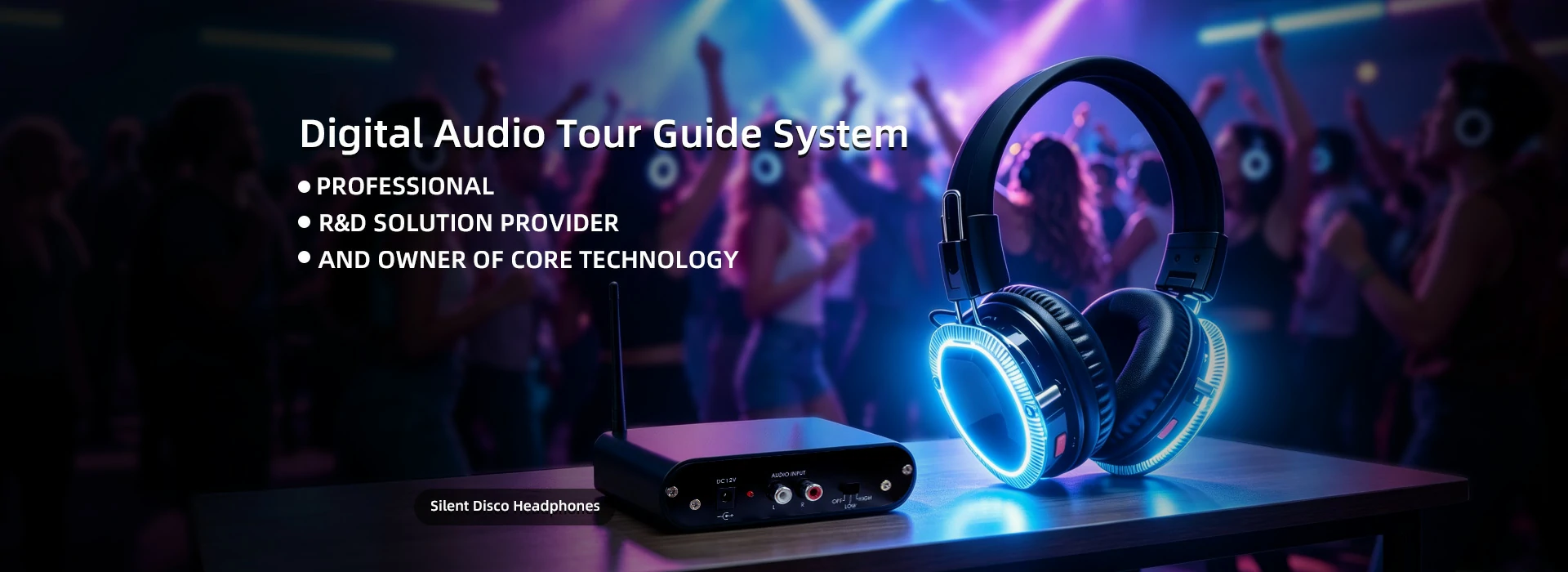
The third custodian is the student-activities coordinator, whose fleet leads a double life. On Friday the Silent Disco Wireless Headphone System runs a quad party; on Tuesday the same kit guides prospective families through open day. The headphone bodies fold flat, which is why the whole set fits back into its transport cases and shelves above the coat rack instead of claiming a storage room of its own.
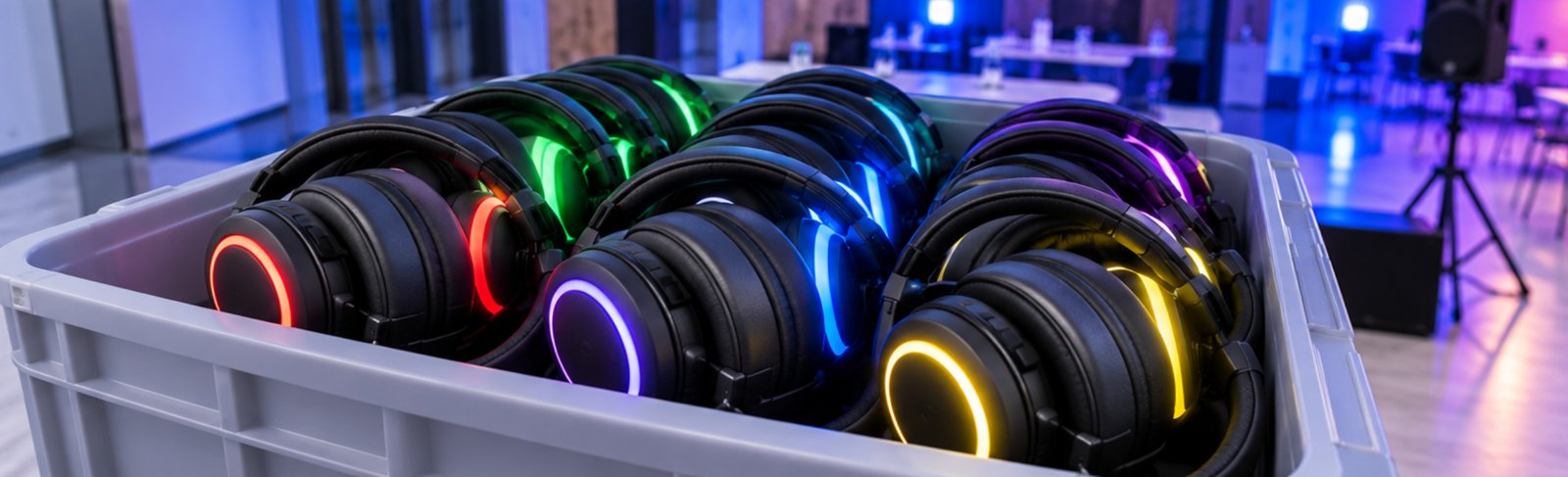
The kit's built-in maintenance signal is the LED ring. Each of the ten FM-stereo channels maps to one of five indicator colors — red, green, blue, purple, yellow — so a coordinator sweeping the room after an event can spot a headphone left on the wrong channel from across the hall, and a headphone showing no light at all has either drained its 500mAh battery or been switched off, the two states the return desk needs to tell apart before recharging. Ten hours of operation per charge and a three-hour top-up over Micro USB mean an event fleet is routinely back in service the same evening. The 40mm Mylar drivers, with a signal-to-noise ratio above 75dB and total harmonic distortion under 1%, still matter to the custodian for one reason: units that sound good get returned charged and coiled, and units that crackle get abandoned in corners.
The Columns That Survive a Shared Sign-Out Sheet
When all three fleets share one equipment desk, the registration sheet needs columns that mean the same thing for every unit. The comparison below keeps only fields all three products publish in their own documentation, so a volunteer can verify any row against any unit without guessing.
| Field | RC2406 | RC2501 | Silent Disco kit |
|---|---|---|---|
| Channels | 80 | 50 | 10 (FM stereo) |
| Receiver battery | 3.7V 1000mAh | 3.7V 1000mAh | 3.7V 500mAh built-in |
| Receiver runtime | 20h | 35+h | 10h |
| Charging port | DC Port | Type-C | Micro USB |
| Unit identification aid | Multi-color shell batches | Single gray shell | Five-color LED per channel |
Three fields deliberately stay off the table. Transmitter and receiver weights differ within the RC line (the RC2406 transmitter weighs 59g against a 50g receiver, the RC2501 a matched 47g), while the silent disco documentation does not state a per-headphone weight, so a shared weight column would compare a known figure against an unverified blank. Output power tells the same story: the RC line publishes 10mW and 13mW figures, the disco kit describes range in two power modes instead, so range belongs in the body text and not in a merged cell.
🔮 The Reissue Round: Passing Each Unit to the Next Cohort
December's return week is the third handover, and the desk runs it as a twenty-minute functional check rather than a visual glance. Every RC receiver powers on and walks one full channel scan; a unit that skips channels has a selector problem worth flagging before spring intake. Every silent disco headphone is paired to its home channel and held up to confirm the LED color matches the sheet — a five-second test that catches both drained batteries and units swapped between channel banks during the term. Chargers get counted against their fleets, because a DC Port spare that migrated to the Type-C drawer in October is invisible until move-in day, when forty units need charging and only thirty-eight cables surface. Units that pass get a fresh label, a dated tag on the case, and a shelf assignment for the next cohort; units that fail go into a separate tray with a note naming the symptom, not the suspicion. None of this paperwork is fleet-specific — the same round works for any unit in the tour guide equipment line, which is why the desk trains volunteers on the round once, not once per fleet.
⚖️ When a Receiver Goes Missing Between Dorms and Lecture Halls
Loss on a campus is rarely theft; it is distance. The RC2406 and RC2501 both specify an open-field transmission span of 1 to 200 meters, which comfortably covers a lecture hall and its lobby but tempts users to keep walking — a tour that ends at the far gate leaves receivers scattered along a route the desk never sees. The silent disco kit frames the same physics differently: its low-power mode holds about 200 meters for indoor events, while high-power mode pushes beyond 500 meters across open ground, which is a feature at an outdoor party and a liability when a borrowed transmitter walks to the far end of a sports field. The desk's countermeasure is administrative, not technical: every unit's registration entry records the group, the route and the return date, so a receiver found in a library lost-and-found in week six can be matched to the October 3rd architecture tour within minutes and recharged instead of being written off.
Reading the Warranty Terms When Receivers Change Owners
Custodianship also decides what the warranty actually pays for. The silent disco documentation states a one-year warranty with a defective rate held under 1% through individual testing before shipment — figures that hold when units are tested at the return desk rather than discovered broken at issue. The RC line's coverage follows the same logic: a channel-scan log from December gives the service desk a dated symptom instead of a vague complaint, and a fleet that documents its checks claims warranty work far more cleanly than one that rediscovers faults in September. None of this requires technical staff. It requires the lending program to treat the twenty-minute reissue round as part of the equipment's cost, the same way it treats charging carts and spare labels.
Frequently Asked Questions
1. How far apart can the transmitter and receivers be during a campus tour?
A: Plan around the 200-meter open-field span both RC units specify, and treat walls as range spenders. In practice the commentary stays clean while the group remains inside one building wing; the silent disco kit's high-power mode, rated beyond 500 meters over open ground, is reserved for quad events where the coordinator controls the footprint.2. Who charges what during the busiest intake days?
A: The RC2501 receivers go out at 35-plus-hour runtime and may not need a charger all week; RC2406 receivers run 20 hours and return to the cart nightly; silent disco headphones take a three-hour Micro USB top-up between same-evening sessions. Three fleets, three charging rhythms — which is why the desk labels every cable by port type, not by fleet.3. What fails first in a student-lending fleet?
A: Ports and cables, before electronics. A DC Port fleet that shares a drawer with Type-C and Micro USB spares eventually charges nothing, and the failure surfaces on the worst possible day. The December reissue round counts every cable against its own fleet for exactly this reason.4. Can one fleet serve both guided tours and silent events?
A: The silent disco kit doubles most easily, because its ten FM-stereo channels can carry two simultaneous audio sources for an event night and one commentary track for a walking tour, with the LED color confirming which mode each headphone is in. The RC2406, with eighty channels, is the better pick when six orientation groups share one quadrangle and interference, not silence, is the problem.The equipment itself is the easy part of an orientation season. What determines whether several hundred receivers come home is the handover chain: a desk that logs shells and channels before move-in day, students whose charging habit matches the port in their unit, and a December round that tests, labels and reissues instead of hoping. Fleets that respect the chain spend their budget on new units; fleets that skip it spend the same budget replacing the ones that walked away. More worked examples of lending programs and guided fleets are collected in the site's solutions library.