
A leading China factory specializing in Wireless Tour Guide Systems, Church Audio Guides, and Translation Headphones with premium OEM/ODM solutions.

Tel:+86 18922879583

Email:tiger.wang@richitek.com

RC085, RC2468 and RC2408: Installing a Tour System That Resets Between Border Shifts

A border crossing is not a venue with one tour route; it is a building that processes stranger-groups all day, every group arriving with its own language, its own escort, and its own schedule. The installation question therefore differs from a museum or a factory. Nothing can be bolted to a fixed route, because there is no fixed route: equipment has to serve the ten o'clock coach, reset, and be ready for the eleven o'clock one. Our project at a mid-size land crossing last month dealt with exactly that, and the deployed answer listed in the simultaneous interpretation system range, and it used three units for three install points: the RC2408 at the handout desk in the arrival hall, the RC2468 along the outdoor walk-through line, and the RC085 in the secondary inspection room. This guide follows the installation in the order it actually happened, and it ends with the reset routine that keeps the whole system honest between shifts.

⚙️ Three Install Points, One Handover Discipline

The crossing had three acoustically different zones and one operational constraint. The arrival hall echoes and hosts up to four visitor groups at once; the outdoor walk-through line stretches across open asphalt with visitors who are literally passing through; and the secondary inspection room is a small, secure space where officers ask questions and visitors answer them. The constraint was the reset: no technician is on site between coach waves, so whatever gets installed has to be re-ready by a desk officer in under ten minutes. That requirement shaped every later choice, from channel plans to charging furniture, and it is the single thing most worth copying from this deployment.

The acceptance walk on installation day doubled as a lesson in what the zones really needed. The first attempt placed the walk-through transmitter at the line's entrance, which felt natural and produced dropouts at the far gate whenever a coach idled beside the fence with its engine running; moving the mount to the midpoint, a twenty-minute job on an existing pole, ended the complaint without touching a single channel setting. The hall's channel groups were renamed after the first week, from technical labels to the names of the coach companies that used them, which sounds cosmetic until a new desk officer assigns a group in four seconds instead of asking a colleague. Installations fail in the seams between zones, and both of these fixes lived in exactly those seams.

RC2408 at the Handout Desk: Eighty Channels Absorb the Arrivals

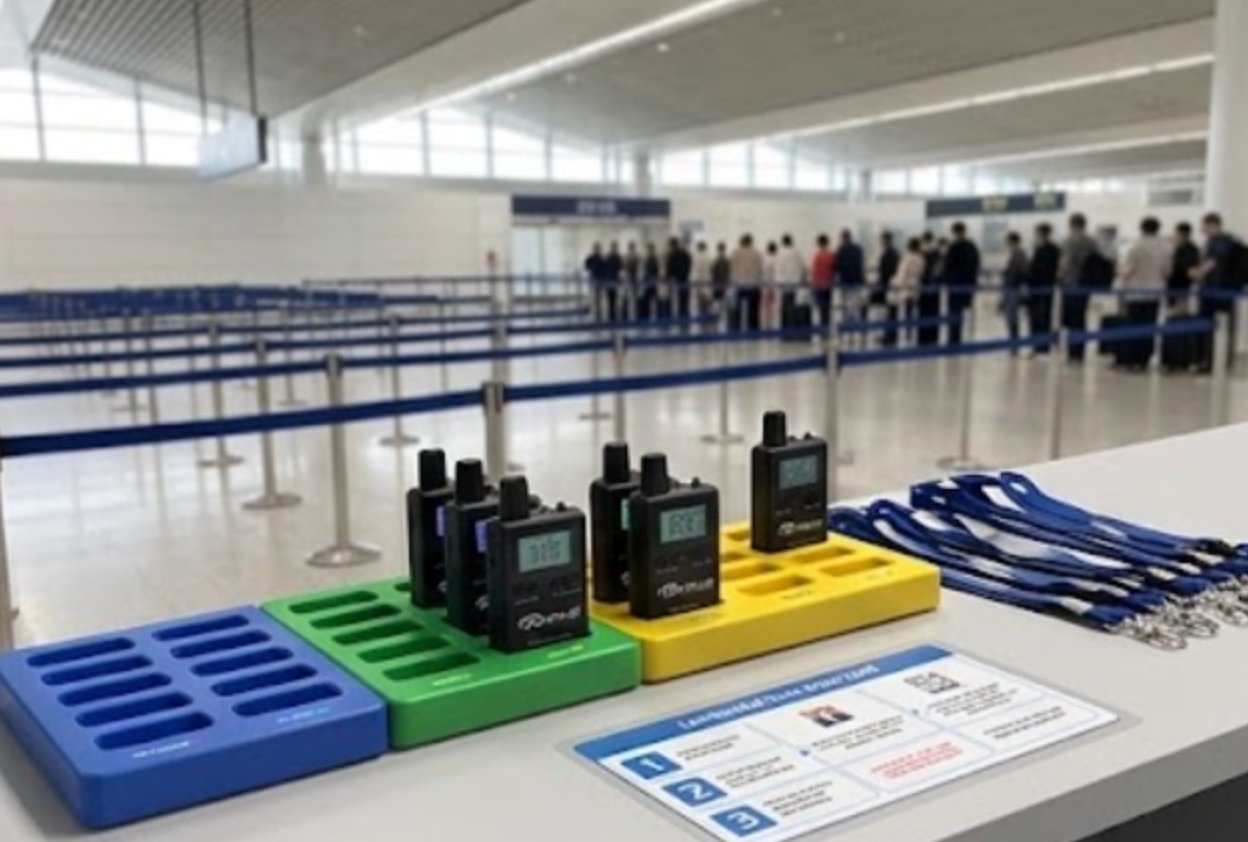
The arrival hall is where equipment leaves and returns, so the installation started there. The RC2408 transmitter and its receivers sit in a charging bank beside the handout desk, pre-assigned to three fixed channel groups so that overlapping coach parties never share a frequency. Eighty channels on the 2.4GHz ISM band carry the load comfortably; even when four escorted groups moved through the hall simultaneously, each escort kept an independent frequency, and one-key channel synchronization made the assignment repeatable for whoever was holding the transmitter that day. The figures that matter to an installer: 2403-2483MHz operating range, up to 200 meters, ten hours of transmitter runtime and twenty on the receiver, at 59g and 50g respectively, charged over DC, per the RC2408 specification.
RC2408-border_crossing_handout-desk-channel-bays

Two installation details earned their keep in the first week. The bank was labeled by group color rather than by device number, because desk officers rotate and colors survive rotation better than serial numbers. And the desk was given a laminated three-step card, hand out, collect, dock, that takes about as long to read as the reset itself takes to perform. The RC2408's two-way communication was left switched off at this station; the hall is for moving people, not for questions.

RC2468 on the Walk-Through Line: Eighteen Grams for Transient Visitors

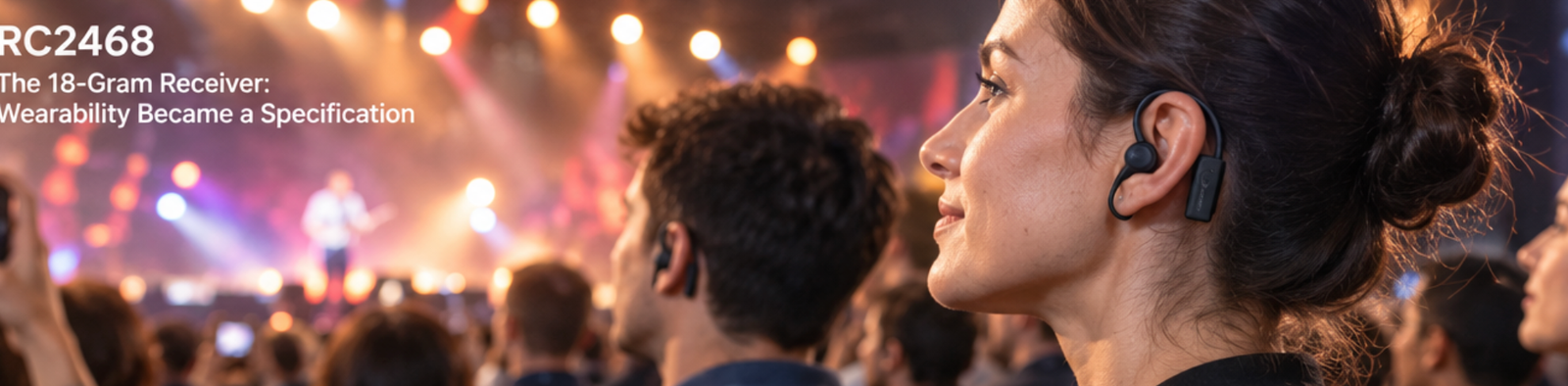
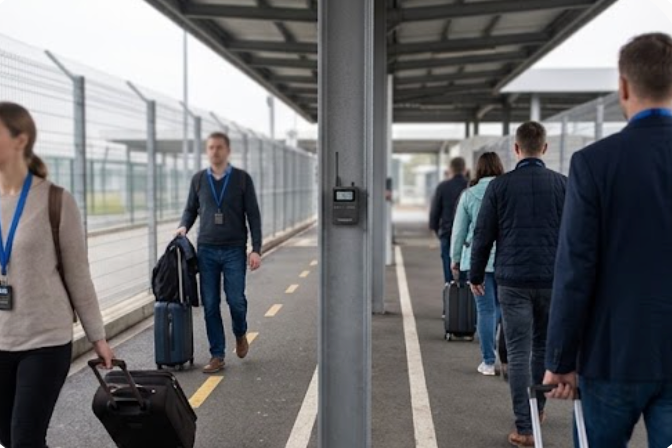
The outdoor line is the zone where visitors will not tolerate anything: they are tired, in a hurry, and often carrying luggage. The RC2468 won this post on the weight of its receiver, 18g on a neck lanyard, light enough that visitors clip it on without instruction and return it without complaint. Installation here was a coverage exercise rather than a furniture exercise: one transmitter mounted at the line's midpoint reaches the full 1-to-200-meter span of the route, and its 50 PLL-synthesized channels sit far enough from the hall groups' RC2408 assignments that the two systems never negotiated for airspace. The transmitter's 1500mAh cell runs twelve hours, which covers a border day without a swap, and the receiver's 300mAh cell returns ten hours from each charge cycle. An installer should note the practical trick the site used: because receivers come in black and blue, the blue units were reserved for the walk-through line, so a unit found anywhere else in the building announces which station it escaped from, according to the RC2468 product page.
RC2468-border_crossing_walkthrough-blue-lanyard

RC085 in the Secondary Inspection Room: UHF Walls and an F2 Question

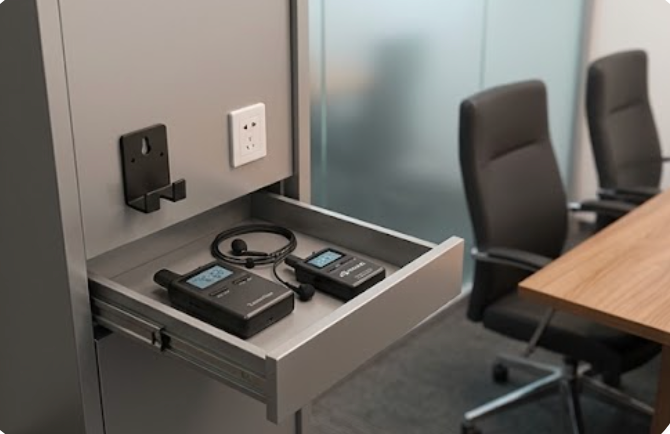
The secondary inspection room is a different acoustic problem. It is small, it sits behind a reinforced wall, and its traffic is conversational rather than broadcast: an officer asks, a visitor answers, sometimes through an interpreter who cannot enter. The RC085 took the room because its UHF platform, 470-510MHz, bends around construction that troubles 2.4G, and because its dual working modes fit the room's two moods: F1 one-way broadcast when the officer is explaining a document, and F2 two-way mode when the visitor needs to answer through the interpreter link. The LCD smart screen on the transmitter makes the mode switch a one-press affair, and auto sleep between sessions keeps the unit alive across a long shift without a mid-day charge. Installation was a bracket, one powered transmitter, and a two-receiver set kept in the room's equipment drawer, the smallest footprint of the three stations, as the RC085 page describes.

Interference planning across the three stations turned out simpler than expected, and the reason is worth writing down. The two 2.4G systems share a band but not behavior: the RC2408 hall groups sit on their fixed assignments near the building's center, while the RC2468 line transmitter broadcasts from the outdoor midpoint with fifty channels of its own, and the two never competed because their coverage shapes barely touch. The RC085 lives on a different band entirely, 470-510MHz, so the reinforced wall that weakens 2.4G actually works in its favor, keeping the room's audio inside the room. A single-band site would have forced compromises at every seam; spreading the deployment across two bands made each station independently quiet.
RC085-border_crossing_inspection-room-drawer-set

AttributeRC2408 (handout desk)RC2468 (walk-through line)RC085 (inspection room)
Band2.4GHz ISM, 2403-2483MHz2.4GHz ISM, 2403-2483MHzUHF 470-510MHz
Channels80, one-key sync50, PLL synthesisMulti-channel groups
RangeUp to 200m1-200m open areaUp to 200m
BatteryTX 10h / RX 20h, DC chargingTX 1500mAh 12h / RX 300mAh 10hAuto sleep / wake-up (capacity not published)
WeightTX 59g / RX 50gTX 59g / RX 18gLightweight ergonomic (figure not published)
ModesTwo-way capable (kept off at this station)1-to-many broadcastF1 one-way / F2 two-way, LCD smart screen
Installer noteColor-labeled bank, 3-step reset cardBlue receivers mark this stationFits a single equipment drawer

What Each Unit Publishes for the Installer

The table exists mostly to show what an installer can plan around and what must be observed. Ranges, channel counts, runtimes and weights are all published and survived the site's acceptance test unchanged. The RC085's battery capacity and unit weight are not published figures, so the reset routine treats its charge state by observation, and its drawer set gets a weekly charge check instead of a runtime assumption. That is not a weakness of the deployment; it is a division between what the datasheet promises and what the desk officer actually needs to know, which is whether the unit is charged and where it belongs.

The Kit Check That Closes Every Shift

The reset routine deserves its own paragraph because it is the part that outlived the installation week. At shift close, the desk officer runs one pass through three stations: dock the RC2408 receivers in their color bays, sweep the walk-through line for stray blue units with a five-minute walk, and confirm the RC085 drawer set powers on. The whole circuit takes under ten minutes, needs no technician, and produces a visible yes or no at each station. In the first month the routine caught three items left in coach luggage and one RC2468 transmitter that had been moved to a storage cabinet, all recovered the same evening. A border crossing never stops arriving, and the system that serves it cannot afford a maintenance calendar; it resets the way the building resets, shift by shift, by whoever is already there. The product family behind these three stations is listed on the manufacturer's tour guide range, and our solutions notes collect the deployment patterns from other crossing-like sites.


Frequently Asked Questions

1. Why does the arrival hall use 2.4G while the inspection room uses UHF?

The zones fail differently. The hall needs many groups at once, which the RC2408's eighty channels absorb, while the inspection room sits behind reinforced construction where the RC085's 470-510MHz UHF signal travels more reliably than 2.4G. Matching band to zone removed both problems at the design stage rather than the troubleshooting stage.

2. Who performs the between-shifts reset if no technician is on site?

The desk officer does, with a laminated card and a ten-minute circuit: dock the RC2408 receivers in their color bays, walk the outdoor line to collect stray blue RC2468 units, and confirm the RC085 drawer set powers on. In the first month this routine recovered three units left in coach luggage and one misplaced transmitter the same evening.

3. The RC085 page does not publish a battery capacity. Does that block deployment?

No. Its auto sleep and wake-up power management carries the unit through a shift without a mid-day charge, so the site simply added a weekly charge check of the drawer set instead of trusting an unpublished runtime figure. Where a datasheet is silent, the routine observes rather than assumes.

4. How do four simultaneous coach groups avoid hearing each other's escorts?

Each RC2408 group is pre-assigned to a fixed channel from the eighty available, and one-key channel synchronization re-establishes the assignment whenever a transmitter changes hands. Overlapping groups in the hall stayed on independent frequencies for the whole first week, including the busiest arrival wave.


2026年10月30日 11:44
ꄘ click: 42

Get the spec sheet, MOQ and a factory-direct quote

Tell us the venue, the group size and how many languages you need. An engineer at our Shenzhen factory replies within one business day with the matching model, a written quote, lead time and the CE / RoHS / ISO 9001 documents.

Talk to an engineer WhatsApp +86 189 2287 9583

Prefer email? tiger.wang@richitek.com  |  OEM / ODM, custom tooling and neutral packaging available  |  send the enquiry through our contact page

Shenzhen Rich Age Electronics Co., Ltd. (Richitek) - manufacturing wireless tour guide systems, church translation headsets and museum audio guide equipment since 2007.

no data

RC085, RC2468 and RC2408: Installing a Tour System That Resets Between Border Shifts

time: 2026年10月30日 click:42

A border crossing is not a venue with one tour route; it is a building that processes stranger-groups all day, every group arriving with its own language, its own escort, and its own schedule. The installation question therefore differs from a museum or a factory. Nothing can be bolted to a fixed route, because there is no fixed route: equipment has to serve the ten o'clock coach, reset, and be ready for the eleven o'clock one. Our project at a mid-size land crossing last month dealt with exactly that, and the deployed answer listed in the simultaneous interpretation system range, and it used three units for three install points: the RC2408 at the handout desk in the arrival hall, the RC2468 along the outdoor walk-through line, and the RC085 in the secondary inspection room. This guide follows the installation in the order it actually happened, and it ends with the reset routine that keeps the whole system honest between shifts.

⚙️ Three Install Points, One Handover Discipline

The crossing had three acoustically different zones and one operational constraint. The arrival hall echoes and hosts up to four visitor groups at once; the outdoor walk-through line stretches across open asphalt with visitors who are literally passing through; and the secondary inspection room is a small, secure space where officers ask questions and visitors answer them. The constraint was the reset: no technician is on site between coach waves, so whatever gets installed has to be re-ready by a desk officer in under ten minutes. That requirement shaped every later choice, from channel plans to charging furniture, and it is the single thing most worth copying from this deployment.

The acceptance walk on installation day doubled as a lesson in what the zones really needed. The first attempt placed the walk-through transmitter at the line's entrance, which felt natural and produced dropouts at the far gate whenever a coach idled beside the fence with its engine running; moving the mount to the midpoint, a twenty-minute job on an existing pole, ended the complaint without touching a single channel setting. The hall's channel groups were renamed after the first week, from technical labels to the names of the coach companies that used them, which sounds cosmetic until a new desk officer assigns a group in four seconds instead of asking a colleague. Installations fail in the seams between zones, and both of these fixes lived in exactly those seams.

RC2408 at the Handout Desk: Eighty Channels Absorb the Arrivals

The arrival hall is where equipment leaves and returns, so the installation started there. The RC2408 transmitter and its receivers sit in a charging bank beside the handout desk, pre-assigned to three fixed channel groups so that overlapping coach parties never share a frequency. Eighty channels on the 2.4GHz ISM band carry the load comfortably; even when four escorted groups moved through the hall simultaneously, each escort kept an independent frequency, and one-key channel synchronization made the assignment repeatable for whoever was holding the transmitter that day. The figures that matter to an installer: 2403-2483MHz operating range, up to 200 meters, ten hours of transmitter runtime and twenty on the receiver, at 59g and 50g respectively, charged over DC, per the RC2408 specification.

RC2408-border_crossing_handout-desk-channel-bays

Two installation details earned their keep in the first week. The bank was labeled by group color rather than by device number, because desk officers rotate and colors survive rotation better than serial numbers. And the desk was given a laminated three-step card, hand out, collect, dock, that takes about as long to read as the reset itself takes to perform. The RC2408's two-way communication was left switched off at this station; the hall is for moving people, not for questions.

RC2468 on the Walk-Through Line: Eighteen Grams for Transient Visitors

The outdoor line is the zone where visitors will not tolerate anything: they are tired, in a hurry, and often carrying luggage. The RC2468 won this post on the weight of its receiver, 18g on a neck lanyard, light enough that visitors clip it on without instruction and return it without complaint. Installation here was a coverage exercise rather than a furniture exercise: one transmitter mounted at the line's midpoint reaches the full 1-to-200-meter span of the route, and its 50 PLL-synthesized channels sit far enough from the hall groups' RC2408 assignments that the two systems never negotiated for airspace. The transmitter's 1500mAh cell runs twelve hours, which covers a border day without a swap, and the receiver's 300mAh cell returns ten hours from each charge cycle. An installer should note the practical trick the site used: because receivers come in black and blue, the blue units were reserved for the walk-through line, so a unit found anywhere else in the building announces which station it escaped from, according to the RC2468 product page.

RC2468-border_crossing_walkthrough-blue-lanyard

RC085 in the Secondary Inspection Room: UHF Walls and an F2 Question

The secondary inspection room is a different acoustic problem. It is small, it sits behind a reinforced wall, and its traffic is conversational rather than broadcast: an officer asks, a visitor answers, sometimes through an interpreter who cannot enter. The RC085 took the room because its UHF platform, 470-510MHz, bends around construction that troubles 2.4G, and because its dual working modes fit the room's two moods: F1 one-way broadcast when the officer is explaining a document, and F2 two-way mode when the visitor needs to answer through the interpreter link. The LCD smart screen on the transmitter makes the mode switch a one-press affair, and auto sleep between sessions keeps the unit alive across a long shift without a mid-day charge. Installation was a bracket, one powered transmitter, and a two-receiver set kept in the room's equipment drawer, the smallest footprint of the three stations, as the RC085 page describes.

Interference planning across the three stations turned out simpler than expected, and the reason is worth writing down. The two 2.4G systems share a band but not behavior: the RC2408 hall groups sit on their fixed assignments near the building's center, while the RC2468 line transmitter broadcasts from the outdoor midpoint with fifty channels of its own, and the two never competed because their coverage shapes barely touch. The RC085 lives on a different band entirely, 470-510MHz, so the reinforced wall that weakens 2.4G actually works in its favor, keeping the room's audio inside the room. A single-band site would have forced compromises at every seam; spreading the deployment across two bands made each station independently quiet.

RC085-border_crossing_inspection-room-drawer-set

AttributeRC2408 (handout desk)RC2468 (walk-through line)RC085 (inspection room)
Band2.4GHz ISM, 2403-2483MHz2.4GHz ISM, 2403-2483MHzUHF 470-510MHz
Channels80, one-key sync50, PLL synthesisMulti-channel groups
RangeUp to 200m1-200m open areaUp to 200m
BatteryTX 10h / RX 20h, DC chargingTX 1500mAh 12h / RX 300mAh 10hAuto sleep / wake-up (capacity not published)
WeightTX 59g / RX 50gTX 59g / RX 18gLightweight ergonomic (figure not published)
ModesTwo-way capable (kept off at this station)1-to-many broadcastF1 one-way / F2 two-way, LCD smart screen
Installer noteColor-labeled bank, 3-step reset cardBlue receivers mark this stationFits a single equipment drawer

What Each Unit Publishes for the Installer

The table exists mostly to show what an installer can plan around and what must be observed. Ranges, channel counts, runtimes and weights are all published and survived the site's acceptance test unchanged. The RC085's battery capacity and unit weight are not published figures, so the reset routine treats its charge state by observation, and its drawer set gets a weekly charge check instead of a runtime assumption. That is not a weakness of the deployment; it is a division between what the datasheet promises and what the desk officer actually needs to know, which is whether the unit is charged and where it belongs.

The Kit Check That Closes Every Shift

The reset routine deserves its own paragraph because it is the part that outlived the installation week. At shift close, the desk officer runs one pass through three stations: dock the RC2408 receivers in their color bays, sweep the walk-through line for stray blue units with a five-minute walk, and confirm the RC085 drawer set powers on. The whole circuit takes under ten minutes, needs no technician, and produces a visible yes or no at each station. In the first month the routine caught three items left in coach luggage and one RC2468 transmitter that had been moved to a storage cabinet, all recovered the same evening. A border crossing never stops arriving, and the system that serves it cannot afford a maintenance calendar; it resets the way the building resets, shift by shift, by whoever is already there. The product family behind these three stations is listed on the manufacturer's tour guide range, and our solutions notes collect the deployment patterns from other crossing-like sites.

Frequently Asked Questions

1. Why does the arrival hall use 2.4G while the inspection room uses UHF?

The zones fail differently. The hall needs many groups at once, which the RC2408's eighty channels absorb, while the inspection room sits behind reinforced construction where the RC085's 470-510MHz UHF signal travels more reliably than 2.4G. Matching band to zone removed both problems at the design stage rather than the troubleshooting stage.

2. Who performs the between-shifts reset if no technician is on site?

The desk officer does, with a laminated card and a ten-minute circuit: dock the RC2408 receivers in their color bays, walk the outdoor line to collect stray blue RC2468 units, and confirm the RC085 drawer set powers on. In the first month this routine recovered three units left in coach luggage and one misplaced transmitter the same evening.

3. The RC085 page does not publish a battery capacity. Does that block deployment?

No. Its auto sleep and wake-up power management carries the unit through a shift without a mid-day charge, so the site simply added a weekly charge check of the drawer set instead of trusting an unpublished runtime figure. Where a datasheet is silent, the routine observes rather than assumes.

4. How do four simultaneous coach groups avoid hearing each other's escorts?

Each RC2408 group is pre-assigned to a fixed channel from the eighty available, and one-key channel synchronization re-establishes the assignment whenever a transmitter changes hands. Overlapping groups in the hall stayed on independent frequencies for the whole first week, including the busiest arrival wave.


Get the spec sheet, MOQ and a factory-direct quote

Tell us the venue, the group size and how many languages you need. An engineer at our Shenzhen factory replies within one business day with the matching model, a written quote, lead time and the CE / RoHS / ISO 9001 documents.

Talk to an engineer WhatsApp +86 189 2287 9583

Prefer email? tiger.wang@richitek.com  |  OEM / ODM, custom tooling and neutral packaging available  |  send the enquiry through our contact page

Shenzhen Rich Age Electronics Co., Ltd. (Richitek) - manufacturing wireless tour guide systems, church translation headsets and museum audio guide equipment since 2007.

no data
×

Contact us

email:
name:
subject:
content: