
A leading China factory specializing in Wireless Tour Guide Systems, Church Audio Guides, and Translation Headphones with premium OEM/ODM solutions.

Tel:+86 18922879583

Email:tiger.wang@richitek.com

RC2406 and Silent Disco Wireless Headphones: The Investor Visit Trend That Trades One Big Tour for Three Small Ones

Industrial parks courting investors have quietly rebuilt the way they show a site. The single sixty-person caravan with a loudspeaker wagon has given way to three or four simultaneous small tracks: a technical line through the clean bays, a commercial line through the pilot lines, and an ESG line that ends in the boardroom. Each track hears a different guide at the same hour, and none of them can leak sound into the next.

That structural change, not any single gadget, is the real trend of this season. It reshapes what gets bought, how many channels get planned, and which corners of the route stay silent. This article reads the shift through three RichAge devices that map onto it almost one-to-one, using only figures published on the product pages. For the venue side of these programs, see our conference and event solutions.

What Changed in the Delegation Pattern

Economic development teams describe the same arc from different cities: delegations used to arrive monthly and huge, now they arrive weekly and small. A twelve-person fund delegation does not fill a coach, but it still wants its own guide, its own route and its own pace, and it overlaps with a due-diligence pair and a government group on the same morning. The park's visitor center, staffed for one big circuit, suddenly runs three circuits at once.

The arithmetic behind that shift is what budget holders feel first. Three parallel groups need three live voices, which means three transmitters working at the same time in overlapping territory, plus enough receivers to hand every guest one without a deposit desk slowing the lobby. Equipment designed around one large crowd behaves badly under that load; equipment designed around channel discipline behaves well.

Smaller Batches, Packed Calendars

Frequency is the second half of the trend. When visits cluster on Tuesdays and Thursdays, the recharge window between groups shrinks to a lunch break, and the gear that survives is the gear that tops up fast or simply lasts the day. Rental-style fleets that go out and come back twice a day also collide with the laundry problem: headset cushions wiped between every handover, batteries checked by a dock light rather than a guess.

Small batches also change the failure math. A dead receiver in a sixty-person caravan gets absorbed by the crowd; the same dead unit in a nine-person track is a third of the room falling silent. Spares move from the storage cage to a drawer beside the front desk, and the pool gets sized per track rather than per season.

The crews running the desks describe the swap-over in almost identical words. A fleet built for one caravan had a depot, a checklist and one morning ritual; a kit built for three tracks has three pouches, three channel cards and a laminated map of which transmitter goes with which guide. None of it is complicated, but all of it is new, and the parks that skipped the retraining step spent their first split-delegation morning passing one receiver down a line of nine people like a church collection plate.

Each Parallel Group Needs Its Own Channel

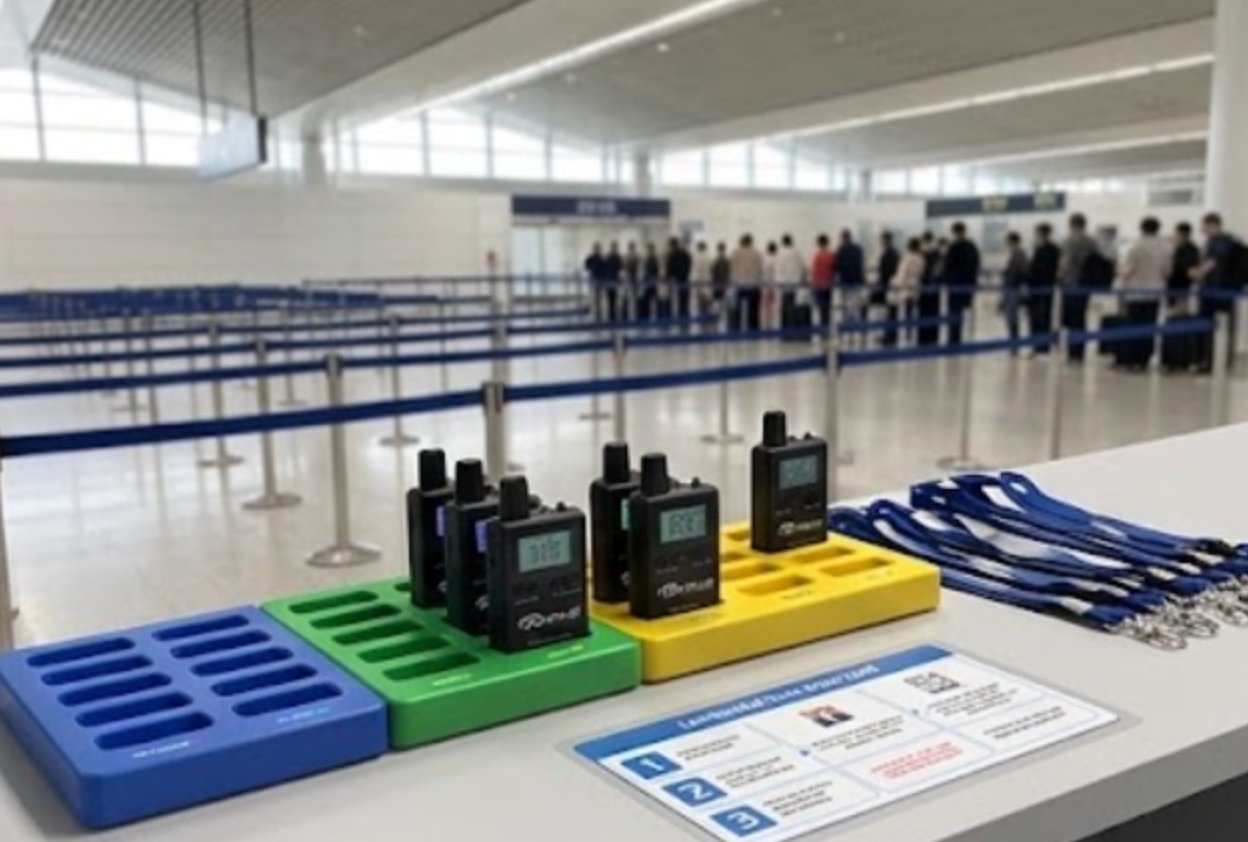
The live-commentary workhorse of this pattern is the RC2406 80-channel 2.4G tour guide system, and its channel bank is the reason. Eighty channels on 2403-2483 MHz give the visitor center enough slots to run three guided tracks plus a training class in the annex without re-planning the moment a fourth group appears. Transmitters run 10 hours on a 3.7V 1500mAh cell and receivers 20 hours on 1000mAh, so a Tuesday with two waves of visits never asks the fleet to see a charger before dusk.

Weight matters more as batches shrink, because nine guests notice the hardware in their hands. At 59g for the transmitter and 50g for the receiver, the RC2406 disappears into a jacket pocket between stops, and the DC-port charging carts sit in the visitor center rather than following the route. Interference resistance, the reason this model exists, shows up when the park's own Wi-Fi and sensor traffic crowd the 2.4GHz band mid-tour.

RC2406-investor_site_visit_parallel-groups-80-channel

🎪 Keypads Where Guides Used to Stand

Not every stop keeps a live voice. Parks increasingly end the guided circuit at a demonstration hall, then release guests into a self-guided zone where a deputy has gone back to her desk. The device filling that gap is the 2.8-inch semi-auto digital audio guide: a visitor keys a two-digit code on the 0-9 pad and the commentary for that exhibit plays immediately, with no guide and no schedule attached.

The published numbers make the deployment case by themselves. Sixteen languages and up to 9999 audio files on 2GB of internal memory hold every pitch the park has ever recorded, and an 18-hour battery on Micro USB charging means the units go back on the shelf at night without a docking ritual. Guests who skipped the live track because they arrived late simply walk the self-guided zone with the same content the others heard an hour earlier, which is exactly the flexibility the weekly-visit calendar demands.
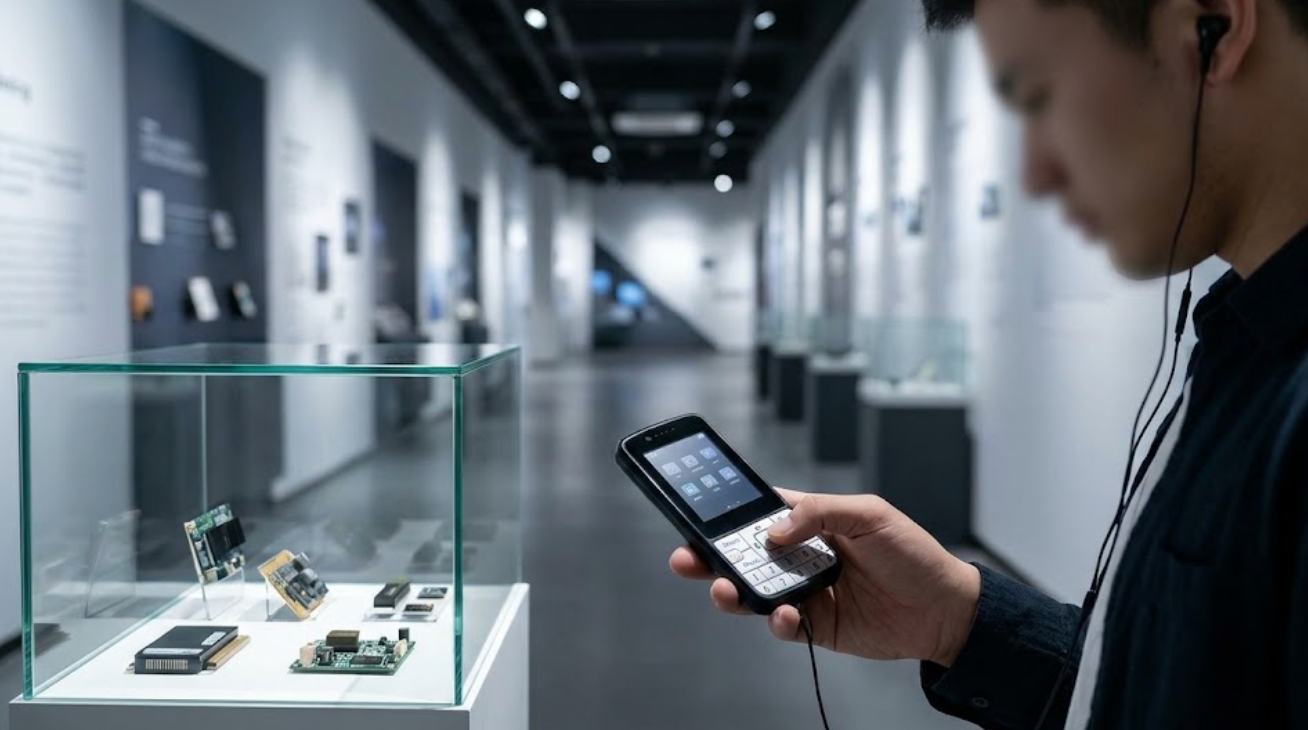
2.8-Inch-investor_site_visit_self-guided-keypad-zone

Quiet Hours in the Signing Room

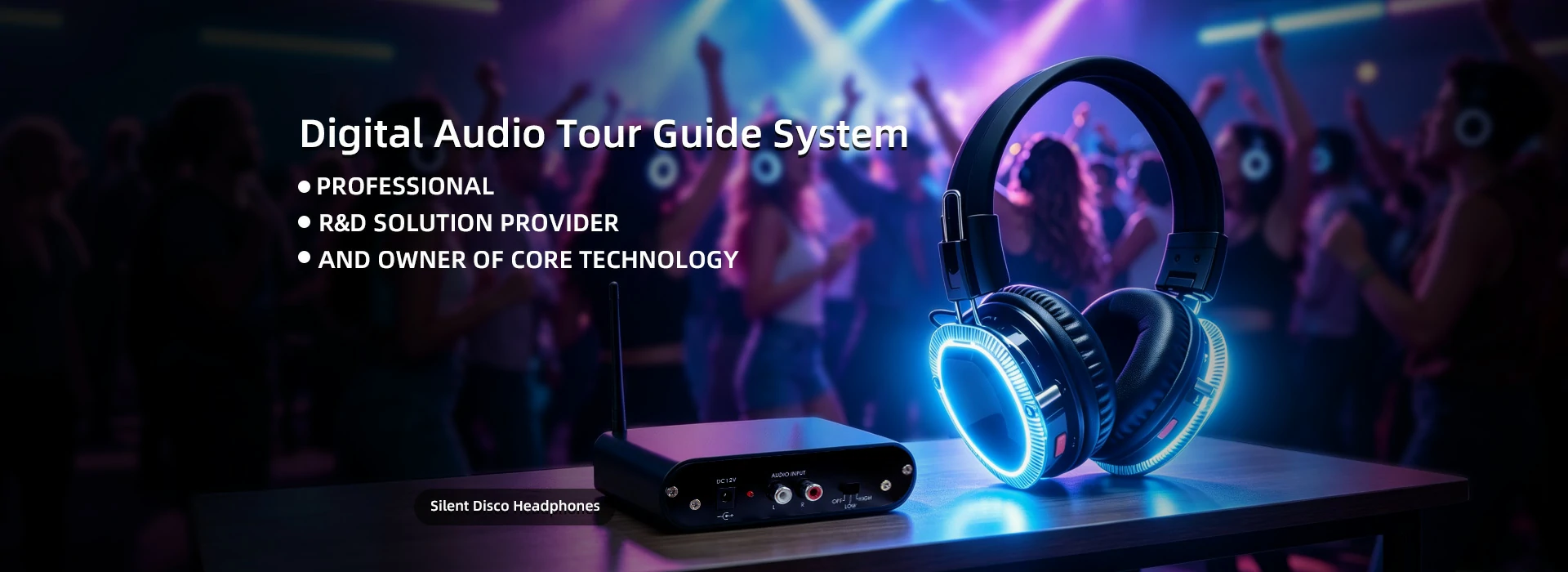
The third track ends somewhere sound must not escape: the signing room, the model-suite floor above an occupied office, the demo theater between shows. Parks have started running those segments on the Silent Disco wireless headphone system, whose multi-channel UHF link feeds every guest directly with no room speaker at all.

The published specification fits the use precisely. Each headphone carries its own volume control beside an LED channel indicator, so a guest who drifts to the window still hears the host, and a channel change is visible rather than announced. Forty-millimeter Mylar drivers deliver a 30-20000Hz response with SNR above 75dB and THD below 1 percent, and the 500mAh built-in battery runs 10 hours on a 3-hour charge, which covers a full visiting day from a morning dock. Wall-penetrating UHF range keeps the host's voice intact through a partition wall, where a loudspeaker would simply be banned.

The silent format also solves a social problem the trend created. When three tracks converge on the model suite at the same time, three guides talking normally produce a wall of noise that no floor plan fixes; three silent sessions on three headphone channels produce nothing at all, and the groups separate themselves by LED color. Facilities managers who spent years banning amplification in occupied buildings have become the quietest advocates of the format, precisely because it removes the rule they had to enforce.
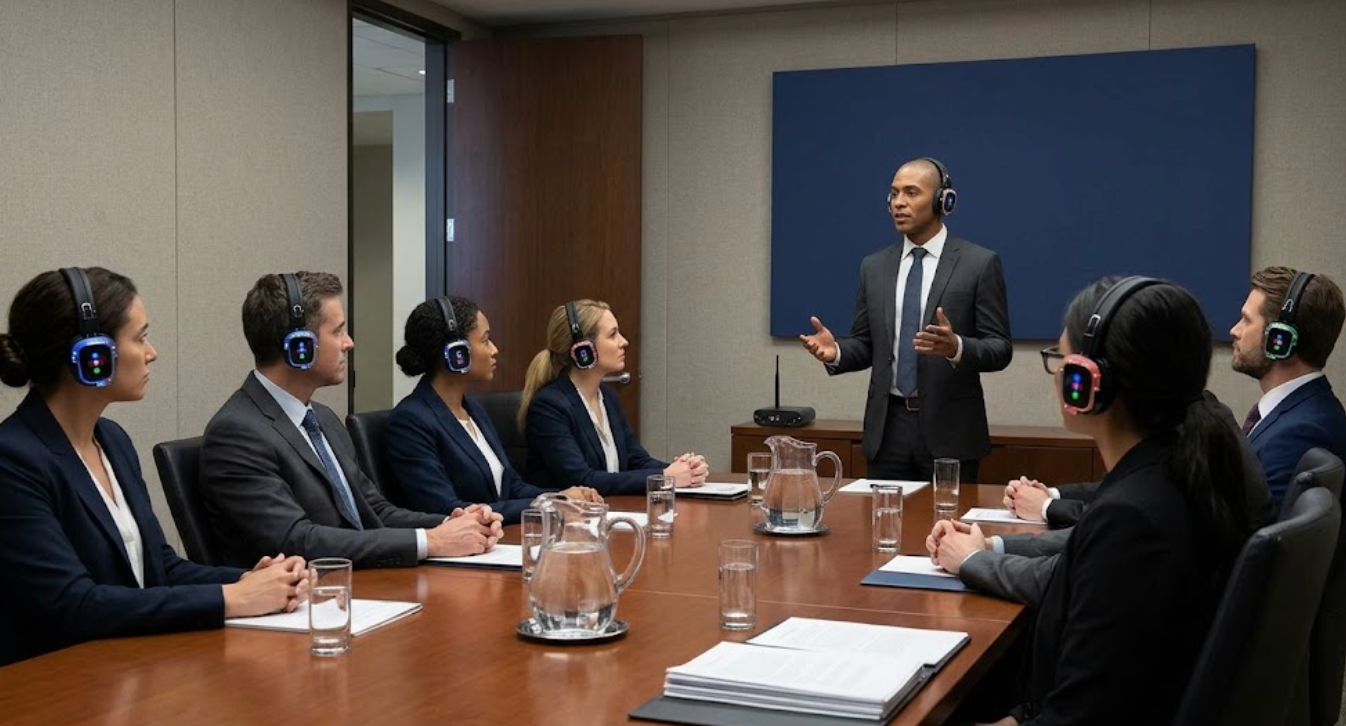
SilentDisco-investor_site_visit_signing-room-silent-session

🔮 What This Trend Means for Buying

The purchasing pattern follows the operating pattern: fewer bulk fleets of one model, more three-line kits. The sheet below collects the published figures side by side, taken from each product page; the 2.8-inch player publishes no channel count because it is a self-guided player, not a radio system, and that absence is part of the point.

Published figureRC24062.8-Inch Semi-Auto Digital Audio GuideSilent Disco Wireless Headphone System
Signal type2.4G live commentary, 2403-2483 MHzSelf-guided playback, number-key inputMulti-channel UHF, wall-penetrating
Capacity figures80 channels16 languages, 9999 files, 2GB memoryPer-headphone volume, LED channel indicator
BatteryTX 3.7V 1500mAh, 10h; RX 3.7V 1000mAh, 20h18h on Micro USB charge500mAh built-in, 10h operation, 3h charge
Audio detailInterference-resistant PLL plan0-9 keypad, instant point-and-play40mm Mylar drivers, 30-20000Hz, SNR above 75dB, THD below 1%
WeightTX 59g, RX 50gLightweight ergonomic bodyNot published
Role in the splitLive parallel tracksSelf-guided zone after the circuitSilent segments in sound-controlled rooms

A park converting from one big circuit to three small tracks buys roughly the same number of receivers as before, but spreads them across two radio devices and one player, adds a dock plan that respects a lunch-break turnaround, and stops treating the signing room as a place a loudspeaker can go. None of that requires new construction; it requires matching each device to the segment of the visit that changed.

Frequently Asked Questions

1. Can three guided tracks really run at once without interference?

Yes, and with room to spare. The RC2406 publishes 80 channels on 2403-2483 MHz, so three simultaneous tracks occupy three slots and leave the rest for training rooms or a fourth group. Its interference-resistant design matters at industrial parks, where tenant Wi-Fi and sensor traffic already crowd the band.

2. What happens when a delegation arrives without a booked guide?

The self-guided zone absorbs them. A 2.8-inch semi-auto player plays the coded commentary the moment a visitor keys the exhibit number, with 16 languages and up to 9999 files stored on 2GB of memory. An 18-hour battery on Micro USB charging lets the units cycle all day without a mid-day dock.

3. How long do the silent headphones last on a visiting day?

The published figure is 10 hours of operation from the 500mAh built-in battery, reached after a 3-hour charge. A unit docked when the visitor center opens covers the entire day, including an afternoon signing ceremony, and the LED channel indicator shows guests whether they are on the right feed before the host begins.

4. Is the audio quality of the silent system good enough for a formal presentation?

The published numbers say yes: 40mm Mylar drivers with a 30-20000Hz frequency response, SNR above 75dB and THD below 1 percent, and per-headphone volume so each listener dials their own level. Formal presentations actually favor the format, because the host controls the room while guests control only loudness.

Splitting one big tour into three small ones is a staffing decision that ends in a purchasing decision. Match the RC2406 to the parallel live tracks, the keypad player to the self-guided tail, and the silent headphones to the rooms where sound cannot go, and the weekly visit calendar stops being a scheduling crisis. To compare the full range for your visitor center, browse the wireless tour guide system range, or explore our solutions for more route layouts.


2026年10月30日 10:58
ꄘ click: 52

Get the spec sheet, MOQ and a factory-direct quote

Tell us the venue, the group size and how many languages you need. An engineer at our Shenzhen factory replies within one business day with the matching model, a written quote, lead time and the CE / RoHS / ISO 9001 documents.

Talk to an engineer WhatsApp +86 189 2287 9583

Prefer email? tiger.wang@richitek.com  |  OEM / ODM, custom tooling and neutral packaging available  |  send the enquiry through our contact page

Shenzhen Rich Age Electronics Co., Ltd. (Richitek) - manufacturing wireless tour guide systems, church translation headsets and museum audio guide equipment since 2007.

RC2406 and Silent Disco Wireless Headphones: The Investor Visit Trend That Trades One Big Tour for Three Small Ones

time: 2026年10月30日 click:52

Industrial parks courting investors have quietly rebuilt the way they show a site. The single sixty-person caravan with a loudspeaker wagon has given way to three or four simultaneous small tracks: a technical line through the clean bays, a commercial line through the pilot lines, and an ESG line that ends in the boardroom. Each track hears a different guide at the same hour, and none of them can leak sound into the next.

That structural change, not any single gadget, is the real trend of this season. It reshapes what gets bought, how many channels get planned, and which corners of the route stay silent. This article reads the shift through three RichAge devices that map onto it almost one-to-one, using only figures published on the product pages. For the venue side of these programs, see our conference and event solutions.

What Changed in the Delegation Pattern

Economic development teams describe the same arc from different cities: delegations used to arrive monthly and huge, now they arrive weekly and small. A twelve-person fund delegation does not fill a coach, but it still wants its own guide, its own route and its own pace, and it overlaps with a due-diligence pair and a government group on the same morning. The park's visitor center, staffed for one big circuit, suddenly runs three circuits at once.

The arithmetic behind that shift is what budget holders feel first. Three parallel groups need three live voices, which means three transmitters working at the same time in overlapping territory, plus enough receivers to hand every guest one without a deposit desk slowing the lobby. Equipment designed around one large crowd behaves badly under that load; equipment designed around channel discipline behaves well.

Smaller Batches, Packed Calendars

Frequency is the second half of the trend. When visits cluster on Tuesdays and Thursdays, the recharge window between groups shrinks to a lunch break, and the gear that survives is the gear that tops up fast or simply lasts the day. Rental-style fleets that go out and come back twice a day also collide with the laundry problem: headset cushions wiped between every handover, batteries checked by a dock light rather than a guess.

Small batches also change the failure math. A dead receiver in a sixty-person caravan gets absorbed by the crowd; the same dead unit in a nine-person track is a third of the room falling silent. Spares move from the storage cage to a drawer beside the front desk, and the pool gets sized per track rather than per season.

The crews running the desks describe the swap-over in almost identical words. A fleet built for one caravan had a depot, a checklist and one morning ritual; a kit built for three tracks has three pouches, three channel cards and a laminated map of which transmitter goes with which guide. None of it is complicated, but all of it is new, and the parks that skipped the retraining step spent their first split-delegation morning passing one receiver down a line of nine people like a church collection plate.

Each Parallel Group Needs Its Own Channel

The live-commentary workhorse of this pattern is the RC2406 80-channel 2.4G tour guide system, and its channel bank is the reason. Eighty channels on 2403-2483 MHz give the visitor center enough slots to run three guided tracks plus a training class in the annex without re-planning the moment a fourth group appears. Transmitters run 10 hours on a 3.7V 1500mAh cell and receivers 20 hours on 1000mAh, so a Tuesday with two waves of visits never asks the fleet to see a charger before dusk.

Weight matters more as batches shrink, because nine guests notice the hardware in their hands. At 59g for the transmitter and 50g for the receiver, the RC2406 disappears into a jacket pocket between stops, and the DC-port charging carts sit in the visitor center rather than following the route. Interference resistance, the reason this model exists, shows up when the park's own Wi-Fi and sensor traffic crowd the 2.4GHz band mid-tour.

RC2406-investor_site_visit_parallel-groups-80-channel

🎪 Keypads Where Guides Used to Stand

Not every stop keeps a live voice. Parks increasingly end the guided circuit at a demonstration hall, then release guests into a self-guided zone where a deputy has gone back to her desk. The device filling that gap is the 2.8-inch semi-auto digital audio guide: a visitor keys a two-digit code on the 0-9 pad and the commentary for that exhibit plays immediately, with no guide and no schedule attached.

The published numbers make the deployment case by themselves. Sixteen languages and up to 9999 audio files on 2GB of internal memory hold every pitch the park has ever recorded, and an 18-hour battery on Micro USB charging means the units go back on the shelf at night without a docking ritual. Guests who skipped the live track because they arrived late simply walk the self-guided zone with the same content the others heard an hour earlier, which is exactly the flexibility the weekly-visit calendar demands.

2.8-Inch-investor_site_visit_self-guided-keypad-zone

Quiet Hours in the Signing Room

The third track ends somewhere sound must not escape: the signing room, the model-suite floor above an occupied office, the demo theater between shows. Parks have started running those segments on the Silent Disco wireless headphone system, whose multi-channel UHF link feeds every guest directly with no room speaker at all.

The published specification fits the use precisely. Each headphone carries its own volume control beside an LED channel indicator, so a guest who drifts to the window still hears the host, and a channel change is visible rather than announced. Forty-millimeter Mylar drivers deliver a 30-20000Hz response with SNR above 75dB and THD below 1 percent, and the 500mAh built-in battery runs 10 hours on a 3-hour charge, which covers a full visiting day from a morning dock. Wall-penetrating UHF range keeps the host's voice intact through a partition wall, where a loudspeaker would simply be banned.

The silent format also solves a social problem the trend created. When three tracks converge on the model suite at the same time, three guides talking normally produce a wall of noise that no floor plan fixes; three silent sessions on three headphone channels produce nothing at all, and the groups separate themselves by LED color. Facilities managers who spent years banning amplification in occupied buildings have become the quietest advocates of the format, precisely because it removes the rule they had to enforce.

SilentDisco-investor_site_visit_signing-room-silent-session

🔮 What This Trend Means for Buying

The purchasing pattern follows the operating pattern: fewer bulk fleets of one model, more three-line kits. The sheet below collects the published figures side by side, taken from each product page; the 2.8-inch player publishes no channel count because it is a self-guided player, not a radio system, and that absence is part of the point.

Published figureRC24062.8-Inch Semi-Auto Digital Audio GuideSilent Disco Wireless Headphone System
Signal type2.4G live commentary, 2403-2483 MHzSelf-guided playback, number-key inputMulti-channel UHF, wall-penetrating
Capacity figures80 channels16 languages, 9999 files, 2GB memoryPer-headphone volume, LED channel indicator
BatteryTX 3.7V 1500mAh, 10h; RX 3.7V 1000mAh, 20h18h on Micro USB charge500mAh built-in, 10h operation, 3h charge
Audio detailInterference-resistant PLL plan0-9 keypad, instant point-and-play40mm Mylar drivers, 30-20000Hz, SNR above 75dB, THD below 1%
WeightTX 59g, RX 50gLightweight ergonomic bodyNot published
Role in the splitLive parallel tracksSelf-guided zone after the circuitSilent segments in sound-controlled rooms

A park converting from one big circuit to three small tracks buys roughly the same number of receivers as before, but spreads them across two radio devices and one player, adds a dock plan that respects a lunch-break turnaround, and stops treating the signing room as a place a loudspeaker can go. None of that requires new construction; it requires matching each device to the segment of the visit that changed.

Frequently Asked Questions

1. Can three guided tracks really run at once without interference?

Yes, and with room to spare. The RC2406 publishes 80 channels on 2403-2483 MHz, so three simultaneous tracks occupy three slots and leave the rest for training rooms or a fourth group. Its interference-resistant design matters at industrial parks, where tenant Wi-Fi and sensor traffic already crowd the band.

2. What happens when a delegation arrives without a booked guide?

The self-guided zone absorbs them. A 2.8-inch semi-auto player plays the coded commentary the moment a visitor keys the exhibit number, with 16 languages and up to 9999 files stored on 2GB of memory. An 18-hour battery on Micro USB charging lets the units cycle all day without a mid-day dock.

3. How long do the silent headphones last on a visiting day?

The published figure is 10 hours of operation from the 500mAh built-in battery, reached after a 3-hour charge. A unit docked when the visitor center opens covers the entire day, including an afternoon signing ceremony, and the LED channel indicator shows guests whether they are on the right feed before the host begins.

4. Is the audio quality of the silent system good enough for a formal presentation?

The published numbers say yes: 40mm Mylar drivers with a 30-20000Hz frequency response, SNR above 75dB and THD below 1 percent, and per-headphone volume so each listener dials their own level. Formal presentations actually favor the format, because the host controls the room while guests control only loudness.

Splitting one big tour into three small ones is a staffing decision that ends in a purchasing decision. Match the RC2406 to the parallel live tracks, the keypad player to the self-guided tail, and the silent headphones to the rooms where sound cannot go, and the weekly visit calendar stops being a scheduling crisis. To compare the full range for your visitor center, browse the wireless tour guide system range, or explore our solutions for more route layouts.



Get the spec sheet, MOQ and a factory-direct quote

Tell us the venue, the group size and how many languages you need. An engineer at our Shenzhen factory replies within one business day with the matching model, a written quote, lead time and the CE / RoHS / ISO 9001 documents.

Talk to an engineer WhatsApp +86 189 2287 9583

Prefer email? tiger.wang@richitek.com  |  OEM / ODM, custom tooling and neutral packaging available  |  send the enquiry through our contact page

Shenzhen Rich Age Electronics Co., Ltd. (Richitek) - manufacturing wireless tour guide systems, church translation headsets and museum audio guide equipment since 2007.

×

Contact us

email:
name:
subject:
content: