A leading China factory specializing in Wireless Tour Guide Systems, Church Audio Guides, and Translation Headphones with premium OEM/ODM solutions.

Tel:+86 18922879583

Email:tiger.wang@richitek.com

RC2408, RC2500 and the Silent Disco Headphone System: A Launch-Day Troubleshooting Ladder for the Demo Floor

Auto shows and product launches fail acoustically in a way that warehouses and museums never do. A dozen exhibitors run demonstrations inside one hall, the organizer adds a main stage, and every visitor expects to hear the right presenter and nothing else. When something goes wrong, the crew rarely has more than the pause between two sessions to find the cause. This article sorts the three silence problems that show up on a launch day and matches each one to the hardware that ends it: the conference and launch-event kit built around the RC2408, the long-shift RC2500, and the Silent Disco headphone rig for closed demo rooms.

The sorting rule is simple. If visitors hear the wrong presenter, the fault lives in the frequency plan. If headsets die before the afternoon session, the fault lives in the battery plan. If audio from a private demo room turns up in the neighboring hall, the fault lives in transmitter power. Each section below takes one of those symptoms, traces it to the layer that produces it, and shows which of the three systems resolves it fastest.

RC2408 Fences the Dial Before Anyone Powers On

The classic launch-day fault is the wrong-voice complaint: a visitor on demo island three hears the pitch meant for island one. The cause is almost never a broken receiver. It is two islands assigned to the same channel, or a receiver that drifted off its assignment when someone re-paired it during setup. The RC2408 Wireless Tour Guide System was built for exactly this crowd: 80 independent channels on the global 2.4GHz ISM band at 2403-2483MHz, which is enough room to give every demo island its own block and still keep spares for the main stage and the press room.

The workflow that prevents the complaint costs nothing extra. Before doors open, the crew writes a channel map on the setup board: islands one through five take channels in the first block, the VIP route takes a second block, and a gap separates neighboring assignments so adjacent hardware never sits on touching frequencies. When a visitor reports the wrong voice, the fix is a lookup, not a diagnosis: check the map, re-assign, move on.

The launch hall adds interference that a museum never sees, and the channel plan has to absorb it. LED video walls, wireless microphone racks, and a few thousand visitor phones all crowd the 2.4GHz band, and the RC2408's PLL-locked tuning holds each assignment while the background noise shifts hour by hour. The eighty-channel budget also buys next year's floor plan: a stand that grows from five islands to eight does not need a second system, only a second block written on the same board.

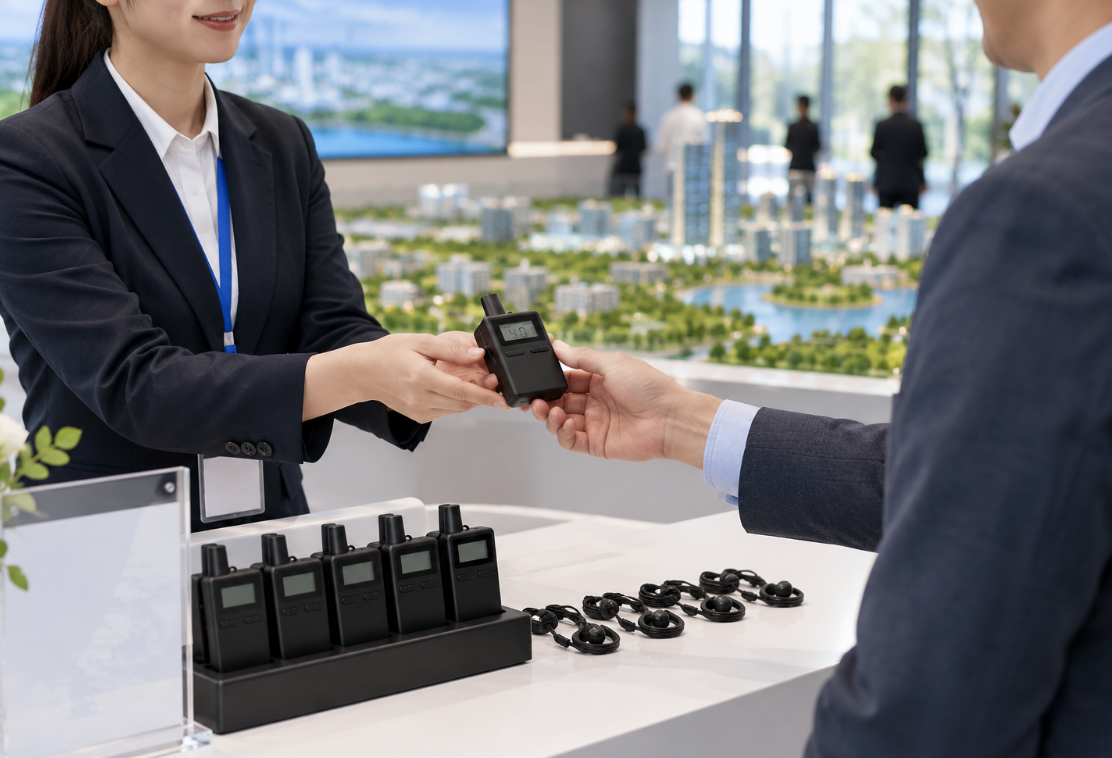
RC2408-auto_show-channel-fence

Between sessions the RC2408 earns its second advantage: one-key channel synchronization. A launch day may run six or eight sessions, and each turnover may re-assign the fleet to a fresh block for the next presenter. Re-pairing sixty receivers by hand does not fit inside a fifteen-minute turnover; one synchronized command does. Battery expectations stay predictable across that schedule, with the transmitter rated at 10 hours of continuous work and each 50g receiver reaching 20 hours, so a unit charged the night before finishes the day without a mid-shift swap.

RC2500 Holds the Anchor Slot Through the Longest Day

Every show has one role that cannot rotate: the presenter stationed at the centerpiece vehicle or the main reveal podium, talking from the first press briefing to the last evening reception. That anchor slot is where the RC2500 Wireless Tour Guide System belongs, because its endurance figures are the deepest in the fleet: the transmitter runs 15 hours per charge and the receiver reaches 35 hours and more, with a standby figure of 35 hours and more on top.

The RC2500 is also the unit that absorbs the misclicks a long day produces. Its multi-function control puts synchronization, shutdown, and mute on dedicated one-key actions, so a presenter who fumbles during a live reveal presses one button instead of navigating a menu. The 104g transmitter has the substantial feel that anchors expect on a lanyard, and the Type-C charging port means the overnight top-up shares the same cables as the crew's phones, which removes one more item from the packing checklist.

There is a staffing dividend in that endurance, too. A crew that trusts the anchor unit stops building a midday relief roster, and the person who runs the centerpiece keeps the same transmitter from the press briefing to the evening reception, which means one pairing, one lanyard, and one microphone technique learned once. Shows that still want insurance carry a second RC2500 in the case as a cold spare rather than a working rotation, and because the spare shares the same one-key controls, activating it under pressure takes seconds.

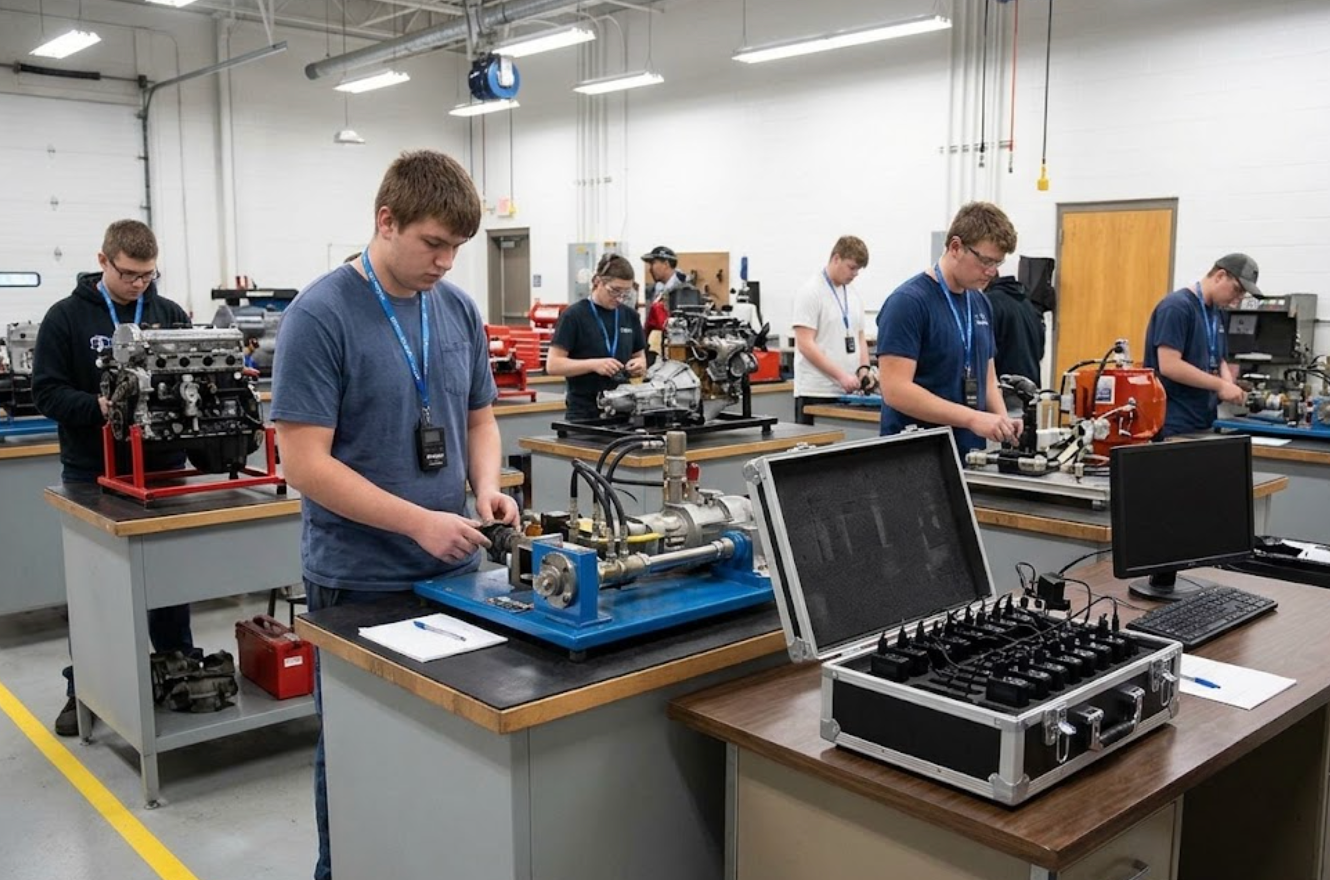
RC2500-auto_show-all-shift-anchor

The troubleshooting value of this tier shows up in what stops happening. Anchors on short-endurance hardware get swapped at midday, and every swap is a chance to pair the wrong receiver to the wrong podium. A transmitter that comfortably spans the entire show day removes the swap, and with it the most common self-inflicted fault of the afternoon. Fifty channels cover the anchor's own fleet with room to spare, though the RC2500's channel count is deliberately reserved for its core role rather than spread across every island in the hall.

🔋 The Closed-Room Rig Answers to a Power Switch

The strangest launch-day complaint is audio arriving where it was never invited: the neighboring press room hears the demo playing behind the wall, or the cafe picks up the reveal rehearsal. Closed-room demonstrations need headphone audio that reaches everyone inside and nobody outside, and the Silent Disco Wireless Headphone System treats that as a power-mode decision rather than an accident. Its RC-50RF transmitter runs in two modes: high power reaches past 500 meters and penetrates walls and ceilings, while low power holds the signal to roughly 200 meters, which keeps a demo contained to its own room.

The rig's 10 FM stereo channels solve a different launch problem: two presenters, one bench. A product manager can narrate in one language on channel one while an engineer takes deeper questions in another on channel two, and visitors switch by pressing a key instead of waiting for a second session. The five-color LED rings on each RC-409 headphone double as a diagnostic display: a crew member can sweep the room and spot, from across the floor, any headset sitting on the wrong color.

That color check scales into an audit habit that costs ten seconds per session. Before the doors of the demo room reopen, one crew member walks the perimeter while a colleague flips each channel in turn; any headset glowing the wrong color gets pulled and re-keyed on the spot. Because the headphones fold flat into a single transport case, the count at pack-down is a visual sweep rather than a checklist, and a rental fleet returning from a show can be verified channel by color before the next booking.

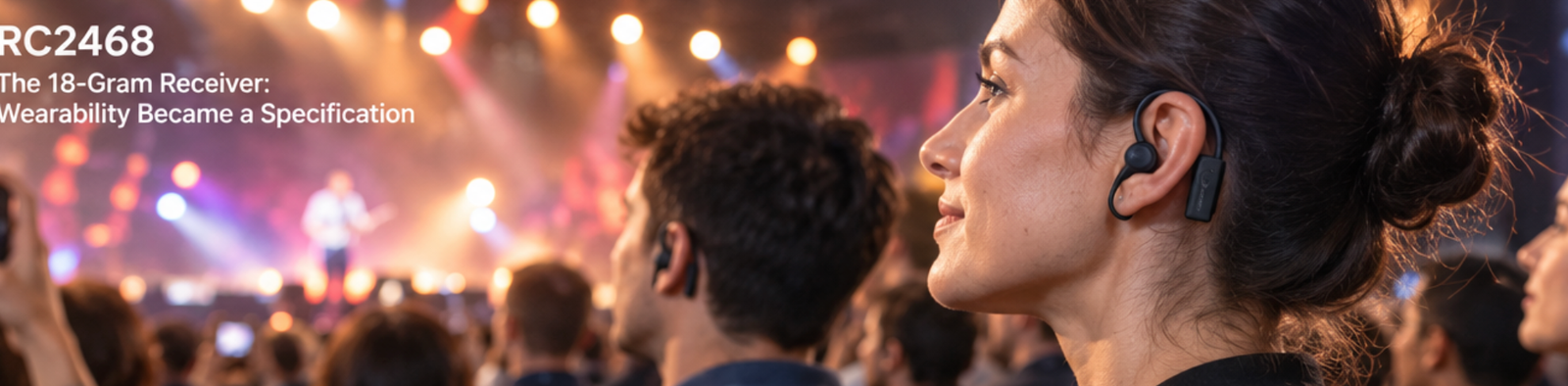
SilentDisco-auto_show-demo-room-mode

Turnaround math matters for a rig that runs all day in a fixed room. The headphones hold 500mAh of charge for 10 hours of operation and refill in 3 hours over Micro USB, so a fleet split into two halves can rotate through a lunchtime charge and still cover an evening reception. The 40mm Mylar drivers keep speech intelligible over the hall's background noise, with a signal-to-noise ratio above 75dB, and the foldable frame packs the whole fleet back into one case at the end of the run.

The Columns All Three Pages Can Fill

SpecificationRC2408RC2500Silent Disco Headphone System
Channels805010 (FM stereo)
Transmission range1-200m1-200mUp to 200m low-power; over 500m high-power
Receiver battery life20h35+h10h per charge
Charging portDC PortType-CMicro USB

What the Spec Pages Withhold

A few fields do not align cleanly across the three pages and are better read in prose than in a shared table. The two tour guide systems operate on the same published 2.4GHz band, 2403-2483MHz, while the Silent Disco page describes its link as UHF/RF stereo without publishing a numeric band, so the band row stays out of the table. Warranty terms also differ: the RC2408 and RC2500 pages carry the standard three-year mainboard warranty, and the Silent Disco page lists one year, which matters when a rental fleet takes show-floor abuse week after week.

Output power is the field this article deliberately leaves unquoted. The Silent Disco rig publishes a two-mode range figure instead of a wattage, and the tour guide pages list their transmission power at levels that read small next to consumer radios but are tuned for the licensing rules of the 2.4GHz band. None of these numbers changes the troubleshooting logic, which runs on channel maps, charge rotation, and power modes rather than raw wattage. Readers who want the complete published parameter set for either tour guide model will find it in the wireless tour guide system catalog.

🔮 A Diagnostic Order for the Next Show Morning

When the hall opens at nine and the complaints start at ten, work the ladder in the order the faults were sorted here. First, wrong voice: pull the channel map and re-assign, using the RC2408's sync key if a whole fleet moved. Second, dead headsets: check whether the unit was charged at all, then fall back to the RC2500 anchor units, whose 35-hour receivers absorb the shortfall. Third, audio in the wrong room: walk the Silent Disco transmitter back from high power to low power and confirm the LED colors at the door.

Crews that keep this order on the setup board resolve most launch-day audio faults inside a single session break, because each symptom points at one layer and each layer has exactly one owner in the kit. The deeper habit is to run the ladder in reverse during setup: fence the dial, charge the anchor, set the power mode, and the morning complaints never arrive. For readers weighing this kit against competing brands before committing to a fleet, the running head-to-head record lives in the solutions and comparison section.

🔋 Charge Rotation as a Piece of Show Infrastructure

A launch-day battery plan fails at the same place every time: the crew assumes one overnight charge covers one show day, and the show runs longer than the plan. The three systems in this kit answer that assumption differently. The RC2500 anchor units ignore the rotation entirely, since 35-hour receivers and a 15-hour transmitter span a two-day show. The RC2408 fleet charges once overnight and finishes a 10-hour transmitter day and a 20-hour receiver day with margin. The Silent Disco rig is the only one that genuinely needs a mid-day plan, and its 3-hour recharge makes a two-half rotation practical.

The rotation detail that separates organized crews from improvising ones is where the chargers live. A single charging table at the back of the demo room, labeled by half-fleet, turns the Silent Disco swap into a two-minute routine; the same table holds the RC2408 fleet's overnight top-up so no cable hunts happen during setup. Power strips taped along the booth's rear wall complete the picture, and the morning check is a glance at three indicators rather than a test of every unit.

Budget the rotation before the show, not during it. A two-day regional launch with one anchor, five islands, and a closed demo room needs roughly: one RC2500 pair plus a cold spare, an RC2408 fleet sized to the standing audience plus twenty percent, and two Silent Disco half-fleets that alternate through the lunch break. Written on the same setup board as the channel map, that plan becomes the third document a show crew cannot work without.

Frequently Asked Questions

1. Can the RC2408 and the Silent Disco rig run in the same hall without interfering?

Yes, because they are planned like neighbors, not like rivals. The RC2408's 80 channels leave room to place its fleet away from the frequencies the Silent Disco rig occupies, and the rig's low-power mode shrinks its footprint to a single room. A written channel map that includes both systems ends the question before it becomes a fault.

2. How many receiver units does a demo island actually need?

Count the standing audience a bench can hold and add twenty percent for shared headsets between two visitors. The RC2408 receivers weigh 50g, which keeps the comfort cost of a spare low, and the one-key sync means late additions pair in seconds rather than minutes.

3. Is the Silent Disco system suitable for the main stage?

It can serve a stage, but it is designed for contained rooms and multi-source benches: 10 channels, five-color LED identification, and foldable headphones built for rotation through a charge case. For a main stage that talks to the whole hall for hours, the RC2500's 35-hour receivers and one-key mute match the duty better.

4. What should be on the charger overnight for a two-day show?

Everything except the RC2500 anchor fleet, which finishes a two-day run without a recharge thanks to its 15-hour transmitter and 35-hour receivers. The RC2408 fleet tops up from a 10-and-20-hour day with room to spare, and the Silent Disco half-fleet rotation should be plugged in the moment the room closes, since its 3-hour refill fits inside any dinner break.

5. Who owns the troubleshooting ladder on a mixed-brand floor?

One person, and the assignment is written next to the channel map. The most common reason a ladder fails in practice is that two crews each assume the other is checking frequencies, charge state, and power modes. When a single owner signs the setup board, the wrong-voice check, the charge audit, and the power-mode walk each happen exactly once before doors open.


2026年10月29日 10:20
ꄘ click: 11

Get the spec sheet, MOQ and a factory-direct quote

Tell us the venue, the group size and how many languages you need. An engineer at our Shenzhen factory replies within one business day with the matching model, a written quote, lead time and the CE / RoHS / ISO 9001 documents.

Talk to an engineer WhatsApp +86 189 2287 9583

Prefer email? tiger.wang@richitek.com  |  OEM / ODM, custom tooling and neutral packaging available  |  send the enquiry through our contact page

Shenzhen Rich Age Electronics Co., Ltd. (Richitek) - manufacturing wireless tour guide systems, church translation headsets and museum audio guide equipment since 2007.

RC2408, RC2500 and the Silent Disco Headphone System: A Launch-Day Troubleshooting Ladder for the Demo Floor

time: 2026年10月29日 click:11

Auto shows and product launches fail acoustically in a way that warehouses and museums never do. A dozen exhibitors run demonstrations inside one hall, the organizer adds a main stage, and every visitor expects to hear the right presenter and nothing else. When something goes wrong, the crew rarely has more than the pause between two sessions to find the cause. This article sorts the three silence problems that show up on a launch day and matches each one to the hardware that ends it: the conference and launch-event kit built around the RC2408, the long-shift RC2500, and the Silent Disco headphone rig for closed demo rooms.

The sorting rule is simple. If visitors hear the wrong presenter, the fault lives in the frequency plan. If headsets die before the afternoon session, the fault lives in the battery plan. If audio from a private demo room turns up in the neighboring hall, the fault lives in transmitter power. Each section below takes one of those symptoms, traces it to the layer that produces it, and shows which of the three systems resolves it fastest.

RC2408 Fences the Dial Before Anyone Powers On

The classic launch-day fault is the wrong-voice complaint: a visitor on demo island three hears the pitch meant for island one. The cause is almost never a broken receiver. It is two islands assigned to the same channel, or a receiver that drifted off its assignment when someone re-paired it during setup. The RC2408 Wireless Tour Guide System was built for exactly this crowd: 80 independent channels on the global 2.4GHz ISM band at 2403-2483MHz, which is enough room to give every demo island its own block and still keep spares for the main stage and the press room.

The workflow that prevents the complaint costs nothing extra. Before doors open, the crew writes a channel map on the setup board: islands one through five take channels in the first block, the VIP route takes a second block, and a gap separates neighboring assignments so adjacent hardware never sits on touching frequencies. When a visitor reports the wrong voice, the fix is a lookup, not a diagnosis: check the map, re-assign, move on.

The launch hall adds interference that a museum never sees, and the channel plan has to absorb it. LED video walls, wireless microphone racks, and a few thousand visitor phones all crowd the 2.4GHz band, and the RC2408's PLL-locked tuning holds each assignment while the background noise shifts hour by hour. The eighty-channel budget also buys next year's floor plan: a stand that grows from five islands to eight does not need a second system, only a second block written on the same board.

RC2408-auto_show-channel-fence

Between sessions the RC2408 earns its second advantage: one-key channel synchronization. A launch day may run six or eight sessions, and each turnover may re-assign the fleet to a fresh block for the next presenter. Re-pairing sixty receivers by hand does not fit inside a fifteen-minute turnover; one synchronized command does. Battery expectations stay predictable across that schedule, with the transmitter rated at 10 hours of continuous work and each 50g receiver reaching 20 hours, so a unit charged the night before finishes the day without a mid-shift swap.

RC2500 Holds the Anchor Slot Through the Longest Day

Every show has one role that cannot rotate: the presenter stationed at the centerpiece vehicle or the main reveal podium, talking from the first press briefing to the last evening reception. That anchor slot is where the RC2500 Wireless Tour Guide System belongs, because its endurance figures are the deepest in the fleet: the transmitter runs 15 hours per charge and the receiver reaches 35 hours and more, with a standby figure of 35 hours and more on top.

The RC2500 is also the unit that absorbs the misclicks a long day produces. Its multi-function control puts synchronization, shutdown, and mute on dedicated one-key actions, so a presenter who fumbles during a live reveal presses one button instead of navigating a menu. The 104g transmitter has the substantial feel that anchors expect on a lanyard, and the Type-C charging port means the overnight top-up shares the same cables as the crew's phones, which removes one more item from the packing checklist.

There is a staffing dividend in that endurance, too. A crew that trusts the anchor unit stops building a midday relief roster, and the person who runs the centerpiece keeps the same transmitter from the press briefing to the evening reception, which means one pairing, one lanyard, and one microphone technique learned once. Shows that still want insurance carry a second RC2500 in the case as a cold spare rather than a working rotation, and because the spare shares the same one-key controls, activating it under pressure takes seconds.

RC2500-auto_show-all-shift-anchor

The troubleshooting value of this tier shows up in what stops happening. Anchors on short-endurance hardware get swapped at midday, and every swap is a chance to pair the wrong receiver to the wrong podium. A transmitter that comfortably spans the entire show day removes the swap, and with it the most common self-inflicted fault of the afternoon. Fifty channels cover the anchor's own fleet with room to spare, though the RC2500's channel count is deliberately reserved for its core role rather than spread across every island in the hall.

🔋 The Closed-Room Rig Answers to a Power Switch

The strangest launch-day complaint is audio arriving where it was never invited: the neighboring press room hears the demo playing behind the wall, or the cafe picks up the reveal rehearsal. Closed-room demonstrations need headphone audio that reaches everyone inside and nobody outside, and the Silent Disco Wireless Headphone System treats that as a power-mode decision rather than an accident. Its RC-50RF transmitter runs in two modes: high power reaches past 500 meters and penetrates walls and ceilings, while low power holds the signal to roughly 200 meters, which keeps a demo contained to its own room.

The rig's 10 FM stereo channels solve a different launch problem: two presenters, one bench. A product manager can narrate in one language on channel one while an engineer takes deeper questions in another on channel two, and visitors switch by pressing a key instead of waiting for a second session. The five-color LED rings on each RC-409 headphone double as a diagnostic display: a crew member can sweep the room and spot, from across the floor, any headset sitting on the wrong color.

That color check scales into an audit habit that costs ten seconds per session. Before the doors of the demo room reopen, one crew member walks the perimeter while a colleague flips each channel in turn; any headset glowing the wrong color gets pulled and re-keyed on the spot. Because the headphones fold flat into a single transport case, the count at pack-down is a visual sweep rather than a checklist, and a rental fleet returning from a show can be verified channel by color before the next booking.

SilentDisco-auto_show-demo-room-mode

Turnaround math matters for a rig that runs all day in a fixed room. The headphones hold 500mAh of charge for 10 hours of operation and refill in 3 hours over Micro USB, so a fleet split into two halves can rotate through a lunchtime charge and still cover an evening reception. The 40mm Mylar drivers keep speech intelligible over the hall's background noise, with a signal-to-noise ratio above 75dB, and the foldable frame packs the whole fleet back into one case at the end of the run.

The Columns All Three Pages Can Fill

SpecificationRC2408RC2500Silent Disco Headphone System
Channels805010 (FM stereo)
Transmission range1-200m1-200mUp to 200m low-power; over 500m high-power
Receiver battery life20h35+h10h per charge
Charging portDC PortType-CMicro USB

What the Spec Pages Withhold

A few fields do not align cleanly across the three pages and are better read in prose than in a shared table. The two tour guide systems operate on the same published 2.4GHz band, 2403-2483MHz, while the Silent Disco page describes its link as UHF/RF stereo without publishing a numeric band, so the band row stays out of the table. Warranty terms also differ: the RC2408 and RC2500 pages carry the standard three-year mainboard warranty, and the Silent Disco page lists one year, which matters when a rental fleet takes show-floor abuse week after week.

Output power is the field this article deliberately leaves unquoted. The Silent Disco rig publishes a two-mode range figure instead of a wattage, and the tour guide pages list their transmission power at levels that read small next to consumer radios but are tuned for the licensing rules of the 2.4GHz band. None of these numbers changes the troubleshooting logic, which runs on channel maps, charge rotation, and power modes rather than raw wattage. Readers who want the complete published parameter set for either tour guide model will find it in the wireless tour guide system catalog.

🔮 A Diagnostic Order for the Next Show Morning

When the hall opens at nine and the complaints start at ten, work the ladder in the order the faults were sorted here. First, wrong voice: pull the channel map and re-assign, using the RC2408's sync key if a whole fleet moved. Second, dead headsets: check whether the unit was charged at all, then fall back to the RC2500 anchor units, whose 35-hour receivers absorb the shortfall. Third, audio in the wrong room: walk the Silent Disco transmitter back from high power to low power and confirm the LED colors at the door.

Crews that keep this order on the setup board resolve most launch-day audio faults inside a single session break, because each symptom points at one layer and each layer has exactly one owner in the kit. The deeper habit is to run the ladder in reverse during setup: fence the dial, charge the anchor, set the power mode, and the morning complaints never arrive. For readers weighing this kit against competing brands before committing to a fleet, the running head-to-head record lives in the solutions and comparison section.

🔋 Charge Rotation as a Piece of Show Infrastructure

A launch-day battery plan fails at the same place every time: the crew assumes one overnight charge covers one show day, and the show runs longer than the plan. The three systems in this kit answer that assumption differently. The RC2500 anchor units ignore the rotation entirely, since 35-hour receivers and a 15-hour transmitter span a two-day show. The RC2408 fleet charges once overnight and finishes a 10-hour transmitter day and a 20-hour receiver day with margin. The Silent Disco rig is the only one that genuinely needs a mid-day plan, and its 3-hour recharge makes a two-half rotation practical.

The rotation detail that separates organized crews from improvising ones is where the chargers live. A single charging table at the back of the demo room, labeled by half-fleet, turns the Silent Disco swap into a two-minute routine; the same table holds the RC2408 fleet's overnight top-up so no cable hunts happen during setup. Power strips taped along the booth's rear wall complete the picture, and the morning check is a glance at three indicators rather than a test of every unit.

Budget the rotation before the show, not during it. A two-day regional launch with one anchor, five islands, and a closed demo room needs roughly: one RC2500 pair plus a cold spare, an RC2408 fleet sized to the standing audience plus twenty percent, and two Silent Disco half-fleets that alternate through the lunch break. Written on the same setup board as the channel map, that plan becomes the third document a show crew cannot work without.

Frequently Asked Questions

1. Can the RC2408 and the Silent Disco rig run in the same hall without interfering?

Yes, because they are planned like neighbors, not like rivals. The RC2408's 80 channels leave room to place its fleet away from the frequencies the Silent Disco rig occupies, and the rig's low-power mode shrinks its footprint to a single room. A written channel map that includes both systems ends the question before it becomes a fault.

2. How many receiver units does a demo island actually need?

Count the standing audience a bench can hold and add twenty percent for shared headsets between two visitors. The RC2408 receivers weigh 50g, which keeps the comfort cost of a spare low, and the one-key sync means late additions pair in seconds rather than minutes.

3. Is the Silent Disco system suitable for the main stage?

It can serve a stage, but it is designed for contained rooms and multi-source benches: 10 channels, five-color LED identification, and foldable headphones built for rotation through a charge case. For a main stage that talks to the whole hall for hours, the RC2500's 35-hour receivers and one-key mute match the duty better.

4. What should be on the charger overnight for a two-day show?

Everything except the RC2500 anchor fleet, which finishes a two-day run without a recharge thanks to its 15-hour transmitter and 35-hour receivers. The RC2408 fleet tops up from a 10-and-20-hour day with room to spare, and the Silent Disco half-fleet rotation should be plugged in the moment the room closes, since its 3-hour refill fits inside any dinner break.

5. Who owns the troubleshooting ladder on a mixed-brand floor?

One person, and the assignment is written next to the channel map. The most common reason a ladder fails in practice is that two crews each assume the other is checking frequencies, charge state, and power modes. When a single owner signs the setup board, the wrong-voice check, the charge audit, and the power-mode walk each happen exactly once before doors open.


Get the spec sheet, MOQ and a factory-direct quote

Tell us the venue, the group size and how many languages you need. An engineer at our Shenzhen factory replies within one business day with the matching model, a written quote, lead time and the CE / RoHS / ISO 9001 documents.

Talk to an engineer WhatsApp +86 189 2287 9583

Prefer email? tiger.wang@richitek.com  |  OEM / ODM, custom tooling and neutral packaging available  |  send the enquiry through our contact page

Shenzhen Rich Age Electronics Co., Ltd. (Richitek) - manufacturing wireless tour guide systems, church translation headsets and museum audio guide equipment since 2007.

×

Contact us

email:
name:
subject:
content: