RC2402, RC085 and RC2406: A Festival Roster Built on Crowd Pressure
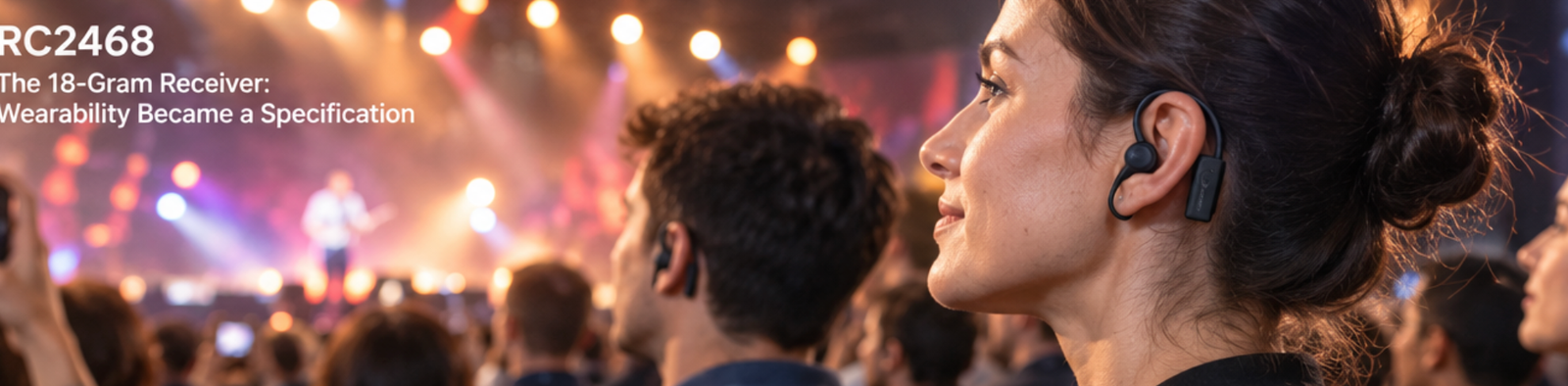
An outdoor festival does not really hire one crew; it hires three, and the difference between them is measured in people per square meter. The field packed against the main stage barrier, the roaming teams that patch gaps between zones, and the quiet corner where VIP guests actually want to hold a conversation all make different demands on the person wearing a headset. A staffing plan that hands every zone the same hardware either overspends on the calm areas or starves the loud ones. This guide sorts the roster by density first and by equipment second, then matches each tier to one of three transmitters so the equipment list writes itself from the ground plan.
💡 Why the Roster Starts With Square Meters
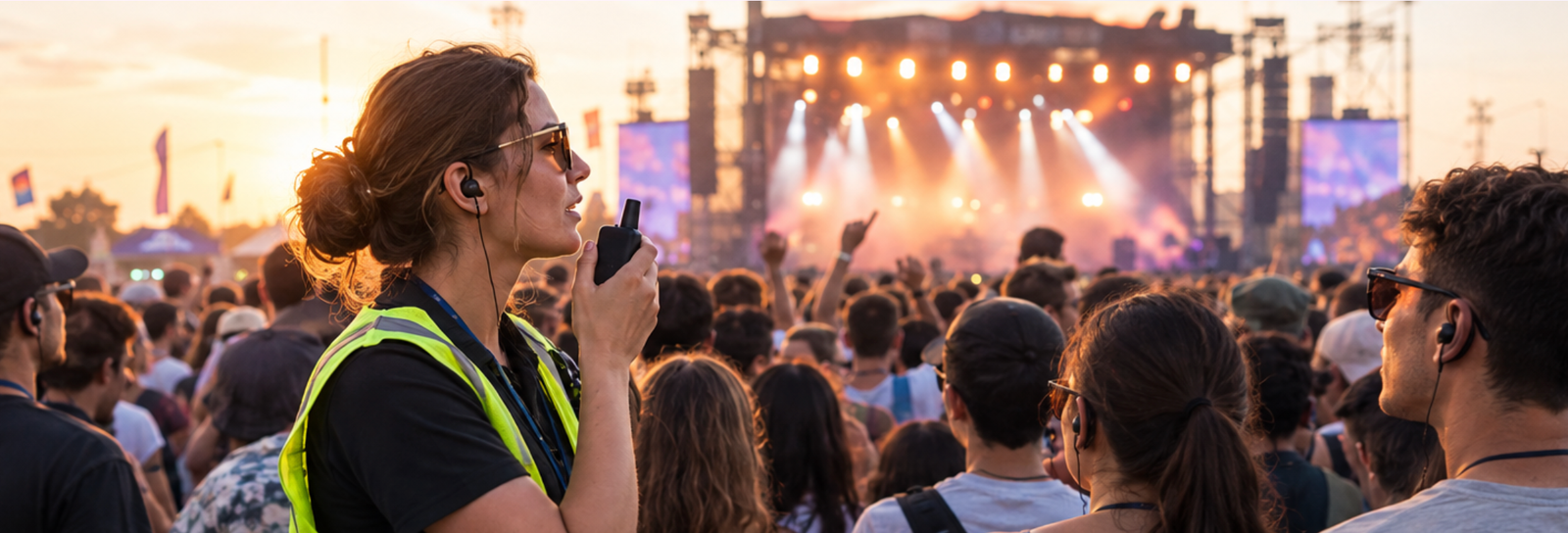
Draw the site map and divide it into three pressure bands. The first band is the dense field directly in front of the stages, where guests stand shoulder to shoulder for hours and every smartphone in the crowd fights for airspace. The second band is the mid-density circulation area: lane crews, medical pairs and runner teams that move with the flow and need to talk back, not just listen. The third band is the low-pressure edge — hospitality terraces, the family lawn, the press riser — where a guest wears a receiver for an hour and notices its weight more than its range. Zone-by-zone staffing is the same discipline conference organizers use, just stretched across a field instead of a hall.
One concrete Saturday shows how the three bands split a real site. A two-stage festival with a 9,000-guest capacity might run 760 guests in the dense field between the barrier and the mix tower, 5,400 spread through the food court and lanes, and the rest along the perimeter terraces. The field needs four guides on microphones and roughly five hundred receivers issued at three barrier points; the lanes need no receivers at all but fourteen two-way earpieces; the terraces need two hosts and ninety receivers that come back before the headline set even starts. Three bands, three usage curves, three different return times — and the equipment sheet follows directly from those curves rather than from a flat percentage of headcount.
Each band also carries its own failure mode. In the dense field the enemy is radio congestion: hundreds of phones, payment terminals and production links sharing the same air. In the circulation band the enemy is silence — a runner who cannot answer the gate chief wastes minutes walking back. In the quiet band the enemy is embarrassment: a crosstalk leak from a neighboring zone drifts into a conversation that was supposed to stay private. One device per band, chosen for that failure mode, is cheaper than any compromise unit stretched across all three.
The Dense Field in Front of the Stage Belongs to the RC2406
Where the crowd stands thickest, the air is worst. Payment terminals, phone hotspots and dozens of unofficial transmitters crowd the spectrum, so a guide system with only a handful of channels can be boxed out by its own environment. The RC2406 carries 80 channels built on PLL anti-interference technology, which lets the stage-left crew sit on a clean slot even while stage-right, the merch tent and the medical post all run their own groups at the same hour. The channel count is the whole argument: an 80-channel fence means the next crew that arrives can always find a door.
The fence arithmetic is worth writing down because it decides the plan's headroom. A single stage day at this size runs six to nine simultaneous guide groups: two per stage, one for the accessibility platform, one for media, one for sponsors, and whatever the medical post keeps open. At 50 channels that is comfortable until a vendor's own intercom or a broadcast link lands next door and forces a mid-afternoon move; at 80 channels the site keeps at least seventy unused slots even on its busiest hour, and moving one group never means renegotiating with another. The PLL lock also holds the slot once chosen, so a group that settles at channel 63 in the soundcheck is still at channel 63 during the encore instead of drifting onto a neighbor.
The physical conditions in that field argue for the same unit. Beverage spills and rain spray are routine at the barrier line, and the RC2406's IPX4 splash-resistant rating matches a day of both without a protective sleeve. Its receivers weigh 50 grams, which matters when a guest wears one for a three-hour set, and the 1500mAh lithium battery is rated for full-day continuous use, so a morning charge survives the headline slot. Transmitter endurance is 10 hours and receivers hold 20, which covers a festival day twice over and leaves the overnight reset as a formality rather than a scramble.
Roaming Crews Answer Back on the RC085
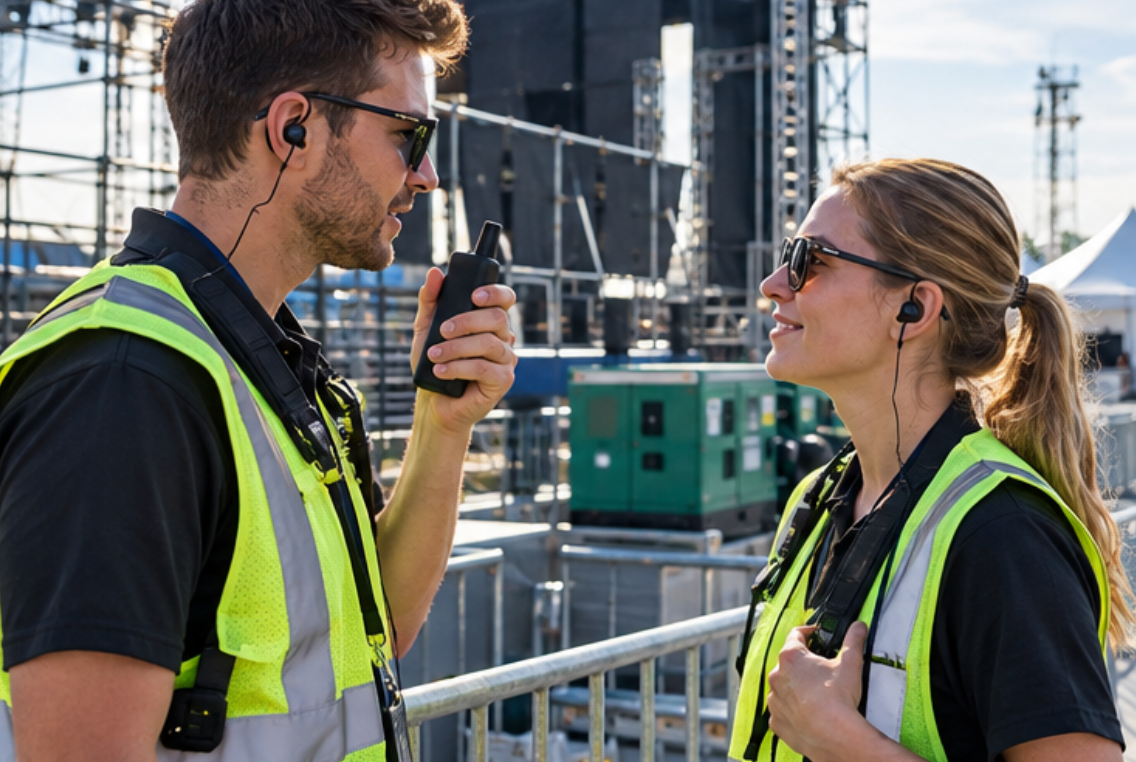
The circulation band fails in a different direction. Lane stewards, medical pairs and runner teams do not need to hear a script; they need to reply. The RC085 is the only one of the three kits with a two-way mode: its F1 setting runs the standard one-way broadcast for briefings, while F2 opens two-way communication so a gate chief can hear the runner's answer without a second radio system. On a site where the production crew already carries clip-on radios, folding the guest-facing audio and the crew check-back into one UHF platform removes an entire device class from the roster sheet.
The hardware supports that role. The RC085 transmits on 470–510MHz UHF, a band with stronger penetration through tents, scaffolding and generator stacks than 2.4GHz, and it offers 100 channels for group operation — more slots than any other unit on the site. The transmitter carries an LCD smart screen with auto sleep and wake-up, so a crew chief can read the channel at a glance in the dark behind the stage. Battery endurance runs 12 hours on the transmitter and 20 on the receiver, the longest transmitter shift of the three kits, which suits a team that deploys before the gates open and stands down after the last encore.
Two page-level details round out the RC085's crew role. The first is that the unit accepts an optional headset or lavalier microphone, which is how the same transmitter that guides a tour doubles as the safety briefing microphone at the morning gate meeting — one device, two jobs, no duplicate kit on the roster. The second is the published receiver sensitivity of roughly -102dBm, the figure that explains why the UHF link stays intelligible behind generator stacks and inside steel scaffolding where a weaker front end would hiss. Neither detail changes what the crew pays per unit, but both change how many separate devices the production office has to buy, charge and count.
The RC2402 Holds the Quiet Corner
The low-pressure band has almost no radio congestion, so raw channel count stops being the deciding factor, and comfort plus privacy move to the front. The RC2402 is the basic 2.4G standard version with 50 channels, and on a quiet terrace 50 clean slots are more than any hospitality zone will ever occupy at once. What the zone actually buys with this unit is discretion: the RC2402 includes intelligent encryption technology that prevents crosstalk, so a VIP terrace guide never leaks into the family lawn group two slots away, and one-click frequency synchronization lets a supervisor re-team the whole zone between sittings without re-briefing every host.
The quiet corner also gets one organizational trick that costs nothing: all three kits ship in colors that can be ordered per batch for volume buyers, so a site can make the terrace fleet visually distinct from the field fleet at a glance. When ninety receivers come back at 21:40 and five hundred come back at 23:15, the color split means an unpaid intern can sort the return cart correctly on the first pass, and a unit that wandered home in the wrong crate is spotted before it is reissued to the wrong zone. For operators whose season crosses borders, the RC2402's license-free 2.4G operation removes the frequency paperwork from that planning entirely, which is often the difference between quoting a neighboring country's date and declining it.
Weight and battery figures finish the case. Receivers weigh 50 grams and the transmitter 59, the lightest pairing on the sheet together with its sibling, and guests who wear a unit for a single tasting or tour notice the difference. The transmitter runs 10 hours and receivers 20 on their lithium packs, and the 2403–2483MHz band is license-free worldwide, which matters to festival operators whose season crosses borders and whose hospitality contractor may arrive from another country with hardware expectations formed elsewhere.
The Three Kits on One Sheet
The numbers below come from the September 2026 comparison sheet, the single source of record for every figure in this guide, so the roster committee can photocopy it straight into the equipment plan.
| Comparison Dimension | RC2402 | RC085 | RC2406 |
|---|---|---|---|
| Core Frequency Band | 2403–2483 MHz (2.4G) | 470–510 MHz (UHF) | 2403–2483 MHz (2.4G) |
| Number of Channels | 50 | 100 | 80 |
| Transmission Distance | 1–200m | 1–200m | 1–200m |
| Output Power | 10mW | 8–10mW | 10mW |
| Transmitter Battery Life | 10h | 12h | 10h |
| Receiver Battery Life | 20h | 20h | 20h |
| Transmitter Weight | 59g | 65g | 59g |
| Receiver Weight | 50g | 60g | 50g |
| Charging Port | DC Port | USB | DC Port |
Read as a hiring sheet, the table says what the zones already suggested: the RC085 buys the longest transmitter shift, the widest band and the deepest channel bench at the cost of slightly heavier receivers, the RC2406 buys interference headroom in the middle of the sheet, and the RC2402 buys the same comfort numbers as the RC2406 with fewer channels than either — which its zone never misses.
Where the Spec Pages Go Quiet
Three differences between the kits live outside the table because the manufacturer publishes them unevenly, and the roster sheet should quote only what each product page actually states. Certification lists are the first case: the RC2402 page lists CE, EMC, LVD, RED and RoHS, the RC085 page lists CE, RED and RoHS, and the RC2406 page lists RoHS compliance, so a procurement officer who needs a specific mark should confirm it against the page for the unit being bought rather than assume the set carries it. The second case is ingress protection: only the RC2406 page states an IPX4 splash rating, so water resistance cannot be claimed for the other two kits even though all three work the same festival. The third case is feature asymmetry: the F1/F2 two-way modes belong to the RC085 alone, the intelligent encryption belongs to the RC2402 alone, and neither page extends those features to its siblings. Where a page is silent, this guide stays silent with it rather than inferring.
What the pages do agree on is the support picture: all three product pages state a three-year warranty covering the mainboard, with vulnerable parts such as headsets, microphones and batteries excluded. For a festival that runs a season of weekends, that split matters — the mainboard is the part a rental fleet cannot quickly swap, while earpieces and packs are consumables the site stocks anyway.
Training the Gate Line and the Overnight Reset
Density-based rosters fail at handover, not at purchase, so the training block deserves its own line on the plan. The good news is that none of the three kits asks a seasonal steward to learn much. One-click frequency synchronization on the RC2402 and the PLL channel lock on the other two units mean a supervisor presets every group the night before, and a crew member's entire skill is power, wear and speak. The same morning-length training routine works for teaching and instruction crews, which is why many festival organizers reuse their hospitality briefing deck across the medical and lane teams without a separate session. The RC085's F2 mode does need one extra drill — a thirty-second answer-back exercise so runners practice releasing the talk button — and that is the only equipment-specific training on the site.
Staffing math closes the loop. A dense field of two thousand guests typically runs one guide per two hundred to three hundred guests with receivers issued at the barrier, a circulation band runs on fixed pairs rather than ratios, and the quiet corner needs one host per sitting. Because the receiver fleets share the same 20-hour endurance figure, the charging cart does not care which zone a unit came home from, and neither does the person who counts them back in.
The full count for the example Saturday lands at six transmitters and roughly five hundred ninety receivers across the three fleets, which is small enough to fit on one charging cart and one reclaim table. What keeps that count honest is issuing discipline tied to the bands: barrier points hand receivers out against ticket scans and take them back at the same gate, the lane teams sign their two-way earpieces out at the production office where the F2 drill happened, and the terrace host collects her ninety units at the sit-down she already runs. No zone ever borrows another zone's fleet, so the nightly audit is three short counts instead of one long argument about where a missing unit was last seen.
After the encore the three fleets converge on one charging table, and the sheet's charging column becomes the night shift's instruction. The RC2402 and the RC2406 charge over their DC ports while the RC085 charges over USB, so the cart needs both cable families labeled by zone. Transmitter packs — 1500mAh in the two 2.4G units, 1200mAh in the UHF unit — and receiver packs of 1000mAh across all three fleets refill inside the window between the last set and the first soundcheck, and the 20-hour receiver endurance means even a unit that missed the cart still opens the next day alive. The full wireless tour guide system range follows the same reset logic, so adding a fourth zone next season extends the routine instead of replacing it.
The last item on the nightly checklist is a channel audit rather than a battery one. Confirm the dense field still sits on its 80-channel fence slot, the UHF crew on one of its 100, and the quiet corner on its encrypted 50, because the spectrum at a festival changes nightly as vendors arrive. A five-minute audit keeps each tier's original argument — interference headroom, two-way reply, private comfort — true for every show day of the season.