A leading China factory specializing in Wireless Tour Guide Systems, Church Audio Guides, and Translation Headphones with premium OEM/ODM solutions.

Tel:+86 18922879583

Email:tiger.wang@richitek.com

RC9150 and RC8860 at the Terminal Gate: The Compliance Path Each Radio Takes Ashore

A wireless tour guide kit arriving at a container terminal passes two inspections, not one. The first happens at customs, where the paperwork travels with the carton. The second happens at the gate itself, where the radio has to earn its place among cranes, steel racking and two-shift noise without breaking a single national rule about who may transmit on which frequency. Equipment that fails the second inspection gets locked in a site office drawer just as surely as equipment that fails the first gets turned back at the border.

This article follows three kits through that double inspection: the RC9150 on the global 2.4G band, the RC8860 on UHF 860-870 MHz, and the 2.8-Inch Semi-Auto Digital Audio Guide, a recorded player that never transmits at all. Each takes a different compliance path through the same port, and the differences decide which kit belongs on which route.

📡 📡 What Gets Checked Before a Radio Powers On at a Port Terminal

Three questions stand between a shipment and a working deployment, and they arrive in a fixed order. First, the frequency question: is this band license-free in this country, or does the operator need a permit before the first transmission? Second, the documentation question: does the unit carry the certifications the destination market expects, CE and its radio sibling RED being the usual entry ticket? Third, the site question: can the hardware survive the physical rules of the terminal, from washdown hoses to noise levels that swallow a whisper?

Notice that only one of the three is about radio law. The other two are about paper and physics, and a kit that aces the frequency question can still fail on a missing declaration or a housing that quits after one rainy shift. The three products below answer the three questions in three different ways, which is precisely why a mixed fleet makes sense for industrial tour headsets and terminal walkthroughs alike.

The order matters because each check has a different owner and a different lead time. The frequency question belongs to the destination country's regulator and can be settled from a desk weeks before sailing. The documentation question belongs to whoever assembles the shipment file, and it is answered the day the certificates are photocopied into the dossier. The site question belongs to the terminal itself and usually only surfaces on the morning of the first walkthrough, when the shift supervisor hands over a map of hearing-protection zones and a list of rules nobody thought to ask about. A fleet that prepares the three questions in reverse order — site first, paperwork second, frequency last — discovers its problems at the worst possible moment, standing at the gate with a group of visitors waiting.

💰 The 2.4G Passport: RC9150 Deploys on a Global, License-Free Band

The RC9150 transmits on 2403-2483 MHz, the global ISM band that every Wi-Fi router and Bluetooth headset already shares. License-free worldwide is not marketing shorthand here; it is the regulatory design of the band itself, which means a radio bought for a Rotterdam terminal works unchanged in Singapore, Busan or Long Beach without a single regional variation to check. For a shipping company that rotates staff and visitor groups across continents, that one property removes the entire first inspection from the checklist.

The documentation stack travels with it. The unit ships with CE, EMC, LVD, RED and RoHS certifications, which covers both the radio directive and the low-voltage and safety directives inspectors sometimes ask about on industrial sites. Inside the link, intelligent encryption keeps the audio content private, a detail that matters when the briefing covers cargo manifests or security procedures that should not reach a bystander's earbud. On the bench numbers, the transmitter runs 15 hours and the receiver 35-plus hours on 3.7V 1800mAh cells, with 100 independent channels and a 200-meter open-ground range carrying the link through a crowded terminal. Charging runs over Type-C, so the same cable stock that powers the site's other gear powers the radios.

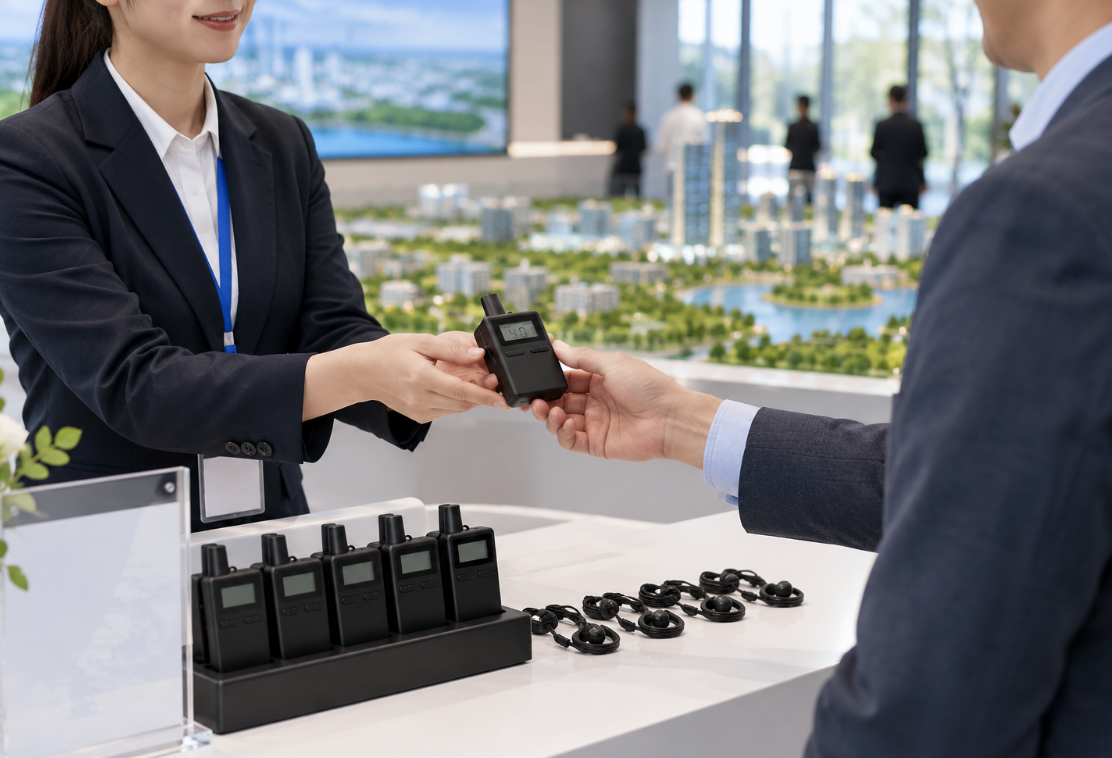
rc9150-multigroup-terminal

RC8860 and the UHF Fine Print: Free in Most Regions, Restricted in the Rest

The RC8860 takes a different bargain. Its 860-870 MHz UHF band is globally accepted and license-free in most regions, and UHF's physical behavior — strong penetration through walls and steel obstacles — is exactly why it earns its keep in a container yard. But "most regions" is the phrase the compliance officer underlines. License conditions for UHF differ country by country: some allow the band freely, some cap the power, some reserve slices for other services. A fleet that never leaves one country loses nothing; a fleet that crosses borders inherits a verification task at every stop.

Where the paperwork is in order, the hardware holds up its side. Twenty PLL-synthesized channels keep groups separated without crosstalk, the transmitter carries 1500mAh for 10 hours against the receiver's 1000mAh for 20 hours, and the whole link respects the same 200-meter open-ground envelope. The housing carries an IPX4 splash-proof rating, which stands up to washdown spray and the rain that a quay deck guarantees. Certifications cover CE and RoHS, and the warranty runs three years on the mainboard with the headset, microphone and battery excluded as consumables — a clause worth reading before the purchase order, not after the first repair.

The twenty channels deserve a word on their own, because group arithmetic is where compliance meets daily operation. Three visitor groups can walk the same quay simultaneously — one on channel 4, one on 9, one on 15 — and each transmitter addresses only its own receivers, so the three briefings never bleed into each other. That still leaves seventeen channels unassigned, which absorbs the neighbor terminal's own kit or a fourth group added without warning. The PLL synthesis behind the separation is what keeps a crowded yard from turning into a chorus of overlapping guides, and it does so without any coordination beyond agreeing which group takes which number.

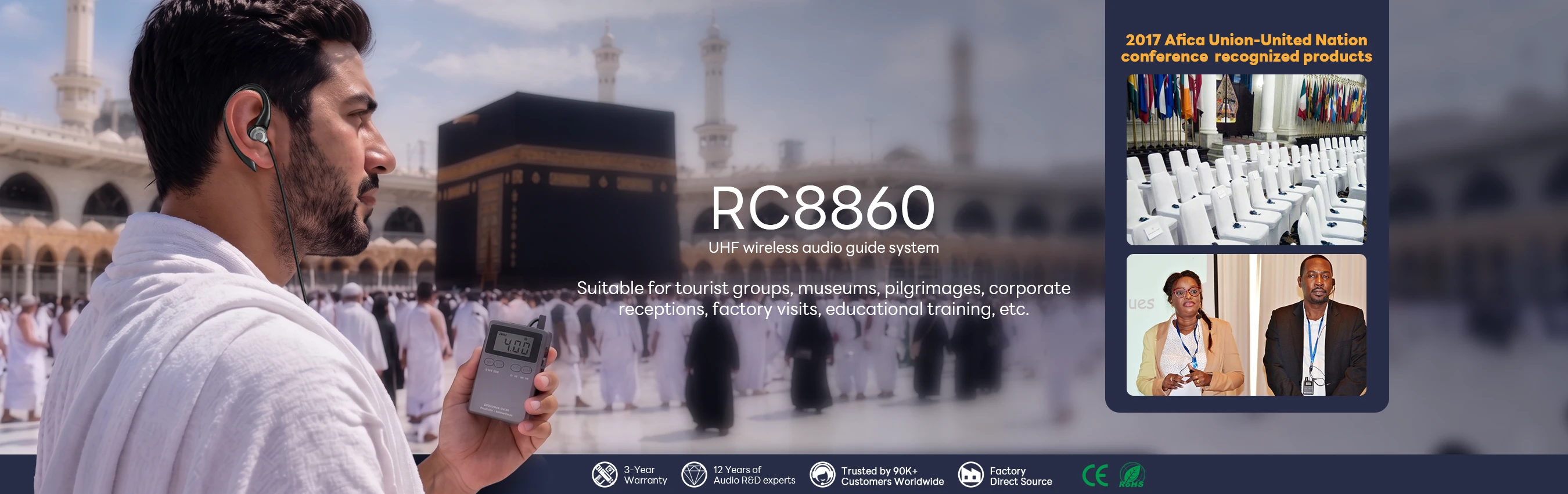
rc8860-quay-washdown

📡 The Recorder That Signs Nothing: 2.8-Inch Semi-Auto Playback Without a Radio

The third kit answers the compliance question by refusing to ask it. The 2.8-Inch Semi-Auto Digital Audio Guide contains no transmitter at all: a visitor keys a 0-9 number pad, and the unit plays the matching file from its 2GB of internal memory. No transmission means no frequency license, no radio directive, and no site-coordination talk — the device is legally just another consumer electronics product crossing the border. In terminals that double as secure facilities, or in zones where transmitting equipment needs written permission regardless of band, that silence is the entire feature.

The trade is capacity for freedom. The player holds up to 9999 audio files across 16 languages, which absorbs a full multilingual safety induction, and it runs 18 hours per charge through a Micro USB interface, enough to cover both shifts of a two-shift site before it sees a cable again. It will never carry a live question from the back of the group, and it cannot be re-briefed mid-walk the way a transmitted tour can. Where the content is fixed, the script is reviewed in advance, and the route is repeatable, the recorder is the compliance path with the shortest paper trail.

Running a recorder fleet is mostly a content exercise. Terminal inductions change when routes change, so the practical routine is a numbered map: exhibit point one through however many the route holds, each with sixteen language files behind the same key, named so a visitor pressing 7 always hears the same stop regardless of the language selected. Updates ride in over the same Micro USB port that charges the unit, which means a content refresh happens on a bench with a laptop rather than through any regulatory process at all. For a safety script that gets re-approved twice a year, that update path — no network, no pairing, no re-licensing — is one more approval the recorder simply never needs.
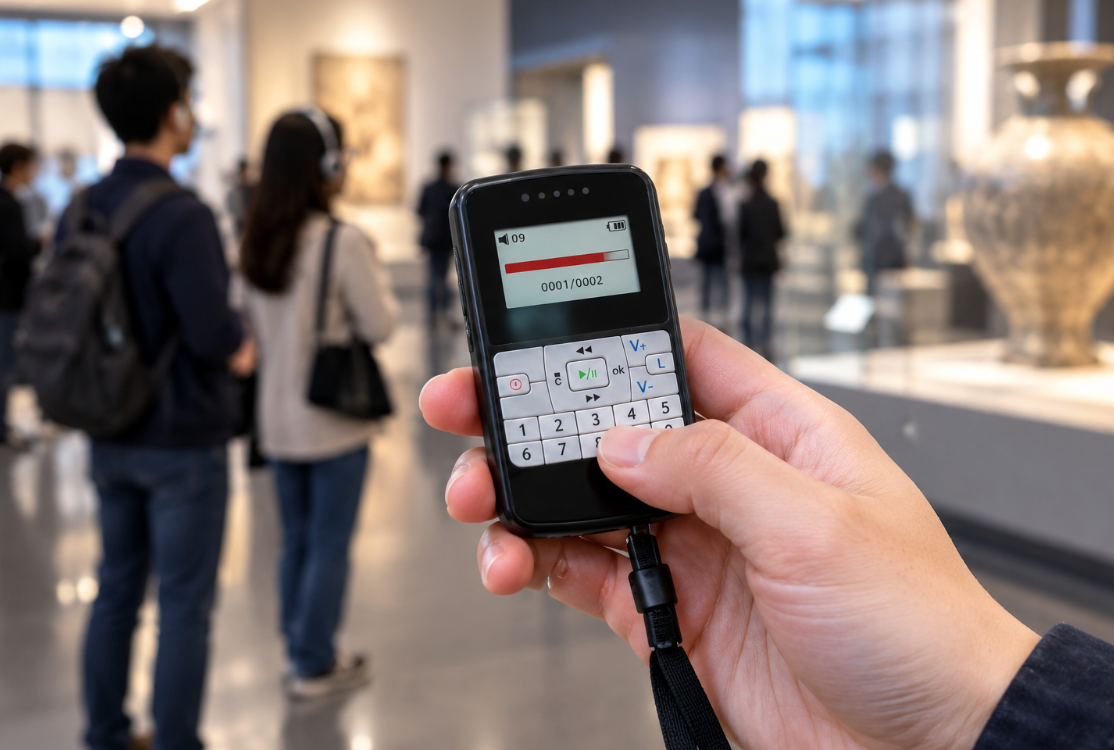
semiauto-recorder-keypad

✅ 📋 The Compliance Sheet: Three Kits, Three Document Stacks

Side by side, the three paths sort cleanly. The table lists only the figures all three kits publish or that clearly do not apply; the columns that only one or two units document are held back and covered in the paragraph below, because a blank cell in a compliance comparison is a different animal from a zero.

Deployment figureRC9150RC88602.8-Inch Semi-Auto
Band and license status2.4G global ISM, license-free worldwideUHF 860-870 MHz, license-free in most regionsNo radio; recorded playback only
Channels10020 (PLL)Not applicable
Rated runtimeTX 15h / RX 35+hTX 10h / RX 20h18h playback
Charging portType-CDC PortMicro USB
Transmission rangeUp to 200m open groundUp to 200m open groundNot applicable

Three columns stayed out of the table on purpose. Certifications are published for the two transmitters — CE, EMC, LVD, RED and RoHS for the RC9150; CE and RoHS for the RC8860 — but not for the recorder, so the column moves here rather than showing a gap. Ingress protection is documented only for the RC8860's IPX4 housing. Content encryption is an RC9150 feature with no counterpart on the other two. Warranty figures are published at three years on the mainboard for both radio kits, with the RC8860's terms explicitly excluding headset, microphone and battery. None of these omissions is a weakness; each is just a field where one kit publishes and the others do not, and pretending otherwise would put invented numbers into a compliance document.

🪧 🦺 Site Rules the Terminal Adds on Top of the Law

Clearing customs does not clear the quay. Terminals run their own hardware rules, and they are stricter than most visitors expect. Hearing protection zones around ship-to-shore cranes cap the ambient noise a guide system must punch through, which favors the RC8860's 50Hz-12kHz voice profile built to cut through industrial sound. Washdown schedules and open-weather decks make the IPX4 rating a working requirement rather than a brochure line. And in facilities where visitor groups move through restricted zones, the site may simply ban active transmitters on certain days — the scenario where the recorder's silent nature turns from compromise to advantage.

Battery discipline is the quiet fourth rule. A two-shift walkthrough schedule asks more from a charging routine than a single museum tour does, and the three kits answer differently: the RC9150's 35-plus-hour receiver stretch covers a multi-day rotation without a nightly cable hunt, the RC8860 pairs a 10-hour transmitter against a 20-hour receiver to match a shift split, and the recorder's 18 hours lands just past the second shift. The right match depends on who recharges at the gate and when.

A concrete morning shows how the rules stack. Thirty visitors arrive for a terminal induction at 09:00 and split into three batches at the gate, each batch taking one transmitter and ten receivers. The route crosses two hearing-protection zones and an active loading bay, so the briefing pauses are pre-agreed with the shift supervisor, the guide's transmitter runs the whole ninety minutes without a swap, and the receivers go into a charging crate at the exit gate where the second batch picks them up for the 11:00 slot. Two batteries per unit per day is the arithmetic that falls out of that schedule — and it is the schedule, not the specification sheet, that decides whether a 20-hour receiver is generous or merely adequate.

Matching the Kit to the Route the Fleet Actually Drives

The decision collapses to one question: how many borders does this route cross? A fleet whose wireless tour guide systems deploy across multiple countries takes the RC9150, because the global ISM band and the five-certification stack make every port identical from a paperwork standpoint. A fleet anchored at one European terminal with deep steel between the groups takes the RC8860, trading multi-country freedom for UHF penetration and the splash-proof housing. A site with fixed scripts, radio-restricted zones or sixteen language requirements loads the recorder and skips the frequency conversation entirely.

Fleets mix them. A common arrangement pairs RC8860 units for the yard floor with a rack of recorders for the induction room, or standardizes on the RC9150 for traveling staff while the recorder handles the visitor center. Mixed fleets inherit a mixed charging shelf — Type-C, DC Port and Micro USB on the same bench — which is worth planning before the first delivery, not after.

If the route map is still open, the solutions overview lays out the full hardware range, and the factory team can confirm certification copies and band conditions for the specific countries on the schedule before the order is cut.


Frequently Asked Questions

1. Is the 860-870 MHz band legal in every country?

License-free in most regions, but not guaranteed everywhere — some countries cap output power or reserve parts of the band for other services. Before a cross-border deployment, verify the band condition for each destination country; a fixed single-country fleet only checks once.

2. Does the RC9150 need a license anywhere it operates?

No. It transmits on 2403-2483 MHz, the global ISM band shared with Wi-Fi and Bluetooth, which is license-free worldwide. The 100 independent channels keep groups separated within the band, and CE, EMC, LVD, RED and RoHS certifications ship with the unit for market-entry inspection.

3. What does the 3-year warranty actually cover?

The mainboard, on both radio kits. Consumable parts are excluded — on the RC8860 the terms name the headset, microphone and battery explicitly. Reading the exclusion list before purchase matters more at an industrial site than at a museum, because headset and battery turnover runs higher there.

4. Can the 2.8-Inch Semi-Auto guide be used where transmitters are banned?

Yes. It contains no radio transmitter at all — playback is triggered from the 0-9 keypad against files stored in 2GB of internal memory — so it is treated as a consumer electronics device rather than transmitting equipment, and it faces no frequency license in any market.

5. Which kit survives rain and washdown on a quay deck?

The RC8860 is the one with a published IP rating: IPX4 splash-proof, rated against light rain and spills. The other two kits do not publish an ingress protection figure, so for open-weather routes their housings should be treated as office-grade and cased accordingly.


2026年10月29日 10:57
ꄘ click: 12

Get the spec sheet, MOQ and a factory-direct quote

Tell us the venue, the group size and how many languages you need. An engineer at our Shenzhen factory replies within one business day with the matching model, a written quote, lead time and the CE / RoHS / ISO 9001 documents.

Talk to an engineer WhatsApp +86 189 2287 9583

Prefer email? tiger.wang@richitek.com  |  OEM / ODM, custom tooling and neutral packaging available  |  send the enquiry through our contact page

Shenzhen Rich Age Electronics Co., Ltd. (Richitek) - manufacturing wireless tour guide systems, church translation headsets and museum audio guide equipment since 2007.

RC9150 and RC8860 at the Terminal Gate: The Compliance Path Each Radio Takes Ashore

time: 2026年10月29日 click:12

A wireless tour guide kit arriving at a container terminal passes two inspections, not one. The first happens at customs, where the paperwork travels with the carton. The second happens at the gate itself, where the radio has to earn its place among cranes, steel racking and two-shift noise without breaking a single national rule about who may transmit on which frequency. Equipment that fails the second inspection gets locked in a site office drawer just as surely as equipment that fails the first gets turned back at the border.

This article follows three kits through that double inspection: the RC9150 on the global 2.4G band, the RC8860 on UHF 860-870 MHz, and the 2.8-Inch Semi-Auto Digital Audio Guide, a recorded player that never transmits at all. Each takes a different compliance path through the same port, and the differences decide which kit belongs on which route.

📡 📡 What Gets Checked Before a Radio Powers On at a Port Terminal

Three questions stand between a shipment and a working deployment, and they arrive in a fixed order. First, the frequency question: is this band license-free in this country, or does the operator need a permit before the first transmission? Second, the documentation question: does the unit carry the certifications the destination market expects, CE and its radio sibling RED being the usual entry ticket? Third, the site question: can the hardware survive the physical rules of the terminal, from washdown hoses to noise levels that swallow a whisper?

Notice that only one of the three is about radio law. The other two are about paper and physics, and a kit that aces the frequency question can still fail on a missing declaration or a housing that quits after one rainy shift. The three products below answer the three questions in three different ways, which is precisely why a mixed fleet makes sense for industrial tour headsets and terminal walkthroughs alike.

The order matters because each check has a different owner and a different lead time. The frequency question belongs to the destination country's regulator and can be settled from a desk weeks before sailing. The documentation question belongs to whoever assembles the shipment file, and it is answered the day the certificates are photocopied into the dossier. The site question belongs to the terminal itself and usually only surfaces on the morning of the first walkthrough, when the shift supervisor hands over a map of hearing-protection zones and a list of rules nobody thought to ask about. A fleet that prepares the three questions in reverse order — site first, paperwork second, frequency last — discovers its problems at the worst possible moment, standing at the gate with a group of visitors waiting.

💰 The 2.4G Passport: RC9150 Deploys on a Global, License-Free Band

The RC9150 transmits on 2403-2483 MHz, the global ISM band that every Wi-Fi router and Bluetooth headset already shares. License-free worldwide is not marketing shorthand here; it is the regulatory design of the band itself, which means a radio bought for a Rotterdam terminal works unchanged in Singapore, Busan or Long Beach without a single regional variation to check. For a shipping company that rotates staff and visitor groups across continents, that one property removes the entire first inspection from the checklist.

The documentation stack travels with it. The unit ships with CE, EMC, LVD, RED and RoHS certifications, which covers both the radio directive and the low-voltage and safety directives inspectors sometimes ask about on industrial sites. Inside the link, intelligent encryption keeps the audio content private, a detail that matters when the briefing covers cargo manifests or security procedures that should not reach a bystander's earbud. On the bench numbers, the transmitter runs 15 hours and the receiver 35-plus hours on 3.7V 1800mAh cells, with 100 independent channels and a 200-meter open-ground range carrying the link through a crowded terminal. Charging runs over Type-C, so the same cable stock that powers the site's other gear powers the radios.

rc9150-multigroup-terminal

RC8860 and the UHF Fine Print: Free in Most Regions, Restricted in the Rest

The RC8860 takes a different bargain. Its 860-870 MHz UHF band is globally accepted and license-free in most regions, and UHF's physical behavior — strong penetration through walls and steel obstacles — is exactly why it earns its keep in a container yard. But "most regions" is the phrase the compliance officer underlines. License conditions for UHF differ country by country: some allow the band freely, some cap the power, some reserve slices for other services. A fleet that never leaves one country loses nothing; a fleet that crosses borders inherits a verification task at every stop.

Where the paperwork is in order, the hardware holds up its side. Twenty PLL-synthesized channels keep groups separated without crosstalk, the transmitter carries 1500mAh for 10 hours against the receiver's 1000mAh for 20 hours, and the whole link respects the same 200-meter open-ground envelope. The housing carries an IPX4 splash-proof rating, which stands up to washdown spray and the rain that a quay deck guarantees. Certifications cover CE and RoHS, and the warranty runs three years on the mainboard with the headset, microphone and battery excluded as consumables — a clause worth reading before the purchase order, not after the first repair.

The twenty channels deserve a word on their own, because group arithmetic is where compliance meets daily operation. Three visitor groups can walk the same quay simultaneously — one on channel 4, one on 9, one on 15 — and each transmitter addresses only its own receivers, so the three briefings never bleed into each other. That still leaves seventeen channels unassigned, which absorbs the neighbor terminal's own kit or a fourth group added without warning. The PLL synthesis behind the separation is what keeps a crowded yard from turning into a chorus of overlapping guides, and it does so without any coordination beyond agreeing which group takes which number.

rc8860-quay-washdown

📡 The Recorder That Signs Nothing: 2.8-Inch Semi-Auto Playback Without a Radio

The third kit answers the compliance question by refusing to ask it. The 2.8-Inch Semi-Auto Digital Audio Guide contains no transmitter at all: a visitor keys a 0-9 number pad, and the unit plays the matching file from its 2GB of internal memory. No transmission means no frequency license, no radio directive, and no site-coordination talk — the device is legally just another consumer electronics product crossing the border. In terminals that double as secure facilities, or in zones where transmitting equipment needs written permission regardless of band, that silence is the entire feature.

The trade is capacity for freedom. The player holds up to 9999 audio files across 16 languages, which absorbs a full multilingual safety induction, and it runs 18 hours per charge through a Micro USB interface, enough to cover both shifts of a two-shift site before it sees a cable again. It will never carry a live question from the back of the group, and it cannot be re-briefed mid-walk the way a transmitted tour can. Where the content is fixed, the script is reviewed in advance, and the route is repeatable, the recorder is the compliance path with the shortest paper trail.

Running a recorder fleet is mostly a content exercise. Terminal inductions change when routes change, so the practical routine is a numbered map: exhibit point one through however many the route holds, each with sixteen language files behind the same key, named so a visitor pressing 7 always hears the same stop regardless of the language selected. Updates ride in over the same Micro USB port that charges the unit, which means a content refresh happens on a bench with a laptop rather than through any regulatory process at all. For a safety script that gets re-approved twice a year, that update path — no network, no pairing, no re-licensing — is one more approval the recorder simply never needs.

semiauto-recorder-keypad

✅ 📋 The Compliance Sheet: Three Kits, Three Document Stacks

Side by side, the three paths sort cleanly. The table lists only the figures all three kits publish or that clearly do not apply; the columns that only one or two units document are held back and covered in the paragraph below, because a blank cell in a compliance comparison is a different animal from a zero.

Deployment figureRC9150RC88602.8-Inch Semi-Auto
Band and license status2.4G global ISM, license-free worldwideUHF 860-870 MHz, license-free in most regionsNo radio; recorded playback only
Channels10020 (PLL)Not applicable
Rated runtimeTX 15h / RX 35+hTX 10h / RX 20h18h playback
Charging portType-CDC PortMicro USB
Transmission rangeUp to 200m open groundUp to 200m open groundNot applicable

Three columns stayed out of the table on purpose. Certifications are published for the two transmitters — CE, EMC, LVD, RED and RoHS for the RC9150; CE and RoHS for the RC8860 — but not for the recorder, so the column moves here rather than showing a gap. Ingress protection is documented only for the RC8860's IPX4 housing. Content encryption is an RC9150 feature with no counterpart on the other two. Warranty figures are published at three years on the mainboard for both radio kits, with the RC8860's terms explicitly excluding headset, microphone and battery. None of these omissions is a weakness; each is just a field where one kit publishes and the others do not, and pretending otherwise would put invented numbers into a compliance document.

🪧 🦺 Site Rules the Terminal Adds on Top of the Law

Clearing customs does not clear the quay. Terminals run their own hardware rules, and they are stricter than most visitors expect. Hearing protection zones around ship-to-shore cranes cap the ambient noise a guide system must punch through, which favors the RC8860's 50Hz-12kHz voice profile built to cut through industrial sound. Washdown schedules and open-weather decks make the IPX4 rating a working requirement rather than a brochure line. And in facilities where visitor groups move through restricted zones, the site may simply ban active transmitters on certain days — the scenario where the recorder's silent nature turns from compromise to advantage.

Battery discipline is the quiet fourth rule. A two-shift walkthrough schedule asks more from a charging routine than a single museum tour does, and the three kits answer differently: the RC9150's 35-plus-hour receiver stretch covers a multi-day rotation without a nightly cable hunt, the RC8860 pairs a 10-hour transmitter against a 20-hour receiver to match a shift split, and the recorder's 18 hours lands just past the second shift. The right match depends on who recharges at the gate and when.

A concrete morning shows how the rules stack. Thirty visitors arrive for a terminal induction at 09:00 and split into three batches at the gate, each batch taking one transmitter and ten receivers. The route crosses two hearing-protection zones and an active loading bay, so the briefing pauses are pre-agreed with the shift supervisor, the guide's transmitter runs the whole ninety minutes without a swap, and the receivers go into a charging crate at the exit gate where the second batch picks them up for the 11:00 slot. Two batteries per unit per day is the arithmetic that falls out of that schedule — and it is the schedule, not the specification sheet, that decides whether a 20-hour receiver is generous or merely adequate.

Matching the Kit to the Route the Fleet Actually Drives

The decision collapses to one question: how many borders does this route cross? A fleet whose wireless tour guide systems deploy across multiple countries takes the RC9150, because the global ISM band and the five-certification stack make every port identical from a paperwork standpoint. A fleet anchored at one European terminal with deep steel between the groups takes the RC8860, trading multi-country freedom for UHF penetration and the splash-proof housing. A site with fixed scripts, radio-restricted zones or sixteen language requirements loads the recorder and skips the frequency conversation entirely.

Fleets mix them. A common arrangement pairs RC8860 units for the yard floor with a rack of recorders for the induction room, or standardizes on the RC9150 for traveling staff while the recorder handles the visitor center. Mixed fleets inherit a mixed charging shelf — Type-C, DC Port and Micro USB on the same bench — which is worth planning before the first delivery, not after.

If the route map is still open, the solutions overview lays out the full hardware range, and the factory team can confirm certification copies and band conditions for the specific countries on the schedule before the order is cut.
Frequently Asked Questions

1. Is the 860-870 MHz band legal in every country?

License-free in most regions, but not guaranteed everywhere — some countries cap output power or reserve parts of the band for other services. Before a cross-border deployment, verify the band condition for each destination country; a fixed single-country fleet only checks once.

2. Does the RC9150 need a license anywhere it operates?

No. It transmits on 2403-2483 MHz, the global ISM band shared with Wi-Fi and Bluetooth, which is license-free worldwide. The 100 independent channels keep groups separated within the band, and CE, EMC, LVD, RED and RoHS certifications ship with the unit for market-entry inspection.

3. What does the 3-year warranty actually cover?

The mainboard, on both radio kits. Consumable parts are excluded — on the RC8860 the terms name the headset, microphone and battery explicitly. Reading the exclusion list before purchase matters more at an industrial site than at a museum, because headset and battery turnover runs higher there.

4. Can the 2.8-Inch Semi-Auto guide be used where transmitters are banned?

Yes. It contains no radio transmitter at all — playback is triggered from the 0-9 keypad against files stored in 2GB of internal memory — so it is treated as a consumer electronics device rather than transmitting equipment, and it faces no frequency license in any market.

5. Which kit survives rain and washdown on a quay deck?

The RC8860 is the one with a published IP rating: IPX4 splash-proof, rated against light rain and spills. The other two kits do not publish an ingress protection figure, so for open-weather routes their housings should be treated as office-grade and cased accordingly.


Get the spec sheet, MOQ and a factory-direct quote

Tell us the venue, the group size and how many languages you need. An engineer at our Shenzhen factory replies within one business day with the matching model, a written quote, lead time and the CE / RoHS / ISO 9001 documents.

Talk to an engineer WhatsApp +86 189 2287 9583

Prefer email? tiger.wang@richitek.com  |  OEM / ODM, custom tooling and neutral packaging available  |  send the enquiry through our contact page

Shenzhen Rich Age Electronics Co., Ltd. (Richitek) - manufacturing wireless tour guide systems, church translation headsets and museum audio guide equipment since 2007.

×

Contact us

email:
name:
subject:
content: