A leading China factory specializing in Wireless Tour Guide Systems, Church Audio Guides, and Translation Headphones with premium OEM/ODM solutions.

Tel:+86 18922879583

Email:tiger.wang@richitek.com

RC8860 and RC2401: Counting the ROI of a Factory Tour Audio System

A plant visit is one of the few marketing assets that pays you back every time a prospect walks the line. But the audio layer behind a guided factory tour is rarely one device. Most lines need a transmitter that survives the floor, a guide unit that keeps a routed group together, and a silent option for the rooms where you cannot raise your voice. This breakdown follows a factory tour audio setup built from three pieces, and shows where the money actually commits and what it buys back. A visitor who hears every word at every station is a visitor who remembers the line; a visitor who misses the safety pitch is a liability you pay for twice.

💡 Why a Plant Visit Needs More Than One Audio Layer

Visitors move through zones that do not share the same acoustic rules. The production floor is loud and full of moving metal, the routing corridor is open but crowded, and the demonstration room is quiet by design. One transmitter pressed into all three zones either gets drowned out on the floor or bleeds sound into the quiet room. Splitting the job across purpose-built hardware is what keeps a tour legible from the first handshake to the last question. The cost of getting this wrong is a re-run, and a re-run is the most expensive tour you will ever host. We have watched a single 2.4G transmitter drop out beside a robotic weld cell, and the guide spent the rest of the walk repeating himself to a group that had already drifted.

📡 The RC8860 UHF Transmitter for the Noisy Production Floor

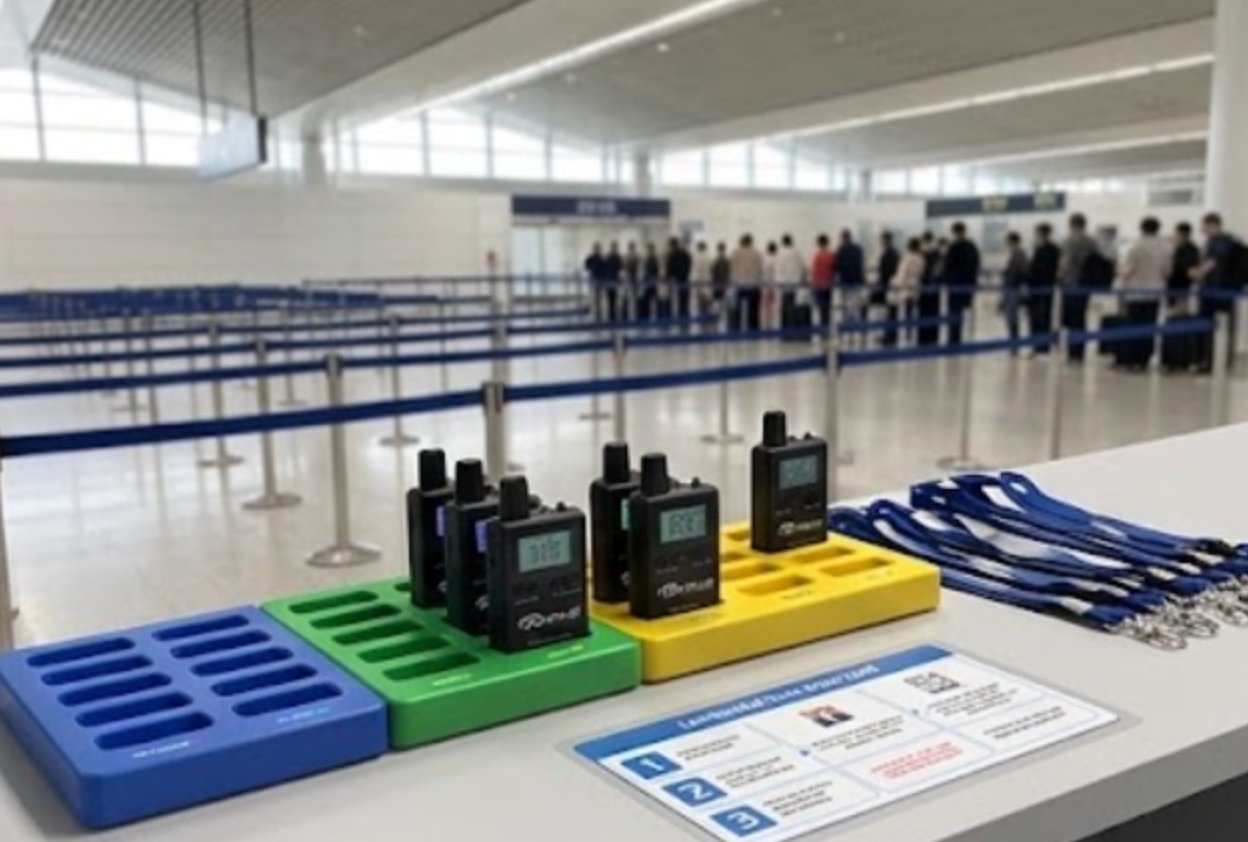
The RC8860 is the unit you reach for when the environment fights the signal. It runs on 860-870 MHz UHF with 20 channels, a band that rides clean through the machinery clutter that crowds 2.4G. The transmitter lasts about 10 hours on a 1500 mAh cell and weighs 59 grams, so a guide wears it all shift without thinking about it. On a floor where forklifts and presses throw RF noise, that UHF headroom is the difference between a tour that holds together and one where visitors drift off the channel. Twenty channels may sound modest next to the RC2401's fifty, but on a UHF band shared by fewer in-plant devices it is more than enough to keep one tour clear of the building's own radio traffic.
RC8860-factory_tour

🎯 The RC2401 2.4G Audio Guide for Routed Group Movement

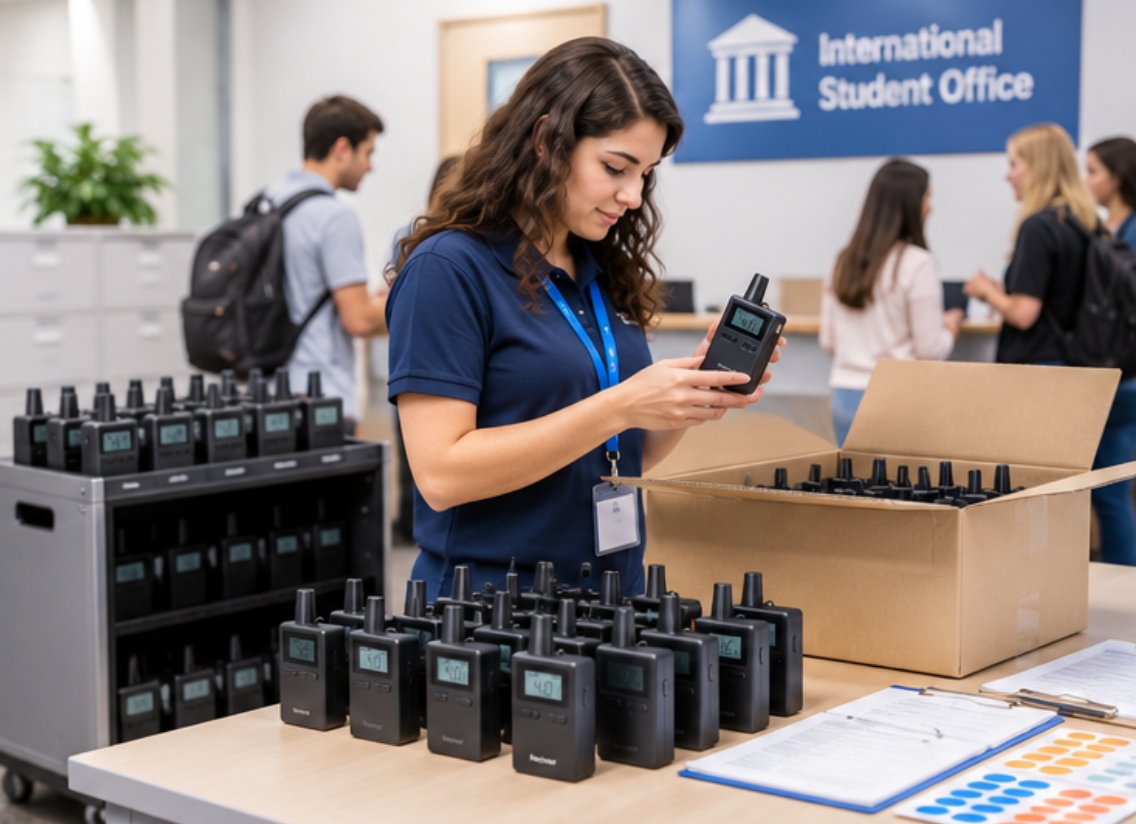
The RC2401 handles the open routing where groups walk a fixed path past stations. It sits on 2403-2483 MHz with 50 channels, which lets several concurrent tours stay on separate frequencies without cross-talk. Battery life mirrors the RC8860 at 10 hours transmitting and 20 hours receiving, with a 59 gram transmitter and a 50 gram receiver. When the goal is keeping thirty people moving as one body through a corridor, the 50-channel spread is what stops two guides from landing on the same frequency mid-walk. On a busy open day with three tours leaving the lobby an hour apart, those channels are what let all three run without a coordinator juggling frequencies between departures.

RC2401-factory_tour

The Silent Disco Kit for Quiet Demonstration Rooms

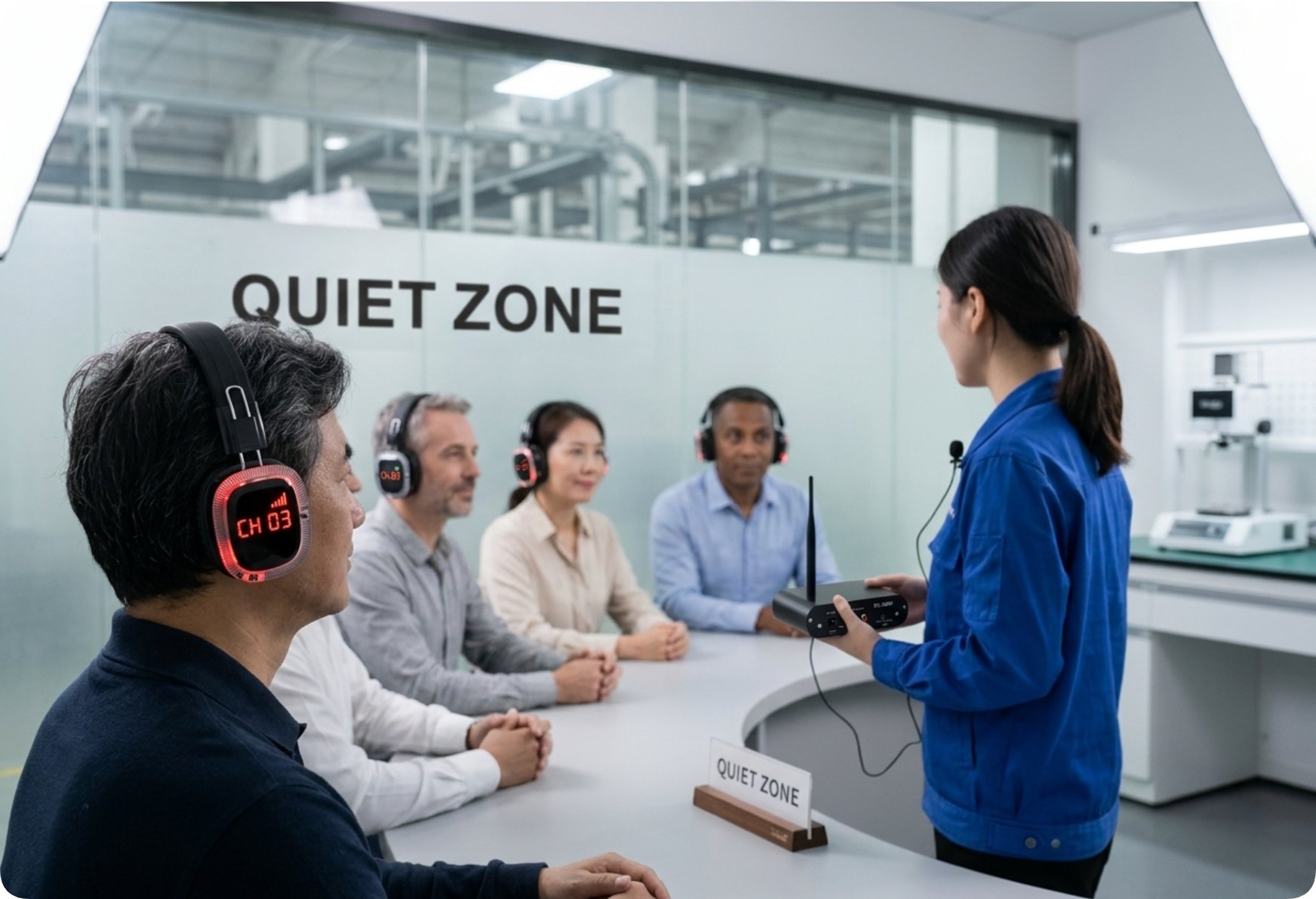
Some rooms on a plant tour are meant to be silent: a clean bench, a calibration cell, a customer demo where the product itself is the sound. The Silent Disco Wireless Headphone System is built from RC-409 headphones and an RC-50RF transmitter, a multi-channel UHF arrangement with LED channel indicators. Visitors hear the guide through the headset while the room stays quiet, so you can run a live demonstration without shutting the line or asking the group to whisper. It is the piece that turns a no-talking zone into a real stop on the route. The LED channel indicators on each RC-409 headset mean a visitor who picked up the wrong unit can find the right channel without flagging down the guide, which keeps the room quiet and the group self-correcting.

Silent-Disco-factory_tour

The Specs That Move the Payback Math

Most of the ROI conversation is not about features, it is about the three numbers that decide whether a tour system earns its keep: how many channels keep groups apart, how long a charge lasts a shift, and how the band behaves where you actually stand. The two tour-guide units share a battery and a weight class but split on the dimension that matters most on a noisy floor.

DimensionRC8860RC2401
Core frequency band860-870 MHz (UHF)2403-2483 MHz (2.4G)
Number of channels2050
Transmission distance1-200 m1-200 m
Output power10 mW10 mW
Transmitter battery life10 h10 h
Receiver battery life20 h20 h
Transmitter weight59 g59 g
Receiver weight50 g50 g
Charging portDC PortDC Port
Tour roleFloor-zone transmitterRouted group audio guide

💰 Three Cost Layers Behind a Tour System

The price tag is the smallest part of the decision. Layer one is hardware: the transmitters, receivers, and the silent-disco kit, bought once and amortized across every tour after. Layer two is recurring operation, the charging cart, the spare batteries, and the few minutes a coordinator spends staging units before each group. Layer three is compliance, the cost you avoid by keeping a quiet room quiet instead of fielding a noise complaint or a failed demonstration. Skipping the silent layer to save money usually pushes that cost into layer three, where it shows up as a cancelled deal. Staging the three pieces takes a coordinator maybe ten minutes before the first group and five between runs, a cost that stays flat whether the day holds two tours or six.

Our wireless tour guide system range is built so layers one and two stay small: DC-port charging means a spare cart tops units between runs, and the 20-hour receiver life covers a full day on a single charge for most plants.

🗺️ Measuring Return Across a Tour Season

Payback is easier to see when you count it in tours rather than months. Assume a plant runs 40 guided tours a year at 25 visitors each, roughly 1,000 visitor-passes annually. The hardware amortizes across those passes while the recurring cost stays at the few minutes of staging per tour. The return shows up as guide labor saved per walk, as tours that no longer need a second run because the audio held, and as demonstration rooms that stay usable. For a line hosting regular delegations, that math usually closes inside the first twelve months. The guide labor saved is the quiet part of the return: one person leads the walk instead of two, because the audio carries without a second staffer repeating the pitch at the back of the group.

🔋 Where Range and Battery Prevent a Second Run

The expensive tour is the one you repeat because the first one fell apart. The 1-200 m transmission distance on both units covers a realistic plant footprint without a mid-route repeater, and the 10-hour transmitter life outlasts a full shift. A coordinator who stages a charged cart between runs is effectively removing the most common cause of a redo: a dead receiver at station four. Range and battery are not spec-sheet decoration here, they are the line items that keep a tour from becoming two. A charging cart stocked with topped spare receivers means the only thing a coordinator checks at the door is that each visitor has a unit, not whether it will survive the last station.

For more deployment guides across plant, campus, and conference tours, the pattern repeats: pick the band for the room, count the channels for the crowd, and treat the silent option as the room that protects your close.

Frequently Asked Questions

1. How many tours before the system pays for itself?

Using a plant that runs 40 tours a year at 25 visitors each, the hardware amortizes across about 1,000 visitor-passes annually while recurring staging stays at a few minutes per tour. With guide labor saved on each walk and demonstration rooms kept usable, payback for most lines lands inside the first twelve months of regular delegations.

2. Why run UHF and 2.4G units together instead of one band?

The floor zone crowds 2.4G with machinery RF, so the RC8860 rides clean on 20 UHF channels at 860-870 MHz. The open routing corridor has no such noise, and the RC2401 uses its 50 channels on 2.4G to keep several concurrent tours on separate frequencies. Running both means each zone gets the band that actually works there.

3. What does the silent disco kit replace on the route?

In a quiet demonstration room you would otherwise lower your voice, shut the line, or skip the stop entirely. The RC-409 headsets with the RC-50RF transmitter let a full group hear the guide while the room stays quiet, so a live demo runs without raising the noise floor or losing the audience.

4. How long does a full tour day of battery last?

The RC8860 and RC2401 both run about 10 hours transmitting and 20 hours receiving on a single charge, which covers a full shift. Both use a DC port, so a spare charging cart tops units between runs and removes the dead-receiver failure that forces a second tour.


2026年10月31日 11:29
ꄘ click: 21

Get the spec sheet, MOQ and a factory-direct quote

Tell us the venue, the group size and how many languages you need. An engineer at our Shenzhen factory replies within one business day with the matching model, a written quote, lead time and the CE / RoHS / ISO 9001 documents.

Talk to an engineer WhatsApp +86 189 2287 9583

Prefer email? tiger.wang@richitek.com  |  OEM / ODM, custom tooling and neutral packaging available  |  send the enquiry through our contact page

Shenzhen Rich Age Electronics Co., Ltd. (Richitek) - manufacturing wireless tour guide systems, church translation headsets and museum audio guide equipment since 2007.

no data

RC8860 and RC2401: Counting the ROI of a Factory Tour Audio System

time: 2026年10月31日 click:21

A plant visit is one of the few marketing assets that pays you back every time a prospect walks the line. But the audio layer behind a guided factory tour is rarely one device. Most lines need a transmitter that survives the floor, a guide unit that keeps a routed group together, and a silent option for the rooms where you cannot raise your voice. This breakdown follows a factory tour audio setup built from three pieces, and shows where the money actually commits and what it buys back. A visitor who hears every word at every station is a visitor who remembers the line; a visitor who misses the safety pitch is a liability you pay for twice.

💡 Why a Plant Visit Needs More Than One Audio Layer

Visitors move through zones that do not share the same acoustic rules. The production floor is loud and full of moving metal, the routing corridor is open but crowded, and the demonstration room is quiet by design. One transmitter pressed into all three zones either gets drowned out on the floor or bleeds sound into the quiet room. Splitting the job across purpose-built hardware is what keeps a tour legible from the first handshake to the last question. The cost of getting this wrong is a re-run, and a re-run is the most expensive tour you will ever host. We have watched a single 2.4G transmitter drop out beside a robotic weld cell, and the guide spent the rest of the walk repeating himself to a group that had already drifted.

📡 The RC8860 UHF Transmitter for the Noisy Production Floor

The RC8860 is the unit you reach for when the environment fights the signal. It runs on 860-870 MHz UHF with 20 channels, a band that rides clean through the machinery clutter that crowds 2.4G. The transmitter lasts about 10 hours on a 1500 mAh cell and weighs 59 grams, so a guide wears it all shift without thinking about it. On a floor where forklifts and presses throw RF noise, that UHF headroom is the difference between a tour that holds together and one where visitors drift off the channel. Twenty channels may sound modest next to the RC2401's fifty, but on a UHF band shared by fewer in-plant devices it is more than enough to keep one tour clear of the building's own radio traffic.

RC8860-factory_tour

🎯 The RC2401 2.4G Audio Guide for Routed Group Movement

The RC2401 handles the open routing where groups walk a fixed path past stations. It sits on 2403-2483 MHz with 50 channels, which lets several concurrent tours stay on separate frequencies without cross-talk. Battery life mirrors the RC8860 at 10 hours transmitting and 20 hours receiving, with a 59 gram transmitter and a 50 gram receiver. When the goal is keeping thirty people moving as one body through a corridor, the 50-channel spread is what stops two guides from landing on the same frequency mid-walk. On a busy open day with three tours leaving the lobby an hour apart, those channels are what let all three run without a coordinator juggling frequencies between departures.

RC2401-factory_tour

The Silent Disco Kit for Quiet Demonstration Rooms

Some rooms on a plant tour are meant to be silent: a clean bench, a calibration cell, a customer demo where the product itself is the sound. The Silent Disco Wireless Headphone System is built from RC-409 headphones and an RC-50RF transmitter, a multi-channel UHF arrangement with LED channel indicators. Visitors hear the guide through the headset while the room stays quiet, so you can run a live demonstration without shutting the line or asking the group to whisper. It is the piece that turns a no-talking zone into a real stop on the route. The LED channel indicators on each RC-409 headset mean a visitor who picked up the wrong unit can find the right channel without flagging down the guide, which keeps the room quiet and the group self-correcting.

Silent-Disco-factory_tour

The Specs That Move the Payback Math

Most of the ROI conversation is not about features, it is about the three numbers that decide whether a tour system earns its keep: how many channels keep groups apart, how long a charge lasts a shift, and how the band behaves where you actually stand. The two tour-guide units share a battery and a weight class but split on the dimension that matters most on a noisy floor.

DimensionRC8860RC2401
Core frequency band860-870 MHz (UHF)2403-2483 MHz (2.4G)
Number of channels2050
Transmission distance1-200 m1-200 m
Output power10 mW10 mW
Transmitter battery life10 h10 h
Receiver battery life20 h20 h
Transmitter weight59 g59 g
Receiver weight50 g50 g
Charging portDC PortDC Port
Tour roleFloor-zone transmitterRouted group audio guide

💰 Three Cost Layers Behind a Tour System

The price tag is the smallest part of the decision. Layer one is hardware: the transmitters, receivers, and the silent-disco kit, bought once and amortized across every tour after. Layer two is recurring operation, the charging cart, the spare batteries, and the few minutes a coordinator spends staging units before each group. Layer three is compliance, the cost you avoid by keeping a quiet room quiet instead of fielding a noise complaint or a failed demonstration. Skipping the silent layer to save money usually pushes that cost into layer three, where it shows up as a cancelled deal. Staging the three pieces takes a coordinator maybe ten minutes before the first group and five between runs, a cost that stays flat whether the day holds two tours or six.

Our wireless tour guide system range is built so layers one and two stay small: DC-port charging means a spare cart tops units between runs, and the 20-hour receiver life covers a full day on a single charge for most plants.

🗺️ Measuring Return Across a Tour Season

Payback is easier to see when you count it in tours rather than months. Assume a plant runs 40 guided tours a year at 25 visitors each, roughly 1,000 visitor-passes annually. The hardware amortizes across those passes while the recurring cost stays at the few minutes of staging per tour. The return shows up as guide labor saved per walk, as tours that no longer need a second run because the audio held, and as demonstration rooms that stay usable. For a line hosting regular delegations, that math usually closes inside the first twelve months. The guide labor saved is the quiet part of the return: one person leads the walk instead of two, because the audio carries without a second staffer repeating the pitch at the back of the group.

🔋 Where Range and Battery Prevent a Second Run

The expensive tour is the one you repeat because the first one fell apart. The 1-200 m transmission distance on both units covers a realistic plant footprint without a mid-route repeater, and the 10-hour transmitter life outlasts a full shift. A coordinator who stages a charged cart between runs is effectively removing the most common cause of a redo: a dead receiver at station four. Range and battery are not spec-sheet decoration here, they are the line items that keep a tour from becoming two. A charging cart stocked with topped spare receivers means the only thing a coordinator checks at the door is that each visitor has a unit, not whether it will survive the last station.

For more deployment guides across plant, campus, and conference tours, the pattern repeats: pick the band for the room, count the channels for the crowd, and treat the silent option as the room that protects your close.
Frequently Asked Questions

1. How many tours before the system pays for itself?

Using a plant that runs 40 tours a year at 25 visitors each, the hardware amortizes across about 1,000 visitor-passes annually while recurring staging stays at a few minutes per tour. With guide labor saved on each walk and demonstration rooms kept usable, payback for most lines lands inside the first twelve months of regular delegations.

2. Why run UHF and 2.4G units together instead of one band?

The floor zone crowds 2.4G with machinery RF, so the RC8860 rides clean on 20 UHF channels at 860-870 MHz. The open routing corridor has no such noise, and the RC2401 uses its 50 channels on 2.4G to keep several concurrent tours on separate frequencies. Running both means each zone gets the band that actually works there.

3. What does the silent disco kit replace on the route?

In a quiet demonstration room you would otherwise lower your voice, shut the line, or skip the stop entirely. The RC-409 headsets with the RC-50RF transmitter let a full group hear the guide while the room stays quiet, so a live demo runs without raising the noise floor or losing the audience.

4. How long does a full tour day of battery last?

The RC8860 and RC2401 both run about 10 hours transmitting and 20 hours receiving on a single charge, which covers a full shift. Both use a DC port, so a spare charging cart tops units between runs and removes the dead-receiver failure that forces a second tour.


Get the spec sheet, MOQ and a factory-direct quote

Tell us the venue, the group size and how many languages you need. An engineer at our Shenzhen factory replies within one business day with the matching model, a written quote, lead time and the CE / RoHS / ISO 9001 documents.

Talk to an engineer WhatsApp +86 189 2287 9583

Prefer email? tiger.wang@richitek.com  |  OEM / ODM, custom tooling and neutral packaging available  |  send the enquiry through our contact page

Shenzhen Rich Age Electronics Co., Ltd. (Richitek) - manufacturing wireless tour guide systems, church translation headsets and museum audio guide equipment since 2007.

no data
×

Contact us

email:
name:
subject:
content: