A leading China factory specializing in Wireless Tour Guide Systems, Church Audio Guides, and Translation Headphones with premium OEM/ODM solutions.

Tel:+86 18922879583

Email:tiger.wang@richitek.com

RC9150, RC2468 and RC2406: Three Answers to the Border-Crossing Audio Brief

A land border is a different kind of tour. The group arrives in one language and clears control in another, guides switch from narration to interpretation several times an hour, and the walk from coach to checkpoint to market stall can stretch past a full working shift. For operators running cross-border day trips, the audio brief is no longer "a transmitter and some receivers". It is a small radio system that has to survive crowding, long hours, two-way talk, and a bag that gets heavier by the hour. We look at where the brief came from and why three models, the RC9150, the RC2468 and the RC2406, each answer a different part of it.

This is not a spec shoot-out between rival brands. It is the story of one operator profile, the cross-border group, and the three product decisions that actually move the needle once you are standing in a busy terminal with forty other tour systems on the air.

🎯 Why Border Crossings Changed the Guide Equipment Brief

For years a sightseeing audio kit was judged on one thing: could the guide's voice reach the back of the group. Border routes broke that single-axis model. At a crossing you are not just narrating a view, you are relaying instructions from an officer, translating a question from a traveller, and keeping the group together through a noisy hall where every other operator is running the same kind of gear. The equipment brief expanded from "loud enough" to "clear, private, and uninterruptible".

That shift is why the scenario page for simultaneous interpretation at crossings and terminals now reads less like a tour-guide flyer and more like a communications brief. Range, battery, and channel headroom stop being nice-to-haves and become the difference between a smooth crossing and a group that loses its guide at the gate.

The Move From Single-Language Paging to Two-Way Interpretation

The first change operators notice is the death of one-way paging. A border group is multilingual by definition: the traveller, the guide, and the controls officer rarely share a language. So the kit has to support a guide who talks, an interpreter who bridges, and travellers who occasionally talk back with a question. One-way broadcast hardware quietly fails this test because it was never built for a conversation.

All three models here run on the 2403 to 2483 MHz band with PLL frequency synthesis, which keeps the link stable while the group moves. The differentiator is no longer "does it transmit" but "does it stay intelligible while three people share the channel in turns". That is an audio and control-quality question, and it is where the brief starts to split the three products apart.

Channel Crowding at a Busy Crossing and the Case for 80 Channels

Walk into any international terminal on a peak morning and count the tour systems. Dozens of groups, each on its own frequency, stacked inside one building. Cheap two-channel hardware collapses into mutual interference here, and the failure mode is ugly: half the group hears the neighbouring guide instead of theirs. Channel headroom is the unsung hero of a clean crossing.

This is the home ground of the RC2406 80-channel 2.4G tour guide system. Where the brief calls for dense deployment, 80 channels give an operator room to park a group away from the crowd and keep the link private. Its transmitter runs about 10 hours and the receiver about 20 hours on a 3.7V 1500mAh and 3.7V 1000mAh cell pair, with a 59g transmitter and a 50g receiver, charged over a DC port.
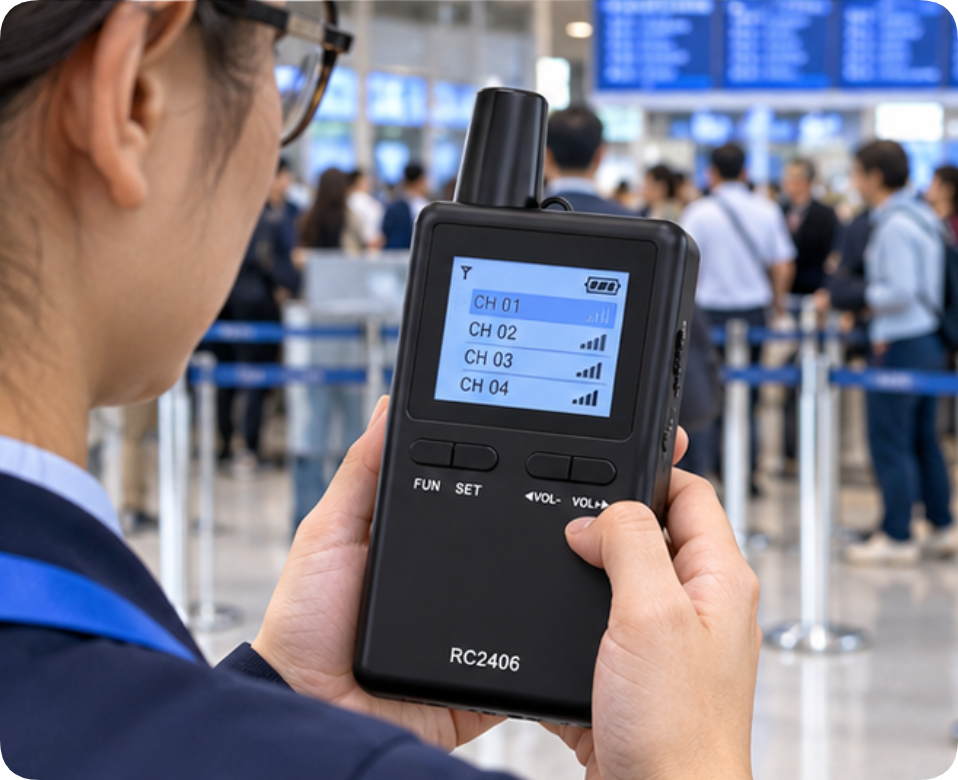
RC2406-border_crossing-channel-crowding

🔋 All-Day Shifts and the Battery Math of a Border Terminal

A border day is long. Coach queue, document check, local transport, market, return queue, and the guide is live for most of it. A receiver that dies at hour six is not a nuisance, it is a lost group. The battery brief is therefore written in shifts, not in "a morning".

The RC9150 2.4G wireless audio guide system is built for exactly this curve. Its transmitter runs roughly 15 hours and the receiver holds 35-plus hours on matched 3.7V 1800mAh cells, with a 97.5g transmitter and a 97.5g receiver, recharged over Type-C. For a lead guide who is on the mic from first handshake to last farewell, that headroom removes the mid-day battery swap from the day's risk list.

RC9150-border_crossing-battery-shift

📱 The Lightweight Turn: Ear-Hook Receivers on Long Walks

The other half of the weight story is the traveller's ear, not the guide's belt. Cross-border routes involve real walking: from coach to hall, across concourses, down to markets. A heavy receiver that swings on a lanyard becomes a complaint by hour three, and complaints at a border are the last thing an operator wants.

The RC2468 ultra-light 2.4G tour guide system answers this with an 18g ear-hook receiver, the lightest in the trio, paired with a 59g transmitter. It trades some battery for that weight, about 10 hours transmit and 8 hours receive on a 3.7V 1500mAh and a tiny 3.7V 300mAh receiver cell, charged over USB, but for a group that walks, the maths favours the ear that forgets it is wearing one.

RC2468-border_crossing-ear-hook-walk

What Buyers Now Specify in a Crossing Tender

Talk to three operators and a pattern emerges in how they now write the brief. They no longer ask "how far" as the only question. They list channel count, because crowding is real. They list transmitter and receiver battery separately, because a long shift is not symmetric. They list receiver weight, because walking groups feel it. And they list the charging port, because a mixed bag of connectors is a logistics tax on every recharge.

None of those lines existed in the old "one transmitter, some receivers" purchase order. The crossing turned a consumer-style buy into a small fleet specification, and the specification is what separates a kit that survives a season from one that gets returned after the first busy weekend.

🔮 Where the Three Models Sit in the Trend Line

Read together, the three models trace the trend rather than compete with each other. The RC2406 is the density play: 80 channels for crowded terminals. The RC9150 is the endurance play: 15 hours transmit and 35-plus hours receive for all-day guides. The RC2468 is the comfort play: an 18g ear-hook receiver for groups that walk. An operator running a full border programme often carries all three and assigns them by role, not by brand loyalty.

For the full Richitek wireless tour guide system range and the supporting deployment solutions, the trend is consistent: the brief got harder, and the answer was specialisation rather than a single do-everything box.

DimensionRC9150RC2468RC2406
Core frequency band2403-2483 MHz2403-2483 MHz2403-2483 MHz
Number of channels1005080
Transmission distance1-200m1-200m1-200m
Output power10mW10mW10mW
Transmitter battery life15h10h10h
Receiver battery life35+h8h approx.20h
Transmitter weight97.5g59g59g
Receiver weight97.5g18g (ear-hook)50g
Frequency response20Hz-8kHz50Hz-200kHz / 50Hz-12kHz50Hz-200kHz / 50Hz-12kHz
Charging portType-CUSBDC Port

Frequently Asked Questions

1. Why does a border group need more channels than a museum tour?

A museum spreads groups across halls and floors, but a border terminal packs dozens of tours into one concourse at the same time. With only a handful of channels, two nearby groups land on the same frequency and each hears the other. The RC2406 carries 80 channels so an operator can move a group clear of the local crowd and keep the link private.

2. Is the RC9150 overkill for a short crossing?

Not if the guide is live for the whole day. Its 15-hour transmitter and 35-plus-hour receiver budget assume a lead guide who talks from the first checkpoint to the last farewell, not a thirty-minute hall visit. On a true all-day border route that headroom removes the mid-shift battery swap from the risk list.

3. Why would a traveller care about an 18g receiver?

Because cross-border routes involve real walking, from coach to hall to market and back. A 50g or 97.5g receiver on a lanyard becomes a complaint by hour three; the RC2468's 18g ear-hook receiver is the one most groups forget they are wearing, which is exactly what you want at a border where attention is already split.

4. Do the three models share a charging standard?

No, and that is worth knowing before you buy a fleet. The RC9150 uses Type-C, the RC2468 uses USB, and the RC2406 uses a DC port. An operator running all three should plan charging slots accordingly rather than assume one cable fits the bag.


2026年11月01日 12:06
ꄘ click: 12

Get the spec sheet, MOQ and a factory-direct quote

Tell us the venue, the group size and how many languages you need. An engineer at our Shenzhen factory replies within one business day with the matching model, a written quote, lead time and the CE / RoHS / ISO 9001 documents.

Talk to an engineer WhatsApp +86 189 2287 9583

Prefer email? tiger.wang@richitek.com  |  OEM / ODM, custom tooling and neutral packaging available  |  send the enquiry through our contact page

Shenzhen Rich Age Electronics Co., Ltd. (Richitek) - manufacturing wireless tour guide systems, church translation headsets and museum audio guide equipment since 2007.

no data

RC9150, RC2468 and RC2406: Three Answers to the Border-Crossing Audio Brief

time: 2026年11月01日 click:12

A land border is a different kind of tour. The group arrives in one language and clears control in another, guides switch from narration to interpretation several times an hour, and the walk from coach to checkpoint to market stall can stretch past a full working shift. For operators running cross-border day trips, the audio brief is no longer "a transmitter and some receivers". It is a small radio system that has to survive crowding, long hours, two-way talk, and a bag that gets heavier by the hour. We look at where the brief came from and why three models, the RC9150, the RC2468 and the RC2406, each answer a different part of it.

This is not a spec shoot-out between rival brands. It is the story of one operator profile, the cross-border group, and the three product decisions that actually move the needle once you are standing in a busy terminal with forty other tour systems on the air.

🎯 Why Border Crossings Changed the Guide Equipment Brief

For years a sightseeing audio kit was judged on one thing: could the guide's voice reach the back of the group. Border routes broke that single-axis model. At a crossing you are not just narrating a view, you are relaying instructions from an officer, translating a question from a traveller, and keeping the group together through a noisy hall where every other operator is running the same kind of gear. The equipment brief expanded from "loud enough" to "clear, private, and uninterruptible".

That shift is why the scenario page for simultaneous interpretation at crossings and terminals now reads less like a tour-guide flyer and more like a communications brief. Range, battery, and channel headroom stop being nice-to-haves and become the difference between a smooth crossing and a group that loses its guide at the gate.

The Move From Single-Language Paging to Two-Way Interpretation

The first change operators notice is the death of one-way paging. A border group is multilingual by definition: the traveller, the guide, and the controls officer rarely share a language. So the kit has to support a guide who talks, an interpreter who bridges, and travellers who occasionally talk back with a question. One-way broadcast hardware quietly fails this test because it was never built for a conversation.

All three models here run on the 2403 to 2483 MHz band with PLL frequency synthesis, which keeps the link stable while the group moves. The differentiator is no longer "does it transmit" but "does it stay intelligible while three people share the channel in turns". That is an audio and control-quality question, and it is where the brief starts to split the three products apart.

Channel Crowding at a Busy Crossing and the Case for 80 Channels

Walk into any international terminal on a peak morning and count the tour systems. Dozens of groups, each on its own frequency, stacked inside one building. Cheap two-channel hardware collapses into mutual interference here, and the failure mode is ugly: half the group hears the neighbouring guide instead of theirs. Channel headroom is the unsung hero of a clean crossing.

This is the home ground of the RC2406 80-channel 2.4G tour guide system. Where the brief calls for dense deployment, 80 channels give an operator room to park a group away from the crowd and keep the link private. Its transmitter runs about 10 hours and the receiver about 20 hours on a 3.7V 1500mAh and 3.7V 1000mAh cell pair, with a 59g transmitter and a 50g receiver, charged over a DC port.

RC2406-border_crossing-channel-crowding

🔋 All-Day Shifts and the Battery Math of a Border Terminal

A border day is long. Coach queue, document check, local transport, market, return queue, and the guide is live for most of it. A receiver that dies at hour six is not a nuisance, it is a lost group. The battery brief is therefore written in shifts, not in "a morning".

The RC9150 2.4G wireless audio guide system is built for exactly this curve. Its transmitter runs roughly 15 hours and the receiver holds 35-plus hours on matched 3.7V 1800mAh cells, with a 97.5g transmitter and a 97.5g receiver, recharged over Type-C. For a lead guide who is on the mic from first handshake to last farewell, that headroom removes the mid-day battery swap from the day's risk list.

RC9150-border_crossing-battery-shift

📱 The Lightweight Turn: Ear-Hook Receivers on Long Walks

The other half of the weight story is the traveller's ear, not the guide's belt. Cross-border routes involve real walking: from coach to hall, across concourses, down to markets. A heavy receiver that swings on a lanyard becomes a complaint by hour three, and complaints at a border are the last thing an operator wants.

The RC2468 ultra-light 2.4G tour guide system answers this with an 18g ear-hook receiver, the lightest in the trio, paired with a 59g transmitter. It trades some battery for that weight, about 10 hours transmit and 8 hours receive on a 3.7V 1500mAh and a tiny 3.7V 300mAh receiver cell, charged over USB, but for a group that walks, the maths favours the ear that forgets it is wearing one.

RC2468-border_crossing-ear-hook-walk

What Buyers Now Specify in a Crossing Tender

Talk to three operators and a pattern emerges in how they now write the brief. They no longer ask "how far" as the only question. They list channel count, because crowding is real. They list transmitter and receiver battery separately, because a long shift is not symmetric. They list receiver weight, because walking groups feel it. And they list the charging port, because a mixed bag of connectors is a logistics tax on every recharge.

None of those lines existed in the old "one transmitter, some receivers" purchase order. The crossing turned a consumer-style buy into a small fleet specification, and the specification is what separates a kit that survives a season from one that gets returned after the first busy weekend.

🔮 Where the Three Models Sit in the Trend Line

Read together, the three models trace the trend rather than compete with each other. The RC2406 is the density play: 80 channels for crowded terminals. The RC9150 is the endurance play: 15 hours transmit and 35-plus hours receive for all-day guides. The RC2468 is the comfort play: an 18g ear-hook receiver for groups that walk. An operator running a full border programme often carries all three and assigns them by role, not by brand loyalty.

For the full Richitek wireless tour guide system range and the supporting deployment solutions, the trend is consistent: the brief got harder, and the answer was specialisation rather than a single do-everything box.

DimensionRC9150RC2468RC2406
Core frequency band2403-2483 MHz2403-2483 MHz2403-2483 MHz
Number of channels1005080
Transmission distance1-200m1-200m1-200m
Output power10mW10mW10mW
Transmitter battery life15h10h10h
Receiver battery life35+h8h approx.20h
Transmitter weight97.5g59g59g
Receiver weight97.5g18g (ear-hook)50g
Frequency response20Hz-8kHz50Hz-200kHz / 50Hz-12kHz50Hz-200kHz / 50Hz-12kHz
Charging portType-CUSBDC Port

Frequently Asked Questions

1. Why does a border group need more channels than a museum tour?

A museum spreads groups across halls and floors, but a border terminal packs dozens of tours into one concourse at the same time. With only a handful of channels, two nearby groups land on the same frequency and each hears the other. The RC2406 carries 80 channels so an operator can move a group clear of the local crowd and keep the link private.

2. Is the RC9150 overkill for a short crossing?

Not if the guide is live for the whole day. Its 15-hour transmitter and 35-plus-hour receiver budget assume a lead guide who talks from the first checkpoint to the last farewell, not a thirty-minute hall visit. On a true all-day border route that headroom removes the mid-shift battery swap from the risk list.

3. Why would a traveller care about an 18g receiver?

Because cross-border routes involve real walking, from coach to hall to market and back. A 50g or 97.5g receiver on a lanyard becomes a complaint by hour three; the RC2468's 18g ear-hook receiver is the one most groups forget they are wearing, which is exactly what you want at a border where attention is already split.

4. Do the three models share a charging standard?

No, and that is worth knowing before you buy a fleet. The RC9150 uses Type-C, the RC2468 uses USB, and the RC2406 uses a DC port. An operator running all three should plan charging slots accordingly rather than assume one cable fits the bag.


Get the spec sheet, MOQ and a factory-direct quote

Tell us the venue, the group size and how many languages you need. An engineer at our Shenzhen factory replies within one business day with the matching model, a written quote, lead time and the CE / RoHS / ISO 9001 documents.

Talk to an engineer WhatsApp +86 189 2287 9583

Prefer email? tiger.wang@richitek.com  |  OEM / ODM, custom tooling and neutral packaging available  |  send the enquiry through our contact page

Shenzhen Rich Age Electronics Co., Ltd. (Richitek) - manufacturing wireless tour guide systems, church translation headsets and museum audio guide equipment since 2007.

no data
×

Contact us

email:
name:
subject:
content: