
A science centre keeps one line about its audio equipment in the purchase file, and that line is written before the first visitor arrives. Three seasons later the same case of transmitters is running a travelling show in the main hall, a self-paced school session in the east gallery, and an evening opening that was not in anyone's budget. Nobody has crossed out the original line. When a new exhibition is booked, the operations team opens the case, counts the units, and discovers that the number they planned against describes a building that no longer exists. The argument that follows is usually about buying newer hardware. It should be about how many times a kit can be handed to a different purpose without becoming untraceable.
This is the part of technical evolution that a specification table does not show. A later model is not automatically a better answer if the institution cannot say where the earlier one ended up. The three units considered here were chosen for a docent-led walk, and each of them now carries a different history of reassignment. Their published figures explain why: channel count decides how many independent explanations can exist at once, endurance decides whether a unit can be borrowed for a second session on the same day, and the charging connector decides how easily it comes back. For a site comparing museum audio guide equipment against a real floor plan, those three lines are more useful than a generation label.
The Line on the Original Purpose
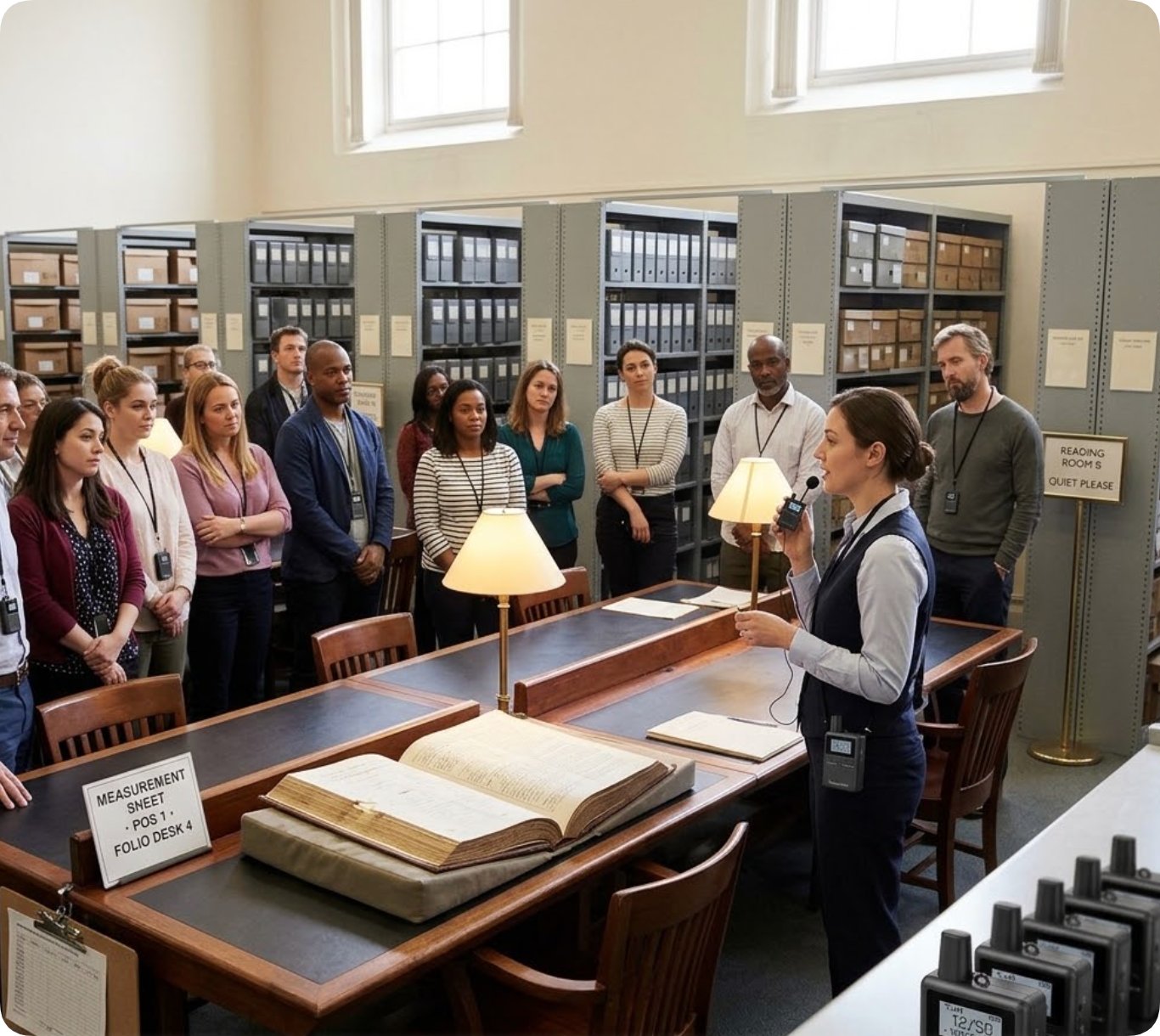
The first entry is always the simplest. A docent takes a transmitter, a group of twenty takes receivers, and the route runs from the entrance hall to the planetarium in about forty minutes. One channel serves the whole party, the case returns to the same shelf at closing, and the only record anyone needs is a count of twenty against twenty. The procurement note names a guided walk and nothing else, because at that moment there is no reason to imagine a second use. Sixteen months later the same note is still the only written description of what the case contains.
The RC2402 sits at the centre of that first arrangement. It is the plain 2.4G unit in this group: fifty channels, a transmitter rated at ten hours and a receiver at twenty, with a DC charging port and a body that weighs fifty-nine grams on the transmitting side. Nothing about it is specialised, which is precisely why it was chosen for a single repeating route. A RC2402 wireless tour guide system does one job without asking the operator to learn a menu, and for the first season that was the entire requirement.
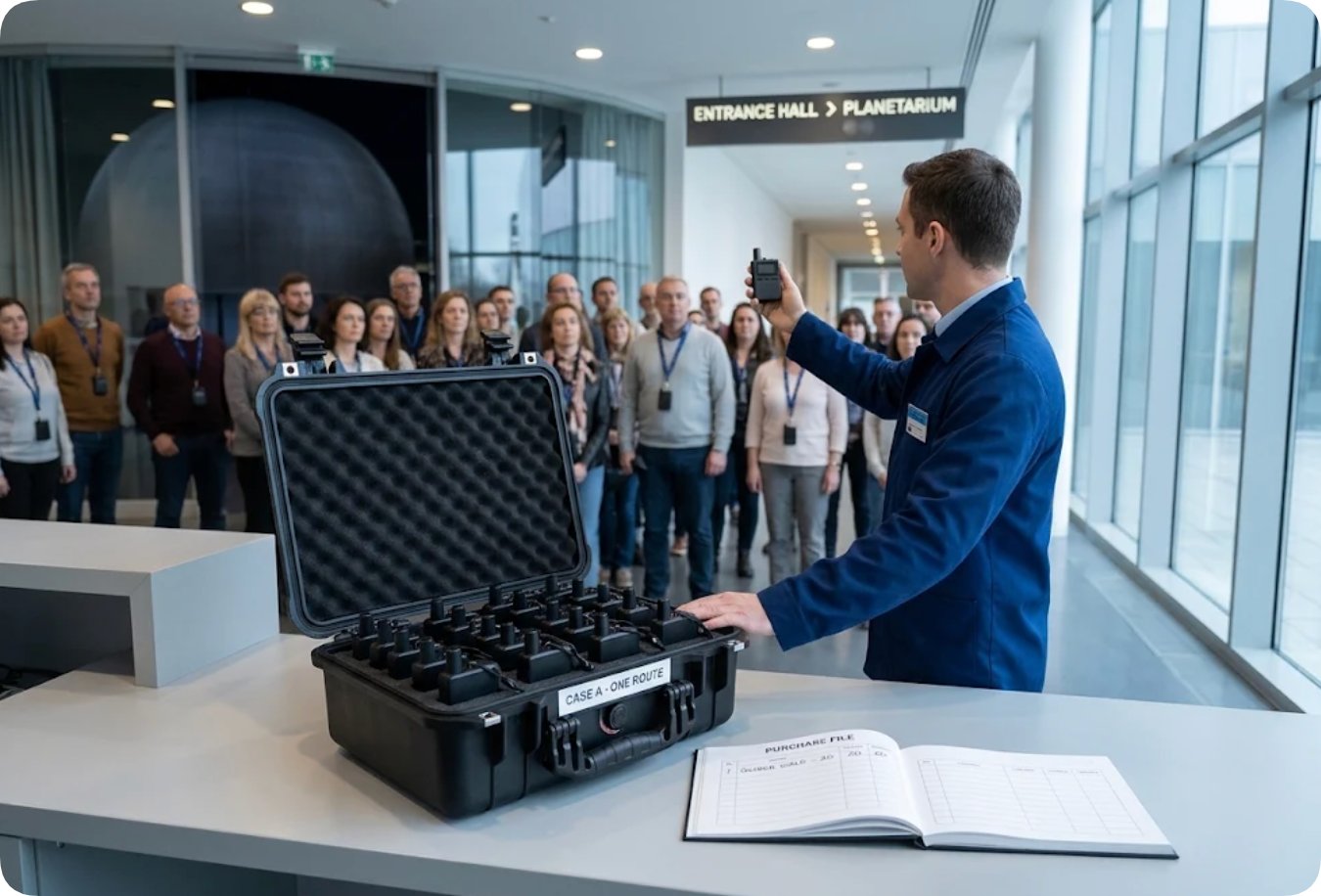
Once the building starts changing, the useful question becomes what the original line failed to record. It did not name a second group, a second room, or a second shift, and it did not say who was allowed to move the case. The table below separates the three kinds of record a hall actually needs from the single one it usually keeps. Each row is a judgement about ownership rather than a number to be compared.
| Record line | What the first order assumed | What the hall later did | What to check at handover |
|---|---|---|---|
| Guided walk | One docent, one fixed route, one channel in use | Two routes leaving the entrance hall at once | Whether both parties can be named on the same sheet |
| Temporary show | Not mentioned in the purchase file | A travelling exhibition occupying the main floor | Which case was opened and who signed for it |
| Self-paced session | Not mentioned in the purchase file | Visitors moving between exhibits without a guide | Whether any unit stayed beside a fixed display |
| Evening opening | One daytime charge per unit | A second session after the building reopened | Whether the returned set was charged between sessions |
Notice that every row except the first is about an event the purchase file never anticipated. An upgrade decided only on the strength of a newer specification will still leave those three rows blank. The published figures for the three units are collected later in this article; they are read here as limits on reassignment, not as a ranking of generations.
When a Travelling Show Takes the Floor
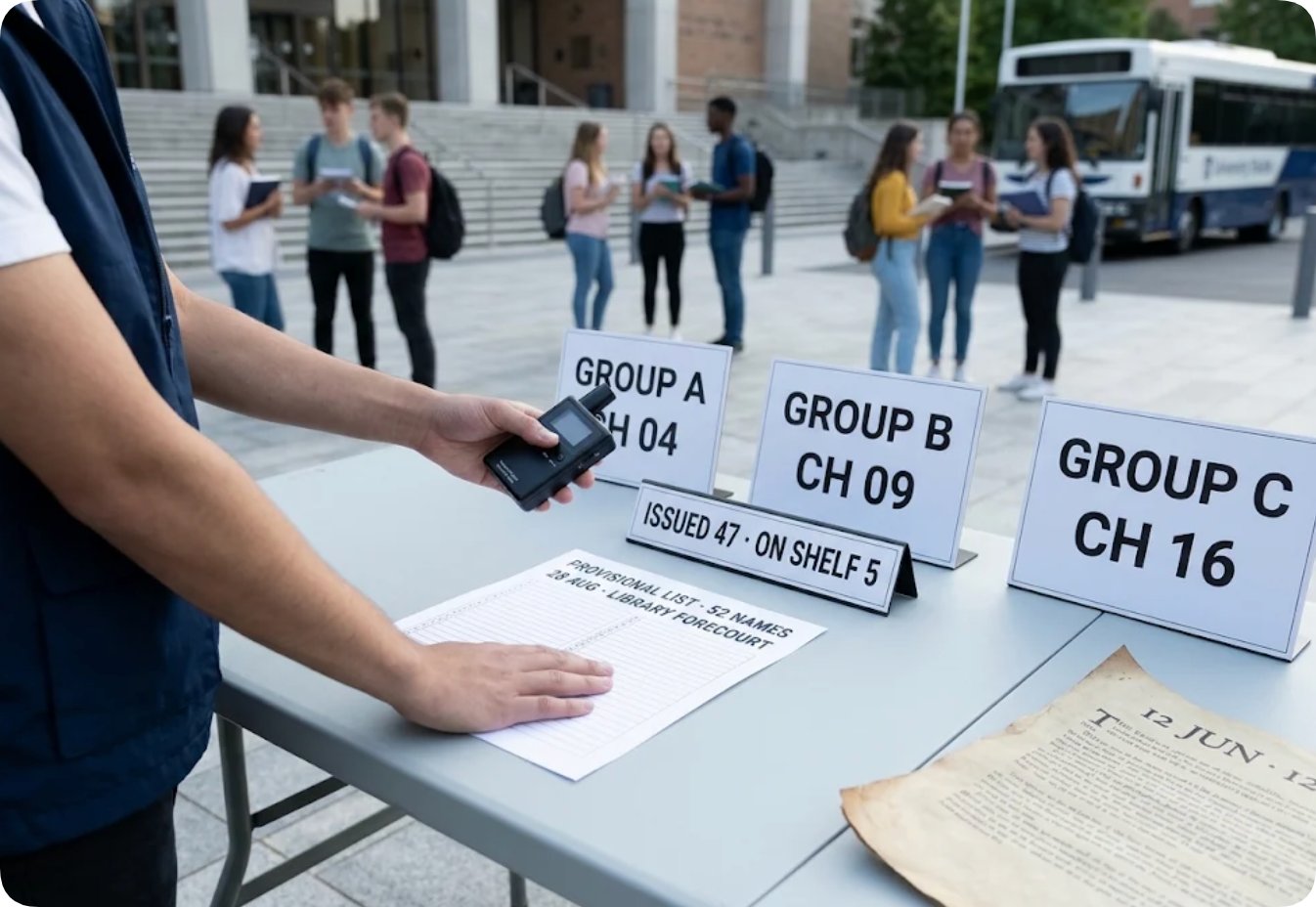
The first reassignment usually arrives as a delivery rather than a decision. A travelling exhibition is booked for eleven weeks, its crates occupy the main hall, and the docent route that used to cross that space is cut into two shorter loops meeting at the staircase. Six interactive exhibits on the loaned show produce their own recorded sound, and a sponsor preview is scheduled before the public opening. The operations team now needs three independent explanations running in one building at the same time, and the original line in the purchase file says one.
This is where the RC2408 becomes relevant, and the reason has nothing to do with distance. Its eighty channels are the published distinction against the fifty of the other two units in this group. In a hall split by a temporary structure, that difference is a count of how many separate conversations can coexist without one guide being heard on another group's receivers. The RC2408 tour guide system keeps its transmitter at ten hours and its receiver at twenty, the same endurance as the basic unit, so the extra capacity is not bought with a shorter day. It is bought so that a floor plan can change without the audio plan being rewritten from scratch.
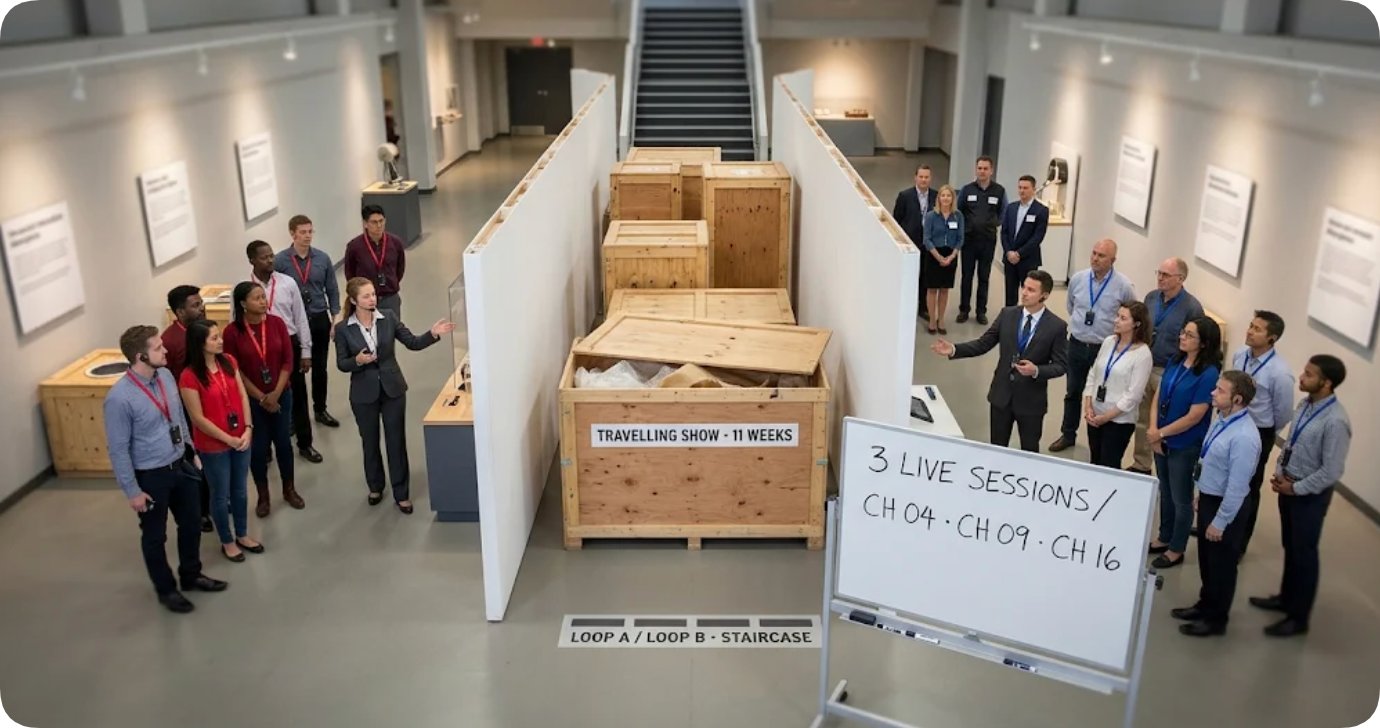
What actually went wrong that season was smaller than a coverage failure. The preview group was given receivers from the case that normally served the planetarium loop, and the show's own exhibit labels were tuned to a volume that assumed visitors were not wearing a headset. Two adjustments were needed, and neither appeared in any specification: a note saying which case belonged to which loop, and an agreement that the exhibition's own audio would be lowered near the entrance. Both were settled on a Tuesday morning with a pen, and both were forgotten before the next show arrived.
Three Reassignments Nobody Logged
By the second year the case had been reassigned three times. The travelling show took the main hall for eleven weeks. A school programme then asked for self-paced sessions in which pupils moved between six exhibits without a docent. An evening opening was added for a donor week, with the building closing at five and reopening at seven. Each change was agreed in a conversation, implemented by whoever was on duty, and never written beside the original line. When a unit went missing in March, the count showed one short but no record could say which of the three purposes had last held it.
The RC2501 is the unit that ends up carrying the longest of those days. Its published transmitter endurance is fifteen hours and its receiver endurance is more than thirty-five, against ten and twenty for the other two, and it charges over Type-C rather than a DC port. That combination matters less as a headline than as a practical permission: a set borrowed for a morning delegation can be returned at noon, charged from a common cable, and borrowed again for an evening session. The RC2501 wireless tour guide system also weighs forty-seven grams on both sides, which is why it tends to be the set people reach for when the day has no natural end.
The figures below are taken from the model specification table that governs these three units, not from marketing copy. Frequency response is deliberately absent. The RC2402 and RC2408 publish separate transmitter and receiver ranges, while the RC2501 publishes one combined figure, so the three cannot be placed in a single column without implying a comparison the pages do not support. Dimensions, ingress protection, certification detail and warranty terms are likewise not uniformly published across the three pages in one comparable form, so they are not inferred here either.
| Model | Channels | Transmitter battery | Receiver battery | Weight (TX / RX) | Charging |
|---|---|---|---|---|---|
| RC2402 | 50 | 10h | 20h | 59g / 50g | DC port |
| RC2501 | 50 | 15h | 35+h | 47g / 47g | Type-C |
| RC2408 | 80 | 10h | 20h | 59g / 50g | DC port |
Read across a row and the table describes a shape of working day rather than a generation. Read down a column and the differences are narrow: one unit has more channels, one has longer endurance and a different connector, and two are identical on most of the figures. That narrowness is the reason the reassignments went unrecorded. From the outside the three cases looked interchangeable, so nobody thought to write down which purpose had claimed which set.
Where the Loan Cupboard Enters the Record
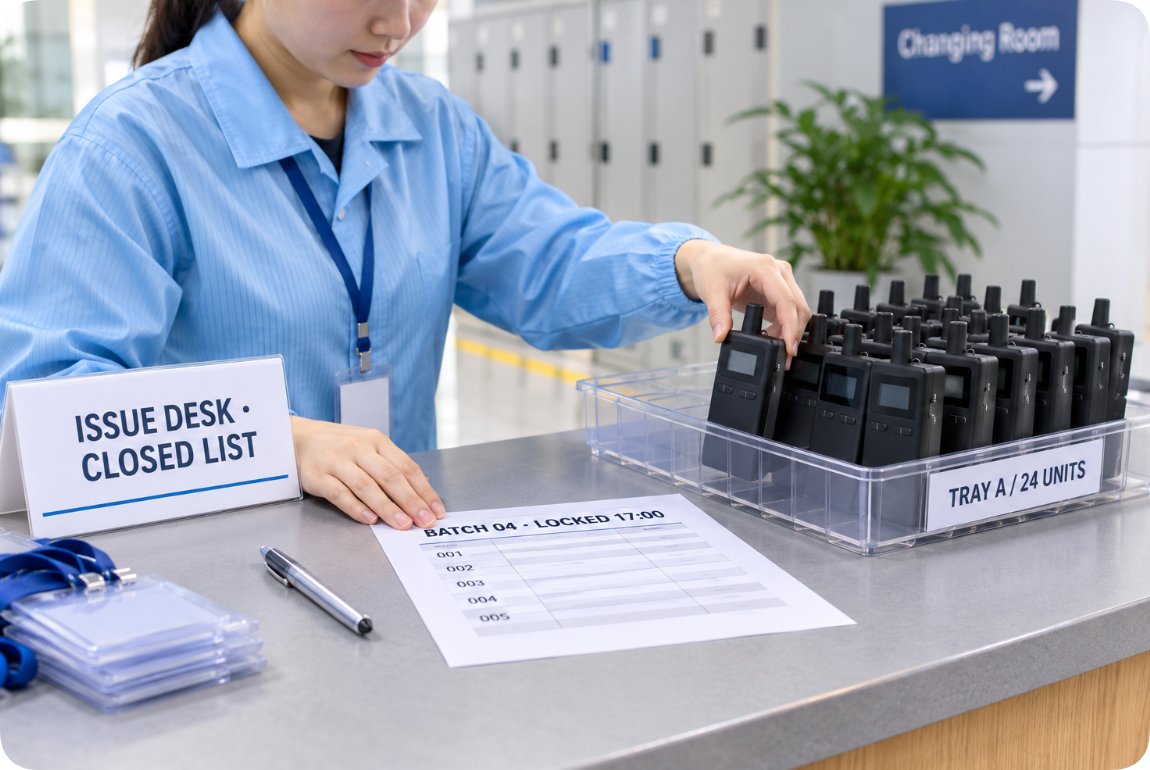
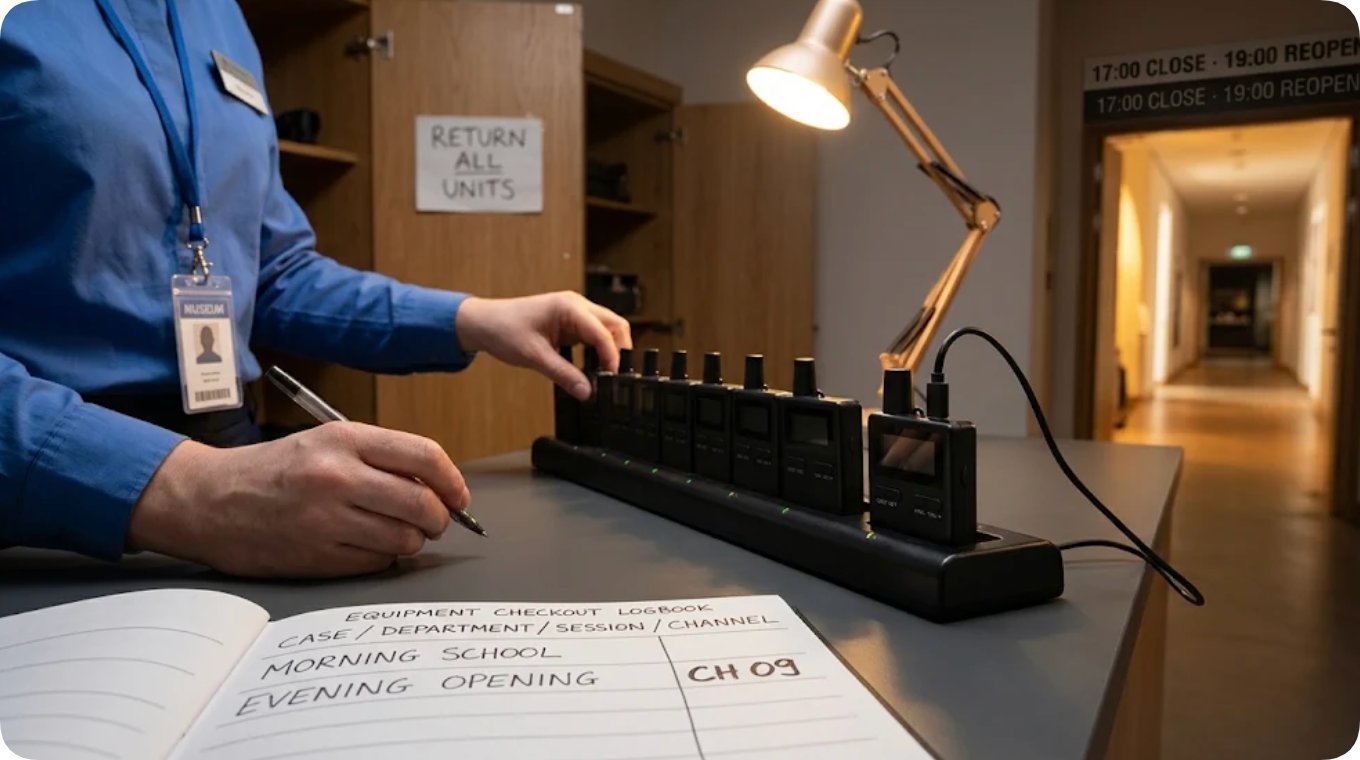
A lending cupboard is a better archive than a purchase file. It records the moment a kit leaves the shelf, the department that took it, the session it was taken for, and the state it came back in. The science centre in this case had a handwritten book with four columns, and for the first season the fourth column was always empty because the same docent signed everything out and back. By the second year three departments were using the same shelf, and the fourth column had become the only place where a reassignment could be seen at all.
The failure mode is specific. A set booked out for a school session was returned with its receivers paired to a channel that the evening opening had been using, and the next morning's docent found half the group listening to a recorded exhibit loop. Nothing was broken. Two numbers had simply been left in the wrong state because the return line asked only whether the count was complete. Adding a single column for the channel in use solved more problems that year than any hardware change, and it cost a page of the book.
This is also where a pooled kit differs from a borrowed one. A pooled set has no owner for the duration of a session, so the person who returns it is rarely the person who configured it. The centre eventually settled on a rule that a unit borrowed back from another department is re-paired before it goes on the shelf, even when the next session is not yet scheduled. The rule is boring, it is written on the inside of the cupboard door, and it is the closest thing the building has to a configuration policy.
Second Life for a Fixed Exhibit
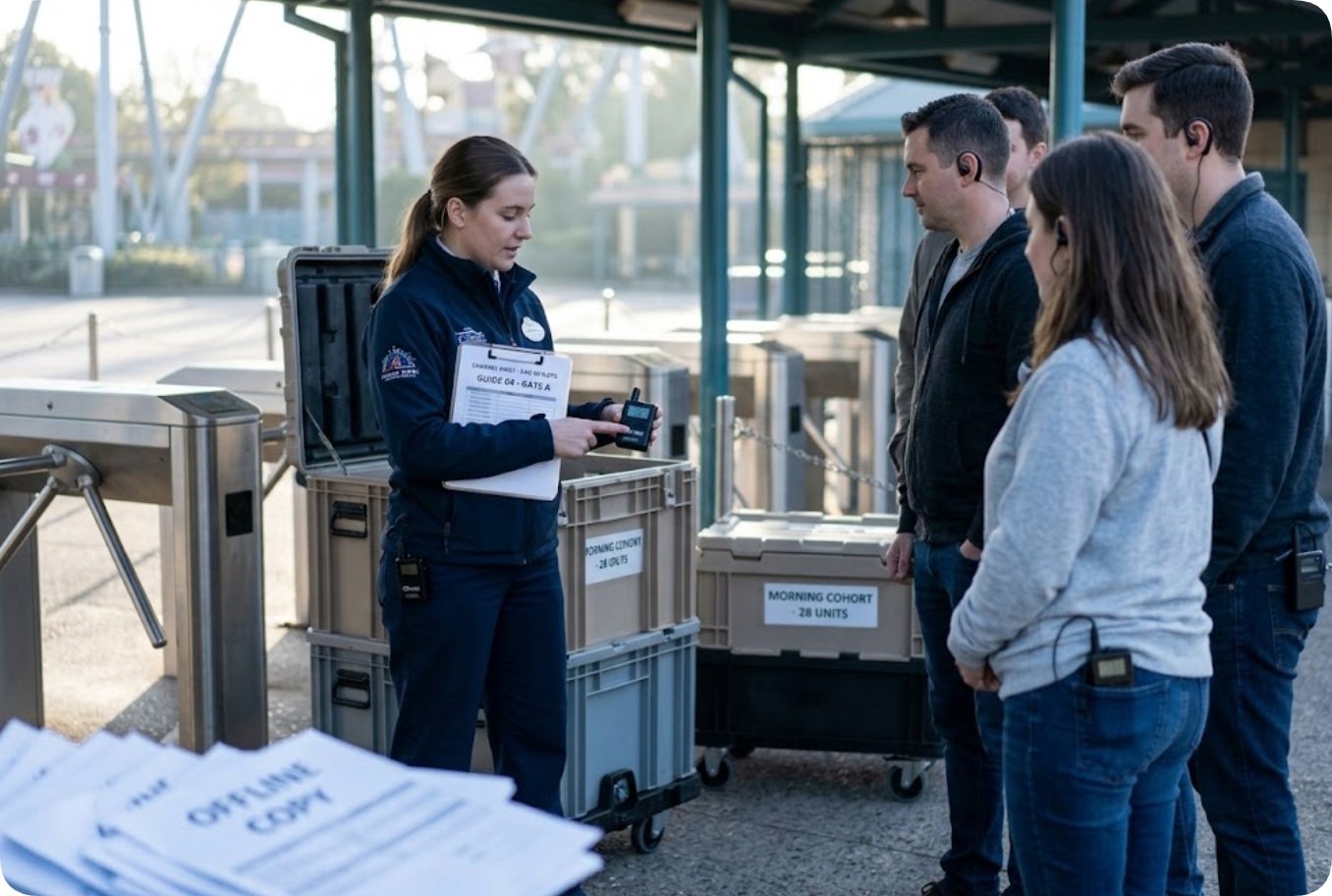
The most durable reassignment is the one nobody calls a deployment. A unit ends up beside a single display, switched on each morning by the gallery attendant and never carried anywhere. It has acquired a second life as a fixed explanation, and the qualities that made it useful on a walking route are no longer the ones that matter. Nobody needs its range, its channel count, or its endurance. What matters is that a visitor can pick it up without instructions and that an attendant can tell at a glance whether it is ready.
That distinction changes how the wireless tour guide system range should be read by a buyer. A unit chosen for a guided walk is chosen for the person holding the transmitter; a unit left beside a display is chosen for the person who has to maintain it. The plain unit with a DC port is perfectly adequate on a route, but a set that can be topped up from the same cable as everything else in the gallery is easier to keep alive across a cross-department rota. Ease of return, not peak capability, is what earns a piece of equipment its second life.
There is a caution here for anyone writing the next specification. A fixed exhibit tends to accumulate small, undocumented adaptations: a printed card explaining the button, a spare receiver kept behind the plinth, a charger that was borrowed from another department and never given back. When the exhibition changes, those adaptations travel with the case or get lost with the display. The centre that logs them as part of the kit, rather than as part of the room, is the one that can hand the same unit to the next show without a week of rediscovery.
How a Channel Plan Survives a Floor Change
Channel planning is usually drawn once, on a plan of the building as it stood at opening. A travelling exhibition moves a wall, a school session claims a corner, and suddenly two groups that were never meant to be neighbours are working within a few metres of each other. The plan is not wrong because the channels are too few. It is wrong because the plan recorded rooms, and the building now runs on sessions. Redrawing it means listing the explanations that can happen simultaneously, then assigning a channel to each one, rather than assigning a channel to each space.
That is the practical reading of fifty against eighty channels for this group of units. The larger figure permits more independent explanations to coexist, which is valuable while a temporary show is adding sessions faster than the floor plan can be updated. The smaller figure is entirely sufficient for a single loop and remains sufficient for two loops if the operators agree which one starts first. Neither number predicts whether the plan will be redrawn before the next show arrives, and that is the part worth putting into a explore our solutions conversation with a supplier: who rewrites the sheet, and when.
A workable routine is short enough to fit on the same page as the lending book. Before each change of exhibit, list the simultaneous sessions for the first week, mark which case each one draws from, and write the channel beside the case rather than beside the room. After the change, check the two sessions that share a wall. The centre described here found that one ten-minute check before a preview caught the pairing left over from a school group, and that no amount of extra capacity would have caught it, because the fault was in the record and not in the radio.
What Three Years Later Asks of the Next Brief
Three years after the first order, the useful brief is not a request for a newer generation. It is a list of the reassignments the building has already absorbed and the ones it expects to absorb next, mapped onto the small number of published differences between the units. A site that runs one guided walk needs very little. A site that runs a guided walk, a temporary show, a self-paced school session and an evening opening needs to know which case can serve two of those in a day, which can serve two at once, and which must come back to the shelf before it is lent again.
An earlier school open class deployment made a similar point about cost: the first line on an order is rarely the one that decides the total. Here the first line decides even less, because the equipment outlives the route it was bought for. The three units in this comparison are close enough on paper that a specification-led choice would be almost arbitrary; the choice becomes clear only when the brief names the second and third purposes. Ask a supplier how a kit is re-paired, how it is charged between sessions, and what the record looks like when it comes back, and the answer will say more about the next three years than a generation label ever will.
The original line in the purchase file is still there, and it is still accurate as far as it goes. What the building needed was a second line, written the first time somebody opened the case for a purpose nobody had planned. A science centre that writes that line keeps its equipment traceable through every change of exhibit that follows. One that does not will keep buying newer hardware to solve an accounting problem, and will keep finding the same short count at the end of the season.