
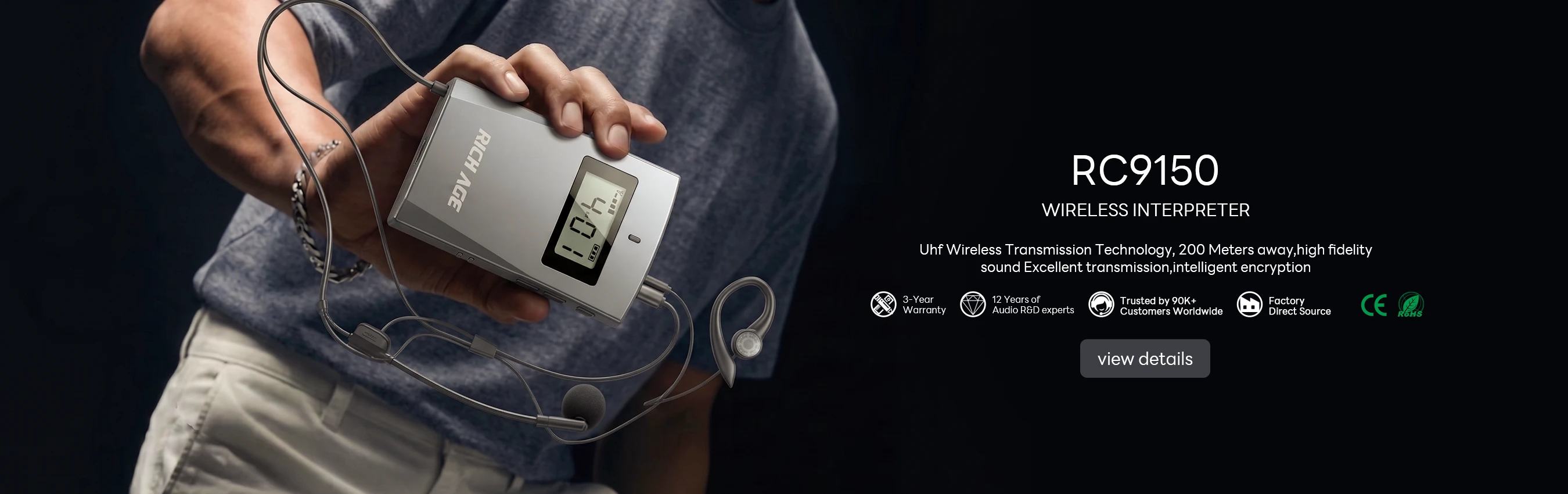
Red education bases send visitors through memorial halls, former headquarters, and open-air revolutionary sites where a single presenter guides groups of twenty to forty people throughout the day. In this high-intensity workflow, the wireless tour guide receiver must remain unobtrusive: clear in audio performance, long on battery endurance, and intuitive during continuous staff handovers. By evaluating three core models from the Richitek education audio range (RC9150, RC2408, and RC2500), this technical breakdown illustrates how hardware design has evolved to resolve practical site maintenance challenges.
📈 Site Demands Across Revolutionary Heritage Routes
Most heritage routes transition continuously between indoor exhibition rooms and outdoor grounds with the same presenter leading the itinerary. This imposes three specific hardware requirements: consistent RF signal penetration through thick structural walls and across open yards, sufficient battery capacity for full-day operation without mid-shift charging, and a lightweight chassis that reduces carrying fatigue over multi-hour tours. Furthermore, with morning school delegations followed by afternoon study groups, devices must support immediate deployment with zero learning curve.
Channel Allocation and Spectrum Management
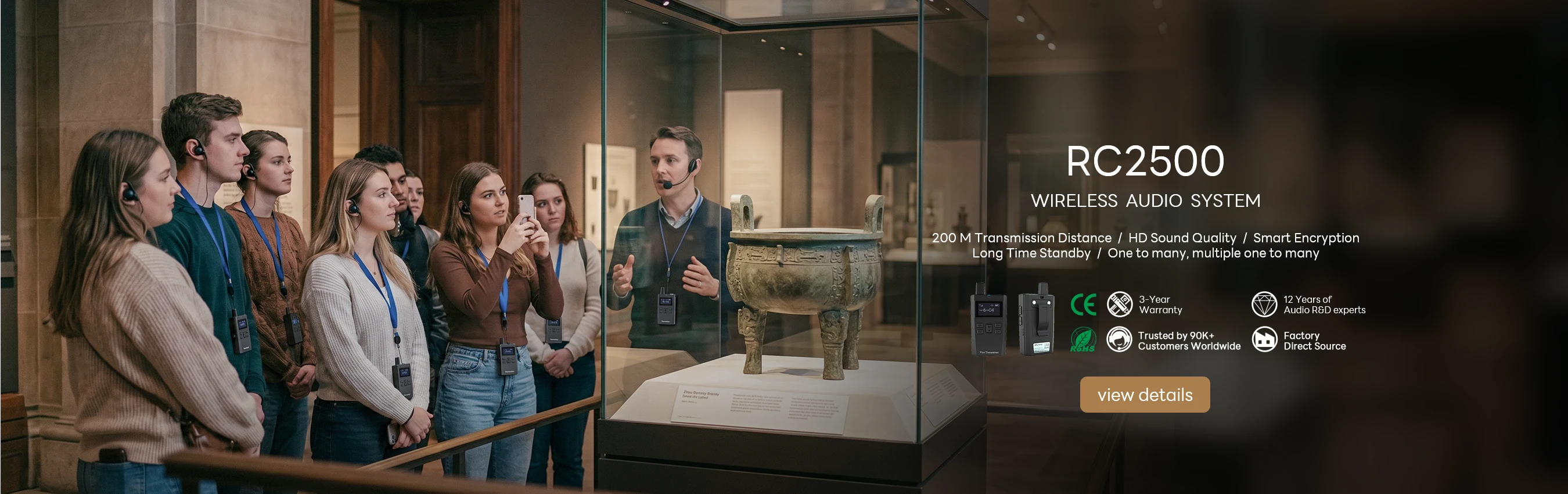
Channel capacity dictates multi-group concurrency without signal crosstalk. While a single guided route uses only one channel, hosting multiple tour groups simultaneously within the same hall increases signal interference risks if channel availability is restricted. The RC9150 features 100 independent channels, making it optimal for large bases managing high tour volume; the RC2408 provides 80 channels for medium-to-large venues; and the RC2500 provides 50 channels, which fully supports single-building facilities or fixed-route operations.

🔋 Battery Endurance During Full-Day Operation
Operating power determines overall maintenance overhead. The RC9150 transmitter operates for 15 hours with a receiver runtime exceeding 35 hours; the RC2500 offers identical performance with 15-hour transmitter and 35+ hour receiver limits. The RC2408 delivers 10 hours for the transmitter and 20 hours for the receiver—sufficient for single-day use while requiring stricter daily charging discipline. Extended receiver runtime allows partial mid-day top-ups to comfortably cover consecutive touring shifts.

Charging Interface and Maintenance Logistics
Port standardization directly impacts charging station management. Both the RC2500 and RC9150 feature standard Type-C interfaces, allowing compatibility with universal charging cables and multi-port charging cases. The RC2408 utilizes a dedicated DC port, requiring model-specific adapters. For mixed-model deployments, charging infrastructure should be structured around DC requirements while leveraging Type-C units for field flexibility.

Chassis Weight and Portability Comparison
Physical weight is a critical factor during long walking tours. The RC2408 prioritizes ultra-lightweight ergonomics, weighing 59g for the transmitter and 50g for the receiver—approximately half the mass of traditional models. The RC9150 and RC2500 weigh between 97.5g and 104g per unit. For presenters carrying equipment continuously over a 6-hour shift, this 40g to 50g reduction significantly decreases pocket drag and lanyard strain.
Synchronization, Mute Controls, and Field Usability
All three systems incorporate Phase-Locked Loop (PLL) frequency synthesis to prevent channel drift, but offer distinct control interfaces. The RC2500 features one-button channel synchronization, instant mute, and power control, allowing presenters to manage channel switching without menu navigation. The RC9150 and RC2408 utilize simplified physical buttons paired with robust standby circuits, ensuring quick staff handovers without operational friction.
⚖️ Generational Hardware Progression and Selection Strategy
Comparing these models demonstrates a clear engineering progression: the RC2500 serves as a reliable baseline featuring long battery endurance and one-touch controls; the RC9150 expands to 100 channels with Type-C charging to support multi-group venue expansion; and the RC2408 provides an ultra-lightweight form factor with 80 anti-interference channels for enhanced portability.
| Specification | RC9150 | RC2408 | RC2500 |
|---|---|---|---|
| Frequency Range | 2403-2483 MHz | 2403-2483 MHz | 2403-2483 MHz |
| Channel Count | 100 Channels | 80 Channels | 50 Channels |
| Operating Range | 1-200 m | 1-200 m | 1-200 m |
| RF Output Power | 10 mW | 10 mW | 10 mW |
| Transmitter Battery Life | 15 h | 10 h | 15 h |
| Receiver Battery Life | 35+ h | 20 h | 35+ h |
| Transmitter Weight | 97.5 g | 59 g | 104 g |
| Receiver Weight | 97.5 g | 50 g | 104 g |
| Charging Port | Type-C | DC Port | Type-C |
| Key Features | 15h TX / 35h+ RX extended battery life | 80-channel anti-interference design | One-button sync / power / mute; 35h+ RX life |
Hardware procurement requires evaluating channel requirements, charging interface logistics, and chassis weight. Explore the complete Richitek product catalog for additional system specifications.
For deployment strategies tailored to specific operational budgets, refer to our previous analysis: Deploying Audio Guides at Red Education Bases on a Fixed Budget.